
Chesterton Radio
Chesterton Radio
0
Chesterton Radio is a daily podcast that blends original fiction, Father Brown mysteries, classic radio drama, and thoughtful conversations, all inspired by G. K. Chesterton and C. S. Lewis. The show also includes literary deep dives, daily Morning Prayer, and reflections on Christian storytelling. Broadcasting from Atchison, Kansas, it aims to offer a quiet refuge from modern noise and to rediscover the moral imagination. Listeners are invited to slow down and enjoy timeless stories that illuminate truth, goodness, and beauty.
Епізоди
-
 The Little Poor Man — St. Francis at 800 | Daybreak 04.10.2026 49хвEight hundred years after the death of St. Francis of Assisi, why does the Little Poor Man still seem so alive?This Sunday on Daybreak, from The Little Station on Commercial Street, we look beyond the familiar birds-and-birdbaths image of Francis to the far more surprising figure G. K. Chesterton encountered: fighter, builder, troubadour, joyful radical—and, finally, a man who tried to mirror Christ.We’ll also step into the Chesterton Radio Listening Room, where you can hear the Ave Maria Hour dramatization St. Francis of Assisi and Chesterton’s complete St. Francis of Assisi in three parts.Keep the Little Station on the air: Chesterton Radio is listener-supported. If these programs, stories, prayers, and old broadcasts are worth having around, please consider supporting our work.Listen anytime: The Open Door, our 24/7 Chesterton Radio live stream, is always playing at Live.ChestertonRadio.com.Visit the Mercantile: Chesterton Radio goods and gifts help support the station—find the Mercantile at ChestertonRadio.com.From The Little Station on Commercial Street in Atchison, Kansas — stories, ideas, wonder.St. Francis of Assisi - Ave Maria HourSt. Francis of Assisi - G. K. Chesterton - Ch. 8-10St. Francis of Assisi - G. K. Chesterton - Ch. 5-7St. Francis of Assisi - G. K. Chesterton - Ch. 1-4 Get full access to CHESTERTON RADIO at www.chestertonradio.com/subscribe
 -
 Chesterton Radio University: St. Francis and the World Made New 04.10.2026 35хвHow can a man who gives up so much become so joyful?In this opening episode of Chesterton Radio University, we explore G. K. Chesterton’s St. Francis of Assisi, especially “The Problem of St. Francis” and “Le Jongleur de Dieu.” Chesterton invites us to consider how humility, gratitude, and love of Christ transformed Francis’s understanding of the world—and why his poverty cannot be separated from his extraordinary joy.Alongside the book, we draw on Benedict XVI’s reflections and a painted portrait of the saint. Related listening from Lives of Great Men and Ave Maria Hour offers another way to encounter Francis and consider how radio storytellers present his life.Read, listen, and join the discussion at ChestertonRadio.com. Visit the Open Door live stream for around-the-clock listening. If you enjoy our work, please consider becoming a paid subscriber or visiting the Chesterton Radio Mercantile. Your support helps keep The Little Station on Commercial Street on the air.St. Francis of Assisi - Lives of Great MenThe Problem of St. Francis - St. Francis of Assisi - G.K. Chesterton - Ch.1St. Francis of Assisi - G. K. Chesterton - Ch. 1-4St. Francis of Assisi - G. K. Chesterton - Ch. 5-7St. Francis of Assisi - G. K. Chesterton - Ch. 8-10St. Francis of Assisi - Ave Maria Hour Get full access to CHESTERTON RADIO at www.chestertonradio.com/subscribe
 -
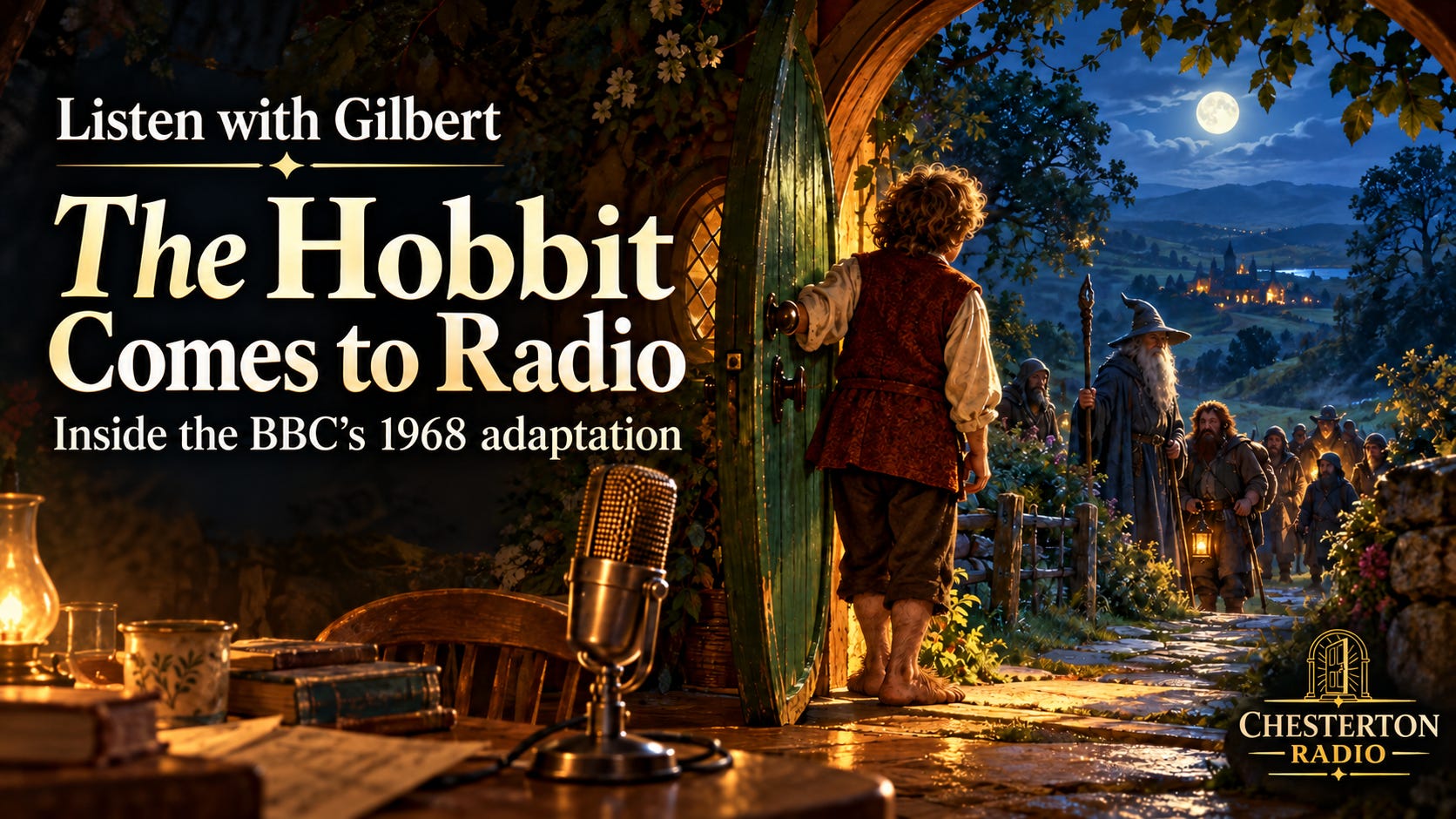 Listen with Gilbert: The Hobbit Comes to Radio 04.10.2026 42хвBilbo Baggins leaves the comfort of home and enters a world of riddles, songs, trolls, and dragons. In this Listen with Gilbert deep dive, we explore how the BBC’s 1968 full-cast production turned Tolkien’s The Hobbit into radio drama—from Paul Daneman’s Bilbo and Anthony Jackson’s Tale Bearer to David Cain’s music and the BBC Radiophonic Workshop’s sound effects.Hear the complete authorized BBC recording here. Then join us on the Chesterton Radio live stream, visit our Mercantile, and support independent radio at ChestertonRadio.com. Get full access to CHESTERTON RADIO at www.chestertonradio.com/subscribe
 -
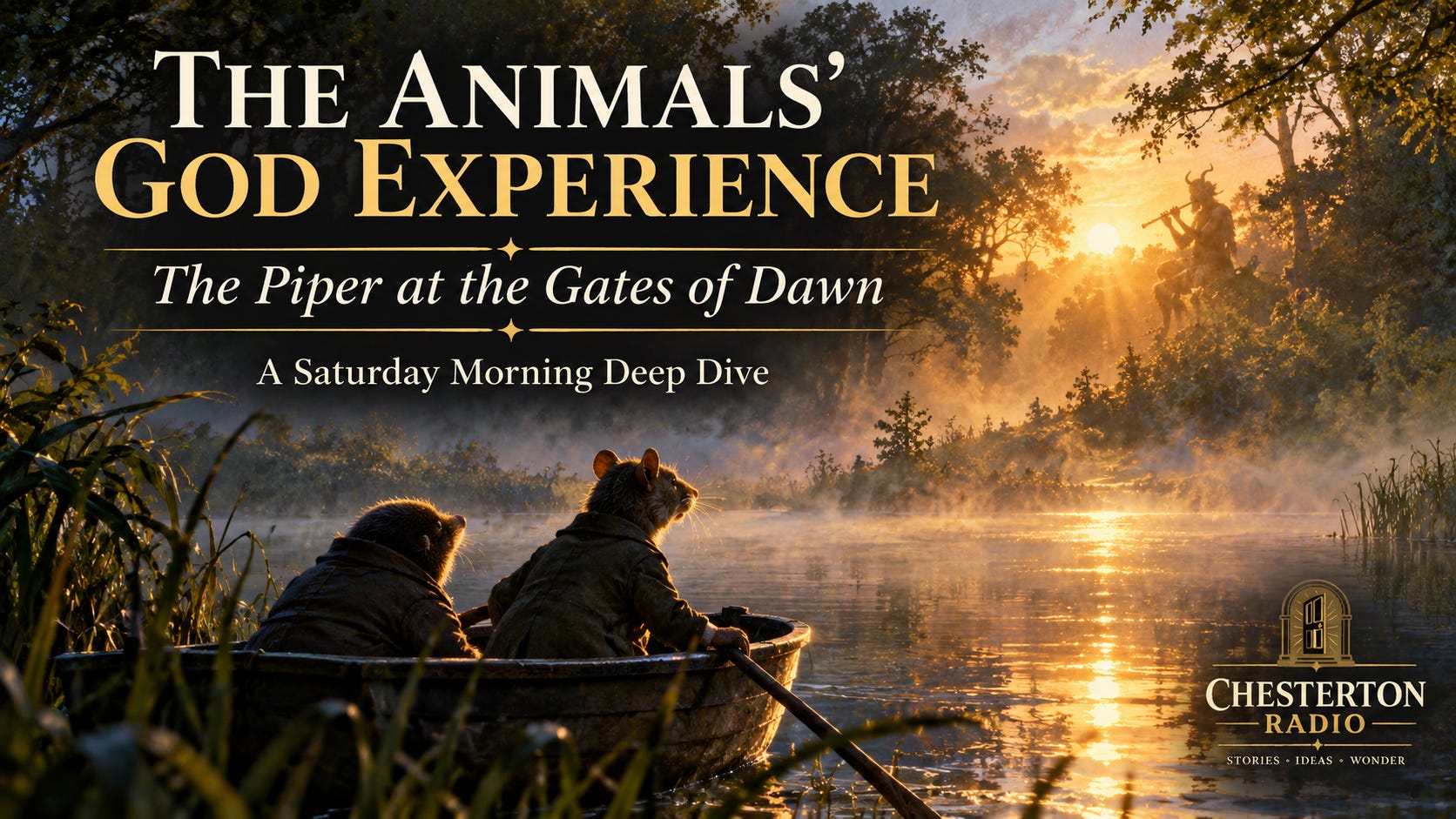 The Animals’ God Experience 03.10.2026 36хвAt Saturday morning at eleven, we open an old door again.Fr. Robert Griffin, C.S.C. — “Griff” — once filled this hour on WSND-FM at Notre Dame with his beloved Children’s Hour. And he had a wonderfully simple name for one of the strangest and most beautiful chapters in children’s literature.He called Kenneth Grahame’s “The Piper at the Gates of Dawn” “the animals’ God experience.”In this Chesterton Radio Deep Dive, we follow Rat and Mole into the darkness as they search for Otter’s missing son, Portly. Somewhere along the river, Rat begins to hear music. Dawn approaches. The familiar world of The Wind in the Willows gives way to awe, fear, beauty and worship — and an encounter with the mysterious “Friend and Helper.”Why did Grahame place this extraordinary mystical episode in the middle of a children’s book? Why Pan? What is the meaning of the animals’ worship — and why, afterward, are they given the merciful gift of forgetting what they have seen?It is a story about childhood, creation, wonder and the possibility of encountering something too beautiful to explain.And decades after Griff shared such stories on WSND, we return to Saturday morning at eleven.Chesterton Radio — The Little Station on Commercial Street in Atchison, Kansas.Listen anytime to our 24/7 Open Door live stream:https://Live.ChestertonRadio.comExplore more original programs, stories and deep dives:Chesterton Radio is listener-supported. If you value this little independent station and would like to help us keep the door open, please consider becoming a supporter.And visit the Chesterton Radio Mercantile for mugs, shirts and other ways to support the station:Thank you for listening — and for helping keep the little station on Commercial Street on the air. Get full access to CHESTERTON RADIO at www.chestertonradio.com/subscribe
 -
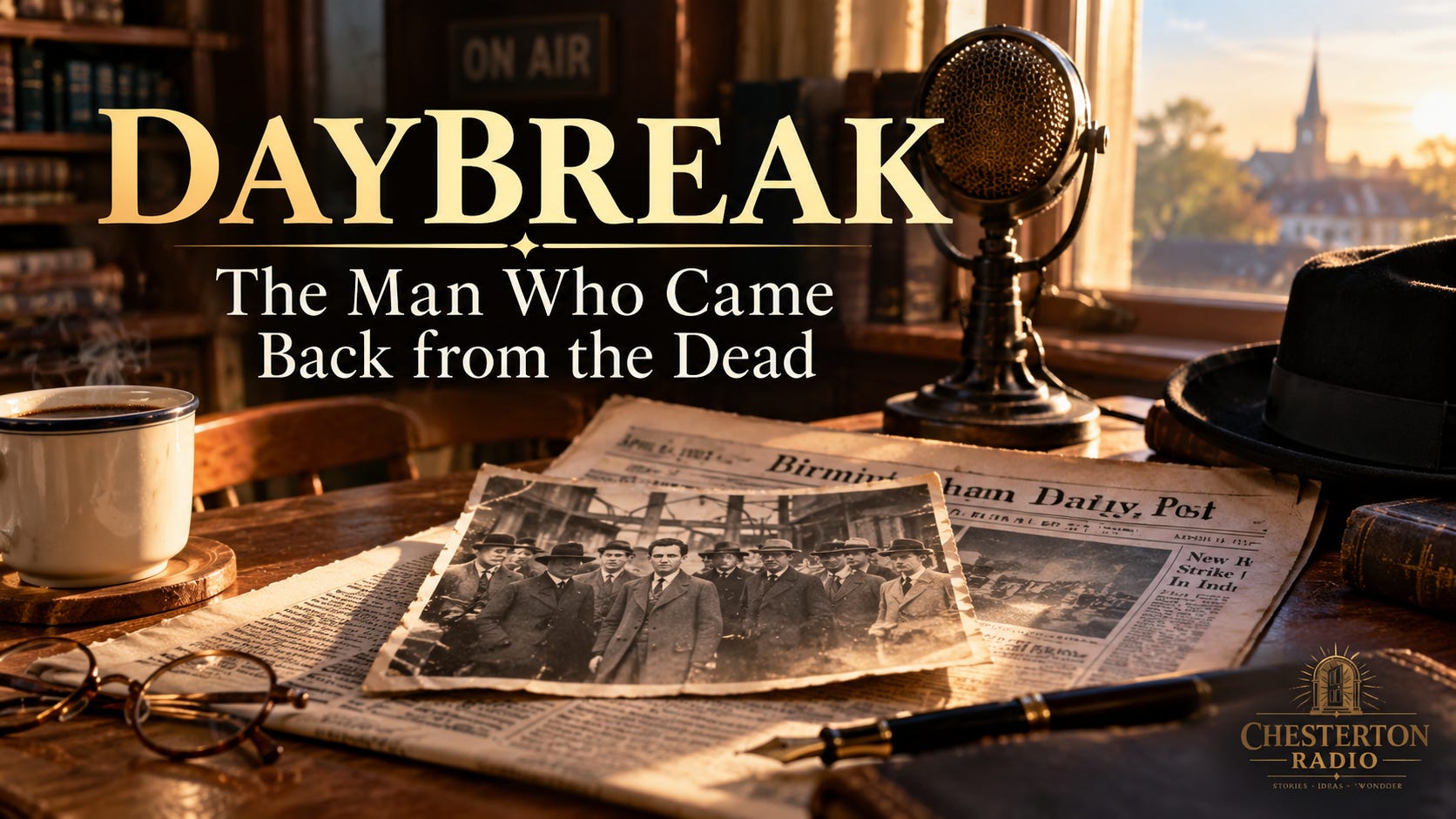 The Man Who Came Back from the Dead | Daybreak 03.10.2026 36хвSeven years after Eleanor Vale’s husband supposedly died in a fire, a newspaper photograph arrives—and there he is among the living. This morning on Daybreak, we step inside Chesterton Radio’s new original mystery, Father Brown and the Man Who Burned, and consider what Father Brown understands about grief, guilt, memory, and the small details everyone else misses.We’ll also look ahead to the Newman Guide Virtual College Fair and find an unexpected echo in today’s Gospel: perhaps wisdom sometimes begins not by knowing more, but by noticing what is already in front of us.From The Little Station on Commercial Street in Atchison, Kansas—a good story, a wider view of the day, and a thought worth carrying into it.Read the new Father Brown mystery: ChestertonRadio.comListen anytime: The Open Door, Chesterton Radio’s 24/7 live stream.Keep the Little Station on the air. If you enjoy Daybreak, our original stories, classic radio, and daily programming, please consider becoming a supporting subscriber. And visit the Chesterton Radio Mercantile—every purchase helps support the station. Get full access to CHESTERTON RADIO at www.chestertonradio.com/subscribe
 -
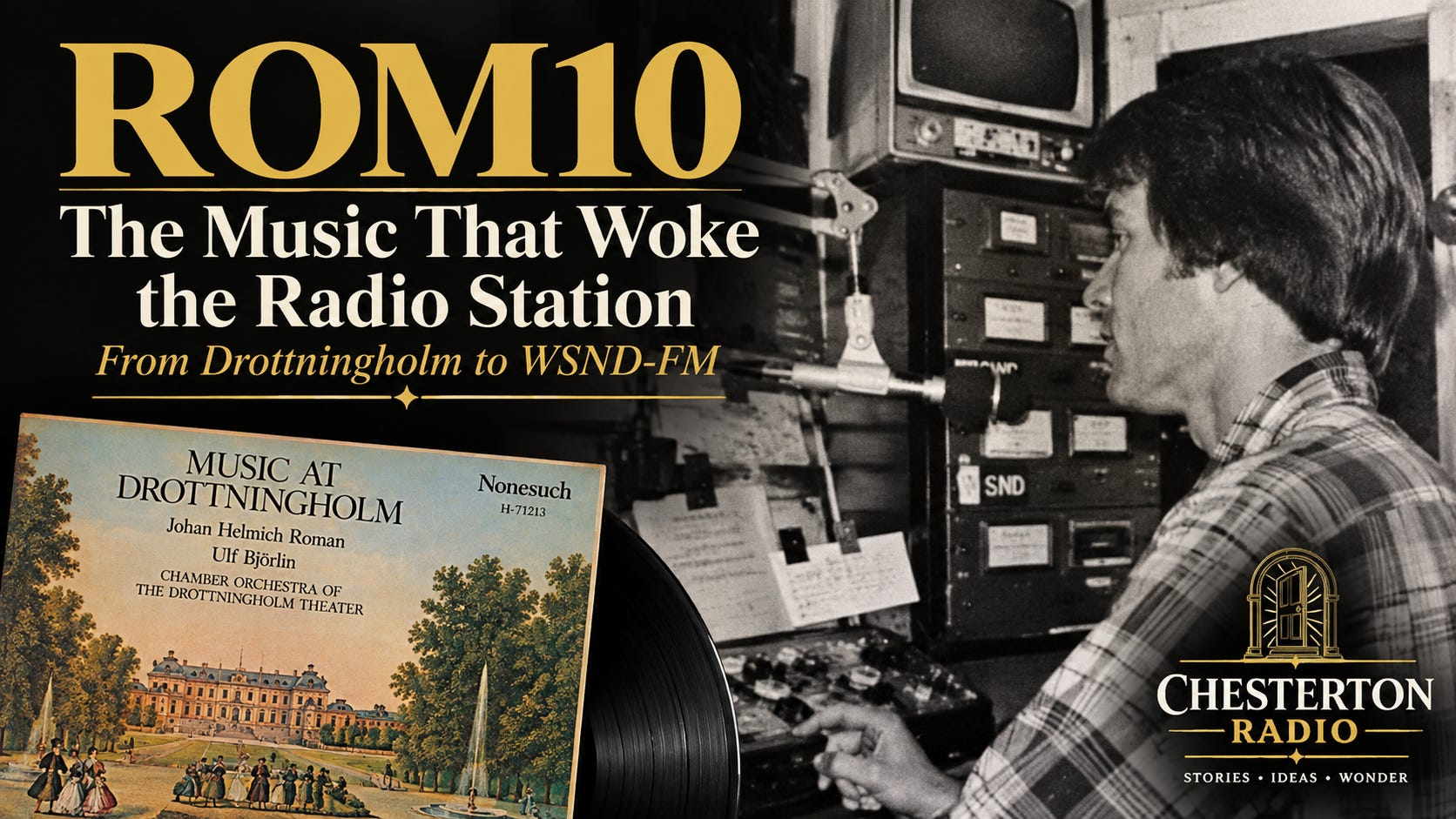 ROM10: The Music That Woke the Radio Station 02.10.2026 43хвIn the record library at WSND-FM at the University of Notre Dame, it was simply ROM10.Each morning, student announcer Paul would pull the record, cue the turntable, bring the station on the air, and let the brilliant brass of Johan Helmich Roman’s Drottningholmsmusiken begin. Then, over Ulf Björlin’s recording, came the familiar words:“Welcome to another day of broadcasting from the University of Notre Dame…”The record was Nonesuch H-71213, Music at Drottningholm. The music had been written for a Swedish royal wedding in 1744. Somehow, more than two centuries later, it had become the soundtrack for waking up a college FM station in South Bend, Indiana.Then the record—and even the exact piece—slipped into memory.Nearly fifty years later, a few fragments remained: Roman. Drottningholm. Brass. Nonesuch. Ulf Björlin. ROM10.And then the record turned up again.This Chesterton Radio deep dive follows an extraordinary musical journey from Drottningholm Palace in 1744, through Nonesuch Records and the clock-tower studios of WSND, to the rediscovery of the actual recording in 2026.It is a story about classical music, college radio, vinyl, memory—and what happens when an old record begins to play and suddenly a long-silent radio station comes back to life.Listen to the original recording:Music at Drottningholm — Nonesuch H-71213See WSND in the 1981 Notre Dame Dome:1981 Dome — WSND AM/FM spreadFrom Chesterton Radio — The Little Station on Commercial Street. Get full access to CHESTERTON RADIO at www.chestertonradio.com/subscribe
 -
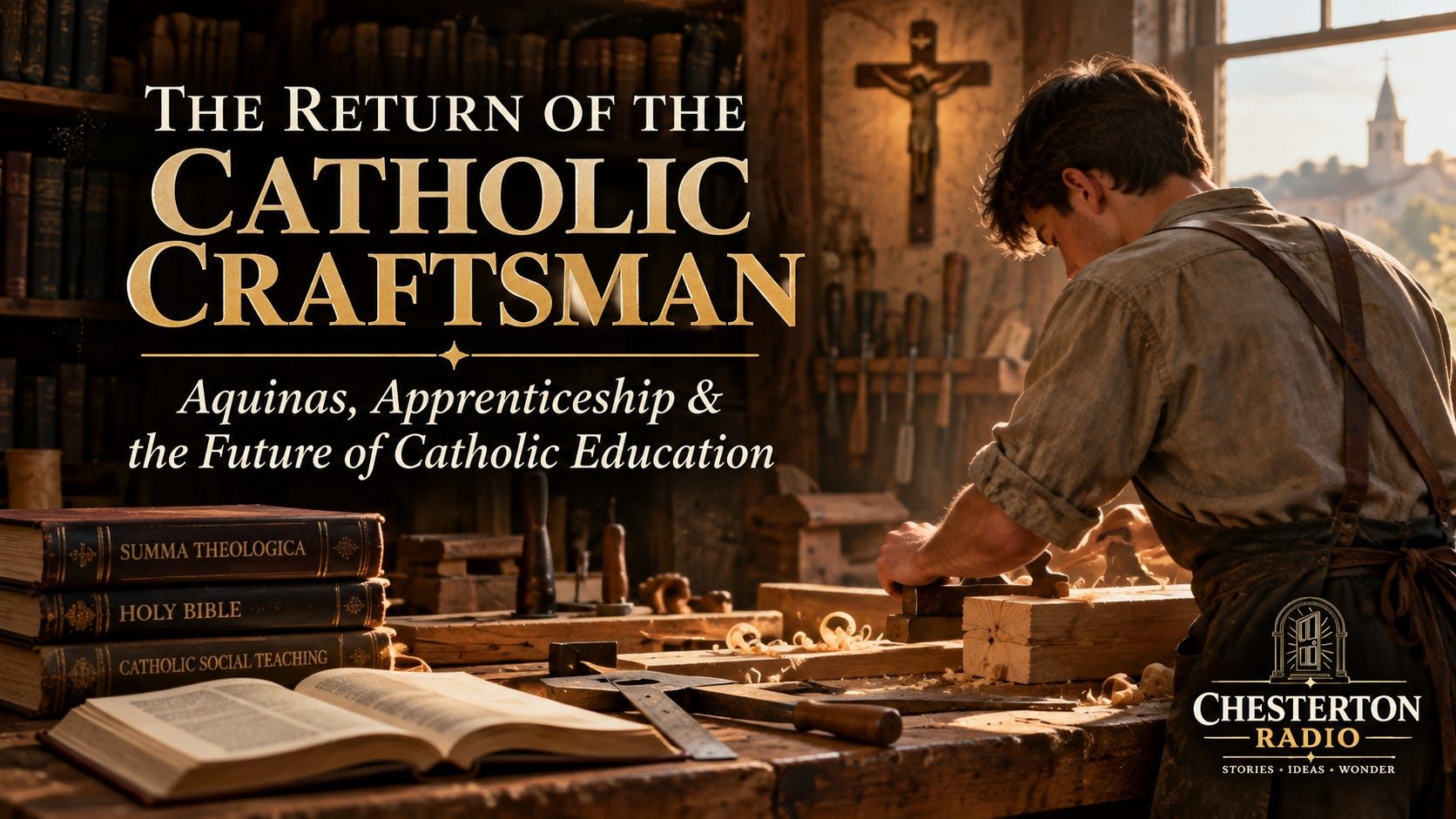 The Return of the Catholic Craftsman 02.10.2026 43хвWhat if a young Catholic didn’t have to choose between Aquinas and a toolbox?In this Chesterton Radio deep dive, we visit two remarkable experiments in Catholic education: the College of St. Joseph the Worker and San Damiano College for the Trades. Both are attempting to reunite things modern education has often pulled apart—intellectual formation and skilled work, prayer and craftsmanship, the liberal arts and the trades.We explore how these schools work, what students actually study and build, their apprenticeship and financial models, Catholic teaching on the dignity of work, and the important questions surrounding accreditation, credentials, cost, and long-term viability.Along the way, we look at St. John Paul II’s Laborem Exercens, the example of St. Joseph the Worker, Harmel Academy, and an older Catholic understanding of education in which forming the mind did not require neglecting the hands.Are these simply a handful of unusual new schools—or the beginnings of something much larger?Perhaps the future of Catholic education will involve rediscovering something very old: that learning, prayer, craftsmanship, family, community, and useful work belong together.Support the Little Station on Commercial StreetChesterton Radio is listener-supported. If you value original programs and deep dives like this one, please consider supporting our work.Visit the Chesterton Radio Mercantile for mugs, shirts, and other ways to support the station, and join us anytime on the Open Door, our 24/7 Chesterton Radio live stream.Listen, explore, and support the station at ChestertonRadio.com.The door is always open. Get full access to CHESTERTON RADIO at www.chestertonradio.com/subscribe
 -
 Daybreak: Angels, Machines & the Unseen World 02.10.2026 40хвIt’s Friday morning at Chesterton Radio, and October 2 brings an unusual question: how much of reality lies beyond what we can see or measure? On today’s Daybreak, we begin with the Feast of the Guardian Angels, wander through stories of technology, culture, history and the unexpected, and finish in the Listening Room with Chesterton Radio’s Angel Collection of classic radio dramas.A curious morning conversation from The Little Station on Commercial Street—a few things worth knowing before the day gets underway. Get full access to CHESTERTON RADIO at www.chestertonradio.com/subscribe
 -
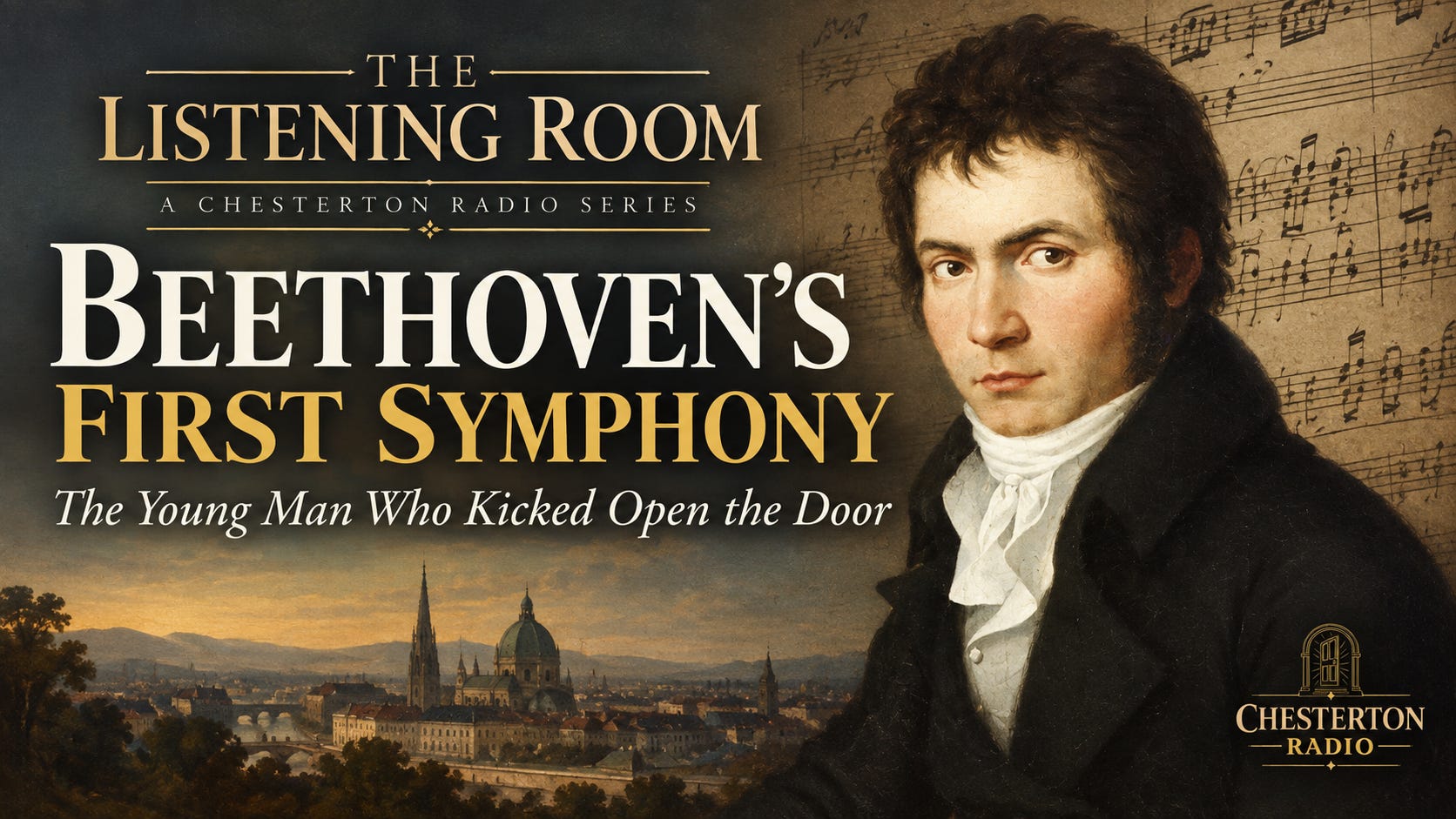 Beethoven’s First Symphony: The Young Man Who Kicked Open the Door 02.10.2026 38хвVienna, 1800. Beethoven is twenty-nine years old, Mozart is gone, Haydn is the acknowledged master—and an ambitious young composer is about to unveil his first symphony.In this inaugural episode of The Listening Room, we sit down with Beethoven’s Symphony No. 1 in C major, Op. 21 and listen for the moments when the familiar Classical world begins to shift.Why does the symphony seem to start in the wrong key? Why does Beethoven call the furious third movement a minuet? And why does the finale begin as though the orchestra is cautiously learning how to play a scale?No music degree required. We’ll walk through the symphony movement by movement, hear what Beethoven inherited from Mozart and Haydn, and discover the flashes of humor, impatience and audacity that point toward the Beethoven of the Fifth and Ninth.The Listening Room is a Chesterton Radio guided journey through the great works of classical music—from symphonies and concertos to opera and the sacred repertoire.Come in. Sit down. And listen.Chesterton Radio — The Little Station on Commercial Street in Atchison, Kansas🎧 Now ListenBeethoven — Symphony No. 1 in C major, Op. 21Marek Janowski · WDR Symphony OrchestraListen to the complete symphony on YouTubeThere’s also a useful Musopen page containing the work, recordings and score resources. MusopenBeethoven Symphony No. 1 — Musopen Get full access to CHESTERTON RADIO at www.chestertonradio.com/subscribe
 -
 GI Jill vs. Tokyo Rose 01.10.2026 58хвSomewhere in the Pacific, an American serviceman turns the radio dial. From one station comes GI Jill—music, jokes, familiar voices and a little taste of home. From another comes the voice Americans would remember as “Tokyo Rose.”But the story we remember isn’t quite the story that happened.Who was GI Jill? Who was Tokyo Rose—and was there ever really a single Tokyo Rose at all? Why did American troops willingly tune in to enemy broadcasts? And how did music, humor, homesickness and personality become weapons in a war fought over the airwaves?In this Chesterton Radio Deep Dive, we return to the strange nighttime radio world of World War II, listen to the stories behind GI Jive and The Zero Hour, and follow the remarkable fate of Iva Toguri D’Aquino—the American woman who became forever associated with a name she never actually used.Two voices. Two sides of the Pacific. Millions of young Americans listening.The war was being fought on the radio, too.🎧 Hear the broadcasts yourselfGI Jill — G.I. JiveMartha Wilkerson broadcasting music and conversation to American servicemen over AFRS.Listen to surviving G.I. Jive broadcastsIva Toguri — The Zero HourHear the August 14, 1944 Radio Tokyo broadcast featuring Toguri as “Orphan Ann.”Listen to the surviving Zero Hour broadcast Get full access to CHESTERTON RADIO at www.chestertonradio.com/subscribe
 -
 Mystery Theater Companion: Honeymoon with Death 01.10.2026 18хвWhat if you returned from your honeymoon, reported your husband’s murder—and everyone insisted you had never been married?From the Little Station on Commercial Street in Atchison, Kansas, Mystery Theater Companion returns to the earliest days of CBS Radio Mystery Theater with Honeymoon with Death, Episode 6, originally broadcast January 11, 1974.Lois Nettleton stars in a wonderfully unsettling mystery built around a question radio is uniquely equipped to ask: What happens when you know what you experienced, but you have no way to prove it?We listen for the performances, the clues, Himan Brown’s production, E. G. Marshall’s unmistakable presence, and the clever way the story makes the listener share Jennifer’s uncertainty.Hear the original first—or join us until the spoiler warning and come back afterward.At what point did you stop doubting Jennifer—or did you?Mystery Theater Companion — from Chesterton Radio and the Little Station on Commercial Street. Get full access to CHESTERTON RADIO at www.chestertonradio.com/subscribe
 -
 Daybreak | Stories & Ideas Worth Waking Up For 01.10.2026 45хвGood morning, and welcome to Daybreak from the Little Station on Commercial Street in Atchison Kansas - Chesterton Radio.We begin October with a fresh look at the stories, ideas, history, culture, and curious corners of the world that are worth a few minutes of attention.No shouting. No endless news cycle. Just an intelligent and occasionally unexpected way to start the day.Pour the coffee. The day is just getting started.Daybreak — a morning companion from Chesterton Radio. Get full access to CHESTERTON RADIO at www.chestertonradio.com/subscribe
 -
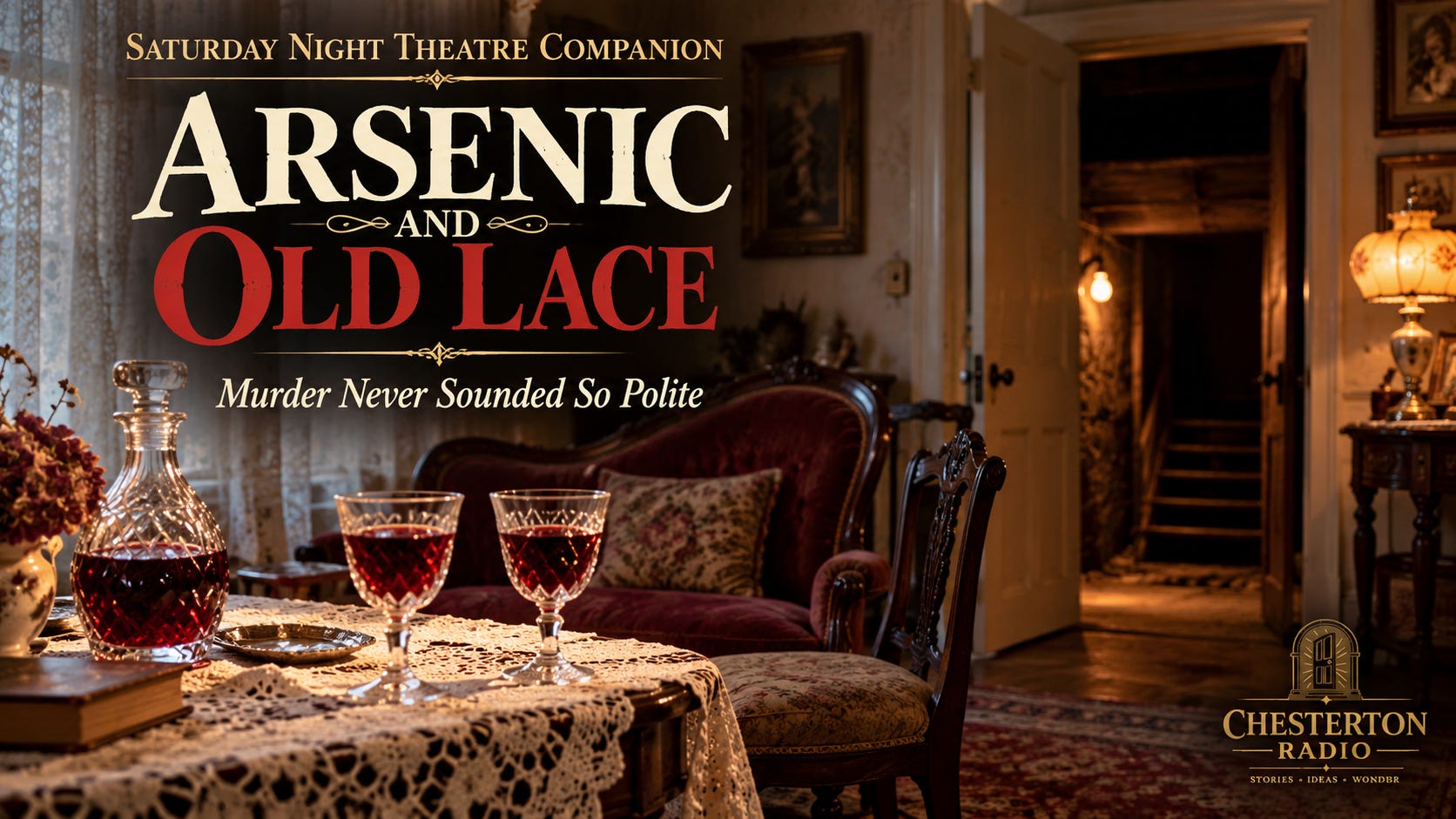 Arsenic and Old Lace: Saturday Night Theatre Companion 01.10.2026 28хвThere are some plays that radio has to reinvent.And there are others that seem almost to have been waiting for radio all along.Arsenic and Old Lace is one of those.A quiet house in Brooklyn.Two charming elderly sisters.A nephew who believes he is Theodore Roosevelt.Another nephew who is a theatre critic.And, somewhere in the house, a body.Actually, quite a few bodies.Tonight on the Saturday Night Theatre Companion, we return to Joseph Kesselring’s wonderfully improbable world of murder, manners, madness—and elderberry wine.And this time, we have an unusual opportunity.Because on Chesterton Radio we can hear Arsenic and Old Lace three different ways.There is the BBC Saturday Night Theatre production.There is the 1952 American production from Best Plays of the New York Stage, featuring Boris Karloff.And there is an earlier, much shorter Screen Guild Theatre adaptation with Boris Karloff and Eddie Albert.Three productions.Three different amounts of time.Three different approaches to exactly the same problem:How do you put one of Broadway’s great visual farces on the radio?And perhaps the surprising answer is—very easily.This Deep Dive includes Spoilers. We invite you to listen to the three original productions then return for our discussion. Arsenic and Old Lace - Boris Karloff - Best Plays of the New York StageArsenic and Old Lace - Joseph Kesselring - BBC Saturday Night TheatreArsenic & Old Lace - Boris Karloff & Eddie Albert - Screen Guild TheatreA PERFECTLY RESPECTABLE HOUSEThe great joke of Arsenic and Old Lace begins before anybody says anything funny.Everything looks respectable.The Brewster house is the sort of place where one expects tea, lace curtains, polished furniture and good manners.Abby and Martha Brewster are precisely the sort of women one would trust.They are kind.They are generous.They are concerned about their neighbors.They attend church.They help people in need.And they murder lonely old men.Not angrily.Not for money.Not even, in their minds, maliciously.They regard it almost as a charitable service.A lonely gentleman comes to the door.He is welcomed inside.Conversation follows.And eventually he is offered a glass of elderberry wine.Unfortunately, the recipe has been improved.Arsenic.Strychnine.And just a little cyanide.The joke works because Abby and Martha never become villains.Everyone else understands that they are murderers.They understand themselves to be helpful ladies.And Joseph Kesselring never allows those two realities to meet.That is the engine that drives the play.ENTER MORTIMER BREWSTERInto this peaceful domestic arrangement comes Mortimer Brewster.Mortimer is a drama critic.That is important.Kesselring has placed a professional observer of theatrical absurdity inside a situation considerably more absurd than anything he could possibly review.Mortimer thinks he understands bad plays.Then he goes home.His brother Teddy believes himself to be Theodore Roosevelt.He charges up the stairs as though they were San Juan Hill.He is digging the Panama Canal in the cellar.And when Abby and Martha need somewhere to put their latest deceased gentleman, Teddy is quite willing to bury another victim of yellow fever in the Canal Zone.Mortimer gradually discovers all of this.And the comedy becomes increasingly frantic because Mortimer is apparently the only sane person in the house.Or at least he thinks he is.That distinction becomes increasingly important.THEN JONATHAN COMES HOMEAnd now the comedy changes.Jonathan Brewster returns.Unlike Abby and Martha, Jonathan knows perfectly well that he is a murderer.He arrives with Dr. Einstein, the man responsible for repeatedly altering Jonathan’s face.Unfortunately, one of those operations has left Jonathan looking like—Boris Karloff.That joke must have been irresistible in 1941.Because the actor playing Jonathan Brewster in the original Broadway production actually was Boris Karloff.The audience sees Karloff walk onto the stage.The characters insist that he looks like Boris Karloff.And Jonathan becomes furious whenever anybody mentions it.It is one of those theatrical jokes that ought to be impossible to transfer to radio.Except that radio found an extraordinarily simple solution.Hire Boris Karloff.BORIS KARLOFF RETURNSThat makes the Best Plays production particularly interesting.This isn’t simply a famous film actor being recruited for a radio adaptation.Karloff is returning to a role that belonged to him.And you can hear it.The temptation would be to make Jonathan into Frankenstein’s monster—to exploit Karloff’s horror reputation and make every entrance ominous.But Jonathan is funnier than that.He is dangerous, certainly.But he is also vain.Touchy.Petulant.He absolutely hates the Karloff comparison.And Karloff understands the joke better than almost anybody could.The horror icon is playing a murderer who is deeply offended because everyone thinks he looks like a horror icon.That extra layer survives beautifully without scenery.Perhaps it even becomes funnier.Because radio listeners know the face they cannot see.THE ONE-HOUR VERSIONThe Best Plays broadcast has another advantage.Time.At roughly an hour, it can let the situation develop.That matters enormously with Arsenic and Old Lace.Farce isn’t simply a collection of jokes.It is architecture.One improbable fact must be established.Then another.Then another.The audience must understand where everybody is, what everybody knows, what everybody does not know, and what disaster is about to occur if one more person walks through the door.Cut too much of that away and you still have the story.But you may lose the mechanism.The longer Best Plays treatment lets that mechanism run.We have time to understand Abby and Martha.We have time for Teddy.We have time for Mortimer’s growing desperation.And when Jonathan arrives, he isn’t simply another eccentric Brewster.He changes the temperature of the room.NOW TRY IT IN THIRTY MINUTESWhich makes the Screen Guild Theatre version fascinating for exactly the opposite reason.It has roughly half the time.That changes everything.Radio anthologies regularly faced this problem.Take a successful stage play or motion picture that might occupy two hours or more—and make it fit between the opening announcement and the closing commercial.Thirty minutes.Characters disappear.Scenes collapse into one another.Exposition becomes brutally efficient.Anything that does not move the central plot has to justify every second it occupies.And yet Arsenic and Old Lace can survive this treatment remarkably well.Why?Because its central idea is so strong.Two sweet old ladies poison lonely gentlemen.Teddy buries them.Mortimer discovers what is happening.Jonathan arrives.Chaos follows.The short adaptation becomes almost a demonstration of how strong Kesselring’s construction really is.Strip away much of the ornament and the machine still runs.But listen carefully to what changes.The longer versions allow anticipation.The shorter version depends upon acceleration.Those are not quite the same kind of comedy.AND THEN THERE IS THE BBCWhich brings us to Saturday Night Theatre.The BBC tradition approaches material like this differently from the Hollywood anthology programs.There is less pressure to remind us constantly that a star is present.There is more room for ensemble playing.And Arsenic and Old Lace is fundamentally an ensemble piece.Mortimer may be our guide through the insanity, but the Brewster household itself is really the star.Listen to the rhythm.A door opens.Someone arrives.Someone else must not discover something.Teddy charges away.Abby and Martha calmly discuss something horrifying.Mortimer tries to restore order.Another person arrives.And the entire structure shifts again.On stage, much of this is visual.On radio, the microphone has to establish the geography.Footsteps matter.Doors matter.Distance from the microphone matters.Voices approaching from another room matter.Even silence matters.The listener gradually constructs the Brewster house in the imagination.And once that house exists, the comedy can move through it.WHY THIS WORKS SO WELL WITHOUT PICTURESThis is one of the pleasures of listening to Arsenic and Old Lace rather than watching it.Consider Teddy.A stage audience can see him charge up the stairs.A radio audience hears the charge.And somehow the staircase becomes enormous.We don’t merely see Teddy Brewster pretending to be Theodore Roosevelt.We participate in Teddy’s version of reality.The same thing happens with the cellar.We don’t need to see the Panama Canal.We know it is there.We know what is being buried there.And every time somebody heads toward the cellar, our imagination supplies everything the scenery cannot.Radio is exceptionally good at this.The impossible becomes completely convincing because the listener has done half the work.THE SECRET IS TONEThere is another reason the play survives so many adaptations.Nobody can play the central joke as though it were a joke.Abby and Martha cannot wink at us.If they seem sinister, the whole thing collapses.They must be absolutely sincere.The elderberry wine really is, in their minds, an act of mercy.Teddy must genuinely be Teddy Roosevelt.Jonathan must genuinely consider himself the serious criminal in a family he regards with contempt.And Mortimer must genuinely believe that if he can just explain things clearly enough, sanity might somehow return.It never does.The comedy comes from the collision of those certainties.That is why a restrained radio performance can sometimes work better than an exaggerated one.The straighter everyone plays it, the stranger it becomes.WHAT ABOUT THE MOVIE?For many people, Arsenic and Old Lace means Cary Grant and Frank Capra.And the 1944 film is certainly the version that carried the story most widely into popular culture.But listening to the radio productions reminds us that this was a play first.It doesn’t actually require cinematic scale.Its world is domestic.A room.A staircase.A cellar.A window.A front door through which exactly the wrong person will inevitably arrive.That confinement is part of its strength.The Brewster house is a comic pressure vessel.Kesselring keeps adding people until the pressure becomes almost unbearable.Then somebody rings the doorbell.THREE VERSIONS, THREE EXPERIMENTSSo if you’re listening through the Chesterton Radio collection, don’t think of these three productions as duplicates.Try them as an experiment.Begin with the Screen Guild Theatre version.Hear how ruthlessly the story can be compressed.Then listen to Boris Karloff in the hour-long Best Plays production.Notice what returns when the actors are given more room.And finally settle into the BBC Saturday Night Theatre production.Listen particularly to the ensemble.The pacing.The use of space.The way an American Broadway comedy changes—slightly, but perceptibly—when interpreted through the BBC radio drama tradition.Same house.Same bodies.Same elderberry wine.Different radio.AND LISTEN FOR BORISThere is one final pleasure in all of this.Boris Karloff spent much of his career trapped, lovingly perhaps, inside the public image created by horror films.But Karloff was much more than Frankenstein’s monster.He was a skilled stage actor.A radio actor.And a performer with a wonderful sense of comedy.Arsenic and Old Lace allows him to turn his own reputation into the joke.Jonathan Brewster is terrifying because he looks like Boris Karloff.Boris Karloff plays Jonathan Brewster.And Boris Karloff is furious about looking like Boris Karloff.There are not many jokes in theatrical history that can operate on quite that many levels at once.THE OPEN DOORPerhaps that is why Arsenic and Old Lace remains so enjoyable.It never asks us to believe that its world is realistic.It asks us to believe that everyone inside that world thinks it is realistic.Abby and Martha remain gracious hostesses.Teddy remains President Roosevelt.Jonathan remains offended.Mortimer keeps trying to make sense of everything.And somewhere downstairs, the Panama Canal keeps getting deeper.Three radio productions give us three opportunities to enter that house.So pour yourself something to drink.Although perhaps—just this once—not the elderberry wine.Then turn down the lights and listen.This has been the Saturday Night Theatre Companion from Chesterton Radio.The old plays are still here.The great voices are still speaking.And the door is always open. Get full access to CHESTERTON RADIO at www.chestertonradio.com/subscribe
 -
 Daybreak 30.09.2026 33хвGood morning from The Little Station on Commercial Street. Daybreak is Chesterton Radio’s daily morning conversation, bringing together worthwhile stories from Newman Guide colleges and Chesterton Academies with Catholic life, books, history, classic radio, and culture from both sides of the Atlantic. It’s a warm, curious start to the day, with a thought worth carrying into it. Get full access to CHESTERTON RADIO at www.chestertonradio.com/subscribe
 -
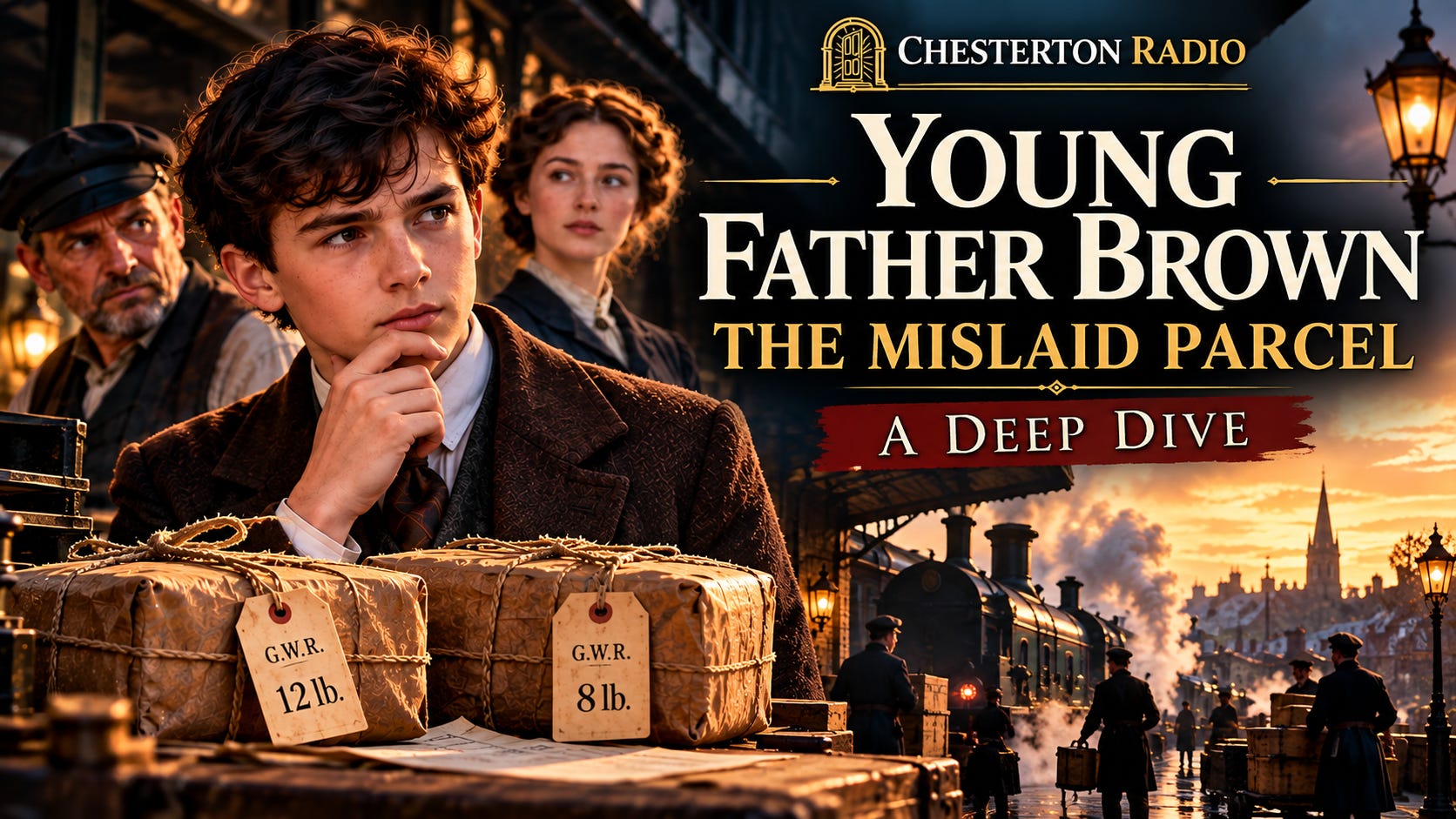 Before the Collar: How Young Father Brown Learned to See the Truth | A Deep Dive 26.09.2026 32хвBefore he became the quiet priest-detective who understood the secrets of the human heart, Father Brown was a boy who enjoyed being right.In this Chesterton Radio deep dive, we explore The Mislaid Parcel, the opening mystery in our original Young Father Brown series.A twelve-pound railway parcel has apparently become an eight-pound package. A widow’s livelihood is at stake. A railway porter falls under suspicion. And sixteen-year-old Paul Brown believes he has solved the case—until his certainty begins to do more harm than good.But this is more than a discussion of a Victorian railway mystery. It is a look at the making of Father Brown.We examine Thomas Brown’s patient approach to evidence, Margaret Brown’s insistence on considering the human consequences, Catherine Doyle’s practical wisdom, and the dignity of Joseph Reed, the man Paul wrongly accuses.Drawing on G. K. Chesterton’s original Father Brown stories and his reflections on detective fiction, we ask a larger question:How does a clever boy become a wise priest?Along the way, we explore the difference between observation and understanding, between discovering the truth and doing justice, and between admitting a mistake and repairing the harm it caused.Young Father Brown is an original Chesterton Radio literary series imagining the early life of Chesterton’s famous character. Its events and supporting characters are new fiction, not part of Chesterton’s original canon.📖 Read the complete original story, free:https://www.chestertonradio.com/p/young-father-brown-the-mislaid-parcel🎙️ Listen to Chesterton Radio:If you enjoy thoughtful mysteries, classic literature, and original storytelling, please subscribe, share this episode, and consider becoming a paid supporter. Your membership helps us create more original fiction, literary deep dives, and daily programming.Chesterton Radio — Stories · Ideas · Wonder© 2026 Korzenecki & Company, LLC. Get full access to CHESTERTON RADIO at www.chestertonradio.com/subscribe
 -
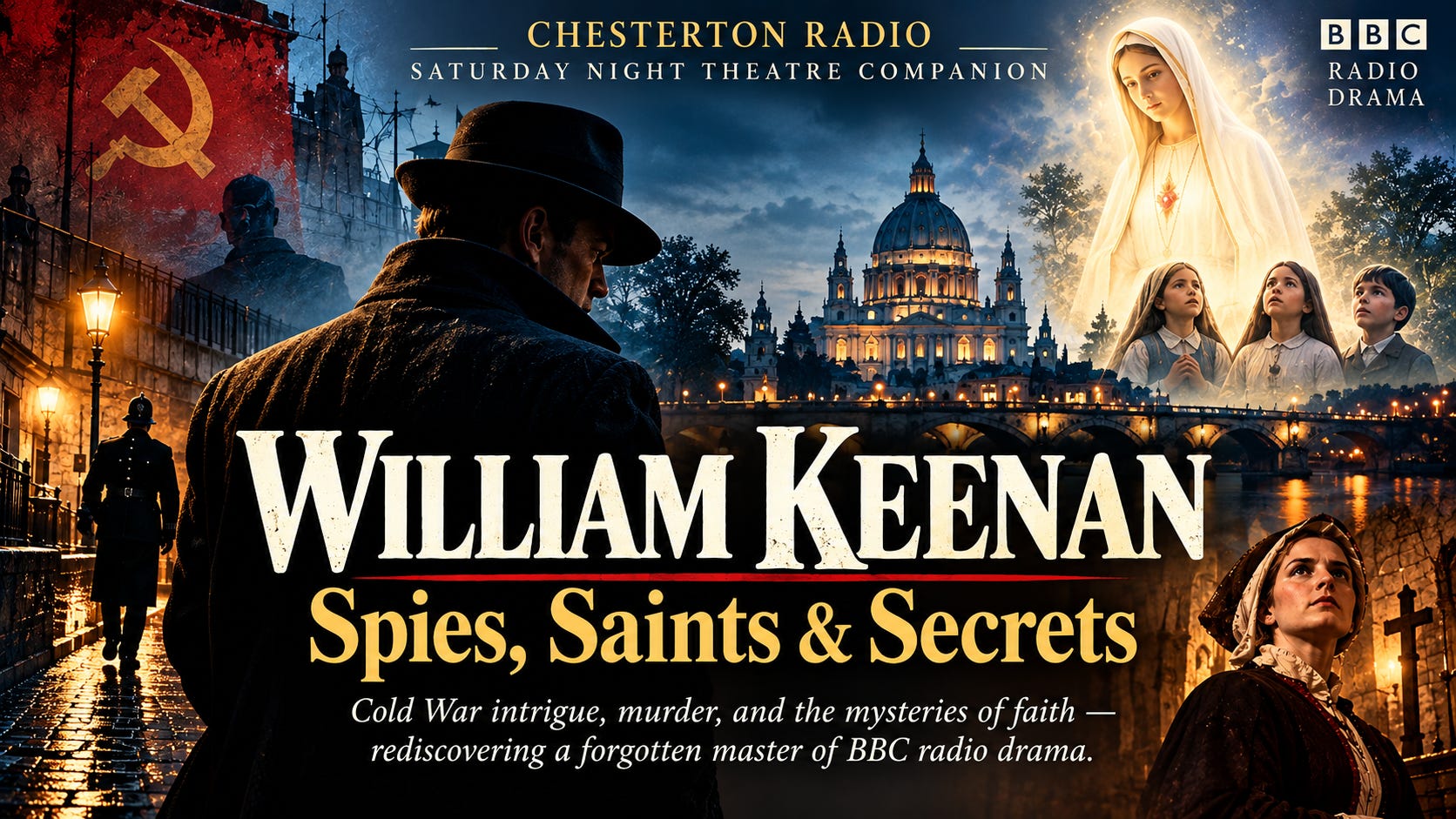 William Keenan: Spies, Saints & Secrets 26.09.2026 49хвA spy disappears into the shadows of Cold War Europe. A policeman walks a lonely beat. Three shepherd children in Portugal witness something that will change the world.What connects these seemingly different stories? The remarkable imagination of William Keenan.In this edition of Chesterton Radio’s Saturday Night Theatre Companion, we rediscover the English journalist, novelist, Catholic writer, and BBC dramatist whose work ranged from gripping espionage thrillers to police mysteries and powerful explorations of religious faith.We follow Keenan’s interconnected Michael Heywood spy trilogy — Late Into the Night, The Night of Caesar’s Knives, and The Vienna Connection — through a dangerous world of intelligence agents, divided loyalties, and Cold War deception.Then we turn to the darker streets of British crime drama with Lonely Beat and The Dark Windows of a Room, where the search for truth becomes intensely personal.Finally, we explore Keenan’s Catholic imagination through Fatima and Margaret Clitherow, two extraordinary stories of faith, courage, persecution, and conscience in the face of political power.Along the way, we examine the lost art of BBC radio drama, the actors and producers who brought these stories to life, and the extraordinary ability of sound and silence to create entire worlds in the listener’s imagination.From the back streets of Manchester to the corridors of Soviet intelligence, from Elizabethan England to the fields of Fatima, Keenan’s plays return again and again to one enduring question:What does a person do when the truth demands courage?Join us for a journey into the golden age of British radio drama — and the rediscovery of a storyteller whose work deserves to be heard again.Listen to the original plays:William Keenan — Complete Radio Drama CollectionKeep the Open Door open.Chesterton Radio is independent, listener-supported radio. Your paid subscription helps us preserve classic radio drama, produce original documentaries, and keep our 24/7 stream available to listeners everywhere.Listen, subscribe, and supportChestertonRadio.com Listen to the 24/7 Live StreamChesterton Radio — The Open Door to Classic Radio, Mystery, Literature & Faith. Get full access to CHESTERTON RADIO at www.chestertonradio.com/subscribe
 -
 J. B. Priestley: The Dangerous Art of Ordinary Life 25.09.2026 40хвAn innocent question at a dinner party. A respectable suburban household hiding an extraordinary secret. A family haunted by the past. And a clock that may not be telling the whole truth.Welcome to the remarkable world of J. B. Priestley, one of Britain’s most celebrated novelists, playwrights, and broadcasters.In this Saturday Night Theatre Companion, we explore the extraordinary imagination behind Dangerous Corner, Laburnum Grove, Eden End, The Linden Tree, Angel Pavement, Salt Is Leaving, The Carfitt Crisis, and The Demon King.From the comfortable drawing rooms of middle-class England to the psychological mysteries of time itself, Priestley understood that the most unsettling dramas often begin with the most ordinary people.Discover how his experiences in the First World War shaped his worldview, why he became fascinated with the possibility of alternative timelines, and how his wartime broadcasts made him one of the most recognizable voices in Britain.Along the way, we revisit London After Dark, explore his influence on British theatre, and uncover the surprising connections between his mysteries, his social conscience, and his enduring questions about human responsibility.Can the truth destroy a life? Can the past be changed? And if we were given a second chance, would we make the same mistakes?Pull up a chair. The curtain is rising, the clock is ticking, and nothing is quite as it seems.Listen to the complete J. B. Priestley collectionhttps://www.youtube.com/playlist?list=PLD6HK813WRututUDcaR9F4TTyLgpIMZ0KKeep the Open Door OpenChesterton Radio is an independent, listener-supported home for classic radio drama, literary mysteries, forgotten stories, and original programming.If you enjoy our Saturday Night Theatre Companions, please consider becoming a paid subscriber. Your support helps us preserve these remarkable stories and introduce them to new generations.Subscribe and support Chesterton Radio:Listen to the Open Door, streaming 24/7:https://live.chestertonradio.comChesterton Radio — The Open Door to Timeless Stories.Salt is LeavingCarfitt CrisisLaburnum GroveDangerous CornerEden EndThe Linden TreeLaburnum GroveStudio ONeAngel PavementDangerous CornerLondon After DarkThe Demon KingPriestley Playlisthttps://www.youtube.com/playlist?list=PLD6HK813WRututUDcaR9F4TTyLgpIMZ0K Get full access to CHESTERTON RADIO at www.chestertonradio.com/subscribe
 -
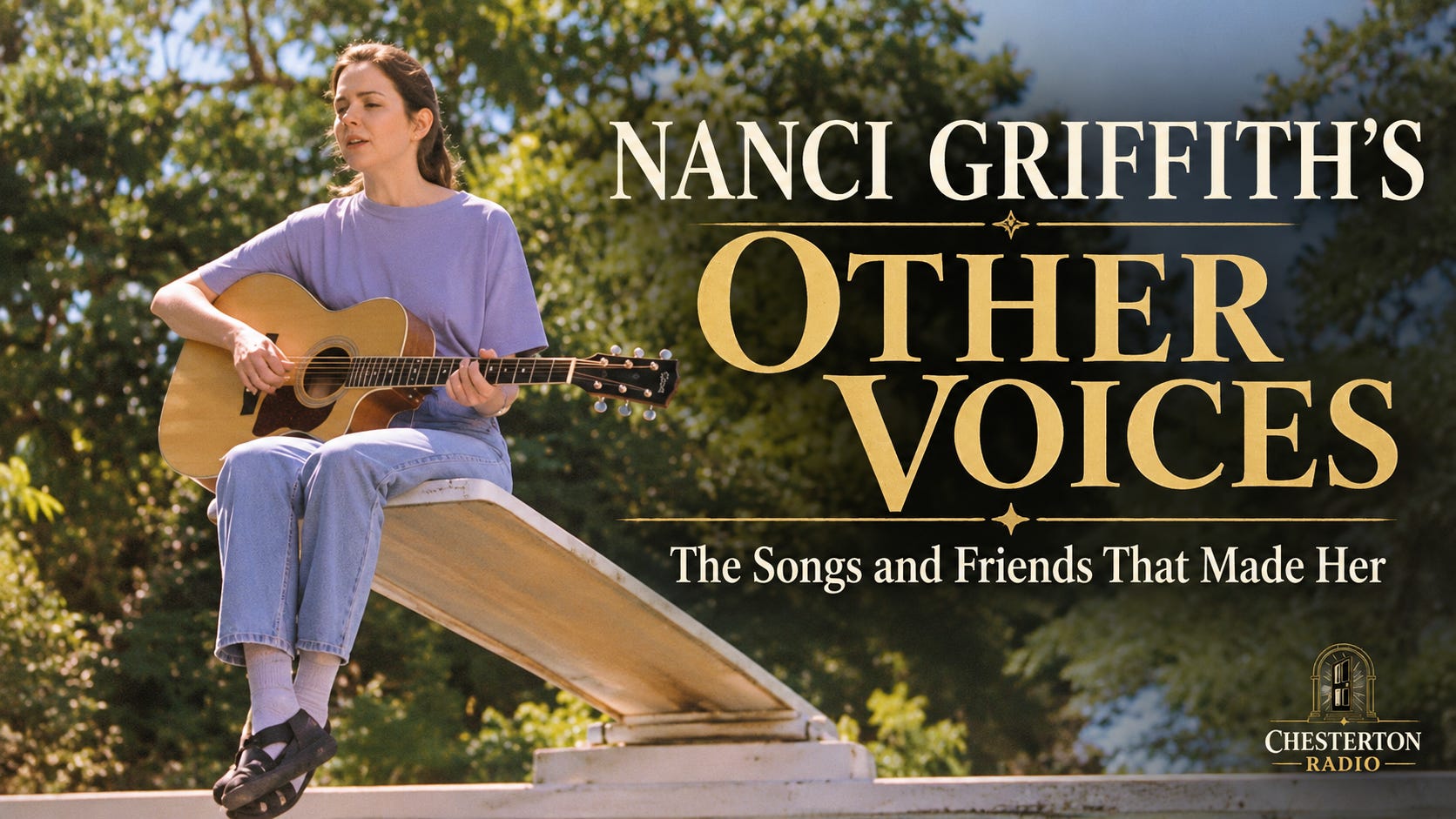 Nanci Griffith’s Other Voices: The Songs and Friends That Made Her 25.09.2026 35хвNanci Griffith was one of America’s great songwriters. Yet at the height of her career, she did something remarkable: she turned the spotlight away from herself.With Other Voices, Other Rooms and Other Voices, Too, Nanci celebrated the writers, singers and songs that had formed her—from Townes Van Zandt, Guy Clark and John Prine to Kate Wolf, Bob Dylan, Woody Guthrie, Odetta and Sandy Denny.But the story is even richer on film.It begins with Nanci sitting on the diving board of her old high-school swimming pool, singing and remembering where it all began. We follow her from the Texas folk scene through a remarkable series of David Letterman appearances, where a professional relationship grows into genuine affection. At one point Letterman simply tells her: “I love your music, I love your work and I love you!”Then comes the extraordinary gathering of friends surrounding Other Voices—musicians sharing songs, memories and a tradition that was never really owned by any one performer.We revisit the unforgettable all-star performance of Guy Clark’s “Desperados Waiting for a Train,” and then travel across the Atlantic for Other Voices, Too, where Nanci’s remarkable relationship with Ireland and the British and Irish folk traditions comes to the foreground.Dolores Keane. Sandy Denny. Dave Van Ronk. Emmylou Harris. Guy Clark. Townes Van Zandt. John Prine. Odetta. And so many more.This isn’t simply the story of two albums.It’s the story of a songwriter who understood that songs are handed down—from writer to singer, friend to friend, generation to generation.Nanci Griffith spent much of her life preserving other voices.In the end, those other voices helped preserve Nanci. Get full access to CHESTERTON RADIO at www.chestertonradio.com/subscribe
 -
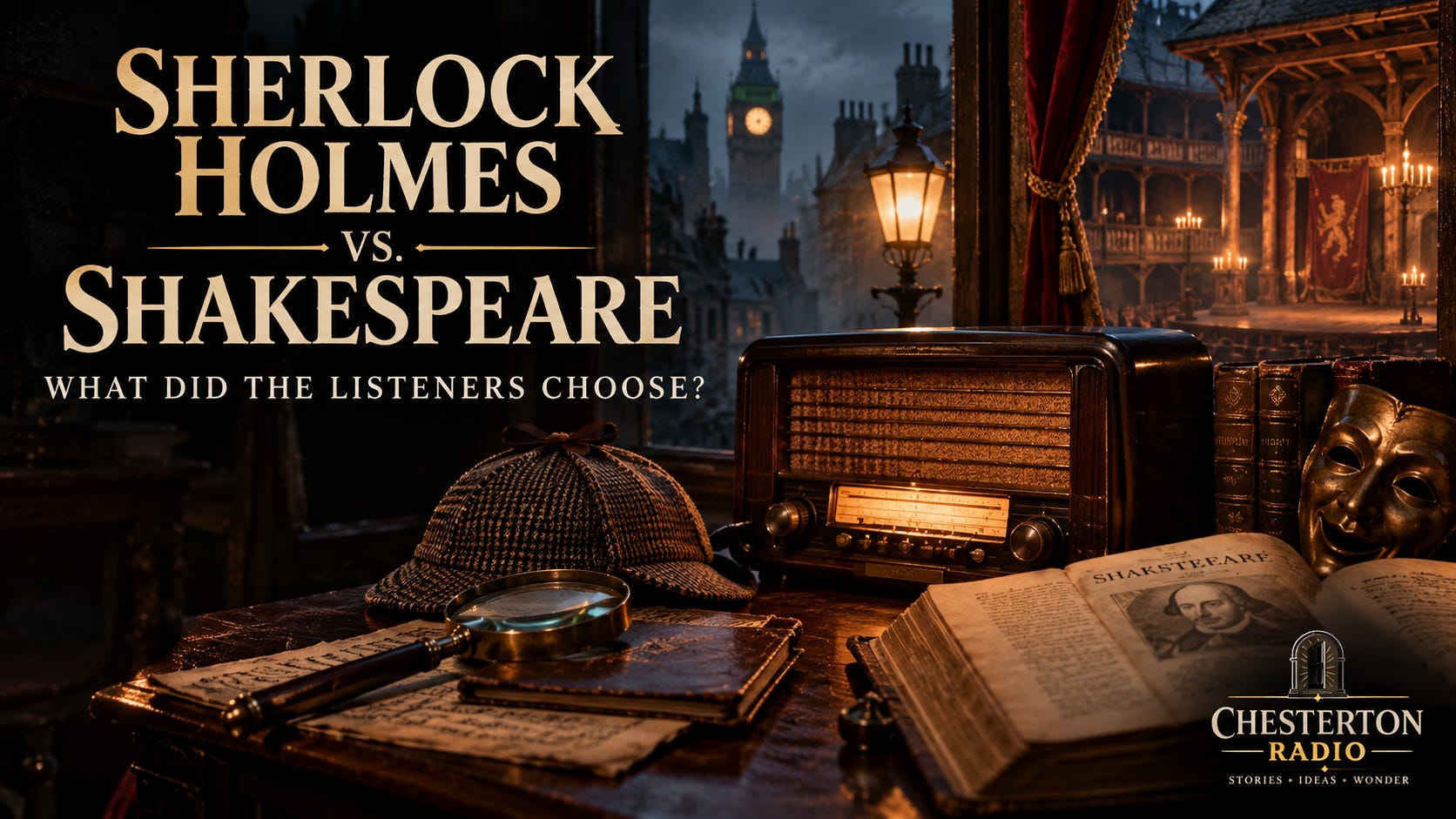 Sherlock Holmes vs. Shakespeare 24.09.2026 22хвSherlock Holmes or Shakespeare?Basil Rathbone and Nigel Bruce take on murder in the moonlight, the Fifth of November and Christmas at Baker Street. Richard Burton goes to Agincourt. Orson Welles tackles Twelfth Night and Hamlet. Leslie Howard and Rosalind Russell bring us Much Ado About Nothing. Laurence Olivier and Ralph Richardson enter the world of Richard III. And the BBC returns to two of the greatest Sherlock Holmes stories ever written.In this Chesterton Radio Deep Dive, we count down eleven listener favorites—from #11, Murder in the Moonlight, to #1, A Study in Scarlet—and explore why Sherlock Holmes and Shakespeare work so remarkably well on radio.What do Baker Street and the Globe have in common? Why can voices, footsteps, music and silence sometimes create a world more vivid than anything on a screen? And what does this listener countdown tell us about the stories and performances people still want to hear decades later?Along the way, we encounter Basil Rathbone, Nigel Bruce, Richard Burton, Orson Welles, Leslie Howard, Rosalind Russell, Laurence Olivier and Ralph Richardson—and discover more than a century of storytelling behind the broadcasts.Listen to The Open Door — Chesterton Radio LiveThe radio is always on. Join us for classic radio drama, mysteries, stories, music and original Chesterton Radio programming on The Open Door, our continuous live stream:Live.ChestertonRadio.comHelp Keep the Door OpenChesterton Radio is listener-supported. If you enjoy these Deep Dives, our original programs and The Open Door live stream, please consider becoming a paid subscriber or supporting the station. Your support helps us preserve, curate and create thoughtful radio for listeners who still believe the imagination is the greatest screen ever made.Listen. Share. Subscribe. And help us keep the door open.Listener Favorite Count-Down!11. Murder in the Moonlight - Sherlock Holmes - Basil Rathbone - Nigel Bruce - Sherlock Holmes is a fictional private detective created by British author Sir Arthur Conan Doyle. Referring to himself as a “consulting detective” in the stories10. Henry At Agincourt - Henry V - Shakespeare - Richard BurtonHenry at Agincourt is a sequence from Shakespeare’s Henry V featuring Richard Burton and John Neville9. The Fifth of November - Sherlock Holmes - Basil Rathbone - Nigel BruceSherlock Holmes is a fictional private detective created by British author Sir Arthur Conan Doyle. Referring to himself as a “consulting detective” in the stories8. Twelfth Night - Orson Welles - Shakespeare - Columbia PresentsTwelfth Night, or What You Will is a romantic comedy by William Shakespeare, believed to have been written around 1601–1602 as a Twelfth Night’s entertainment for the close of the Christmas season7. The Night Before Christmas - Sherlock Holmes - Basil Rathbone & Nigel BruceA series of fourteen films based on Sir Arthur Conan Doyle’s Sherlock Holmes stories was released between 1939 and 1946; the British actors Basil Rathbone and Nigel Bruce played Holmes and Dr. John Watson, respectively6. Much Ado About Nothing - Leslie Howard & Rosalind Russell - Streamlined Shakespeare - ComedyStreamlined Shakespeare, which featured a series of one-hour adaptations of Shakespeare plays5. Murder in the Casbah - Sherlock Holmes - Basil Rathbone - Nigel BruceHolmes is known for his proficiency with observation, deduction, forensic science, and logical reasoning that borders on the fantastic, which he employs when investigating cases for a wide variety of clients, including Scotland Yard4. Hamlet - Orson Welles - Shakespeare - Columbia WorkshopThe Tragedy of Hamlet, Prince of Denmark, often shortened to Hamlet, is a tragedy written by William Shakespeare.3. The Hound Of the Baskervilles - Sherlock Holmes - BBC Saturday Night TheatreThe Hound of the Baskervilles is the third of the four crime novels written by Sir Arthur Conan Doyle featuring the detective Sherlock Holmes. 2. Richard III - Olivier - Richardson - Shakespeare - Columbia WorkshopThe Old Vic Theatre Company presentation of Shakespeare’s Richard III featuring Laurence Olivier and Ralph Richardson1. A Study in Scarlet - BBC Saturday Night Theater - 1st Sherlock Holmes StoryA Study in Scarlet is an 1887 detective novel written by Arthur Conan Doyle. The story marks the first appearance of Sherlock Holmes and Dr. Watson, Get full access to CHESTERTON RADIO at www.chestertonradio.com/subscribe
 -
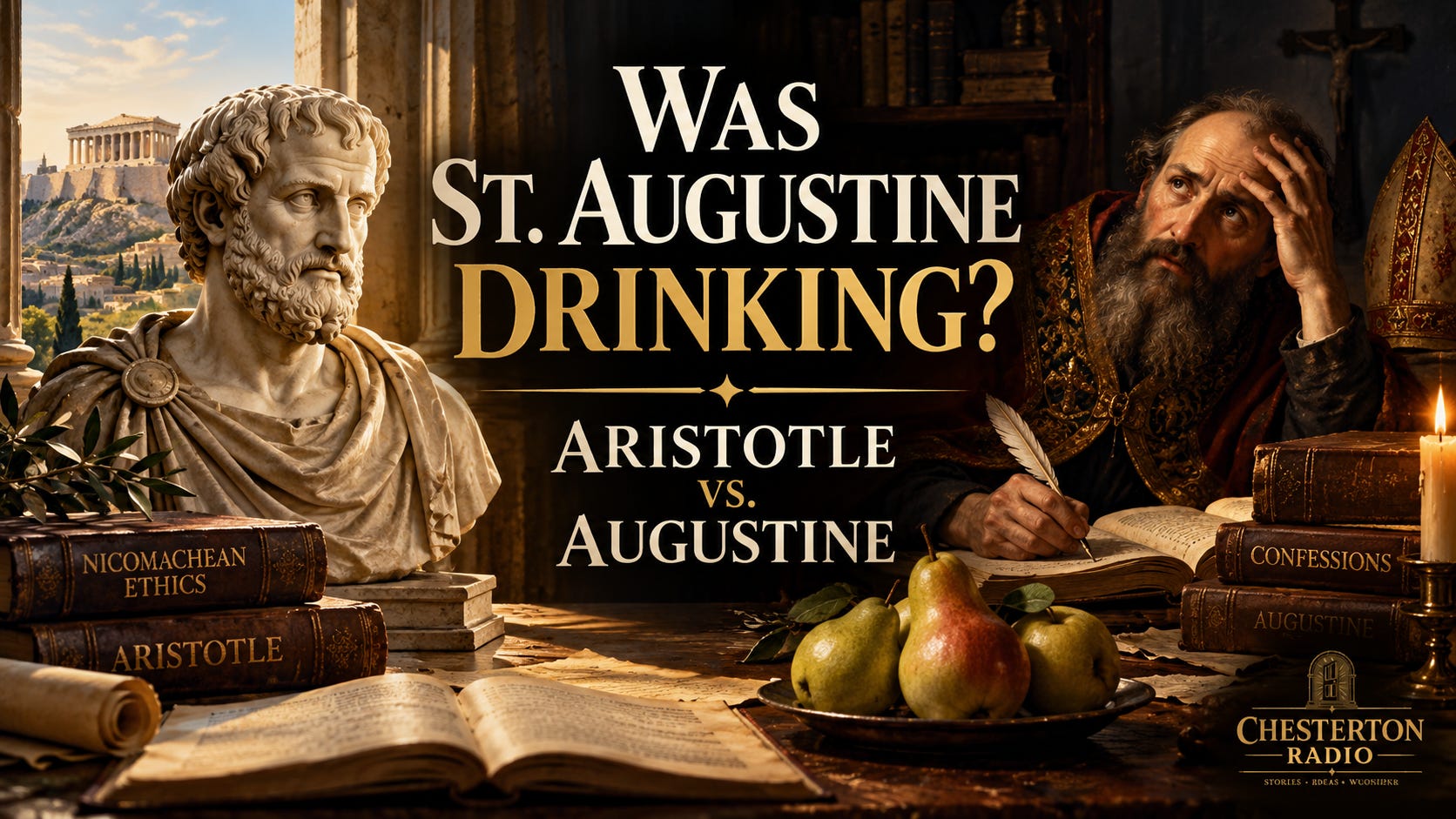 Was St. Augustine Drinking? Aristotle vs. Augustine 24.09.2026 37хвAristotle tells us how to become good: practice virtue, form good habits, develop character, and learn to desire what is worthy.Then St. Augustine arrives.He steals pears he doesn’t even want. He agonizes over desire. He discovers that knowing the right thing doesn’t necessarily make us do it. He searches his own memory, argues with himself about his own will, and eventually asks a seemingly impossible question: Does the present moment even exist?No wonder a modern college student might read the two and conclude: Aristotle makes sense. Augustine must have been drinking.But what if the strangest parts of Augustine are actually the most perceptive?In this Chesterton Radio Deep Dive, we put Aristotle’s Nicomachean Ethics beside Augustine’s Confessions and explore two very different approaches to happiness, virtue, desire, free will, self-control, friendship, sin, grace—and the maddening difficulty of being human.We also revisit St. Augustine’s remarkable life through the classic Ave Maria Hour radio dramatization and follow the intellectual road from ancient Greece through Augustine and eventually to Thomas Aquinas.Aristotle asks: How does a human being become good?Augustine asks: Why can’t I make myself do the good I already know I should do?Maybe Aristotle explains how we train human beings.And Augustine explains what it feels like to actually be one. Get full access to CHESTERTON RADIO at www.chestertonradio.com/subscribe
Схожі подкасти


Популярний у
Цей подкаст також потрапляв у чарти подкастів у цих країнах.
