
SEA of Startups
Decoding the Pulse of Founders, Capital & Conviction in Southeast Asia.
0
Real, raw, relatable takes on Southeast Asian startups. One investor, the week's news, no script.
Epizódok
-
 Twelve doors out: Southeast Asia's exits are back, and the buyers are flying in 30.09.2026 19pThere are two ways out of a company in Southeast Asia.One of them is loud. On 20 October, GCash will ring the bell at the Philippine Stock Exchange in the biggest listing that country has ever done. Cornerstone investors with names like BlackRock and T. Rowe Price. A valuation that starts with a number most Filipino founders will never see in their lifetime.The other is quiet. A few weeks earlier, on 8 September, private equity firm Navis Capital closed the sale of a chain of premium Malaysian supermarkets, Village Grocer, Ben’s Independent Grocer and a few others, to a Thai retailer. No bell. No cameras. Just a wire transfer and, reportedly, around five times the money they put in more than a decade ago.For years the complaint about this region was that there were no exits. Great companies, nowhere to sell them. That complaint just stopped being true. The door is cracking open. But before anyone pops the champagne, walk through it with me and look at who is standing on the other side. Because it is almost never a Southeast Asian.One. Six and a half times the money, four more companiesHere is the number that made me put this on the docket. In the first half of this year, venture-backed companies in Southeast Asia returned $5.65 billion in exits, per DealStreetAsia. Trade sales, listings, the lot. In the first half of last year, that figure was $856 million.Call it a six and a half times jump in twelve months. Hear only that and you would think the drought is over, and the region has finally figured out how to give investors their money back.Here is the part that gets buried. That $5.65 billion came from twelve exits. Twelve. The year before, it was eight. The value went up more than six times. The number of companies actually getting out went up by four.Sit with that, because it is the whole story of this market right now. The money is real. The breadth is a mirage. Twelve companies is not a wave of liquidity. Twelve companies is a handful of very large outcomes, and everybody else is still sitting in the waiting room.We saw the same trick with funding. The region raised $7.25 billion in the first half, the strongest since 2022. Sounds fantastic, until you notice that deal volume fell to its lowest level since at least 2018, and a single data centre deal carried the headline. Strip that one out and regional funding actually fell. The median Series A cheque shrank. The average founder is not living in the record. The average founder is living in the drought.When you see “exits are back” or “funding hits a record,” your first question is always the same. How many deals?Two. The loud door, and who already has a keyThe public market. The listing. The dream. And in the Philippines, that dream is about to come true in a very big way.GCash, the wallet on almost every Filipino phone, is going public through its parent, Mynt. The offer could raise around 80 billion pesos, roughly $1.4 billion, and closer to $1.6 billion with the overallotment. At the top of the range, Mynt is worth 669 billion pesos, about $11.5 billion. It is the largest listing in the history of the Philippine Stock Exchange, and it beats the old record, Monde Nissin, comfortably. More than 20 cornerstone investors are in, BlackRock and T. Rowe Price among them. The offer period opens on 6 October. Trading starts on the 20th.I want to be genuinely positive here, because this matters and I am on record as bullish on the Philippines. For a decade, the knock on Manila was that it could not host a listing like this. Any serious technology company would have to go to Singapore or New York to find money deep enough. GCash is proving that wrong on home soil. That is a real milestone, and Filipino founders should take a moment with it.Then I put the investor hat back on and read the cap table out loud, because Real. Raw. Relatable. means I do not just clap at big numbers.GCash is not a scrappy startup three friends built in a Makati garage. Mynt is a joint venture between Globe Telecom and the Ayala group, one of the most powerful families in the country, and Ant Group, the fintech affiliate of China’s Alibaba. The anchor buyers flying in are the giant American asset managers. So the biggest technology listing in Philippine history is, honestly described, a telco and a Chinese fintech giant selling a slice of their joint venture to Wall Street.That is not a criticism of the deal. It is a great deal, and GCash is a great company. It is a question about the pattern. If the only way to a landmark listing is to already be owned by a conglomerate and a foreign tech giant before you start, what exactly does that prove for the founder with no conglomerate behind them?Across the region in the first half, there were 47 listings raising about $3 billion. Healthy on paper. But reliable public liquidity for a venture-backed technology company still exists on a very short list of exchanges. Malaysia will point out that Bursa has been busy, and SkyeChip showed a local chip designer can list at home. Fair. It is still the exception. For most of the region, the loud door is not actually on offer.The public door is open. Just notice how narrow it is, and who already has a key.Three. The quiet door is a grocery aisleMost exits here do not happen with a bell and the start of public trading. They happen with a strategic buyer writing a cheque and quietly absorbing your company. Trade sales are the workhorse. And the clearest picture of this entire market I have seen is a story about groceries.Back to Navis. More than a decade ago, they started putting together a group of premium Malaysian supermarkets under a company called The Food Purveyor: Village Grocer, Ben’s Independent Grocer, BSC Fine Foods and a couple of others. This month they closed the sale for about RM1.66 billion. Good outcome, clean exit, the kind of return that keeps a fund alive.The buyer? CP Axtra, the Thai company that runs Lotus’s. And this is where one deal stops being one deal and starts being a pattern, because this is not the first time CP has gone shopping in Malaysia.Rewind to 2020. CP Group bought Tesco’s entire business in Thailand and Malaysia for $10.6 billion, one of the biggest deals in Asia that year. The Malaysian piece alone was valued at around $3 billion. Seventy-four Tesco stores were rebranded as Lotus’s.Follow the timeline. In 2020, CP buys the value end of the market, the big hypermarkets. In 2026, CP buys the premium end, the shops where the affluent city crowd does its weekly run. Put them together and one Thai conglomerate now has more than 120 outlets across Malaysia, covering everyone from the most price-sensitive shopper to the most comfortable. Top to bottom. The whole aisle.And it is not only CP. The other big premium chain in Malaysia is Jaya Grocer. Grab bought a majority of it at the end of 2021, in a deal reported at RM1.5 to 1.8 billion, roughly $400 million. Grab is a Singapore company. Some Malaysians will argue that point with me, and I am going to keep calling it Singaporean anyway.So let me say the thing plainly. Malaysia’s two leading premium supermarket chains are now both foreign-owned. One Thai, one Singaporean. Malaysian operators and Malaysian investors built these businesses into category leaders, and when it was time to sell, the buyer flew in from Bangkok or Singapore. Each time.That is the exit market in one shopping trip. You build it here. You sell it there.Four. The pattern holds in techWiden out from groceries and the data backs it up. In the first half, technology M&A in the region fell to 41 deals, down 37% on the year before, according to DealStreetAsia. So even while exit value went up, the number of tech deals went down. Fewer transactions, bigger cheques. The same concentration we started with.And who did the deals that did happen? Foreign buyers completed 30 of the 41. Nearly three in four. Domestic acquirers managed eleven. Japanese corporates, Chinese groups, regional conglomerates like CP: they are the ones clearing the market while local buyers sit on their hands.One more piece, the least glamorous and the most telling. A growing share of what gets counted as an exit here is not really an exit at all. It is one private equity fund selling to another. By some estimates, secondaries are now around 30% of exit value in the region. Funds are getting older. Their LPs want some money back. There is no strategic buyer and no open listing window. So the asset goes to the fund down the street, and everyone calls it liquidity.That is a perfectly respectable strategy. Secondaries are a well-worn path in more mature markets. But put the whole board together. Exit value is up, yes. But the deals are few, they skew large, they are increasingly bought by companies headquartered outside the region, and a big chunk of what is left is just capital rotating between funds.Five. The constraint was never capitalThe old complaint was that Southeast Asia had no exits. That was never quite right. The truer version, the one I want you to take away, is this: the constraint here was never capital. There has always been money. The constraint is liquidity, the ability to actually turn a company into cash.And the person most able to give you that liquidity today does not live here.Six. What I would actually do with thisI do not like diagnosing and walking away. So if you are a founder or an early investor in this region, here is what I would do.1. Build for a specific strategic buyer, and be honest with yourself about who they are. If you are building a consumer brand in Malaysia or Indonesia, your most likely exit is a regional conglomerate or a foreign strategic, not a listing. Know that on day one. Know their names. Build the thing they will eventually need to own, because buying you is faster than building you.2. Stop worshipping the listing. The GCash IPO is a beautiful, rare event. It is not your path. For almost every company here, the realistic door is a trade sale, and there is no shame in that. A five times return in a quiet sale to a Thai retailer spends exactly the same as a bell on an exchange.3. Sit with the uncomfortable question. If you care about this region beyond your own cheque, the grocery story should bother you. When the value end and the premium end of an entire national category both end up owned from outside the country, where is the domestic champion ever supposed to come from?The bowForeign capital validating our companies is a good thing. Foreign capital owning every company that gets good is a different thing. I do not have a clean answer for that. But we should stop pretending it is not happening.The headline this quarter is that exits are back. They are, and the value is real. Just remember, every time you see that number, to ask two things. How many companies? And where did the buyer fly in from?Twelve doors, mostly foreign on the other side. That is the market we are actually in.So tell me where I am wrong. If you think foreign buyers are the best thing that ever happened to this region, I genuinely want to hear it, because the pushback is usually where the next episode starts. And if you know a founder quietly assuming an IPO is their ending, send them this. They probably need to hear about the quiet door.This piece accompanies this week’s episode of SEA of Startups. Real. Raw. Relatable. Listen on Spotify, Apple Podcasts, or YouTube, and subscribe to the newsletter at seaofstartups.substack.com. This is a public episode. If you would like to discuss this with other subscribers or get access to bonus episodes, visit seaofstartups.substack.com
 -
 Count who gets paid: the least glamorous AI money in Southeast Asia 23.09.2026 36pSomebody is going to stand on a stage in Singapore this month and tell you two things. Southeast Asia now has more than 60 profitable tech startups. And the region is in the middle of a $4 billion AI boom.Both numbers are true. Both are also lies. Not made up. Lies the way your uncle lies at dinner, where every word checks out and the whole thing is still nonsense.So I am going to tell you up front where this lands. The most profitable AI business in Southeast Asia is not building the model. It is not even the thing people are calling the AI boom. It is teaching people how to actually use it. That is a services business. It gets paid on day one, or net 30. And it is the one lane where being a follower is not a weakness. It is the strategy.I am writing this from KL with the haze back, the Twin Towers invisible from three streets away and a throat that sounds like I gargled a satay grill. We cannot see through the sky this week. We can still see through the press releases.One. The 40 people who never logged back inThis did not start with a report. It started with watching the same movie play out across my portfolio and my network.A company I am close to spent good money last year buying every AI tool you can name. Seats for the whole team. I did the same thing myself. I had so many subscriptions I lost count, and I justified every one as my R&D budget.Fast forward to today and ask how it is going. Past the slides, the honest answer is this. A handful of people went fully red-pilled and got the lift. The rest logged in once, maybe twice, felt a bit confused or a bit silly, and quietly went back to doing the job the way they already knew how.Nothing was wrong with the tools. The tools are incredible. What was missing was the boring part. Nobody sat down with 40 people and taught them, in plain language, for their actual job, how to make the thing useful before nine o’clock on a Monday.Once you see it, you see it everywhere. Startups, SMEs, corporates. The gap is not the model. The gap is the person in the chair who was never taught, and was too embarrassed to say so.Multiply that person across 680 million people and you do not have a technology problem. You have the biggest teaching job this region has ever faced. And where there is a job that big that nobody has done yet, there is money.Two. Take a wrench to the headline numbersFirst, the 60-plus profitable startups. It comes from a single list, quoted everywhere, and nobody says who is on it or how profitable is defined. I sanity-checked it against my own portfolio and I would apparently be a meaningful chunk of the region’s total. I am a good solo GP. I am not that good.Here is what I will concede. Directionally, it is right. I sit across from early-stage founders every week, and genuinely profitable venture-backed companies are less rare than they used to be. The capital drought forced it. Treat the number as a direction, not a fact.The second one is worse. Native AI startups in the region raised about $4.1 billion so far this year, roughly double all of last year. Pop the champagne.Now pull the thread. Kling AI, the video generation unit of Beijing’s Kuaishou, raised a $2.8 billion Series D. That one round is about 68 percent of the entire “boom.” Strip it out and you are looking at a fraction of the headline. The number of rounds actually fell, from 41 last year to 23 this year. That is not a boom. That is one cheque and a thinner deal count.Of what is left, almost all of it lands in Singapore. With the usual caveat I will keep repeating until it stops being true: half the region is incorporated in a Singapore holdco, so the geography in these tables is partly an accounting artefact.So put both numbers down. Neither tells a founder in Manila or Bangkok where to make money in AI this year. Here is the rule I want you to carry for the rest of this piece:Do not count logos on a slide. Do not count dollars in one giant round. Count who sells a thing and collects cash.Three. AI projects do not fail. They stall on people.We have all seen the MIT-style reports on enterprise AI projects that never deliver a return. I do not think most of them fail, exactly. They stall. And not because the model is not smart enough, or the tool is badly designed. They stall because nobody knows how to use it, nobody trusts it, and the pilot dies quietly in a slide deck.If you have ever rolled out a CRM at a growing company, you know this movie. The software was never the hard part. Changing the daily habit was.Research on the roughly $400 billion corporate learning market lands on the same point: workforce readiness, not technology, is what blocks most enterprise AI. One survey has three in four companies saying they cannot keep up with their own demand for new skills. They have the tools. They have the budget. They do not have the drivers.That flips the story. If the model is not the moat and the model is not the blocker, the bottleneck in the entire AI economy is human. It is a teaching problem. A change management problem. A get-accounts-payable-to-trust-the-tool problem. That is not a San Francisco problem. That is an on-the-ground, local, human problem. And being close to the ground is one of the few things we are genuinely good at.Four. Sell shovels, not a prayerThe AI training and enablement slice of corporate learning is somewhere in the six to seven billion dollar range today, heading toward something like 18 by the end of the decade. Estimates vary and I am not going to pretend to precision. Every serious forecast points the same way: up and to the right, fast.Here is why I care. Teaching people is a services business, and services get paid differently. No eight-year burn. No praying you hit an inflection before the money runs out. A company signs a purchase order, you deliver, you invoice, you get paid. Assuming a good payer. We have all met the other kind.This is the picks and shovels trade of the AI era. You can run at the hills and maybe strike gold. Or you can sell shovels to everybody running, and get paid whether they find gold or not. You do not need a frontier lab or a $200 million round. You need expertise, a curriculum, a customer and a purchase order.That is a business. Not a bet.Five. Three kinds of buyer, all moving at onceDemand for this is not spread evenly around the world. It is concentrated here. Surveys have roughly 96 percent of Southeast Asian employers prioritising upskilling, against around 85 percent globally. Young workforce, fast adoption, hundreds of millions of people who came online mobile-first and now have AI in their pocket from day one. The instinct that let this region skip the desktop and skip the credit card is now pointed at AI.And this is not a prediction. Two of these moves landed this month while most people were not looking.Individuals. On 16 September, Singapore rolled out more than 200 AI courses under SkillsFuture, and citizens who take one get six months of a premium AI tool for free, so they can actually practise. A government putting shovels directly in people’s hands.Educators. ASEAN education officials endorsed AI Ready ASEAN, backed by Google.org and the ADB, moving from awareness into applied learning with a target of more than 1.7 million students and teachers by the end of 2028. That is not a webinar. That is a regional workforce being built on purpose.Governments. Here at home, Malaysia’s national AI skilling push with Microsoft, Microsoft Elevate, has already reached 80,000 learners from its pilot. The part I like is who it includes: educators, small business owners, civil servants, even retired servicemen and women. That is a whole-of-country bet that the bottleneck is people and the fix is teaching.A word to my friends in the Philippines, because this one is yours to win. The youngest population, the strongest English, and a workforce that already trains and supports the rest of the world for a living. You have done the BPO. You have done the data annotation. If any country here is built to become the place that teaches the region to use AI, it is you. Do not let anyone tell you that is a small ambition.Demand is not the question. Demand is the one thing we are not short of. The only question is who supplies it, and whether that supplier is one of us.Six. What it looks like as a companyTake Gnowbe out of Singapore. AI-powered microlearning for enterprise. The client list is not hopeful startups. It is General Mills, Shangri-La, MetLife. Blue chips paying real money.The clever bit: they are SkillsFuture-accredited, so corporate clients can get up to 90 percent of the training cost co-funded by the government. Malaysia has its own version in HRD Corp. Employers pay into the levy whether they like it or not, and a lot of them genuinely struggle to spend it. There is cash sitting there. Smart operators build straight on top of it.What I respect is that this is a capital-light business. Nobody raised nine figures and set it on fire. It is a book of blue-chip customers, government co-funding pulling demand through the door, quietly compounding. That is what a healthy company looks like when the hype leaves the room.And it is not one company. A business in our portfolio has started running AI training in India and has landed some very large contracts. Someone in my network doing the same in the Middle East tells me they have more demand than they can possibly supply. Corporate bootcamps are running week-long intensives for executive teams. None of it shows up in that $4 billion number, because nobody is counting it. Which is exactly why there is still room.Seven. The plumber is now worth more than the engine builderThere is a job title that barely existed three years ago and is now the hottest role in AI: the forward-deployed engineer. The idea is simple. Instead of selling a company a model and wishing them luck, you send an engineer to sit inside the customer and make the thing work in their actual mess.It is the Palantir playbook, now going mainstream, and at the top labs the people who make it work have become the people who close the deal.Why? Because the project dies on the unglamorous stuff. The AI cannot talk to the customer’s ancient database. It cannot get through their login system. It hits a data rule that says this information cannot leave the country. None of that is intelligence. All of it is plumbing. And the person who does the plumbing is now worth more than the person who built the engine.A one-week course for a bank’s back office and an engineer embedded for six months in a factory are the same business: get the thing to work for real people in a real building in this region. Teaching at one end, deployment at the other, and every dollar in between is a dollar for making AI useful, not inventing it. That entire line, from the classroom to the server room, is ours to own, because it is won on the ground, in local context and local language.Eight. Now take a wrench to the word “trained”I opened by taking apart “profitable.” Fair is fair, so let me do the same to “trained.”1.7 million learners. 80,000 reached. 200 courses. Big, impressive numbers. And a lot of what sits underneath them is a two-hour awareness webinar and a certificate of attendance. Sitting through a webinar does not make you a skilled worker any more than watching a cooking video makes you a chef. When you hear a giant training number, ask the boring question. Trained to do what, exactly? And can they still do it the following Monday?Second, a lot of these programmes are funded by the American giants: Google.org, Microsoft, AWS. That is genuinely generous. It is also not charity. Free curriculum is a demand funnel. Teach a million people to build on your cloud and a chunk of them pay you cloud bills for the rest of their careers. The training is real, and it is also a customer acquisition cost. Hold both.Which is actually the whole opportunity. The free, generic, awareness-level stuff is covered. The giants have it. What they do not have, and probably do not care about, is the deep end. Sector-specific, applied training, taught in Bahasa, Tagalog, Thai or Vietnamese, for the way business actually gets done here. Teaching a bank’s compliance team, a hospital’s admin staff or a factory floor to use AI in their actual workflow, with their actual rules.Do not just hand out the shovels somebody else made. Own the part that teaches people to dig.Nine. If you wanted to build this on MondayLet me stop being the analyst and be the investor who would write the cheque. Here is how I would tell you to do it.1. Pick a lane you already know. Do not sell generic AI literacy, it is crowded and much of it is free. Sell AI for insurance underwriters, for property agents, for hospital admins. Narrow is where you can promise a real outcome and deliver it.2. Sell the outcome, not the attendance. The moment you can say “we cut this team’s reporting time in half, and here is the measurement,” you are not a trainer anymore. You are a consultant, and consultants charge ten times more.3. Stand on the government’s money. Get accredited under SkillsFuture, HRD Corp or the local equivalent, so the state picks up a big chunk of the bill. You are not competing with free. You are riding the subsidy that makes your deal an easy yes.4. Win one logo, then never let it go. Land one respected enterprise in your lane, do the work so well they put their name to it, and use that name to walk into the next ten. In services, one great reference customer beats any funding round.5. Stay capital-light on purpose. Customer cash funds the growth. That is the whole point of the model. Do not turn into a burn machine to impress somebody on a stage.It will probably not get you on the cover of anything. It will get you paid every month for solving a problem the entire region has at the same time.The bowThe conference circuit is going to sell you 60 profitable startups and a $4 billion AI boom. One is a list with the definition deleted. The other is mostly one company. Neither is where the money is.Remember the 40 people who never learned to use the tools the boss bought them. That is not one company’s problem. That is the whole region, at once. Enterprise AI does not fail on the model. It fails on the people. So every worker, every boss and every government is trying to fix the same human problem at the same time, and they are all holding a cheque.We are probably not going to build the smartest model. We are not going to out-Anthropic Anthropic. I have made peace with that, and so should you. If one of the crazy ones out there can actually do it, I would love to find and back them.But we are going to teach 680 million people how to use it. We are going to send an invoice for that teaching, and we are going to get paid. Followers who teach can beat innovators who burn.So here is my question for you. Look at your own team. How many of the people you bought AI seats for are actually using them? And if the answer embarrasses you, who is going to fix it: you, a free webinar, or a local founder who just found their business?This piece accompanies this week’s episode of SEA of Startups. Real. Raw. Relatable. Listen on Spotify, Apple Podcasts, or YouTube, and subscribe to the newsletter at seaofstartups.substack.com. This is a public episode. If you would like to discuss this with other subscribers or get access to bonus episodes, visit seaofstartups.substack.com
 -
 Exposing the AI panic: who actually profits? 16.09.2026 35pThis week a guy who, as far as anyone can tell, had never posted anything in his life put up a thread about artificial intelligence and got 170 million eyeballs on it in five days.A former Anthropic employee, or so the byline says. Within 48 hours you had Senator Bernie Sanders talking about banning superintelligence, market people calling for a bloodbath on Monday morning, and half my group chats forwarding the same screenshot to each other.Then, almost on cue, the chief executive of one of the biggest AI labs on earth published an essay saying, and I am paraphrasing, we need to slow this thing down before it gets away from us.And then China told him to get lost.So here is the question I want to sit with. Not “is AI going to kill us all.” That is the wrong question, and frankly it is the question everybody wants you asking, because it sells. The question is this. When the most powerful people in the most powerful technology of our lifetime suddenly all agree you should be afraid, or suddenly all agree you should not be, who actually benefits from that?And the second one, the question that matters if you are reading this from KL, Manila, Bangkok, Jakarta or Singapore. While the big boys fight about the brakes, are we building this future, or are we just being told what the rules are?One. Where I stand, so you knowLet me put my cards on the table before I say another word, because I am about to be skeptical of a lot of people in this piece, and you deserve to know where I am coming from.I am an optimist on AI. Full stop. I invest in it. I use it every single day, in my fund, in my other businesses, in how I read the market. I think it is one of the best things to ever happen to a small team trying to compete against a large incumbent. If you are a founder in this region with four people and a good idea, this is the closest thing you have ever had to a fair fight.So I am not here to scare you.But optimism is not the same thing as being naive, and this is the part people get wrong. Every powerful technology in human history arrived with bad actors attached to it. Every single one. Fire, gunpowder, nuclear fission, the internet. Even the ATM got used for fraud. Cheques got used for fraud. The tool does not decide. People do.There will always be rogue states. There will always be criminals. There will always be somebody who wants to take the sharp end of a good thing and hurt someone with it. That is not an AI problem. That is a human problem, and it is as old as we are.So hold both of these at once, because I am going to keep coming back to it. I am bullish. I am also clear-eyed. Those are not opposites. Anybody telling you that you have to pick one is selling you something.Two. Panic has sponsors nowBack to our mystery man and his 170 million impressions.Here is what should bother you about that thread, and it has nothing to do with what he actually said. Multiple outlets that dug into it came away thinking the virality itself was manufactured. An account with basically no history, suddenly spiking on numbers that do not behave the way organic posts behave.In plain language: somebody may have paid to make you panic.I do not know that for certain, and neither does anyone else, and that is exactly the point. We now live in a world where the fear itself is a product. Somebody can build it, ship it and sell it. Whether the goal is attention, influence, or moving a stock on a Monday morning, panic has sponsors.So when a piece of content seems engineered to make your stomach drop, the correct response is not to feel the fear and forward it to the family group chat. The correct response is to ask a boring question. Who wanted me to feel this way, and what do they get if I do?That is not cynicism. That is media literacy in 2026. And it applies just as hard to the calm, reassuring voices as it does to the scary ones. Keep it in your pocket, we need it in about two minutes.Three. Sincere and self-serving are not oppositesOn 12 September, Dario Amodei, chief executive of Anthropic, published an essay called “We Must Pace the Frontier.” Just under 4,000 words, which by the standards of this genre counts as restraint.The core argument is reasonable on its face. He is not saying stop, and he is careful about that. He is saying slow the rate at which these models get more capable, so that the safety work and the outside checking can keep up. His worry is recursive self-improvement, which is a fancy way of saying an AI that gets good enough at building the next AI that the whole thing starts accelerating on its own, faster than any human can supervise it. His ask is that each generation gets aligned and checked by independent evaluators before anyone sprints to the next one.Honestly, as reasoning, that is not crazy. If you were building a bridge and you had a machine that could design the next, taller bridge by itself, you would want to inspect a few of them before you drove your family across.But here is where you put the glasses back on.When the leader of one of the two or three companies out in front says we should all slow down, bring in third-party evaluators and regulate this properly, what world is he also describing? He is describing a world where the companies already ahead get to lock in their lead. Where the rules get written around the way the current leaders already do things. Where it becomes a lot harder and a lot more expensive for a challenger to catch up. Regulation is a wall, and walls protect whoever is already inside the castle.I am not accusing him of dishonesty. This is the nuance I actually want you to take away. He can be completely sincere about the safety risk, and it can also happen to be extremely good for his business. Both of those can be true at the same time. Sincere and self-serving are not mutually exclusive. Grown-ups can hold that.So I do not clap and I do not boo. I note it. A safety argument from a company that benefits from a safety regime is still worth listening to. It is just not scripture.And by the way, some of the reporting says other lab bosses nodded along with him. Be careful there. “Signalled agreement” is doing a lot of work in those headlines, and I have not seen anything I would put my name to on exactly who endorsed what. So I am going to leave it alone rather than build a story on a soft source. You should demand the same from anyone reporting this to you, including me.Four. The paragraph the Western coverage walked pastHere is the part of that essay most of the Western coverage glided over, and it is the part that matters most for us out here.The same essay that says let us all slow down together for safety also says, and I am being fair to the text, that a Chinese lead in AI would be a grave danger, and that the United States should keep restricting the sale of the most advanced chips and chipmaking equipment to China.Read those two things back to back. Slow down, everybody, in the name of global cooperation and safety. And also, we should keep choking off one specific competitor’s access to the hardware.China noticed. Of course China noticed. Their foreign ministry called it fearmongering and said, more or less, that confrontation and vicious competition will wreck any chance of real global cooperation on AI. Global Times called the essay a Cold War playbook dressed up as safety. The commerce ministry said the real game is the US trying to hold a monopoly on the industry.Now, same rules apply. I am not going to sit here and tell you Beijing is the innocent party and the noble truth-teller. A government framing a safety debate as an anti-China containment plot is also incredibly convenient for that government. It rallies their own industry. It plays well across a developing world that already carries some anti-American sentiment. And it lets them skip straight past the actual substance of whether frontier AI is dangerous. A rebuttal can be fair and strategic at the same time. Again, hold both.And while we are handing out skepticism evenly, let us not forget Washington. The Trump administration has doubled down the other way, leaning hard into acceleration and winning the race. That is also a position, and it also has a book behind it. Chipmakers, defence contractors, and the simple political value of looking strong.Nobody in this fight is a neutral referee. Everybody has a jersey on.Five. The dancing robot and the soldier robot are the same robotAll of this slow down, speed up, contain China material can feel abstract. Percentages, essays, ministry statements. We have been living inside a geopolitical bubble long enough that it all starts to sound the same, and it becomes very easy to tune out.And then last month the abstract got legs. Literally.In Beijing, from 22 to 26 August, they held what people are calling the robot Olympics. The official name is the World Humanoid Robot Games. More than 2,000 humanoid robots. They ran, they boxed, they danced, they played football. Three years ago these machines could barely get down a corridor without a spotter.My first reaction was not fear. It was wonder. I am a bit of a tech nerd, and this is a genuine feat of engineering. A huge chunk of it is coming out of Chinese companies who, by some counts, now ship around 95 percent of the world’s humanoid robots. That is real capability. That is not a PowerPoint and it is not an essay.But here is where it gets heavy, and here is why it fed straight into the panic cycle. Within days of the games ending, the PLA Daily, the official newspaper of the Chinese military, said the quiet part out loud. It called for accelerating the move of this technology from the laboratory to the military training ground. There is a growing pile of reporting on Chinese defence research into humanoids for urban combat, for reconnaissance, for the jobs you do not want to send a human into. There is a state-backed platform, the Fuxi, described as capable of sentry duty and patrols.So the dancing robot and the soldier robot are the same robot. That is the uncomfortable truth, and no amount of Terminator jokes makes it less true.Now watch me apply the same even hand one more time, because it matters. A robot doing a backflip in Beijing is three things at once. It is a genuine leap in capability. It is a soft power flex, a national highlight reel that says look how far ahead we are. And it is a recruiting poster for every hawk on every side who wants a bigger defence budget to counter it. All three are true. The people who want you purely amazed are spinning you. The people who want you purely terrified are spinning you too.And this is exactly what I meant at the top. Bad actors and rogue uses will always exist. Of course a powerful new tool gets pointed at a battlefield. That has been true of every tool humans have ever made. It is a reason to be sober. It is not a reason to be paralysed.Six. Put the fear in a box the right sizeSo people are throwing numbers at you. Two percent. Ten percent. Twenty-five percent chance of catastrophe. Pick your doom figure, there is an expert somewhere with a spreadsheet for each one.I want to give you a tool for handling those numbers, and it is neither “ignore them” nor “panic.” It is context.We accept risk numbers every single day and never think about them for a second.In the United States, your lifetime odds of dying in a car crash are about 1 in 101. One in a hundred and one. Roughly a one percent chance. You got in a car today. You will get in one tomorrow. You did not run a risk assessment, you did not read an essay, you just went.Being struck by lightning in your lifetime, about 1 in 15,300. Dying from a lightning strike, about 1 in 139,000. And nobody, not one person, cancels a beach day over lightning. But when the clouds come in and you hear the thunder, you get out of the pool and off the golf course. That is the whole skill. Size the risk, then respond to the specific signal.So when somebody hands you a scary AI percentage, do not swallow it whole and do not laugh it off. Do what you would do with any risk number in the real world. Ask how it was calculated, because most of these are not calculated at all, they are somebody saying “I feel like it is ten percent.” Ask who is handing it to you. And ask what they get if you believe it. A ten percent number from someone whose business improves when you are scared is worth hearing. It is just not the same as a ten percent number you worked out yourself, or one backed by evidence you can check.And here is the local kicker, the part no podcast in San Francisco is going to give you. Every one of those everyday risks is an American number, because those are the ones that are easy to find. Several countries in this region carry road death rates among the highest in the world, well above the US figure. We live with real, measurable, daily danger. We get on the motorbike. We watch somebody overtake on a blind corner in KL or Jakarta or Ho Chi Minh and we shrug. We cross the road and we function completely fine.That is the human default setting, and it is a good one. We are extremely good at living alongside risk. So fear AI the right amount. Not zero, because bad actors are real. Not the amount that an engineered viral thread wants you to feel either. Feel it, size it, get back to work.Seven. Nobody flew to Jakarta to askWhich brings me to the only part of this whole story we actually control.Look at where each decision in this week of headlines was made. The pace of the models is being set in San Francisco. The chip rules are being written in Washington and enforced against Beijing. The robots are being built in China. And the emotional weather system around all of it is being managed by people who each have something to gain.Notice who is not in any of those rooms. Us. 680 million people, the third or fourth largest internet population on the planet, sitting downstream of every single one of these decisions. Nobody flew to Jakarta to ask Indonesia what pace it wanted. Nobody called Hanoi about the chip rules.So the fair question, the one this show exists to ask, is not whose panic to believe. It is this. Given that we do not control the pace, we do not control the chips and we do not build the robots, what do we actually control?The honest first answer is uncomfortable. On the frontier, right now, we are not innovators. We are rule-takers. And I think we have to say that plainly before we can say anything useful.Eight. One law with a snooze button, one testing lab, a few roadmapsHere is the actual state of play across the region, because it is more interesting than the doom and more mixed than the boosters admit.Vietnam. Give them real credit. On 1 March this year, Vietnam’s Law on AI came into force. First proper comprehensive AI statute in Southeast Asia. Risk-based, human oversight at the centre, and it arrives with a national AI fund and plans for innovation clusters. That is a country planting a flag.Now put the glasses back on, because that is the job. The same law comes with long grace periods. Twelve months for most sectors, eighteen for finance, health and education, which pushes real enforcement out into 2027. And American industry groups are already lobbying Hanoi to stretch that timeline further. So “first AI law in the region” is a great headline and, for now, more a statement of intent than a set of teeth. I am rooting for it. I am not going to pretend a law with a two-year snooze button is the same as a law that bites.Singapore. Completely different bet. Singapore has pointedly not passed a big AI law. Instead there is AI Verify, a testing and governance toolkit they open-sourced, with more than 90 companies signed up last I checked, the big American names included. There is a live regulatory sandbox, work already under way on governing agentic AI, and a line from minister Josephine Teo that I keep coming back to: a strong desire for AI safety does not have to mean pulling up the drawbridge to innovation.That is an entire philosophy in one sentence. Do not build a wall, build a testing lab. Become the place where the world proves its AI is safe. Very Singaporean, and it fits them.Malaysia, home turf. We stood up a National AI Office. The posture so far is soft law first, guidelines and roadmaps rather than a big prescriptive statute, with a full legislative framework that has been working its way toward Cabinet. Credit where it is due, during our ASEAN chairmanship Malaysia pushed the regional digital agreement forward. The risk for us is the same as everywhere: an office and a roadmap are easy, enforcement and real capability are hard.Indonesia is expected to move through a Presidential Regulation rather than a full law, which is faster but also more top-down. And over all of it sits ASEAN, which put out a guide on AI ethics and governance in 2024, added a supplement for generative AI, and is working toward a regional digital agreement meant to close this year, which could finally make some of this binding and interoperable across borders.So that is the map. One real law with a delay switch. One clever no-law testing hub. A couple of offices and roadmaps. And a regional framework that is still mostly soft.Nine. Followers or innovators. My answer.Two halves to this.On the frontier, the raw race to build the smartest, most capable model on earth, we are followers. I have not seen a frontier lab come out of Southeast Asia. We have seen genuinely interesting hardware work, including one Singapore round we covered recently, and interesting small-model work out of Japan. Good, but not the frontier line. We are not going to outspend San Francisco, outspend Washington or outscale Beijing on compute this decade. Anybody in this region standing on a stage telling you their startup is going to build a sovereign frontier model to rival the giants is, with love and respect, cosplaying.And here is the tell. When a country in our region starts talking about AI sovereignty, ask what it is actually sovereign over. The chips are imported. The base models are mostly imported. The cloud it all runs on is mostly foreign. You cannot be sovereign on a stack you rent. Say that part out loud before the next press release.But the frontier is the wrong scoreboard for us.You do not have to win the race to build the model to win at using it. And that second game, the deployment game, we can lead. I also think the foundation models are going to earn the word foundational over time, which is another way of saying they commoditise. Concrete is essential and concrete is cheap. Plan for that.So think about what we actually hold. We hold the users, hundreds of millions of them, coming online with AI in their pocket from day one. We hold the languages and the local context the San Francisco models are still bad at. Straight translation will get solved, that is coming. The rest of the context, how a Malaysian conversation switches languages inside a single sentence, how people here actually pay, what they will and will not trust, is a much longer moat than people think.And we hold neutrality. Singapore can run a chunk of the world’s AI testing precisely because it is not in the American trench or the Chinese trench. Vietnam can write workable, pragmatic law precisely because it is not trying to win a superpower fight. Being not-in-the-fight is an asset, if we are smart enough to use it.So my answer is this. Stop trying to be a frontier innovator, because that is a race we lose and a story that wastes our money. Become the best place on the planet to deploy AI, to govern it sensibly, and to build the applications that work for the way people here actually live and pay and speak. A fast, useful, trusted follower beats a broke, pretend innovator every day of the week.Let billions of dollars flow into the foundation models. Then use what comes out the other end.That is not settling. That is strategy. The Gulf states worked out they were never going to invent the technology, so they became the place capital and infrastructure went instead. We can do the equivalent with deployment and trust, and with genuinely understanding how this gets absorbed into business and daily life here. That lane is wide open.The bowThe doomers want you scared. The accelerationists want you charging. The labs want you regulated in a shape that suits them. Washington wants you picking a side and Beijing wants you picking the other one. And a mystery man on the internet with 170 million impressions may have wanted nothing more than to amplify the fear, or move a stock.Everybody in this story has a motive. Your job, as a founder, an investor or an operator, is not to pick the loudest voice. It is to keep your head, size the risk like the adults we are, and keep building.Because here is where I land, and it is the same place I started. I am an optimist. Used well, this is the best tool a small team in an emerging market has ever been handed. The threats are real. Bad actors are real. Rogue states are real. None of that is new, and none of it is a reason to sit this out.We do not control the pace. We do not control the chips. We do not build the robots. But we control whether Southeast Asia shows up to the next decade as a passenger or as a builder.I know which one I am betting on. I am betting on us as builders.If this made you think differently about who is really setting the rules, do two things. Send it to one founder who needs to hear it, and send it to one policymaker who needs to be challenged by it.This piece accompanies this week’s episode of SEA of Startups. Real. Raw. Relatable. Listen on Spotify, Apple Podcasts, or YouTube, and subscribe to the newsletter at seaofstartups.substack.com. This is a public episode. If you would like to discuss this with other subscribers or get access to bonus episodes, visit seaofstartups.substack.com
 -
 The tourists went home: who is actually left to fund Southeast Asia 09.09.2026 31pLast week one of the firms that taught this region what seed capital even looks like quietly admitted that it will not raise another Southeast Asia fund.500 Global showed up in KL, in Jakarta, in Bangkok more than a decade ago, when honestly almost nobody in the Valley could find these cities on a map, let alone wire money to them. They ran the accelerators. They wrote the small early checks that nobody else was writing at the time. For a lot of founders here, a 500 check was the first time a real Silicon Valley name said yes.DealStreetAsia reported on 31 August that they are not raising another dedicated Southeast Asia fund. Future bets here come out of the global pool. A smaller local team, mostly managing and winding down what they already own.To be fair, and I am going to try to be fair the whole way through this, Khailee Ng pushed back a few days later. Still committed to the region, still managing the existing funds, still looking at new mandates. I believe him. He is tied to this place far more than I am, because I was not born here. And both things can be true at once. You can be genuinely committed to a region and still decide you will not raise a dedicated fund for it.Hold that thought, because the gap between what people say and what they will actually write a check for is the entire point of this piece.And this is not a 500 story. That is just the way in.One. Two canaries, one coal mineRewind and look at Y Combinator, the most famous accelerator on the planet. In 2021 and 2022 their batches swelled to something like 400 companies. Founders from everywhere, checks everywhere, the whole world invited.Then under Garry Tan they cut the batch back to roughly 100. They stepped back from late stage. And they pulled back from the rest of the world. The Winter 2023 batch was about 21% international. The batch right before it was 42%. Cut in half. Today something like 80% of the batch is an AI company, which surprises nobody.Now look at what those two decisions have in common. The biggest early stage machine in the United States, and one of the most important funds this region ever had, a decade apart, looked at the whole wide world and reached the same conclusion. Smaller. Closer to home. Pointed straight at AI.That is the tide going out. Two canaries in the same coal mine, singing the same note. This piece is about what the tide leaves behind here.Two. The boom is four companies wearing a trench coatStart with the number everybody is celebrating, because that number is part of the tell.Global venture capital just had a record six months. Around $510 billion in the first half of 2026. That is more than all of last year in half the time. If you only read that one headline, you would think we are living through the single greatest funding boom in the history of the industry.Put your skeptical hat on with me, because here is the number that actually matters. Artificial intelligence took roughly 77% of all global venture dollars in that half year. Two companies you already know, OpenAI and Anthropic, raised somewhere around $217 billion between them.Say that a different way so it lands. Two companies, essentially in California, took about 43% of all startup funding on planet Earth. The US on its own was about $412 billion, and 86% of that went to AI.Now the caveat, because I promised I would and because the whole brand of this show is that I do not read you a number without telling you what is wrong with it. These figures move depending on who is counting and what they choose to count. Different reports land on slightly different numbers, so treat them as directionally correct rather than precise. And the definition of an AI company right now is extremely generous. Anyone with an API wrapper and a login screen qualifies. Out here we are throwing data centres and chip companies into the same bucket, and it is a fair question whether hardware belongs in an AI funding total at all.Every version of the number tells the same story anyway. The money is concentrating into the US. Inside the US it is concentrating into AI. Inside AI it is concentrating into about four companies, mostly the two I just named.So when a fund manager gets on a stage and tells you venture is back, ask the simple question.Back where?Strip out those few mega rounds in San Francisco and the rest of the planet is not in a boom. Some markets are recovering. That is not the same thing. The oxygen got pulled into one room, and we are not in that room.Three. This time they have something better to do at homeHere is the part that should sting, because it is a change from the old story.This is not the usual complaint where American money ignores us because it does not understand us. This time the US money has something better to do at home. So ask yourself honestly: why would capital that has that choice get on a 14-hour flight to underwrite a logistics startup in Kuala Lumpur, when it can walk three blocks from the office and put a check into a frontier lab that might be worth a trillion dollars?It would not. It is not. That is not a slight against Southeast Asia. That is gravity. The returns moved, so the money moved. Capital is not loyal and it never was.Even the money that does show up in our numbers is not always what it looks like. You will hear that Singapore now captures something like 78% of all Southeast Asian startup funding. Seventy-eight percent, one city. Be careful with that figure too, because a chunk of it is not activity, it is address. Companies born elsewhere domicile a holding company in Singapore for the tax and the safety, and the raise gets counted as Singapore.Strip out the holding company effect and the infrastructure deals, and the amount of genuine early stage, founder-led money landing across the rest of this region is thin. Thinner than the conference panels will tell you.Four. Nobody is funding the fundsWhich brings me to the question the rest of this is really about. If the tourists have gone home to chase AI, and the money that stayed is huddled in one city, who is actually left to fund the next founder in Manila, in Ho Chi Minh, in Kuala Lumpur, in Bangkok?So I went looking at who is raising money to invest in this region. Not investing. Raising. That is the leading indicator, and almost nobody talks about it, because a lot of it is non-public by regulation and quite a lot of it is non-public by design. A fund that cannot raise cannot write checks next year, no matter how confident it sounds or how good the website looks.Here is what you find, and it should stop you.In the first half of 2026, I could not find a single dedicated Southeast Asia fund that reached a final close. Not one. Only one Southeast Asia focused venture fund closed at all in that window. And as of August, no Southeast Asia headquartered venture manager had reported a final close for the year.My data set may well be incomplete. Some of the paid sources I do not subscribe to will show something I cannot see. But the word on the street matches the numbers I can get to. It is tight.Let me translate that out of finance language. The machine that raises the money, that then funds the founders, has basically stopped for the year.Think about how a fund actually works. A general partner goes to family offices, pension funds, high net worth individuals, sometimes corporates, and at the larger end the sovereigns. That is the raise, and it takes a year, two, sometimes three. Then they spend the following years deploying it into startups.So if nobody is closing a fund in 2026, that is not a bad year. That is a hole in the checks founders will feel for the next several years. Regional deal value is already down, and the tank that is supposed to refill it is running close to empty.Keep that one in your pocket for the next time somebody at an event talks glowingly about this region’s bright future. Bright futures are funded in advance, and right now almost nobody is funding the funds.And before you tell me this is just the small tourist players washing out and good riddance, look at the biggest name of all. Peak XV, formerly part of Sequoia, generally well regarded, announced $1.3 billion in February. Genuinely good news. But it is an India fund and an Asia Pacific fund. Not a Southeast Asia fund. The biggest name that ever carried this brand in this part of the world raised money and pointed almost none of it specifically here. India gets its own dedicated vehicles. Asia Pacific, the big blurry bucket, gets one too. Southeast Asia as its own thing, with its own fund and its own partners? Apparently not.That is what I mean by the herd thinning. It is not always a dramatic exit and a farewell blog post. Sometimes it is just a fund quietly taking the words Southeast Asia off the label and hoping nobody notices.I noticed. And I am guilty of a version of it myself. We added Japan, and to make that work we swapped Southeast Asia for APAC.Five. The three letters that decide who keeps their jobSo why did the money that was so in love with this region a few years ago go quiet? I am not going to let us off the hook here, because a big part of this we did to ourselves.The answer is DPI. Distributions to paid-in capital. In plain English: of the money the investors gave the fund, how much did the fund actually give back? Not on paper. Not in a markup. In the bank account, in real dollars, returned to their own investors.The honest answer in Southeast Asia is not much, and not lately. Exit value fell about 32% last year, to something like $4 billion for the entire region. Almost every good exit this region ever produced is still clustered back in 2021 and 2022. Since then it has not been slow. It has been quiet.Put yourself in the shoes of a limited partner. You are a pension fund, a family office, a sovereign wealth fund. You put money into Southeast Asia venture in 2019. In 2021 you were told with a straight face and a beautiful deck that this was the next China. It is 2026. Where are your distributions?For a lot of them the answer is still trapped inside companies that cannot go public because the local markets are too shallow, and cannot find a buyer because the strategic acquirers are not there. Or companies still burning cash, right-sizing, growing slower than the deck promised. The money is technically alive. It is just not coming home.Do that to an investor once and they call it bad luck. Do it across a whole region, across multiple vintages, and they remember. When they sit down to decide where the next allocation goes, they do not come back to the market that locked up their money for ten years and sent them a newsletter about potential. They go where the exits actually happen.Which is exactly what is happening. Capital is rotating into what people now call developed Asia. Japan is leading it, and a lot of money is going there. Korea and Australia are picking up attention. Why? Clearer exits, better governance, stock markets that function and let an investor get the money out. There is real nuance to the Japan story that deserves its own episode, but the direction of travel is not in doubt.So follow the whole picture. US money went home to chase AI. Chinese cross-border money got fenced off by geopolitics. And the LPs still committed to Asia are drifting north and east, toward liquidity, toward the places that pay them back.Now, it would be very easy to stand at this microphone and sound like a victim. We are not victims. This region sold a growth story for a decade and did not build the plumbing to get the money back out. Shallow public markets. Thin strategic buyers. Growth at all costs, which worked right up until the music stopped. Founders and funds that optimised for the next round instead of the eventual exit, because the next up round felt great and the exit felt far away.The tourists did not only leave because AI got shiny. They left because we did not pay them back. That is a much harder sentence to say out loud than blaming San Francisco. It is also the true one, and if we cannot say it we will never fix it.Six. The three doors the survivors walked throughHere is the part I hope is genuinely useful if you are building or investing here right now.The funds that stayed did not calmly keep doing early stage Southeast Asia the way they used to. Almost none of them did. They each walked through one of three doors, and you need to know which door your investor walked through, because it tells you whether they will ever fund a company like yours again.Door one. They moved up the stage curve. Late stage is quietly reviving, because late stage is where the perceived safety is. More numbers, more traction, an established business that is unlikely to go to zero next quarter. It resembles stock picking. The flip side of that safety is brutal for an early founder: if the money moves up, you now have to prove more, earlier, for a smaller check, at a lower valuation than the person who raised two years before you. The bar went up and the check went down at the same time.The clearest example is not a tourist. Monk’s Hill, Singapore based, a firm that spent more than a decade preaching the gospel of early stage, restructured this year. They closed the Jakarta office, ending more than ten years on the ground there, pulled the team back to Singapore, and moved toward growth.Sit with that, because it is this entire argument compressed into one firm. A respected local name, not a fly-in fly-out fund, did two things at once. They moved up and away from the early stage founder, and they retreated geographically to the safe city. When the people who spent ten years telling you early stage was the future decide the future is actually growth, that is not California losing interest in us. That is the herd thinning from the inside, right here at home.Door two. They went physical. If the money is not going into your app, it is going into concrete and steel and cooling systems and power. Data centres in Johor. EV fleets, ports, warehouses, chips. This is the real story hiding behind a lot of the big headline numbers pouring into Southeast Asia. It is not venture capital backing a founder with an idea. It is infrastructure money backing assets with twenty-year contracts. It absolutely counts in the regional funding total, and it does almost nothing for a software founder here trying to raise a seed round. Two completely different kinds of money dressed up as one number.Door three, and this is the big one from where I sit. They started deploying the government’s money against the government’s map. Sovereign and state capital, spending on industrial policy. Malaysia is putting real money behind a sovereign AI cloud, and the Prime Minister has just topped up small business lending. Indonesia has Danantara. Singapore has Temasek and its subsidiaries, including the recent Vertex commitment we covered. Khazanah has its own orbit.This is capital that answers to a ministry and a five-year plan, not to a founder with a strange idea and a prototype. Some of it does go downstream into funds, but those funds are usually there to apply a specific policy, and they do not stray far outside those bounds.I am not knocking state capital. In a drought, the state stepping in is genuinely a good thing and I would much rather have it than not. But be honest about what it is and what it is not. Government money is good at survival. It is good at working capital, at infrastructure, at keeping small businesses alive through a hard year. It was never designed to be patient, slightly crazy, high-risk equity backing a founder building something that does not yet exist. It is not good at the off-the-cuff, the outside-the-box, the grey area.The moment we start pretending state lending and venture capital are the same thing, we get a region full of subsidised companies that survive forever and scale never.So put it on the slide in bold. A microfinance top-up is not a seed round. A sovereign infrastructure fund is not an early stage investor. Let us stop blurring those lines.Seven. Rented money was never going to stayLet me pull this together, because I do not want it to sound like a eulogy.The tide of global capital went out because AI at home offered a better return than a flight to Southeast Asia ever could. The LPs who backed this region did not get paid back, so many rotated to Japan, Korea, Australia, or straight back to the US and Europe. The funds that stayed climbed up to growth, or moved into concrete, or picked up the government’s checkbook. And the early stage founder, the person this whole show exists for, is left standing on the beach wondering where everybody went.Here is the reframe I want you to carry out of this.The money that just left was renting. It was never building. You cannot build a durable home for founders on rented money. We spent a decade optimising this entire region for capital that was never truly committed to it, capital that was always going to leave the second something shinier appeared back home. Hot money. Something shinier appeared, and it left.That is not a tragedy. That is information. Painful, useful information about who was ever really here for us.The trap now is to sit on that beach and wait for the hot money to come back. To keep copy-pasting the Silicon Valley playbook, running the same growth-at-all-costs script, hoping the tourists return with their checkbooks. They are not coming back on your timeline. And even if they do, they will leave again the next time California has a better idea. If your entire plan depends on other people’s money staying interested in you, you do not have a plan. You have a hope.The opportunity, and I mean this as someone still writing checks here on purpose, is that a smaller, more patient, more locally owned base of capital might actually be healthier than the tourist money that just walked out the door. Money that is here because it believes in this place, not because the place was briefly fashionable at a conference. Founders who build for real revenue and a real exit from day one, because there is no other option, because there is no giant growth round coming from San Francisco to bail out a business that does not work.That is a harder region to raise money in. I will not pretend otherwise. It is a far better region to build a real company in.This is exactly why I keep saying what I say about the Philippines and the markets everybody overlooks. When the easy money leaves, the advantage shifts to the people who never had easy money in the first place. The founders who learned to grow on their own cash flow in a market that was never fashionable. Those are the ones still standing when the tide is out. That is not a consolation prize. In this environment, that is an edge.So back to where we started. 500 stepping back. YC going home. Monk’s Hill moving up to growth. Peak XV taking our name off the fund. When the tourists leave, the question is not who is sad to see them go. The question is who is still standing here, willing to write the first check into a founder that nobody in San Francisco will ever get on a plane to meet.That is the whole game now, and honestly it is the game I would rather be playing. Because the people who stay, and the founders they back through this, are going to own what gets built here next. Not rent it. Own it.If this made you think differently about who is really funding this region, do two things. Send it to one founder who needs to hear it, and send it to one investor who needs to be challenged by it.This piece accompanies this week’s episode of SEA of Startups. Real. Raw. Relatable. Listen on Spotify, Apple Podcasts, or YouTube, and subscribe to the newsletter at seaofstartups.substack.com. This is a public episode. If you would like to discuss this with other subscribers or get access to bonus episodes, visit seaofstartups.substack.com
 -
 Southeast Asia's Superapps Finally Made Money. Do Not Copy How. 02.09.2026 24pThree of the biggest companies this region has ever produced just did something they had never done before. They made money.Sea, the Singapore company behind Shopee and Garena, posted a net profit of 487 million US dollars in a single quarter, on 7.8 billion dollars of revenue. GoTo, the Indonesian giant behind Gojek and Tokopedia, booked its second profitable quarter in a row. And Grab, maybe my most hated company in Southeast Asia but the ride hailing app none of us can avoid, is now profitable for a full year and buying back its own stock.If you are a founder, the obvious temptation is to take one lesson from that. Burn. Burn hard, burn big, buy the market, and the profit comes later. That is what the superapps did, and look at them now.I want to talk you out of it. The real story of Southeast Asian tech in 2026 is not that burning worked. It is that Southeast Asia grew up. And the strategy that got these three to profit is the single most dangerous thing a normal founder can copy.THE SHORT VERSION· The burn is not what made them profitable. Discipline in the last two or three years did. The burn is just what they survived.· Two ingredients made it work, and you have neither. A once in a generation land rush, and a backer deep enough to outspend everyone until they died.· Read past the adjusted number. Sea still carries a 6.6 billion dollar hole. GoTo’s real quarterly profit is about 15 million dollars. Grab trades at under a third of its listing price.· Payments is becoming a loss leader for lending. Which means the profit engine of regional fintech is a bet on the credit cycle.· The funding window is not shut. It got selective. That is good news, if you are building something that actually works.1. The scoreboard nobody reads past the headlineStart with the good news, because it is genuinely good.For a decade the knock on Southeast Asian tech was simple. These companies do not make money. They set investor cash on fire to buy growth, and one day the music stops and there is nothing underneath. I said versions of that myself. A lot of us did. Well, the music got quieter, and they adapted.Sea is the cleanest win. Full year 2025, just under 23 billion dollars of revenue and about 1.6 billion dollars of net income. Not adjusted, not massaged. Actual net income. The stock ran from around 102 dollars in late July to about 130 on the back of the quarter. If you held Sea through the pain, you got paid.Now read the fine print, because the fine print is the whole point.SeaThe headline: 487m US dollar net profit in the quarter. 1.6bn net income for FY2025 on about 23bn of revenue.The fine print: Accumulated deficit still around 6.6bn dollars. Two great years have refilled a bit more than 2bn of the hole they dug.GoToThe headline: Second straight profitable quarter. First time crossing 1 trillion rupiah of adjusted profit.The fine print: Actual bottom line net income for the quarter was about 252bn rupiah, roughly 15m US dollars, on a company that size.GrabThe headline: Just under 1bn dollars of quarterly revenue, up 22 percent. Adjusted profit up more than half. 750m dollar buyback.The fine print: Trades around 3 dollars and change against a listing price near 11. Day one shareholders are still deep underwater.The number the headlines love is adjusted, and adjusted quietly removes things like share based compensation and financing costs before it shows you the shiny figure.The burn was vindicated at Sea. It was survived at Grab. It is still being paid off at GoTo. Three outcomes from one strategy, and only one of them is the fairy tale.2. Why the burn worked, and why you have neither ingredientEven for Sea, burning only worked because two things were true at the same time. You need both. You almost certainly have neither.One, this was a genuine land rush. A region of more than 600 million people came online, on mobile, all at once, in categories that really are winner take most. Ride hailing. E commerce. Food delivery. When the prize is a whole region and the market collapses to one or two winners, spending to be that winner can make sense. Most businesses are not like that. Most markets have room for several healthy players, and there, buying share with subsidies just trains your customers to leave the moment you stop paying them.Two, and this is the one people forget. The burn was funded by a capital pipeline almost no founder on earth can access. Sea had Tencent. Grab had SoftBank. GoTo had SoftBank, Alibaba and the biggest names in Indonesia. These companies did not out innovate their rivals. They out funded them. They raised so much, from backers so deep, that they could afford to lose money for longer than the competition could stay alive. The capital was the moat, not the app.So when a founder tells me they are going to run the Grab playbook in their category, I ask one question.Who is your SoftBank?If you do not have a backer willing to fund losses all the way to the horizon, and a market that pays exactly one winner and kills the rest, you are not running the Grab strategy. You are running the part of the Grab strategy that bankrupts everyone who is not Grab.Here is the quiet irony in the numbers. What actually turned these three profitable was not the eight years of losses. It was the last two or three years of doing the opposite. Cutting the burn. Killing the vanity lines. Focusing.For 99.9 percent of founders here, growth at all costs is not a strategy. It is a faster way to die.3. The same pitch is back, with AI on the labelI am banging on about a decade old strategy this week for a reason. It is being sold again, right now, with AI on the front. Same pitch. There is a land grab, get big fast, spend whatever it takes, profit is a later problem. Globally the frontier labs are raising tens of billions for the model race. In this region the AI funding year is basically one giant cheque.For a lab with a bottomless backer, fine. Maybe that is a real land rush, and there is going to be a lot of lost capital when the winner take most reality arrives. But if you are a founder in KL, Manila or Bangkok, building a product on top of somebody else’s models and burning your seed round on compute to grow before you charge, hear me clearly. You are copying the one part of the playbook that only ever worked for a tiny handful of companies with sovereign sized money behind them. That is land grab cosplay without the balance sheet to survive it.The lesson from Sea, Grab and GoTo is not burn to win. It is get disciplined and survive long enough to matter. Bank that one. Throw the other one away.4. Payments finally makes money. Just not from payments.The most useful signal in the whole quarter, read properly, is where GoTo’s profit came from. Not ride hailing, which is now under pressure from pricing regulation anyway. It came from fintech. GoTo’s fintech arm overtook the on demand business to become the single biggest profit contributor in the company, with adjusted profit in that unit up more than 400 percent year on year. Law of small numbers, sure, but the direction is clear.It is not just the giants. In the Philippines, PayMongo hit breakeven early this year with gross profit up 240 percent, a company that was bleeding cash a couple of years ago and turned itself into a real business under new leadership.Easy headline: fintech is booming, payments won. Here is the trap inside it.The actual fee on a payment in this region is collapsing, by design. In Indonesia the QR standard, QRIS, charges a merchant about 0.3 percent, and the central bank waived the merchant fee entirely on transactions under 500,000 rupiah at the end of 2024. Compare that to a Visa or Mastercard swipe at one and a half to three percent. Governments across the region, and globally, are building payment rails that are near free on purpose, because they want financial inclusion, not fee income. Add stablecoins. Add cross border interoperability, my Maybank QR working in Thailand, the Philippines, Singapore. The squeeze only gets worse.So how is anyone profitable? Because the payment is not the business anymore. It is the hook. The money sits on top of it.· Lending. GoTo’s profit engine is credit.· The float. Interest earned on balances sitting in the system, especially with central bank rates where they are.· Cross selling. Credit to the merchant and to the consumer. PayMongo’s growth product is literally called Capital, and it lends merchants money against future sales.The payment gets you the customer and the data. The loan makes you the margin.And the caveat I cannot skip, because this is not all sunshine. A profit engine built on lending in emerging markets is a bet on the credit cycle. It looks fantastic while rates are high and everyone is paying their loans back. It looks very different in a downturn, when the same loan book that made you profitable turns around and bites. We have watched that movie in peer to peer lending, in fractional purchases, in every iteration of consumer credit that got ahead of itself.So when someone tells you fintech is the new profit machine of Southeast Asia, the right response is: great, now show me the loan book, and show me what happens to it when things get hard.If you are building a pure payments startup charging a fee per transaction, be worried. That is a race to zero, and the state is the one pushing it there.5. The money did not leave. It got smart.Last one, for the founders who have been told all year that the funding window is shut. It is not shut. It got selective. And selective is good news if you are building something real.Late in August, a Vietnamese company called M Village, now rebranded Modern Village Lifestyle, raised 26 million dollars led by Japan’s Mizuho with Trip.com adding on, at a valuation north of 120 million dollars. More than double its last round. An up round, in this market.Underneath it: a proven operator, a physical business, 53 locations already open, backed by strategic money at a rising price. Notice what that is not. It is not a frontier AI lab. It is not a blitzscaling app lighting money on fire to buy users. It is a real business priced up because it is working.Full disclosure, I do not do consumer, so the next cafe or quick service chain was never going to be my cheque. But you can feel the pendulum swinging back toward the physical world. Physical goods, physical experiences, businesses where cash flow is back in vogue.Fewer deals. Healthier deals. Better founders funded at fairer prices. That is not a drought. That is a market coming to its senses.If your startup cannot raise right now, the uncomfortable possibility is not that the money left. It is that the money got smart, and it is finally asking the questions it should have asked all along. Do people pay you. Do they come back. Can this ever make money without a miracle. Those questions were suspended for a decade. They are back.It even changes the kind of investor you end up with. Fewer awkward board meetings with someone who helicopters in, demands you quintuple revenue by next quarter, and helicopters out. Big hairy goals are fine. Unreasonable pressure from a tourist is not.The money did not leave the building. It got disciplined, the same way the survivors did.The through line: grew up, not blew upSoutheast Asia grew up. The superapps proved this region can build durable, profitable, globally relevant companies, and we should be proud of that. They played the rules of the game as they were, rode the land rush, survived, and survived long enough to find the discipline.But take one ingredient away, the timing, the first mover position, the seemingly endless capital behind them, and the same strategy is just arson on money somebody handed you.Read the fine print every time. Adjusted is not the same as actual. Interest income is not the same as a moat. A lending book that looks brilliant today is a bet on tomorrow’s credit cycle.So if you take one thing from this week, take this.Do not copy the burn. Copy the discipline that saved them from it.Especially now. Especially with everyone waving AI around and telling you to spend first and ask questions later. The token maxing came, and it left. That pitch built a handful of great companies and buried a thousand more you have already forgotten.Build the kind of business the smart money is paying up for. Proof over hype, every single time.If this made you rethink a slide in your deck, good. Send it to the founder in your life who needs to hear it.LISTEN AND WATCHSpotify:YouTube: https://www.youtube.com/@SEAofStartupsNewsletter: https://seaofstartups.substack.comSEA of Startups is written and hosted by Kevin Brockland. Real. Raw. Relatable. This is a public episode. If you would like to discuss this with other subscribers or get access to bonus episodes, visit seaofstartups.substack.com
 -
 Next, Owned by Whom? 26.08.2026 26pAs you read this, thousands of people are in a convention hall in Bangkok. Techsauce Global Summit, 26 to 28 August, at the Queen Sirikit National Convention Center. Three hundred sessions, hundreds of exhibitors, and one word on every lanyard and every panel title. The word is next. The race to the next model, the next unicorn, the next Thailand.So I want to be a little contrarian this week and not talk about next. I want to talk about what Thailand has already won, because it has won real things and nobody on that main stage is going to say them plainly. And then I want to ask the only question that actually matters when the music is this loud and the capital is this cheap.Not what is next. Next, owned by whom?Because here is the number I cannot get out of my head. This year Thailand pulled in more than two billion US dollars of AI data centre money. Microsoft, Google, ByteDance, the whole parade. Thai AI startups, the actual companies with founders and cap tables, raised about four million.Same country. Same year. Two billion and four million.Say those back to back and you barely need the rest of this piece. But stick around, because the gap between them explains almost everything about Thai tech right now.The country is the host, not the guest of honourStart with the money, because a lot of it is real. Microsoft has committed over a billion dollars to Thai cloud, AI and data centres running from 2026 through 2028. Google opened a Bangkok cloud region in January and put a number on it, forty billion dollars of economic value over five years. ByteDance is building too. National IT spend this year is heading toward 1.1 trillion baht.If you are the Thai government, this looks like winning. The photos are great. Prime minister, hard hats, ribbon, a rendering of a big grey building with a lot of cooling on the roof.I want to be fair, because this is not nothing. Data centres mean construction, power upgrades, some high-skilled jobs, a reason for engineers to stay in the country. Real assets get built. That matters.But I have been doing this long enough to have one reflex when a big number lands on the table. I ask who owns the thing the number is attached to. So let us do that. Who owns the compute in those buildings? Microsoft, Google, ByteDance. Who owns the models running on it? The same names. Who owns the margin, the recurring, high-fat software margin that compounds for twenty years? The same names again.And what does Thailand own? The land. The power lines. The water. The local joint venture partner who helped with the permits. The electricity bill.There is a phrase for this and it is not AI hub. It is compute arbitrage. Thailand is renting out cheap power, cheap land and a plugged-in population of seventy million to companies headquartered eight thousand miles away. The country is the host. It is not the guest of honour.Now hold that against the four million dollars that actual Thai AI founders raised this year, per DealStreetAsia data. A country can host the entire weight of global AI on its soil and fund almost none of its own.Capex or equity: the question to ask all weekHere is the part I want founders to hear, because it is where this gets useful and not just cynical. When you are at Techsauce this week, or reading about it afterwards, and somebody says Thailand’s AI investment hit record levels, stop and ask them one thing. Capex or equity?Data centre capex is offshore-owned infrastructure. Startup equity is Thai-owned companies. They are two completely different things, and this week they will be blended into one flattering headline every single time.Capex builds someone else’s asset on your land. Equity builds your asset. Full stop.The win for Thailand is not the ribbon cutting. It is the day a Thai company owns a real layer of this, something above the substation and the security fence. Until then, be honest about what you are celebrating. You are celebrating being a very good landlord.There is nothing wrong with being a landlord. Ask Singapore. But a landlord does not get wealthy the way the tenant does, and the tenants here are trillion-dollar American software companies. Just know which side of the lease you are on.The champion, and the question underwriters will circleIf the hyperscalers own the infrastructure, where is the Thai champion? Where is the homegrown AI company we can actually point to? There is one. It is called Amity.And it is genuinely impressive, which is what makes this interesting. I am not here to knock it. I am here to hold it up to the light.Amity raised a hundred million dollar Series D in March, one of the largest generative AI rounds in all of Southeast Asia. Revenue over a hundred million a year, up more than tenfold since 2022, targeting two hundred million by the end of this year, and lining up an IPO in 2027. Enterprise AI, chatbots and agents for big organisations: banks, government, retail. By any measure this is a real company. Not a deck and a dream. Revenue.Now here is the detail that tells you a lot about how Thai tech actually works. Amity was founded by Korawad Chearavanont, grandson of the founder of CP Group and son of CP Group’s current chief executive. CP is the largest private company in Thailand. It owns 7-Eleven across the country. It is the majority owner of True, one of the two big telcos. It is in food, agriculture, retail and property, and basically everything you touch in a Thai day.So picture the founding conditions of this startup. You are building an enterprise AI company, and your first potential customers include the biggest convenience store operator in the country, one of the two largest telcos, and a web of banks and companies that all sit inside or next to your family’s group. CP All, the 7-Eleven operator, True and PTT all show up as Amity clients.I need to be precise here, because the lazy version of this take is wrong and I do not want to do the lazy version. The lazy version is that it is just selling to daddy’s companies. That is not accurate. Reporting is clear that only about 35 to 40 percent of Amity’s revenue is generated in Thailand at all, and the company says the majority of its revenue and customers are now outside Thailand entirely. So it is not a captive shell. It has gone and won business in other markets.Credit where it is due, and the accurate version is more interesting than the lazy one anyway. Amity may have been born captive and then grown out of it. A family conglomerate handed a young founder the one thing no other founder in Bangkok can get at any price: a guaranteed home market. Banks, state enterprises, 7-Eleven and True as your first reference points, all while you are still figuring out the product. In enterprise software, a trusted first customer who will not churn while you learn is extremely valuable. He got a whole portfolio of them at the birth of the company.And look, if I am the investor writing that Series D cheque, I do not hate this. A de-risked launch market is a feature. It is plausibly why the thing scaled from ten million to a hundred million of revenue in two years, after taking almost a decade to reach the first ten. The family base was the launch pad.But here is the question I would put on the table if I were sitting across from them, and it is the question underwriters are going to circle before that 2027 IPO. How much of that hundred million plus is arm’s length, won on the merits from customers who could have picked anyone? And how much is related party, business that flows because of the name on the building?That is not an attack. That is diligence. It is the single most important number in the whole story and it is the one that never makes the press release. If most of it is arm’s length, Amity is a genuine Southeast Asian software champion, and I would love to say that loudly. If a big chunk of it is the family buying from the family, then the valuation is telling you a story the revenue quality does not back up.I do not know the answer. Neither do you, and neither does most of that convention hall. But now you know the question. When a Thai founder tells you their startup is crushing it with enterprise logos, the first thing to gently ask is: whose enterprise?And for the ninety-nine percent of Thai founders who do not have a billionaire relative, the lesson is brutal and important. Your hardest first year is finding a customer who will trust you before you have proof. Amity basically skipped that year. You will not. Plan for it.First to adopt is not the same as first to winHere is where Thailand genuinely leads, and where the lead is thinner than it looks.Thailand has the highest AI adoption in ASEAN. Not second, first. An AWS report this year puts it plainly: 43 percent of Thai businesses now use AI consistently, up from 32 percent a year ago. Ninety percent of Thai students use generative AI. The country took to this faster than anyone else in the region.If you only read the headline, Thailand looks like it is running away with it. Then you read the next line, and the next line is the whole story in one statistic. Seventy-four percent of those adopters are stuck at what the report calls the basic stage. Off-the-shelf chatbots, ready-made tools, someone in the office with ChatGPT open in a tab. A few people paste things into it. The actual work, the workflows, the decisions, the output, has not really changed.Longtime listeners will remember Tiwa York on this show calling this exact thing the level 1.5 trap. A company where AI is bookmarked, mentioned in the strategy deck, played with by a few keen people, and yet nothing downstream is different. He called it adoption theatre. Thailand has just gone and proven you can run adoption theatre at the scale of an entire nation.I want to be careful, because first to adopt is not worthless. It means the workforce is not scared of these tools. It means a founder in Bangkok is selling into a market that already says yes to AI instead of flinching at it. That is a real tailwind and I would not throw it away.But adoption is not advantage.Bookmarking ChatGPT is not a moat, it is table stakes. If the whole country is at level one and a half, then the whole country is standing at the same starting line and the race has not actually begun.Which is exactly where the opportunity is, and it may be the best applied AI opening in the region. The gap between 43 percent are using it and 74 percent of them are stuck at basic is a market. That gap is thousands of Thai businesses who have already said yes to AI and have no idea how to go from playing with it to running on it.They do not need another chatbot wrapper. They have twelve of those. They need someone to rebuild an actual workflow in Thai, on Thai documents, Thai regulation, Thai customer behaviour. The unglamorous, deep, vertical work. Take one industry, one painful process, and move a Thai company from level one and a half to level three.That is not going to be the Techsauce keynote. It is a boring, valuable, defensible business, and the demand is already sitting there, pre-warmed and waiting. A country that adopts the fastest and builds the least is leaving the entire middle of the value on the table. If you are a Thai founder, that middle is yours to take. Nobody in that hall is really talking about it, because it does not sound like the future. It just prints money.Bet on the boring strengthNow let me stop being the skeptic, because this is the part where I am genuinely bullish.Thailand keeps trying to win a race it is not built to win, the pure software, pure model, out-innovate Silicon Valley race. And it keeps quietly sitting on top of a thing it already dominates and barely talks about. Thailand makes things.Thailand is the largest automotive manufacturing hub in Southeast Asia, more than 1.8 million vehicles a year, with Toyota, Honda, BMW, Mercedes and a deep, decades-old base of Japanese tier-one suppliers. It is basically the Detroit of Asia, and for once the nickname is earned.And where you have factories at that scale, you have robotics. Thailand’s industrial robot density is somewhere around 70 to 90 robots per 10,000 manufacturing workers. Treat that as directional rather than gospel, but it puts the country second in Southeast Asia behind Singapore and inside the global top fifteen or so for installed industrial robots. This is a country that already runs automation at national scale on the factory floor.Here is why that matters this year and not in the abstract. Two things are happening at once. One, a huge part of that robot base is old, ten to fifteen years old, installed for the old way of building petrol cars, and due for replacement. Two, Thailand has a plan called 30 at 30, thirty percent of vehicle production electric by 2030, and a wave of Chinese EV makers is pouring in to build there.Put those together and you get a full retooling of the most sophisticated manufacturing base in the region. Old lines ripped out, new lines for EVs going in, automation rebuilt from the floor up. That is not a data centre gold rush Thailand watches from the sidelines. That happens inside Thai factories, on Thai shop floors, with Thai engineers who have been running robots for twenty years.This is where a Thai founder has an unfair advantage that a founder in San Francisco could never buy: proximity to the machine. Physical AI, industrial automation, retrofit robotics, the software layer for the tier-two and tier-three suppliers who are being squeezed to modernise. That is a real category, and Thailand is standing right on top of it.There is a hint that it is starting. Amity Robotics, and yes, the same Amity family of brands, closed a seven million dollar seed round in July backed by East Ventures, building physical AI concierge robots. Seven million is small next to the other numbers in this piece, but it is a meaningful round in this part of the world, and it is a signal. Physical AI built in Thailand for a world that runs on a lot of Thai-made hardware.I would argue that seven million dollar seed is a more important sentence about Thailand’s future than the whole billion dollar data centre announcement, because one of them Thailand owns and the other one it rents.Now the honest risk, because I am not going to sell you the bull case without the catch. The same Chinese EV makers bringing the capital are also bringing their own automation stacks, their own robots and their own software. If Thailand is not careful, it ends up doing what it has done before: assembling other people’s cars with other people’s robots, running other people’s code. Busy, employed, and not owning the valuable part.The next move, the one that actually builds Thai wealth and not just Thai employment, is Thai companies owning the automation layer, not just the assembly line. The intelligence on top of the assembly line. That is the startup I want to see pitched. Not another generative AI copywriting tool. A team that walks onto a factory floor in Rayong, looks at a fifteen-year-old robot cell and says, we can make this thing think, and we are Thai, and we are cheaper and closer than anyone you would fly in. That founder can win. That founder will own something. That is the version of next worth racing for.Next, owned by whom?So here is where I land. Techsauce is going to be a fantastic event. It is every year. The energy will be real and the rooms will be full, and much of it will have a layer of hype over a layer of truth.But the question that hall is not asking, the one I want you walking around with all week, is not what is next.Thailand has the users, the highest adoption in the region. Thailand has the factories, the best manufacturing base in Southeast Asia. Thailand has the infrastructure, billions of dollars of it going into the ground right now. What Thailand mostly does not have yet is Thai ownership of the value sitting on top of all three.The founders who fix that are not going to be the ones building the shiniest thing for the main stage. They are going to be the ones putting real applied AI into a back office, or a factory line in Rayong, or a boring workflow inside a Thai bank that has said yes to AI and has no idea what to do next.Bet on the boring strength. Own the layer above the thing everyone else is renting.If you are at Techsauce this week, go find the founder no one is putting on the keynote stage. The one solving something unglamorous and Thai and real. That is who I would be writing a cheque to.Real. Raw. Relatable. This is a public episode. If you would like to discuss this with other subscribers or get access to bonus episodes, visit seaofstartups.substack.com
 -
 Industrial Policy in a Startup Jersey 19.08.2026 29pThere is a company in Singapore that has raised close to half a billion US dollars and has never sold a single thing. Not a small amount of revenue. None.It has a chip. It has a box. It has a founder story, a serious set of engineers, and one of the bigger names in Singaporean venture writing the cheque. What it does not have is a customer you can name or a price you can look up.And here is the part that should make you sit up. That is not a scandal. In 2026, that is a business model.So this one is about a Singapore chip company called Acrab. But Acrab is really just the door. Behind it sits the question every founder and every investor in this region needs an answer to. When a company raises hundreds of millions before it has a product in the market, is that smart money seeing the future early, or is it the dumbest money in history dressed in a lab coat? And underneath that, something more practical. This whole idea of running powerful AI on a small box on your desk instead of in the cloud. Is it real, or is it a slide in a deck?The boxOn 6 August, Acrab closed a $130 million Series B led by Vertex Ventures SEA and India, together with Vertex Growth. Hold that name, Vertex, in your head. We are coming back to it, and it turns out to be the most interesting thing in the whole story.That round took Acrab past $480 million in total funding. The company was founded in 2024 and only came out of stealth this year. By its own description it has visible paths to industrial deployments and expects revenue within 2026. Read that last part again. Expects revenue within 2026 is a very polite, very well lawyered way of saying we have not made any money yet.So what did they build? This is where it gets genuinely interesting, and I do not want to be cynical about the engineering, because the engineering looks real. The chip is called GELIX 1. It is a system on a chip built on a 5 nanometre process, which is a serious modern manufacturing node, pairing a 20 core Arm CPU with a dedicated neural processing unit and 273 gigabytes per second of unified memory bandwidth. If none of those words mean anything to you, here is the translation. This is a real piece of high end silicon, not a science project.Around it they built a product called Agent Box. Think of it as a small computer that sits on your desk and runs AI models locally, on the device, without sending your data off to a data centre somewhere. Acrab says it is designed to support models in the 100 billion parameter class, with persistent memory, multimodal input, and agents that actually do things, all running on the box in front of you. That is the pitch.Now let me do the part I actually get paid to do, which is not believe the pitch.The headline number is a benchmark. Acrab claims its chip processed a prompt at 1,416.8 tokens per second, against 188.9 on a Mac Mini with an M4 Pro. Roughly seven and a half times faster than a high end Apple machine. Sounds incredible. It might be. But let me tell you what that number actually is, because this is where you earn the right to have an opinion.That measurement is something called prefill. Prefill is the speed at which the machine reads and digests your question before it starts answering. It is the reading phase, not the writing phase. It is genuinely useful, and it is exactly one half of the job. The other half, where the machine generates the answer token by token, is called decode.Acrab has not published its decode rate. It has not published time to first token. It has not published power consumption. It has not published thermal data. And crucially, nobody independent has verified any of it. Every one of these numbers comes from Acrab. Even the tech press covering the launch flagged this openly. The claim is prefill only. It is not proof the chip is seven and a half times faster at everything. It is proof it is fast at one specific thing, in one specific test, that the company designed.And the 100 billion parameter claim, the one doing the work in every headline, notice the wording. Designed to support. Not runs. Not we measured it running a 100 billion parameter model at this speed while drawing this many watts. Designed to support is a target, not a result.I am not saying anyone is lying, and I want to be clear about that. I am saying that as of today, GELIX 1 is in validation. It is chasing its first industrial adoption. The first market is the smart cockpit inside cars. No named customer, no public price, revenue as a forecast.So here is your honest scorecard on the product. Real chip, real team, one genuinely fast benchmark on the reading half of the task, and the entire set of numbers that would tell you whether this actually works quietly missing.Half a billion for nothing is now normalBefore you laugh at half a billion dollars for a company with no revenue, look at what is happening everywhere else. Acrab is not the strange one. Acrab is the small one.San Francisco. Safe Superintelligence, founded by Ilya Sutskever, formerly chief scientist at OpenAI, raised $2 billion at a $32 billion valuation. Around 50 employees. No product. No published research. And it has said out loud, on purpose, that it does not intend to ship anything until its mission is complete. Nvidia is one of its backers. Two billion dollars, fifty people, nothing to sell, by design.Thinking Machines, founded by Mira Murati, formerly chief technology officer at OpenAI, raised roughly $2 billion at a $12 billion valuation, then another $5 billion at $50 billion. To its credit it did finally ship a model in July. But it raised the first two billion on a founder name and a thesis, not on a product.And this is not fringe. In 2025, OpenAI and Anthropic between them absorbed around 14 percent of every venture dollar invested anywhere on earth. Anthropic was valued at $965 billion by May this year. The money is not spread out. It is piling into a handful of bets on faith.That is America. Here is where I actually wanted to take this, because Asia is running the same playbook with local accents, and almost nobody here describes it that way.Tokyo. Sakana AI raised $135 million at a $2.65 billion valuation, making it the most valuable startup in Japan. And here is the elegant part. Sakana’s entire philosophy is small. Cheap, efficient models trained on small datasets, tuned to the Japanese language and Japanese business. One of its founders, Llion Jones, co-wrote the original research paper that created the modern AI boom. Rich valuation, thin revenue, sold on pedigree and a thesis that says bigger is not always better. Sit with that, because it is the same bet Acrab is making. The anti-giant bet. Do more with less.Beijing. Moonshot AI raised $2 billion at a $20 billion valuation and is reportedly chasing $30 billion. But here is the twist, and this is the one that should sting. Moonshot is not pre-revenue. Its annualised recurring revenue passed $200 million in April. Its rivals Zhipu and MiniMax already listed in Hong Kong in January. The Chinese champions are not raising on faith. They are raising, making money, and ringing the opening bell.Bangalore. India has decided AI is a sovereignty question. Sarvam raised $234 million at a $1.5 billion valuation, led by the Indian IT giant HCLTech. And Ola’s founder Bhavish Aggarwal is building Krutrim, which is not just making models but building its own chips and its own computing infrastructure. That is a direct echo of what Acrab is doing, wrapped in the flag of national self-reliance.Put the map together. Silicon Valley is doing pre-product on pure faith. Japan is pricing efficiency on pedigree. China is already making money and ringing the bell. India is treating this as national security. And Southeast Asia’s entry into the contest is a box from Singapore that runs AI models on your desk.Pre-revenue is not pre-productOne distinction, and it is the difference between a lazy take on this and a correct one.Pre-revenue is not the same as pre-product. Safe Superintelligence has literally nothing to ship, deliberately. Acrab has a chip and it has a box. And a chip company is not a model company. Silicon costs a fortune before you make a single dollar, because you have to design it and manufacture it long before anyone can buy it. That is the nature of hardware, not a warning sign.So if you are going to judge Acrab, do not judge it against a software lab in California. Judge it against Sakana in Tokyo and Krutrim in Bangalore. Judge it against the other people trying to build hardware and sovereignty in Asia. That is the fairer fight.Where the engine was builtSo who runs it? The chief executive is Dr Ken Phua, the former co-chief executive of Arm China. He spent two decades at Arm and stepped in to co-run its China business in 2020, during a very messy boardroom fight.Let that land. The technical spine of this Singaporean deep tech contender was built at the top of Arm China.I want to be careful and fair here, because this is exactly the kind of thing this show exists to say out loud without turning it into a smear. That is a real, world class credential. It is not a red flag on its own. But it is the same thread we pulled on with Manus and with DayOne. When something is wearing a Singapore jersey, it is always worth asking where the engine was actually built. Here, the engine has an Arm China lineage.There is also a small mystery I could not fully close. A couple of outlets name someone called Tian Qi as the 2024 founder, and that name appears almost nowhere else, while Phua is the public face. I am flagging it, not asserting it. If you know who else is in there, tell me.So is edge AI real, or is it a slide?Now the question the whole thing hangs on, in the plainest language I can manage.Edge AI just means running the model on the device in front of you, instead of sending your request over the internet to a giant data centre and waiting for the answer to bounce back. On the box, not in the cloud. That is the whole idea.Why would you want that? Four reasons, and they are all real. Speed, because there is no round trip to a server. Privacy, because your data never leaves the building. Cost, because you are not paying a cloud bill every time you ask a question. And it works when the internet does not.This is a real market, not a fantasy. Edge AI chips are worth somewhere around $4.4 billion this year, growing more than 20 percent a year. Nvidia already holds close to 40 percent of edge AI compute revenue, and it went and bought Groq, one of the most interesting inference chip companies going, to own more of it. Serious people are putting serious money here.But here is the crack in the Acrab story that no press release is going to point at.The sweet spot for running AI on a device is small models. The industry even has a nickname for it, the Goldilocks zone: roughly seven to thirteen billion parameters, with a bit of clever compression. With four bit quantisation, a four billion parameter model fits in under a couple of gigabytes and runs on your phone. And these small models are shockingly good. There is a documented case of a fine tuned model with under three billion parameters beating a model more than two hundred times its size on a narrow enterprise task. Gartner expects that within a couple of years companies will use small, task specific models around three times more than giant general purpose ones.So the direction of travel is clear. On device, small and specialised beats big and general.Now look back at Acrab’s headline. One hundred billion parameters, on a box. That is an order of magnitude beyond where the rest of the field says the sweet spot sits.So one of two things is true. Either Acrab has a genuine architectural edge that lets it do something the rest of the industry cannot, in which case show me the decode rate, show me the watts, let someone independent test it, and I will be the first one standing up and clapping. Or the 100 billion number is marketing running out ahead of the physics. Right now, on the numbers they have released, I cannot tell you which. And neither can they.Why this region is the right market for itLet me make the constructive case, because I do not want to leave you with only the skepticism.Southeast Asia might be the best market on the planet for edge AI, for reasons that have nothing to do with Silicon Valley.Data sovereignty is becoming law here. 89 percent of Indonesian enterprises now say keeping their data in their own country is a key factor in technology decisions, and you hear the same thing in Malaysia, the Philippines and Thailand. ASEAN is actively pushing on it. Meanwhile the region runs on patchy connectivity and expensive cloud bills.Put those together. Data that must stay onshore, internet you cannot always trust, and a cloud invoice that hurts. Running the model locally on a box stops being a gimmick and starts being the obvious answer. That is not a California idea imported here. That is a genuine regional fit.The tell is on the cap tableWhich brings me back to the name I told you to hold on to. Vertex.Vertex, the venture firm leading this round, is a wholly owned subsidiary of Temasek. And Temasek is owned by the Government of Singapore. Peel back one layer and the marquee backer of this deal is effectively the Singapore state.And the state is not being shy about it. In this year’s budget Singapore committed S$800 million specifically to semiconductor research, sitting inside a S$37 billion national research plan, and it is merging its investment arms to fund deep tech.So let me reframe the whole thing as bluntly as I can. Acrab is not really a startup story. It is industrial policy wearing a startup jersey.Singapore has looked at a world where AI is a matter of national power and chips are the new oil, and it has decided it wants to own a piece of the silicon. So it is putting state money, through a state owned fund, into a chip company run by the former co-chief executive of Arm China, at the exact moment it is pouring billions into semiconductors nationally. This is a country building a strategic asset and calling it a Series B round.And honestly, once you see it that way, it is a better story and a more defensible one. This is not foreign intellectual property quietly routing through Singapore to dodge the geopolitics and sell to American buyers, which is a pattern we have criticised here before. This is the opposite. This is Singapore deliberately hiring Arm China talent to build something it intends to keep.So the honest question stops being is Acrab a real startup. It clearly is a real engineering effort. The honest question becomes this. Is it a smart sovereign bet, or is the state paying startup prices and startup multiples for a national champion it wants for reasons that are not purely financial?My actual takeFor whatever it is worth, from someone who writes small cheques for a living and not state sized ones.The category is very, very real. Small models on real devices work today, and Southeast Asia has better reasons to want them than almost anywhere else. So I am not bearish on the idea.What I am cautious about is the specific claim and the specific price. Half a billion dollars, no revenue, a benchmark that measures half the job, a flagship number sitting well outside where the rest of the field says the physics work, and a cap table that traces back to a government. None of that is disqualifying on its own. All of it together means you keep your applause ready and your hands still until the independent numbers show up.Applaud that Southeast Asia finally has a serious hardware bet with real talent and real ambition behind it. Then ask them for the decode rate, the power draw, and the name of one paying customer. If those show up and they are good, this is one of the most important companies in the region. If they keep not showing up, what you have is a very expensive, very well credentialed box that a government wanted to exist.Here is the one line I want you to take into your next investor meeting or your next board call. Pre-revenue is not pre-product, and a benchmark you cannot reproduce is not a benchmark. It is a poster.The whole world, from San Francisco to Tokyo to Beijing to Bangalore to right here in Singapore, is spending enormous amounts of money on artificial intelligence before the revenue shows up. Some of that will look like genius in five years. A lot of it will look like the most expensive lesson a generation of investors ever paid for. Your job, and my job, is to tell the difference before the money moves, not after.Acrab might be the real thing. The Singapore government clearly thinks the category is worth owning. I just want to see the other half of the numbers before I call it a winner.If this was useful, send it to one founder or one investor who needs it. And if you know who actually founded this company, tell me. I read every reply.A benchmark you cannot reproduce is a poster.Real. Raw. Relatable.... --- ... This is a public episode. If you would like to discuss this with other subscribers or get access to bonus episodes, visit seaofstartups.substack.com
 -
 A salary is not ownership 13.08.2026 31pIn 2022, at the Vietnam Venture Summit, forty one funds stood up and pledged one and a half billion dollars for Vietnamese startups. The pledge covered the three years from 2023 to 2025.Through May of this year, Vietnamese founders raised twenty eight point eight million dollars. Ten rounds.And next month, on the twenty first of September, FTSE Russell reclassifies Vietnam from a frontier market to a secondary emerging market. FTSE’s own estimate is that about six billion dollars of passive index money follows it in.Six billion dollars, arriving on a scheduled date, into the stock exchange. Twenty eight point eight million, across five months, into companies.So I do not want to hear that Vietnam has a funding problem. Vietnam is about to be soaked in money. It is just the wrong money.I will defend this next line anywhere. Vietnam has the best engineering talent base in Southeast Asia. It also spent recent years being told it was the next China, then the next India, then the next Indonesia, then whatever the next thing was that year. Every one of those labels pulled in capital. Not one of them pulled in the kind of capital that funds a company and then hangs around for eight or ten years to find out whether it worked.This is not about how much money there is. It is about what kind. The amount was never the problem.* * *One. Four taps, and the one that is offThere are four ways money flows into Vietnam right now. Three of them are running hard. One has been turned off. Almost every story you read about the country confuses them.Tap one is venture capital, and that is the one that is off. Through May, Vietnamese startups raised twenty eight point eight million dollars across ten equity rounds. In the same period last year it was two hundred and twenty seven million across fifteen rounds. Deal count barely moved. Deal value fell about eighty seven percent. Those are Tracxn numbers and they run through May, not through the full year, and I am going to keep saying that, because a five month figure is not a year.Let me be fair about the baseline, because this is where people overcook the story. Vietnam was never a billion dollar a year venture market. Full year 2024 was four hundred and ninety four million dollars across sixty eight deals. So this is not a collapse from a great height. It is something more boring and more serious. Sixty eight deals a year became ten deals in five months. That is roughly one venture round every two weeks, in a country of a hundred million people, with the deepest engineering talent pool in the region.And Vietnam is not alone in it. Across Southeast Asia the first half was thin. The regional dollar totals held up because people keep stuffing them with data centre deals that should never have been in a startup funding report in the first place. Strip those out and it is down across the board. Vietnam is the sharpest version of a regional problem, not a Vietnamese peculiarity.Tap two is index money, and it is running hard. In April, FTSE Russell confirmed the upgrade, effective the twenty first of September and phased into the global index series through next year. FTSE estimates about six billion dollars of inflows from passive trackers. The World Bank puts near term flows at about five billion and says the long term potential could reach twenty five billion by 2030. Those are their numbers, not mine, and both institutions have an interest in the story being good, so hold them loosely. Even at half those figures it is the largest single capital event in Vietnam’s modern financial history.Here is the part nobody says out loud. Ask what passive money actually does.It buys the index by a pre-designed weighting. It does not read a deck. It does not take a meeting. It does not care who the founder is or what the product does. It buys the listed companies in proportion to their weight, which in Vietnam means banks, property and retail. And when it leaves, it leaves the same way, by weight, on a rebalance date, regardless of how good your quarter was.Not one dollar of that six billion is available to a founder with a working product and eighteen months of runway. Not one. It is not that kind of money.Tap three is borrowed retail money, and it is running very hard. Margin lending at Vietnamese brokerages hit about four hundred and forty five trillion dong at the end of the second quarter, roughly sixteen point nine billion dollars. At the start of 2023 it was one hundred and twenty five trillion. Three and a half times more borrowed money in three years.This is the bit that should make you sit up. That borrowed money is now the main thing absorbing foreign selling. When overseas funds sell Vietnamese stocks, it is domestic retail investors, on credit, taking the other side.The counterargument is a real one. The prevailing view among Vietnamese analysts is that this is not yet a problem: brokerages have strengthened their buffers, July’s margin calls were localised, forced selling did not spread. That is the majority position, held by people who know that market far better than I do.My read is simpler. When the buyer holding your market up is borrowing to do it, your market is not deep. It is propped. Contained and safe are different words, and the gap between them is where people lose money. Borrowed positions unwind faster than anyone models them.Tap four is public listings, and it is reopening hard. Four Vietnamese IPOs raised more than eight hundred and thirty million dollars in the first half of this year, at a combined market value just under seven billion. I am going to hold that one, because tap four tells you the most and it deserves its own section.Put the four side by side. Vietnam has built a functioning machine for turning domestic savings into listed equity. It has built almost nothing for turning savings into new companies. Both get called a capital market. Only one of them compounds into industries that did not exist before.Think about what that does to a talented twenty seven year old in Hanoi who wants to build something. The shortest path to capital is not a seed round, because there are ten of those a year. It is a salaried job at a multinational, a role inside a listed group, or a family business with a balance sheet. Every one of those choices is rational. Individually they are all the right call. Collectively they are how you end up with a country that has world class engineers and no company anyone outside the country can name.* * *Two. The world found Vietnam’s engineers and decided to rent themVietnam has more than eighteen thousand four hundred specialised AI engineers, the largest pool in Southeast Asia. Demand for them is running at about two and a half times where it was in 2023. On technical and system design assessments, the top tier score within about eight percent of their American peers, at sixty to eighty percent lower cost.Disclosure on those figures, because it matters. Most of them come from recruitment firms and offshore advisory shops, which are businesses that exist to sell you a Vietnamese engineering team. Take the direction as real and the decimal places as marketing. Even discounted heavily the picture holds. This is a deep, cheap, genuinely excellent engineering base, and the world knows it. Vietnam is an exporter of talent.Look at what the world is doing with it. Nvidia has been expanding its hiring in Vietnam across manufacturing and operations roles tied to high end GPUs, with Foxconn reported as a possible partner, and it keeps AI model development roles in Hanoi and Ho Chi Minh City.Be careful here, because this is exactly the kind of story that gets inflated in a group chat by Friday. Nvidia has not announced a factory in Vietnam. What is reported is hiring, in roles consistent with more advanced work. That is a signal, not an announcement. But take the signal seriously, because it tells you the whole story in one move. The world found Vietnam’s engineers, and it decided to rent them.Nobody in this story is the villain. Nvidia hiring hundreds of engineers in Hanoi is good for Hanoi and good for those engineers. Hard currency, frontier work, none of the risk. A twenty nine year old with a mortgage and a kid who takes that job over a startup salary is making the correct choice, given the options in front of them.The failure is that nobody local ever put a competing offer on the table.And I want to be even handed about whose fault that is, because it is not only the money’s fault. Investors in this region got risk averse and clustered around whatever was already working, which is how you get ten rounds in five months. Founders own a piece of it too. Plenty of Vietnamese founders spent the last few years priced for a market that stopped existing in 2022, holding out for a valuation that was available once and is not available now. A round that closes is worth more than a valuation you are still defending. That is not investor propaganda. That is arithmetic about runway.The reporting around Vietnam’s funding reset names constraints that are unglamorous and real: reluctance to hire foreign expertise, language barriers, and legal and foreign exchange rules that make a Vietnamese entity harder to fund than a Singapore one. Some of that is business culture and takes a generation. Some of it is paperwork and could be fixed inside a year. In fairness, the government has made real moves on the rules, and the direction of travel is good.But underneath all of it sits one sentence, and it is the sentence I would put on the wall of every ministry in the region, and every university.A salary is not ownership.When an engineer in Hanoi builds something excellent on an offshore contract, the value of what they built shows up on somebody else’s cap table, in somebody else’s currency, in a company listed on somebody else’s exchange. They get a good wage, which is not nothing, especially if you remember what a good wage in Vietnam bought fifteen years ago. They do not get the asset.There is a serious counterargument to all of this and it is called India. India’s services industry created enormous wealth, built a professional middle class, and produced the management layer that now runs a large share of global technology. Some of the people who left came back to fund the next generation through angel networks. Nobody should sneer at that.But look at the shape of it. That wealth accrued slowly and mostly to a handful of very large firms. The product companies came a generation later, out of a domestic market big enough to fund them. Vietnam is being offered the same deal thirty years later, with a smaller domestic market, and with AI compressing the window in which cheap excellent engineering is a durable advantage.I invest at seed across this region, and I will tell you what I actually see in the pipeline. Vietnamese technical teams are frequently the strongest engineering we look at. What is missing is not ability. It is that fewer of them are choosing to own the outcome, because the local machinery for owning an outcome barely exists.* * *Three. Sixty funds for a chain of electronics shopsAt this point somebody tells me the money is simply gone. Hard market everywhere, rates are what they are, nobody is writing cheques. That is not false, but it is not fully true either. And you do not need to leave Vietnam to prove it.Go back to tap four. Four Vietnamese IPOs in the first half of this year, more than eight hundred and thirty million dollars raised, a combined market value just under seven billion.The one to look at is Dien May Xanh. Its offering raised about five hundred and forty five million dollars. Ninety three percent of the shares on offer were taken up. Around sixty domestic and foreign investment funds turned up for the book. It has been cleared to list and starts trading in Ho Chi Minh City, aiming at a market value of roughly three point eight billion dollars.What is Dien May Xanh? It is a chain of electronics shops. It is the retail arm of Mobile World Group, which is itself already listed in Ho Chi Minh City.Sixty investment funds, for a chain of electronics shops carved out of a company that was already public. Ten venture rounds, for the whole country, in five months.Same city. Same year. Substantially overlapping pools of money.There is a cheap version of this section and I am not writing it. Dien May Xanh is a real business with stores, revenue and staff. It deserves to be able to raise capital. A working IPO market in Vietnam is good news, and it is good news for venture too, because a functioning exchange is the exit that makes venture possible at all.But look at the shape of what got funded. An established business, attached to a listed parent, with audited revenue and a decade of trading history, at the very safest end of the risk curve. That is where Vietnamese capital showed up in size, and it showed up in numbers that would fund the country’s entire startup base for the next fifteen years.So here is the whole argument in one paragraph. Vietnamese savers will put sixteen point nine billion dollars of borrowed money into buying existing shares. Vietnamese and foreign funds will put five hundred and forty five million into one carve-out of a listed retailer. Passive index funds will put six billion into the exchange next month because a committee in London changed a classification. And the total that went into new Vietnamese companies, over five months, was twenty eight point eight million dollars.Nobody in that chain is doing anything wrong. Every one of those decisions is defensible on its own. Collectively they add up to a country that will fund almost anything except a founder.* * *Four. The Singapore number, and an honest caveat about itThere is one more number that explains the gap. Of the venture deals that do get done in Vietnam, Singapore based investors account for about thirty nine percent. Domestic Vietnamese investors account for just under twenty percent.Now the caveat, because I do not think that figure means quite what it looks like. A Singapore domicile is often just a legal jurisdiction. Most venture funds in this region are domiciled in Singapore because there are only a handful of jurisdictions that are globally recognised and acceptable to institutional backers. Unless you are a government vehicle or a corporate arm, that is where the fund gets set up. So the Singapore share is probably inflated by structure rather than by geography.What I take from it is different. The domestic number is small enough that whatever genuine local participation exists is likely concentrated in emerging managers, seed and pre-seed funds, and angel networks. That is exactly the layer a country needs to be thick, and in Vietnam it is thin.So the risk capital that reaches a Vietnamese founder is mostly foreign and mostly arrives through Singapore, while the domestic capital, which is vast, stays parked at the safe end. Which means Vietnamese founders get judged against foreign comparables, on Singapore timelines, in Singapore governance formats, by people flying in. And the most common piece of advice those founders receive is to reincorporate in Singapore. As long as the operations and the founders stay put, a holding company on top is mostly a tax and fundability structure rather than an exit from the country. But it does slowly move where the value sits.Nobody in that arrangement is paid to be first. And being first is the entire job of seed capital.* * *Five. Four things I would actually do about itIf you are building in Vietnam right now, and you have been reading me describe your funding market as a set of taps pointed somewhere else, here is what I would do with this. None of it is comfortable.One. Assume there is no local lead investor coming. Not as pessimism, as planning. Ten rounds in five months means the odds of a domestic lead finding you in time are close to zero. Build to the point where a foreign cheque is a decision somebody makes on numbers, rather than a favour somebody does you after an introduction.Two. Price to close, not to signal. A five hundred thousand dollar round that closes in March beats a ten million dollar valuation you are still explaining in November. Your valuation is not your scoreboard. Your runway is.Three. If you take state money, read carefully what the milestone actually measures. If it measures customers, revenue or retention, take it and be glad. If it measures headcount, local presence or filings submitted, you have been handed targets that have nothing to do with whether anyone wants your product. Not a reason to refuse it, because money is money and you need it to survive. A reason to keep two sets of numbers: the ones the grant wants, and the ones that tell you the truth.Four. On the reincorporate in Singapore advice, which you will get from every investor you meet. It is often the right call, and it is often the right call across most of Southeast Asia. Just be clear-eyed about what it does. The company becomes fundable, and over time the brand and the value start to detach from Vietnam. Do it because it solves a real problem for you, not because somebody told you it is what serious founders do.And to be fair to the money for a second, none of this is unique to Vietnam. I would say most of it in Kuala Lumpur, Manila or Bangkok.* * *Six. When private capital thins out, the state sets the priceSo what fills the hole? The same thing that always fills it.Ho Chi Minh City is setting up a municipal venture fund, roughly sixty percent private capital and forty percent state, with target allocations across semiconductors, AI, biotech, green technology and robotics. Credit where it is due: the state money only pays in after the private contributions are complete. To be eligible, a company has to be established in Vietnam and commit to operating in the city for at least five years. Alongside it, Vietnam has stood up an International Financial Centre, inaugurated in Da Nang in January and in Ho Chi Minh City in February.Last week I made almost exactly this argument about Malaysia. Different country, same quarter, same conclusion. I am not apologising for the repetition, because the repetition is the story. Across Southeast Asia right now, private venture is thin enough that the state has become the marginal buyer of startup equity. When that happens the state sets the price, and whoever sets the price sets the behaviour.The design here is better than most. State money following private money instead of leading it is the correct way round, and somebody in that department understood the problem. The open question is who runs it and what they have actually done before, because we have watched that part go wrong elsewhere in the region.Two places I would push back. First, the five year local presence requirement. I understand why a city asks for it, and it is still a constraint on a company that needs to go and live where its customers are. Second, and this is the trap I flagged in the Malaysian numbers, an allocation is a target, not deployed capital. A budget line is not money in a founder’s account.There is a quieter risk that nobody puts in a press release. When the state is the buyer of last resort for equity, companies reorganise themselves around milestones instead of customers. You can hear it in a pitch when it happens. The deck starts answering a scoring rubric. The roadmap starts matching a sector allocation. And a company built to satisfy a rubric is very hard to turn back into a company built to satisfy a market.* * *What all of this says togetherVietnam was the next China. Then the next India. Then the next Indonesia. It should be allowed to be the next Vietnam.Every one of those labels brought in money that wanted the story. Hot money came in, hot money went out, and every time the story got difficult it left faster than it arrived. The talent survived all of it, which tells you the talent was never the problem.So here is the test, and I think it is a fair one. Six billion dollars of index money arrives in September. A state backed fund is being assembled in Ho Chi Minh City. Ask again next August whether any of it produced one company that somebody outside Vietnam can name.If the answer is no, we can stop calling this a funding gap. The money was here. It was just never designed for founders.If you are a Vietnamese founder who has raised in the last twelve months, I want to hear who actually wrote the cheque, and where they were sitting when they wrote it.* * *This piece accompanies this week’s episode of SEA of Startups. Real. Raw. Relatable. Listen on Spotify (or YouTube (https://www.youtube.com/@SEAofStartups), and subscribe to the newsletter at seaofstartups.substack.com. This is a public episode. If you would like to discuss this with other subscribers or get access to bonus episodes, visit seaofstartups.substack.com
 -
 Malaysia does not have a money problem 05.08.2026 30pOn the twenty seventh of July, in a bank tower in Petaling Jaya, the Malaysian government announced more than five billion ringgit of financing for Malaysian startups.It has been a week. I still cannot tell you who is giving it.Not because it is a secret. Because nobody published the list. The minister said fifteen organisations. The fullest account any newspaper ran named twelve, and it introduced them with the word “among”. So somewhere out there are three institutions holding a share of five billion ringgit for Malaysian founders, and not one outlet in the country can tell you their names.Now, I am not going to spend this piece telling you Malaysia has no money. That is the lazy version and it is not true.Malaysia has enormous amounts of money. Thirty billion ringgit sits in committed venture and private equity funds, according to the Securities Commission. A hundred and sixty billion ringgit of data centres is going up in Johor. And two weeks before that press conference, Malaysian retail investors queued up with one point four billion ringgit in cash to buy shares in one small AI company on the ACE Market.One point four billion. For a company raising about twenty million.So the money is here. The appetite for risk is here. Malaysians will absolutely gamble. What almost nobody in this country will do is write a two million ringgit cheque into a company with no revenue and then wait eight years to find out if they were wrong.That is not a funding gap. That is a temperament gap. And you cannot fix a temperament gap with a press release.One. Fifteen organisations, twelve namesStart with what was actually announced, because the detail is better than the headline.The event was called TechnoMART Malaysia: High Tech Financing 2026. It was run by MOSTI, the Ministry of Science, Technology and Innovation, and launched by the minister, Datuk Chang Lih Kang, on the twenty seventh of July at Menara MBSB Bank in Petaling Jaya.His words, and I want to be fair and quote him properly: “We have connected fifteen organisations, including funding agencies and financial institutions. Together, they provide funding worth about five billion ringgit to support our startups and innovators.”Four things about that sentence.First, the verb. He said connected. Not allocated. Not committed. Not budgeted. Connected. And he was straight about it when a reporter pushed him, because a reporter did ask whether the five billion was for this year alone. His answer was that it is an aggregated funding pool from the participating organisations, covering about a year and a half.Aggregated is doing a lot of work there. It means nobody created a fund. Fifteen institutions added up the financing capacity they already had on their books, over eighteen months, and someone put the total on a banner. Not one ringgit changed hands on the twenty seventh of July.Second, and to his credit, the minister said the quiet part himself. He said the financing is not distributed automatically, and that it is subject to each institution’s own eligibility requirements. That is an honest caveat and he did not have to offer it. Credit where it is due.But sit with what it means. There is no single door. There are fifteen doors, and behind each one is a different credit committee with a different form, a different collateral test, and a different definition of the word startup.Third, TechnoMART is not new. It has been running since 2018 and has delivered more than thirty programmes. It is a matchmaking platform. It puts technology companies in a room with financiers. That is a genuinely useful thing to do, and I want to say so plainly, because the commercialisation gap in Malaysia is real. The minister called it the valley of death, and he is right that it exists.It is just not a new pot of money. It got reported like one.Fourth, the list. This is where it stops being funny.New Straits Times named three participants: MRANTI, MBSB Bank and EXIM Bank. Business Today added MIDF. Malaysia Tribune ran the longest list and named twelve: Cradle, SME Bank, Malaysia Debt Ventures, Permodalan Negeri Selangor, MRANTI, Bioeconomy Corporation, ADFIM, EXIM Bank, MTDC, Venture Tech, Kumpulan Modal Perdana and PMB Tijari.Put every outlet together and you get fourteen distinct names, and not one of those reports claims to be the complete list.Look at what is on it. SME Bank. EXIM Bank. Malaysia Debt Ventures. MBSB. MIDF. Those are lenders. Development banks. Institutions whose entire discipline is getting the principal back.There is real equity in there too, and I am not going to pretend otherwise. Cradle, MTDC, Venture Tech and Kumpulan Modal Perdana are equity vehicles. The minister himself listed the instruments: grants, equity, debt, guarantees, blended finance and working capital. Equity is in the mix.What nobody has published is how much of the five billion is equity. There is no split. Not by instrument, not by institution, not by stage. You are told the total and asked to be impressed.And one of the fifteen is ADFIM, the Association of Development Finance Institutions of Malaysia. It is a trade body. It represents lenders. It does not lend.So we are already at fourteen funders and a members’ club.Two. The bank in the lobbyHere is the part that actually changed how I read this story.Five days later, the same New Straits Times reporter filed a second piece on a different subject. MBSB Bank, the bank that hosted the event in its own tower, announced it is committing four billion ringgit to what it calls high growth, high value industries. One billion each for rail, aerospace, automotive and renewable energy.And the chairman gave that quote, in the paper’s own words, “on the sidelines of the TechnoMART Malaysia: High Tech Financing 2026 event”.Same room. Same day.I want to be careful here, because this matters and I am not going to overstate it. Neither article says MBSB’s four billion is part of MOSTI’s five billion. No source links them. I chased this and could not close it, because MOSTI never published a breakdown.So there are two possibilities, and you can pick either one.Possibility one. The four billion is inside the five billion. In which case eighty percent of Malaysia’s headline startup financing pool is one bank’s sector lending strategy, and the startups in question are rail suppliers and solar farms.Possibility two. It is separate. In which case MOSTI’s five billion is spread even thinner across the other fourteen institutions than it already looked.There is no third possibility where this number means what the headline said it meant.And one more detail, because it is the most telling sentence in the whole story. MBSB described this push as diversifying beyond its traditional strength in property financing.A property lender is moving into industrial lending. That is a perfectly sensible corporate strategy and I have no quarrel with it. It is just not startup capital, and it got filed under startup capital.Three. Thirty billion committed, 2.8 billion out the doorSo much for the announcement. Now ask what happened last year, with the money that already exists.The Securities Commission published its capital market masterplan in March. In it is a number that should be the headline of every Malaysian startup story for the next twelve months, and I have seen almost nobody use it.At the end of 2025, Malaysian venture capital and private equity together held thirty point one billion ringgit in committed funds.In that same year, venture and private equity together deployed two point eight billion ringgit, across a hundred and seventeen deals.Thirty billion committed. Two point eight billion out the door. That is under ten percent.And be careful with that two point eight, because I am going to be careful with it. That is venture and private equity combined. The venture slice on its own is smaller. Of the thirty billion committed, only about six billion is venture at all. The other twenty four is private equity, which buys profitable companies. Different animal, different risk, different sport.So when a minister stands up and says Malaysia needs more financing for startups, the honest response is: does it? There is thirty billion ringgit sitting in committed funds in this country and it moved two point eight billion in a year. Adding a fifteen door lending pool to that does not solve the problem. It is the wrong end of the pipe.If you want the sharpest version of this, look at Jelawang Capital.Jelawang is Khazanah’s national fund of funds. It was set up specifically to fix this. One billion ringgit, mandated to back Malaysian venture managers so they can back Malaysian founders. Exactly the right instrument. Genuinely the right idea. I have no criticism of the design.In February, Khazanah reported the results for the year to the end of December. Its first five fund managers had backed more than ten startups, and crowded in about thirty million ringgit.Thirty million. Ten companies. From a one billion ringgit national fund of funds.Fund of funds are slow by design. First five managers, early days, capital calls take years. That is all true and I will defend it. But hold that thirty million next to a five billion ringgit banner and tell me which number describes Malaysia today.Four. Fifty billion of debt, under a billion of equityYou can see the same shape in the budget.Budget 2026 raised the combined equity allocation across KWAP’s Dana Perintis and Khazanah’s Jelawang to seven hundred and fifty million ringgit. Cradle got fifty five million for equity programmes. The co-investment fund got two hundred million.In that same budget: over fifty billion ringgit in loans and guarantees for entrepreneurs.Fifty billion of debt. Under a billion of equity. That is the Malaysian capital stack in two numbers.And I understand why. Debt is politically easy. A guarantee costs nothing until it is called. A loan comes back, in theory, and the minister who announced it is retired by the time it does not. Equity means a civil servant has to sign off on losing public money on purpose, seven times out of ten, and then explain that to the Public Accounts Committee.Nobody in Putrajaya is getting promoted for a portfolio that is down seventy percent on the way to one winner. So nobody builds one.That is not corruption. It is not even incompetence. It is an incentive structure working exactly as designed, and producing precisely the wrong thing.Five. Three hundred and twelve times oversubscribedHere is where I changed my own mind, and I want to walk you through it, because I came into this story ready to write the usual piece about Malaysians being risk averse.That piece is wrong.On the ninth of July, a company called SRKK AI listed on the ACE Market. Small company. Microsoft partner, digital transformation work, AI services. The kind of business that would struggle to raise a Series A from a regional venture fund.The retail tranche of that IPO was oversubscribed three hundred and twelve point three times. Twenty nine thousand four hundred and twenty eight applications. One point four billion ringgit of retail money, chasing fourteen point two million shares.It nearly doubled on its first day.Read those numbers again, because they demolish the risk aversion story. Nearly thirty thousand ordinary Malaysians put one point four billion ringgit in a queue to buy a slice of an unproven AI company. Not a bank. Not a plantation. An AI company.And it was not a one-off. Bursa had thirty three new listings by the middle of June, twenty two of them on the ACE Market. Pentech raised thirty four million. Sum Technology, thirty three. MM Computer, twenty six. In July alone, Stratus Global raised two hundred and eighty five million ringgit at a valuation near a billion.Compare that to the venture side. Through April, Malaysian startups had raised about ninety four million US dollars across eleven equity rounds. Call it four hundred million ringgit, for the whole country, for the year to that point.Malaysian retail investors put three and a half times that into the queue for one small-cap listing. In a fortnight.So no, Malaysia does not lack risk appetite. Malaysia has ferocious risk appetite. It is just extremely specific about the terms. It wants a ticker. It wants a prospectus. It wants a regulated exchange, a listed price, and the ability to be out by Thursday.What it will not do is lock money up for eight years in something illiquid, unpriced and probably worthless.And honestly, that is a rational preference. If I could get exposure to a Malaysian AI company with daily liquidity and a regulator standing behind the disclosure, or the same exposure through a ten year fund with no distributions and a manager I have never met, I know which one my auntie is picking.The same pattern shows up at the other end of the scale. Malaysia’s data centre market in Johor is now worth about a hundred and sixty billion ringgit. It has the largest incoming pipeline in the Asia Pacific, over eight and a half thousand megawatts. Colocation vacancy is zero point seven percent. In the first half of this year, a single Australian operator committed twelve point seven billion ringgit for two facilities.Twelve point seven billion. From one company. For two buildings. That is more than double what fifteen institutions took a press conference to announce for every startup in the country over eighteen months.When Malaysia is asked to fund a building, it finds a hundred and sixty billion. When it is asked to fund a listed share, it finds one point four billion in a fortnight for one company. When it is asked to fund a founder, it holds an event.The constraint was never capital. It was never appetite. It is that this country has not built the one thing that converts appetite into a term sheet, which is a class of people whose actual job is to be early, be wrong most of the time, and get paid for the few times they are not.Six. The leak, and the scoreboardThree more things before I land this.First, the leak. On the sixteenth of July, a study by Oxford Economics modelled what Malaysia’s digital regulation is doing to private investment. Under the restrictive path, it projects venture investment falling twenty six percent by 2035. That is roughly seven hundred and ninety two million ringgit a year, and about twenty two thousand fewer startup jobs.The survey underneath it is worse than the model. Eighty one percent of startups report higher compliance costs. Thirty nine percent now spend more than fifteen percent of their operating costs on compliance. And sixty seven percent say money has come out of research and development to pay for it.The rules in question are the amended data protection act, the Cyber Security Act, the Online Safety Act code that came into force on the first of June, and the AI Governance Bill that went to Cabinet in June.Now the honest caveat, and I am giving it to you because I could not resolve it. I could not establish who commissioned that study. It has the shape of industry-funded research, and industry-funded research about the cost of regulating industry deserves a raised eyebrow. So weigh it accordingly. I am not asking you to take the number as gospel.But even discounted heavily, the direction is the point. One ministry called a press conference to announce five billion ringgit over eighteen months. Another ministry is writing rules that could quietly remove seven hundred and ninety two million a year. One of those requires a stage and a photographer. The other happens in a gazette on a Tuesday.Second, the scoreboard. In April 2024, Malaysia held the inaugural KL20 Summit. Twelve international venture firms, Sequoia and Accel among them, pledged to set up funds and offices in Kuala Lumpur. Three sovereign and semiconductor funds pledged three billion ringgit. It was a genuinely impressive day.Two years on, the published scoreboard is five thousand and five startups registered on the MYStartup platform, and more than twenty four thousand people benefiting from KL20 programmes.Those are attendance figures. Registration is not capital. A beneficiary is not a company.The next summit was announced for June this year, with, in the government’s own framing, the greatest emphasis on venture capital. I went looking for a recap of what came out of it. I could not find one.I want to be careful, because I cannot find it does not mean it did not happen, and I am not going to claim otherwise. But set against the volume of promises made in 2024, the silence is doing some work.Seven. Where I actually landThird, and this is the one that should sting. Look at who actually wrote the equity cheques into Malaysian companies this year.Respond.io, out of Kuala Lumpur, raised sixty two and a half million US dollars in June. Thirty five million in annual recurring revenue, growing a hundred and sixty nine percent, at a thirty percent margin. A genuinely excellent Malaysian company. Led by Camber Partners. American.PolicyStreet raised twenty one million in a Series C first close. Led by Cool Japan Fund. Japanese.Decube raised three million. Anchored by Taiwania. Taiwanese.American, Japanese, Taiwanese.The good news is real, and I will take it. Malaysian companies are now good enough that foreign funds fly in for them. Respond.io at thirty five million in recurring revenue and profitable is a serious business by any standard on earth. And the larger a round gets, the more global its investor base becomes by nature. That is not a scandal.The uncomfortable news is that when the upside on these companies gets distributed, it does not get distributed here. The domestic money stayed in the debt column, where it is safe, where nobody gets blamed, and where nobody gets rich.So here is where I have ended up.Malaysia announced five billion ringgit for startups, from a list of fifteen institutions it never fully published, in a tower belonging to a property lender that is moving into rail and solar, in the same week that thirty thousand of its own citizens queued up with one point four billion ringgit to buy a small AI company on the open market.The money is here. The appetite is here. The talent is here, and the minister was right about that part.What is missing is the person willing to be early and wrong in public. You do not get that person by announcing a number. You get them by building a place where losing money on purpose, most of the time, is a respectable job.If you are a Malaysian founder who has actually been through one of these fifteen doors, I want to hear how it went. And if you know which three institutions never got named, my inbox is open.Until then, Malaysia will keep holding events about the valley of death.And the Americans, the Japanese and the Taiwanese will keep flying in to buy the survivors.This piece accompanies this week’s episode of SEA of Startups. Real. Raw. Relatable. Listen on Spotify (or YouTube (https://www.youtube.com/@SEAofStartups), and subscribe to the newsletter at seaofstartups.substack.com. This is a public episode. If you would like to discuss this with other subscribers or get access to bonus episodes, visit seaofstartups.substack.com
 -
 When the bust ends in a courtroom 29.07.2026 24pFor a decade, Indonesia was not a story about Southeast Asia. It was the story. Two hundred and eighty million people, most of them young, most of them coming online for the first time with a phone in their hand. Gojek, Tokopedia, a parade of unicorns. Every global fund with a Southeast Asia slide put Jakarta in the middle of it, and everybody wanted in.In 2021, at the peak, Indonesian startups raised about $6.9 billion. Not the region. Indonesia by itself.Last year, the whole country raised $355.7 million across 91 deals.That is roughly five cents on the dollar. Indonesia, the giant, the centre of the entire regional pitch, now raises less venture money in a year than Vietnam does, and less in a year than Singapore raises in a month.The music stopped and the bubble burst. That part is not the interesting part. Bubbles burst everywhere. What is interesting is what comes next, and in Indonesia three things arrived at once. The courts came for the founders. The regulator came for the funds. And the smart money quietly started packing its bags.That is the reckoning. Let us walk through it.One. How the balloon got that bigBefore we bury this thing, we have to be honest about how it got so big in the first place, because a bubble this size is never one person’s fault. It is a whole system agreeing not to look too closely.I am going to be honest about my own side of the table, because that is the only way this ends up being fair.You back a startup. Six months later, twelve months later, eighteen months later, another fund puts money in, hopefully at a higher price. And just like that, on your books, your stake is worth more. You have made money on paper. You did not sell anything. You did not return a cent to anyone. But the number on your page went up.That paper number is the single most valuable thing you own, because it is what you carry into the room when you go and raise your next fund. A bigger fund. And a bigger fund pays you a bigger management fee, in cash, this year, whether or not a single rupiah ever comes back to an investor.So let me say the quiet part plainly. These funds spent years marking their own books up to prices that only ever lived on paper, because that paper is what raises a bigger fund and pays a bigger fee. Every asset class on earth plays some version of this game. Private equity plays it. Hedge funds play it. Real estate plays it. Indonesian venture’s bad luck was that here the bubble actually burst, so everyone found out at once.And when everyone marks everything up, nobody wants to be the person who checks. When eFishery was carried on everyone’s books at unicorn prices, every investor holding it got to wave that markup around and raise more. The number made everyone richer on paper. So who exactly was going to drive out to the fish farms and count the feeders? Nobody did.That is how a balloon gets this big. Real founders, real ambition, a genuinely enormous market: all of that was true. But wrapped around it was a thick layer of paper valuation that everyone had a reason to believe and nobody had a reason to test.Then the cheap money went away. Global rates went up, the free-flowing capital dried up, and the next round at a higher price simply stopped coming. The moment the markup stopped going up, the whole thing had to be repriced down to whatever was actually there. Sometimes that is a smaller, real business. Sometimes it turns out there was nothing there at all.As Buffett put it, when the tide goes out you find out who has been swimming naked. In Indonesia, when the tide went out, the state did not shrug. It reached for a hammer.Two. The hammer lands on the frauds, and it shouldStart with the clearest case.eFishery, the internet-connected fish feeder company that sold itself as the future of aquaculture, turned out to be one of the largest frauds this region has ever produced. Two sets of books. The company claimed roughly $752 million in revenue when the real number was nowhere close, and claimed a profit while it was losing tens of millions. The founder was sentenced to nine years, reduced to six on appeal. Two of his executives are going to prison alongside him. The investors who got fooled were not amateurs.Then there is Investree, a fintech lender and at the time one of the respected pioneers, run by a genuine star of Indonesian finance. The regulator says Adrian Gunadi collected around Rp2.7 trillion, about $164 million, from the public without the licence to do it, and routed money through shell companies. When the investigation closed in, he left for Qatar. Interpol red notice, extradition, and he landed back at Soekarno-Hatta in handcuffs in September last year. He faces up to ten years.So far this is a clean story. Frauds exposed, frauds punished. Good. If that were the whole thing I would be telling you the cleanup is working.But the hammer did not stop at the frauds.Three. Four venture capitalists went to prison for a startup that failedThere was a startup called TaniHub, an agritech connecting farmers to buyers. It failed the way startups fail. Two investors had put about $25 million in between 2019 and 2023: MDI Ventures and BRI Ventures.Here is the detail that changes everything. MDI is owned by Telkom Indonesia. BRI Ventures is owned by Bank BRI. Both parents are state-owned. So in the eyes of the law, the money that went up in smoke was state money. And in Indonesia, a loss of state money can be prosecuted as corruption.The man who ran TaniHub, Ivan Arie Sustiawan, did divert funds for himself. That was a fraud. He got nine years, plus a fine and restitution, and according to the court record that is a thief getting what a thief gets. No argument from me.Then the court turned to the investors and convicted them too.Donald Wihardja, former chief executive of MDI Ventures: five years. Nicko Widjaja, former chief executive of BRI Ventures: three years. Two more investment executives, Aldi Adrian Hartanto and William Gozali: two years each.Four venture capitalists in prison for backing a startup that failed.I want to be precise here, because this is the part that made every investor I know, inside the region and outside it, sit up. The court record noted there was no personal gain. These men did not steal. What they were convicted of was approving an investment that lost money. Their own defence was the most basic rule in the whole business: a decision made in good faith that happens to lose money is not a crime, it is the risk you were hired to take. The court did not accept it.I told you the funds were not saints and I meant it. The markup game, the fee game, all of it. I have called parts of my own industry a grift and I stand by that. We earned plenty of the anger coming our way.But there is an enormous gap between you pumped your paper numbers to raise a bigger fund and you belong in a prison cell because a startup failed. The hammer stopped drawing that distinction. It came down on the thieves and on the losers with roughly the same force.Four. And it reached the very topThen there is Nadiem Makarim, co-founder of Gojek and former Minister of Education. At the time he built it, Gojek was the most successful startup this country had ever produced.I am going to be exact, because it matters. He was not convicted of enriching himself, and the court specifically found that he did not. The conviction, on 30 June, was for abuse of authority in how his ministry procured school laptops, and for favouring Google, which had been an early Gojek investor. The court put state losses at Rp1.57 trillion, roughly $88 million, on the basis that the Chromebooks could not be used in regions without internet access. He got ten years, a fine, and an order to pay restitution. He says the deal saved money. He is appealing.I am not going to opine on guilt. That is what the appeal is for, and I have no interest in convicting anyone from behind a microphone. The only thing I can talk about is the picture this makes from the outside.The founder who built the country’s proudest tech company is in a cell. Two founders who faked the numbers and one who fled the country are in cells. And four investors who simply lost money are in cells too.Whatever you think of any single case, the message that lands on every founder and every fund in the country is identical. When the boom turns to a bust here, the bust does not end in a spreadsheet and some red ink. It can end in a courtroom. Every founder and every fund manager in Jakarta is now doing that mental maths.Five. Then the regulator arrived, as it always doesOnce the courtroom is in play, the regulator is never far behind, because the other thing a burst bubble always triggers, everywhere, is new rules. The people who missed the fraud on the way up tend to be the most desperate to look tough on the way down.The financial regulator, OJK, brought in a new regime for venture firms. You now need Rp50 billion, about $3 million, in paid-up capital just to operate a fund. Use your licence within six months or lose it. Full disclosure of who really owns and controls you.Some of that is a reasonable reaction. After Investree ran money through shell companies, wanting to know who actually controls a fund is fair enough, and I understand the intent.But be honest about the $3 million floor. It does not stop the next fraud. Fraud does not care what your paid-up capital is. What it does do is price out emerging fund managers, the exact people a recovering market needs most, the ones willing to back a founder before anyone else will. You do not catch the crook. You just clear the room of the honest small players.And it is not only the private market. Up at the level of the public exchange, MSCI, the firm whose indices steer trillions of dollars of passive money around the world, has put Indonesia under review. It flagged the market for opacity, for murky shareholding structures, for suspected coordinated trading. It has pushed the review out to November and is holding open the option of downgrading Indonesia from emerging market to frontier market.To be clear, Indonesia has not been downgraded. It is under review. But if that downgrade comes, estimates run as high as $13 billion flowing straight back out of the country almost mechanically, as passive funds rebalance away.So stack it up. At the startup level, investors going to prison. At the fund level, small players regulated out of existence. At the public market level, the world’s biggest index provider standing at the exit with a hand on the switch.Every rule, every review, every sentence points the same direction. And the people who move capital for a living can read a compass.Six. The quietest part, and the one that tells you where this goesA few days ago the news broke that Monk’s Hill Ventures, one of the better-known names in the region, has restructured. It shut its Indonesia office, pulled its team back to Singapore, and is moving up market toward later, safer, growth-stage deals.No scandal. No sentence. No headline number. Just a flagship fund quietly closing its door in Jakarta and walking back across the causeway to home base.Sitting next to everything else in this piece, that is not a coincidence. It is the logical last step. The bubble burst, the hammer came down, the rules tightened, and the smart early money did the only rational thing available to it. It stopped writing early cheques there.It will not be the last fund to make that move. It is just the most recognisable name to do it so far.Seven. Where I actually landI do not want this to read as doom, and I do not want it to read as a defence of my own industry.The frauds deserve everything they get. Ivan Arie Sustiawan, who looted TaniHub, gets no sympathy from me. Throw the book. Fraud is fraud and it should be punished. And my own industry earned a hard look for the years it spent inflating paper it knew was soft. A reckoning was coming, and a lot of what has landed is fair.But there is a difference between a reckoning that cleans a market and a reckoning that empties it. Right now Indonesia is doing both at once, and it does not seem to know the difference. It is punishing the fraud, which is right. It is frightening off the risk, which is fatal. And it is doing them in the same breath.Here is the part worth holding onto, though, because you should not walk away thinking the country is finished. It is not.It is still the biggest market in this region. It still has the largest population, and it is still full of people who want to build and buy and grow. And remember that something like ninety percent of the peak money was foreign to begin with. A lot of what just fled was never really rooted here. It bought into a story and some honestly fake valuations, and much of it needed to go, or at least needed to recalibrate.The people are still there. The demand is still there.The question is whether, when the dust settles, anyone with capital is still willing to stand in a room and take a real risk on a Jakarta founder. Right now they are heading for the door.The market that figures out how to call them back is the one that wins the next decade.If you are a founder in Jakarta watching your funding options walk out one by one, or an investor deciding whether to stay, I want to hear from you. My inbox is open.The tide went out on Indonesia. Now we find out who is still willing to swim.This piece accompanies this week’s episode of SEA of Startups. Real. Raw. Relatable. Listen on Spotify, Apple Podcasts, or YouTube, and subscribe to the newsletter at seaofstartups.substack.com. This is a public episode. If you would like to discuss this with other subscribers or get access to bonus episodes, visit seaofstartups.substack.com
 -
 Just passing through: how Malaysia keeps funding the people who leave 22.07.2026 34pOver the past few weeks, three Malaysia stories hit the news that, on the surface, have nothing to do with each other. A government pension fund answered in Parliament for nearly RM200 million lost in a fish farming startup that turned out to be a fraud. A celebrity founder and her husband sat in a courtroom over money that came from two of the biggest state funds. And a quasi-crypto commune in Forest City had its license pulled by the local council and announced it was leaving.A fraud, a trial, and a controversy. Three different casts, three different genres. And underneath all three sits one uncomfortable pattern about how Malaysia spends its public money and who actually ends up on the receiving end of it.Here it is in one line, and the rest of this post is me proving it: when the Malaysian state goes looking for the future, it keeps handing its money and its land to people who are just passing through. And the ones who stayed, who put down roots and built something here, are the ones it keeps overlooking.One. Four audit firms, and nobody counted the feedersStart with the pension fund, because this is the one that should make you angriest, and not for the reason you think.The fund is KWAP. It manages the retirement savings of Malaysian civil servants: teachers, nurses, clerks, the people who keep the country running. About RM195 billion under management, more than RM8 billion in investment income last year. A serious, professional institution.In July 2023, KWAP put nearly RM200 million, call it US$47 million, into eFishery, the Indonesian startup that made internet-connected fish feeders and sold itself as the future of aquaculture in Southeast Asia. You already know how this ends. eFishery was one of the biggest startup frauds this region has ever produced. The company kept two sets of books. It claimed roughly 400,000 smart feeders deployed in the field. The real number was about 24,000. The fleet was inflated more than fifteen times over, and revenue was inflated to match. The founder was sentenced to nine years in an Indonesian prison, since trimmed to six on appeal.The story is back in the news because the Prime Minister stood in the Dewan Negara this week to answer for it, and the anti-corruption commission has opened a probe. The easy story, the one a lot of people wanted, is that somebody was lazy or asleep at the wheel. I do not think that is what happened, and the truth is far more useful.KWAP did not skip the diligence. It was part of a consortium that included SoftBank and Temasek, serious money with serious teams. Between them, the investors hired four separate audit and diligence firms: PwC, Grant Thornton, EY, and KPMG. They hired six more firms to survey the market and validate eFishery’s position in it. They hired Kroll, the corporate investigations outfit, to run background checks on the founders. That is millions of dollars of the most reputable professional diligence money can buy.Every single one of them missed it. Because all of that diligence was done on paper. Financial statements verified, documents cross-checked, management interviewed, the numbers in one data room matched against the numbers in another. As far as I can tell, nobody got in a car and drove out to the fish farms to count the feeders. If a single one of those firms had spent one week doing what any private equity analyst is taught on day one, go to the site, walk the floor, talk to the actual customers, they would have found 24,000 machines where the company promised 400,000. The fraud was not hiding in the accounts. It was sitting in plain sight in the fields, where nobody bothered to look.Every founder and fund manager reading this should burn that in: diligence on documents only tells you the documents are consistent. It does not tell you the documents are true. The cheapest, most boring check in the entire toolkit, physically going and looking at the thing, is the one nobody did.Two fairness notes. RM200 million against a RM195 billion fund is a rounding error, one tenth of one percent. Nobody’s pension is at risk, and when you hear the political noise, keep it in proportion. This is embarrassing, not an emergency. But it is exactly because the money was small that the failure matters. This was not a bet that went wrong. It was a bet that was never really examined, waved through on the strength of who else was in the round. SoftBank is in, Temasek is in, the auditors signed off, so we are in. That may pass in public markets. In private investing it is not investing, it is following. And when a Malaysian pension fund follows a crowd of foreign funds into a foreign fraud, you have to ask the question this whole post is about: what did any of it have to do with building Malaysia?Two. They bought the face, not the businessI am going to be careful here, because this is a live trial. The founders have pleaded not guilty, and I am not here to convict anyone from a microphone. Everything about the alleged conduct is exactly that, alleged, and the courts will decide in due process. But the investment itself, the money going in and the money coming out, is a matter of public record, and that part is fair game.The company is FashionValet, the Malaysian fashion e-commerce startup founded by Vivy Yusof and her husband. Vivy was, and is, one of the most recognizable entrepreneurs in the country, a genuine influencer before that word got cheap, with a modest wear brand, dUCk, that people genuinely loved. She became the face of a certain kind of Malaysian success story. In 2018, two of the largest state funds invested: Khazanah put in RM27 million and PNB put in RM20 million. Call it RM47 million of public money into a homegrown fashion brand.Here is the number that should stop you. When the two funds eventually sold their stakes, they got back a combined RM3.1 million. A loss of roughly RM44 million, confirmed by the Ministry of Finance.Startups lose money, understood. But the losses were visible before anyone wrote a check. FashionValet lost money every single year it operated, and the losses grew from a few hundred thousand ringgit to more than RM10 million a year. Six straight years of red ink, and the funds looked at that and invested anyway.So the obvious question is why. I was not in the room, and I arrived in Malaysia around that time without the context to judge it then. But I do not think the honest answer has much to do with the business. I think the honest answer is worse, because it is a pattern rather than a one-off. They did not buy a business. They bought a face. A narrative, a following, the magazine covers, the idea that if you back the most famous young founder in the country, some of that shine rubs off, and the national funds get to say they are backing national icons. It feels modern. It ticks the marketing boxes. It photographs well.But an icon is not a business model, and a following is not a balance sheet. When the thing you actually bought is a personality, you bought a fragile asset, because the moment public sentiment turns, and in the influencer game it always eventually can, your investment turns with it.And here is the detail that tells you this is a real lesson and not just hindsight dressed up as insight: Khazanah itself, after the whole thing blew up, publicly warned about the risk of what it called icon-driven businesses. The fund said the quiet part out loud. Betting on personality is a structural mistake.Now put the two stories side by side, because they rhyme. In eFishery, the funds bought a foreign founder’s story and never checked the fields. In FashionValet, they bought a local founder’s story and never respected the profit and loss statement. One was a fraud, one was just a bad business, and those are very different things. But the investor mistake underneath both is the same: fund the narrative, skip the boring verification that would have told you the narrative was hollow. In both cases, public money went in on the strength of a name, not a capability.Three. Three names, one machineTwo bad deals is just two bad deals. The reason this is a post and not a shrug is that these are not isolated checks. This is the machine working the way it has always worked.For more than twenty years, the government has tried to build a venture capital scene by pouring public money into funds and programs. Walk the track record. MAVCAP, the state venture arm going back to the early 2000s: over half a billion ringgit committed over the years, and by last reporting somewhere around RM200 million and change had come back. Roughly 38 sen home for every ringgit out. Allow for liquidity and unrealized positions, it is still a very slow, very official way of setting money on fire, and the local venture scene did not become self-sustaining on the back of it.Then came 2020 and Penjana Kapital, a fund of funds worth hundreds of millions, launched to kickstart the sector after the pandemic. Big launch, big numbers. Years later, remarkably little of the money had actually been deployed. The government, the local investors, and the foreign partners all wanted different things, and the apparatus seized up.And after two stalls, it did not stop. It rebranded. The prior attempts were consolidated under the sovereign fund and relaunched in late 2024 under a new name, with a new commitment of capital, as part of an even bigger government mobilization effort. Fresh name, fresh logo, fresh press release, fresh faces.MAVCAP, then Penjana, then the new entity. Three names, one machine, more than two decades. Fairness again, because it matters: real managers got their first checks from these vehicles, some very good local companies were backed, and many of the people involved are smart and sincere. The new iteration is too early to judge, and I genuinely hope it does better. But the machine, as a machine, has not built the thing it was built to build. There is still no self-sustaining venture scene. There is a state that keeps trying to start one.Now connect the machine to the scandals, because some of this public money, including pension money, has flowed into foreign accelerator programs operating in Malaysia. One global program, backed in part by that same pension fund, deployed roughly US$2 million here across 19 tiny checks over about a year and a half, and once you net out the program fees the real number is around 40 percent less. Then the global head office reshuffled its strategy, folded countries together, and Malaysia no longer even has a standalone local program. To be clear, nobody did anything wrong there. A global program runs its playbook, deploys small, and optimizes for its own portfolio. Malaysia is one line in a very large spreadsheet.That is the point. That is the whole point. The local public money keeps flowing to players for whom Malaysia is a line item. A foreign startup that sent the growth story to Indonesia. A foreign accelerator that answers to a global strategy. A fund of funds that returns pennies on the ringgit and gets a new name. In that entire chain, is there anyone whose actual job, whose actual mission, is to build something durable in Malaysia and stay to see it through? The money shows up, the photo gets taken, everyone moves on, and the country is left holding the losses and waiting for the next program launch.Malaysia does not have a capital problem. It has thrown capital at this for two decades. It has an alignment problem. It keeps giving the money to people who are, in the most literal sense, just passing through.Four. An island near SingaporeWhich brings me to Forest City, because the Network School story is the cleanest version of the whole pattern, and it just ended in the most telling way possible.Network School was founded by Balaji Srinivasan, the former Coinbase executive and the leading prophet of the network state, the idea that you can build a new society out of people who share beliefs online rather than a shared piece of land. He set up a real-world version in Forest City, Johor: around 400 residents from more than 70 countries, paying US$1,500 a month to live together, code together, and talk about digital sovereignty.Start with the smallest detail, because it tells you almost everything. From the very beginning, they did not call it Malaysia. The announcement called it, and I am quoting, an island near Singapore. That is how it was sold, over and over. Not Johor. Not Malaysia. The country they were actually living in barely got a mention. They borrowed the neighbor’s reputation and left the landlord’s name off the door. Sit with that for a second. If you will not even say the name of the country you have chosen to live in, you have already told everyone exactly how deep your roots go. Malaysia was never the home. It was the address on the invoice.Then came the controversy. Viral accusations started swirling, and when they did, immigration and the local council did exactly what they should do: they inspected. Whatever you make of the specific claims, every government on earth, when a public accusation lands on its doorstep, is obligated to look into it. That is not persecution. That is a government doing the one job it owes its own citizens.And here is the part every foreigner here, myself included, needs to hear plainly. When you live in someone else’s country, you are a guest. You do not get to decide which of their rules are beneath you. The permits, the inspections, the paperwork: they are the price of being allowed to build there. I get the frustration, genuinely. I am a foreigner in this region myself, a founder and an investor, and I know exactly how it feels when the forms make no sense and something that should take five minutes takes five weeks. That friction is real and it can be maddening.But the response here was an ultimatum, then a shutdown order from the council, and then, while the dust was still settling, a signed deal with another jurisdiction, expedited visas included. If your answer to one inspection is to threaten the country and have a replacement ready by dinner, you were never really here in the first place. You were parked. And the next destination is not a new home either. It is just the next island near somewhere.I will say this too, as someone who has to make judgment calls like these myself: the ultimatum was a bad tactic even on its own terms. You do not win a dispute with a sovereign by publicly threatening to walk out. You win it by fixing the problem, by working with the country, by delivering value rather than just extracting it. Leading with the threat did not show strength. It showed that the exit was already the plan.Was there some benefit to Malaysia while they were here? Maybe, at the margins. A lot of sharp, ambitious people in one place, some knowledge rubbing off on the small fraction who were local, a possible magnet effect for others to come and look around. I will not pretend those are worth nothing. But I do not believe for one second that any of that was the actual intention. Knowledge transfer to Malaysians does not seem to have been the mission. The mission, as far as I can tell, was a cheap base with a nice view of Singapore and rules light enough to ignore. Malaysia was the backdrop, not the product. And the instant the backdrop asked them to comply with the rules, they went and found a new backdrop.Five. Back the ones who already decided to staySo here is the through line I want to leave you with, because it is much bigger than one commune. Malaysia has a long, expensive habit of rolling out the carpet for the passerby: the person who comes to extract rather than to build something that stays, the fund that flies in, deploys, and flies out, the foreign accelerator lured in with public money that quietly folds its tent when the global theme changes, the brand name that gets the ministerial welcome and the photo op.And meanwhile, the people who actually stayed get almost none of it. I say this as a foreigner who did stay. There are people in this country who were not born here, who came and put down real roots, who built companies here, hired locals, mentored founders, invested in founders, and made the boring, unglamorous ten-year bet on this place with no exit lined up in their back pocket. Those people do not get a memorandum signed within hours. They do not get the minister at the airport. They queue up, fill in the same forms as everyone else, and wait.That is upside down. There is dramatically more machinery in this system for luring a brand name than for backing the ones who have been loyal and built roots. And you do not build anything durable by courting the people most ready to leave. You build it by backing the ones who already decided to stay.Right now, as I write this, the public institutions are putting hundreds of millions more into the semiconductor push. That could be the best decision they make this decade, or it could be the same machine with a new logo. The difference will not be the size of the check. It will be whether, this time, the money flows to the people who are staying, and not to the ones already halfway to the next island.This one annoyed some of you, I am sure, and it should have. If you run one of these funds, or if you quietly built something real here and watched the welcome party go to a brand name instead, my inbox is open. Come show me what you built.This piece accompanies this week’s episode of SEA of Startups. Real. Raw. Relatable. Listen on Spotify, Apple Podcasts, or YouTube, and subscribe to the newsletter at seaofstartups.substack.com. This is a public episode. If you would like to discuss this with other subscribers or get access to bonus episodes, visit seaofstartups.substack.com
 -
 The $7.4 Billion Lie 15.07.2026 20pYou have seen the number this week, probably five or six times, from five or six people who all copied it from the same report. Southeast Asian tech funding hit 7.4 billion dollars in the first half of 2026. More than double last year. Recovery is here, the drought is over, break out the good coffee.It is true. It is also one of the most misleading true things I have read all year. Because 4.5 billion of that 7.4 billion went to a single company. One. A data-centre operator. Take that one company out, and on the exact same set of numbers, the region did not double. It went sideways, and depending on how you count, slightly down.And while we are here: when did we start counting data centres as startup funding at all? That is a genuine question, and it is going to matter more than it sounds.One landlord, not a regionHere is the full picture, because the detail is where the headline falls apart. First half of 2026, 7.4 billion raised across Southeast Asia, against 3.2 billion in the same six months last year on the same source. On paper, up 130 percent.Now pull the thread. Of that 7.4 billion, 4.5 went to DayOne, a Singapore-registered data-centre operator, across two Series C rounds to fund a build-out. That is more than 60 percent of everything that flowed into the entire region, in one company, for concrete and cooling and racks.This is not a knock on DayOne. They did nothing wrong. Raising four and a half billion dollars is not a crime, it is a very good year. The problem is not the company. The problem is that we take their balance sheet and hand it to founders across five countries as if it were their momentum. Strip DayOne out and the region raised roughly 2.9 billion in six months, which is less than the 3.2 billion it raised the year before. The honest headline is not “funding doubled.” It is “one landlord had a great six months, and everything else went slightly backwards.”It gets worse when you look at where the money sat. Singapore captured 6.9 of the 7.4, over 90 percent, and still climbing. So this is not a Southeast Asian story. It is a Singapore data-centre story. And even that is a little bit of a fiction, because much of the physical build is not in Singapore at all. It is in Johor, across the causeway in Malaysia. The concrete goes up in Johor, the capital gets booked in Singapore, and the statistics tell you Singapore is booming. The map and the money have stopped agreeing with each other.One caveat to hold onto, because it trips people up. Around the same time, KKR and Singtel bought ST Telemedia’s data-centre business for about 5.2 billion. Huge, and real, but that is mergers and acquisitions. One company buying another. It is not venture funding and it is not in the 7.4 billion. If someone stacks the two and tells you data centres pulled in ten billion, they are double-counting.The money went into concrete. Whether a founder in KL, Jakarta or Ho Chi Minh City ever sees a cent of it is a separate question, and so far the answer is no.And here is the part that should sting. Fintech. Payments. The thing this region was supposed to be about, the super-apps and the wallets and the great Southeast Asian consumer story we told for a decade. Fintech raised 685 million dollars in the first half. Not a slow year. A sector that is basically over as the headline act, and nobody held the funeral.So the founders leave, into a narrower doorNow widen the lens, because the timing matters. The same six months that Southeast Asia congratulated itself on 7.4 billion, global venture funding hit a record 510 billion, a record half driven almost entirely by the AI hype. Of that 510 billion, two companies, OpenAI and Anthropic, raised 217 billion between them. Two American AI labs pulled in 43 percent of all the startup funding on Earth in six months.Put the numbers side by side. All of Southeast Asia raised 7.4 billion, and ex-landlord, call it 2.9. Two AI labs in San Francisco out-raised our entire region by something like 75 to one. We are a young market, I get that. But 75 to one, two companies against a region, is not a gap you shrug off.So what does a smart, ambitious founder do with that information? Some of them are already answering it. They are leaving. Founders who launched in Singapore in 2025 packed up in April and May and moved to the Bay Area. This has always happened, but it is becoming a steady trickle, which is worse, because a trickle does not make the news. It just quietly drains the pool.Here is where I want to be careful, because there is a lazy version of this story. The lazy version is: the money is in San Francisco, so move there and get funded. That is not true anymore. The money in the US has concentrated too, and not just by geography. It has concentrated by story. Look inside that record US number and 86 percent of it went to AI. The same brutal filter is running there, just on a different axis. In Southeast Asia the filter is one landlord. In the US it is one narrative, and if you are not telling it, the cheque book stays shut.Think about what that does to the bar. There used to be a respectable way to raise. You grew triple, triple, double, double, double. You built a business that compounded, showed durable revenue, and that was a clean Series A. That founder today walks into a room in San Francisco and gets a polite no, because the person across the table is not looking for durable. They want a thousand-x. They want the AI story that eats a category in eighteen months, and a healthy business that doubles every year sounds boring next to it.You did not escape the filter. You swapped a filter you understood for one that is even harder to clear.And I want to be fair, because it would be easy to turn this into a loyalty test, and that is not honest. The founders who leave are not traitors. They are moving toward the center of gravity, and San Francisco genuinely is the center of gravity for building right now, especially in AI. But nobody should sell you the fairy tale that the flight to SFO ends with a term sheet. The center of gravity is also the most crowded, most selective room on the planet, and this year it is writing cheques for exactly one kind of story.Whether the founder stays or goes, the answer is the same shape. Here, the money went to a building, not a founder. There, the money goes to one narrative, not a founder. Either way, the ordinary, good, growing company, the backbone of any real startup scene, is the thing nobody is funding. We built a region that funds the warehouse and exports the talent, and the place we export it to only wants that talent if it can promise a miracle.Fewer deals, but not better onesThere is a comeback I always get here, and it is a fair one. Deal count is down, sure, but that is discipline. The market matured. Fewer, bigger, better deals. Quality over quantity. This is healthy.I would love to believe that. In the first half of 2026 there were 127 funding rounds across the region, down from 153 a year earlier. Fewer deals, yes. But look at where the money inside them went. Six billion of the 7.4 went into just twelve rounds of a hundred million dollars or more. Twelve rounds took six billion. The other 115 rounds, every seed cheque, every Series A, every founder not raising nine figures, split roughly 1.4 billion between them.That is not discipline. Discipline is looking at a hundred good companies and carefully backing the best thirty. This is a hundred companies looking up at twelve giants eating almost everything, and scrapping over the crumbs. When the top twelve deals take 80 percent of the capital, that is not a mature market. It is a bare cupboard with one very full shelf.And before anyone tells me last year was some golden baseline we have fallen from, no. Last year was the same shape. In the first half of 2025, fintech was carried by three deals that made up more than half of all fintech funding, and Singapore took over 90 percent of the pie even then. The concentration is not new. It is not a one-off. It is the structure. Southeast Asian venture has run on “one or two deals carry the whole region” for at least two years straight. The only thing that changed in 2026 is that the one deal got bigger, so the number got louder, and the lie got easier to tell.Read the middle of the listLet me be clear about what this is and is not. This is not doom. I am not telling you the region is dead, or that nobody should build here, or that we should all give up and move to California. Plenty of good companies are being built here right now, quietly, with real revenue, and they deserve better than to be background noise behind a data-centre headline. Which, again, I still do not understand why we file under startup funding at all.What I am asking for is honesty about the number. Stop reading 7.4 billion as a sign of health. It is not. It is the balance sheet of one landlord plus a rounding error for everyone else. If you want to know how Southeast Asia is actually doing, do not look at the top deal. Look at deal number three, and deal number fifty, and deal number 127. Look at whether a seed-stage founder in Kuala Lumpur can raise a real round without moving to Singapore first. Look at whether the best people are staying or leaving.Right now, on the honest read, the top of the market is a landlord, the middle is thin, and the sharpest founders are heading to the airport. Until the number without the landlord starts going up, we are not narrating a recovery. We are narrating a story we would like to be true.Real. Raw. Relatable. If this one annoyed you, good. That means you were paying attention. Tell me where I am wrong. This is a public episode. If you would like to discuss this with other subscribers or get access to bonus episodes, visit seaofstartups.substack.com
 -
 Who Owns the Scarce Thing? 08.07.2026 23pThis week the two biggest stories in Southeast Asian tech were not a funding round or somebody’s ninth super app pivot. They were a government chip program in Penang and 3,600 kilometres of fibre being dropped on the seabed between India and Singapore.Two boring stories. Laid side by side, they are the most honest picture of this region you will get right now. Both are asking the same question, the one I ask in every partner meeting at Indelible, the one that decides who gets rich over the next ten years and who just gets used:Who owns the thing that is actually scarce?Malaysia tries to climb a rungOn 1 July, MTDC, the Malaysian Technology Development Corporation, launched the first cohort of Semicon Start Malaysia. Ten companies picked from 39 applicants. A pot of RM10 million for the first phase, up to RM1 million per company, call it US$250k apiece, with Khazanah money in the mix.If you have been in this region as long as I have, your first reaction to “government launches program to build high-tech industry” is a small, tired sigh. We have seen this film. Malaysia has a graveyard of these: grand corridors, MOU signings, innovation valleys, state venture funds that wrote checks into slide decks and got slide decks back. Big announcement, ribbon, photo, handshake. Two years later you go looking for the companies and nobody is home.I had that sigh ready. Then I stopped, because this one has the potential to be different, and the reason why is the whole point of this piece.This time there is a real industry underneath the program. Penang is not a hopeful press release. Penang has been doing semiconductor assembly and testing for decades. A serious slice of the world’s chips passes through Malaysian hands on the way to being packaged and tested. That is not a pitch. That is payroll. Factories that have run for thirty years, and a workforce that already knows the difference between a good die and a bad one.So the bet is not “let’s conjure a chip industry out of nothing.” The bet is much narrower, and potentially much smarter: we already own one rung of this ladder. Can we climb one step up into design, where the money actually sits?The climb has already started without the program. SkyeChip, a homegrown Penang design house doing genuinely hard work (high bandwidth memory, chiplets), listed on Bursa’s Main Market. Before recording this week’s episode I saw a report suggesting Cerebras, the US chip company that also just went public, may be tapping SkyeChip for design work. I have not verified that, so hold it loosely. But the proof point stands either way: a local company has already climbed the exact rung the government now wants ten more companies to climb. Add the National Semiconductor Strategy from a couple of years back, Penang’s own chip design academy, and Selangor standing up a state fund, and you have something rarer than a press release. You have momentum with an industry underneath it.The timing is as good as it has ever been, too. The world wants to diversify where its chips come from. Nobody wants every advanced part made in one strait that could close on a bad Tuesday. Malaysia is neutral, capable, and already in the supply chain. If there was ever a decade to attempt this climb, it is this one.Now the hard part, out loud, because that is what this show is for. Money was never the thing missing here. What has been missing, every single time, is patience and expertise arriving in the same envelope as the cash. A million ringgit and a short program do not build a chip design house. Chip design is a long-term sport played by people who have failed at it a few times first. If Semicon Start is a check and a demo day, it joins the graveyard. If it comes with real design mentors, real customer introductions, and follow-on money that does not vanish when the photo op ends, it has a shot.So the thing to watch is not the RM10 million. It is whether anyone attached to the program has real operating expertise. Money is easy. Knowing what to do with it is the scarce part. Hold that thought.The cable, and what it actually isNow to the seabed. This week it was reported that Microsoft, together with Singapore’s Lightstorm, is leading a consortium building a new subsea cable called I2C: roughly 3,600 kilometres of fibre linking India to Malaysia to Singapore, targeted to go live around 2029, built for AI and data centre demand.Standard disclaimer, because I read these announcements the way I read a pitch deck: this is a 2029 project, consortium details on these things move around, and I have not seen final paperwork, just a news story. Treat the specifics as direction, not gospel.But the direction is what matters. Every few weeks now there is a story like this. A new cable, a new hyperscaler campus, somewhere with cheap power and a friendly minister. And every one of them gets written up as billions pouring into Southeast Asian digital investment. Celebrations all round.Here is what I actually see, and maybe I am a bit cynical: the region being wired up as a very good place to host other people’s compute. The fibre lands here. The data centres sit here. They use our power and our seabed. That is real economic activity and I am not pretending it is nothing. But ask the only question that matters. Who owns the compute? Who owns the demand sitting on top of that cable? Generally, not us. The demand is offshore, the models are somebody else’s, and the margin, the part where value actually compounds, is in Seattle and San Francisco, not Johor.We are the landlord renting out the ground floor, being told to feel grateful for the rent.I am a capitalist. Rent is not a dirty word. It is a perfectly good business, and Singapore has run that playbook for fifty years. But do not confuse being the landlord with owning the building. A region cannot tell itself it is climbing the value chain when what it is actually doing is leasing the basement to the people who own the value chain.This is where the cable and the chips rhyme. Same story, pointed in opposite directions. Malaysia’s chip program is a country trying to own more of the building. The cable is the region agreeing to stay one rung down. One is a strategy. The other is a lease dressed up as a strategy.What is actually scarceValue flows to whoever controls the scarce thing. It always has, AI or no AI. Find what is scarce, own it, and the money flows to you. Own something abundant and you compete it down to nothing.So: in Southeast Asia right now, what is actually scarce?I will tell you what is not. The technology is not scarce. The model is not scarce. Models are commoditizing in front of us, between the big labs’ price war and open source, and they will get cheaper and better every quarter whether you do anything or not. Building your moat on the model is building your house on the tide.Here is what is scarce. The customer who already trusts you. The physical network that took years and real pain to build. The license from a regulator who does not hand them out twice. Distribution into the towns and small shops that no hyperscaler in the world will ever bother to map. The workflow nuance that took ten years of unglamorous work and cannot be copied in a weekend of clever prompting.That is the scarce layer. That is the thing worth owning.Where the winners come fromLook back at the two stories through that lens and they light up. Malaysia is trying to move from an abundant thing (cheap, capable labour, which everyone has) to a scarce thing (design capability, which very few have). Right instinct. Own the scarce rung.The founder version of the same move: the winner is not the one who owns the AI and goes hunting for a customer. The winner is the one who already owns the customer and quietly adds AI on top. The lending business that already has the borrowers and now underwrites them better. The logistics operator that already owns the trucks and the routes and now runs them tighter. The distributor who already reaches 10,000 shops and now forecasts demand for them.Those companies will never put AI in the headline. They do not need to. They already own the scarce thing. The AI is just a sharper tool in a hand that already knows the work.I know that is not a fashionable thing to say in 2026. Every second founder I meet opens with the model they are building on, the AI-native this, the agentic that. The funding tallies love it: somebody counts up the AI startups that raised this quarter, puts out a chart, and everyone nods. But that chart measures ambition, not durable revenue. Those are very different things, and the gap between them is where founders and their investors go to die.And here is the uncomfortable part I want founders to sit with. Every wave of cheap capital, every shiny new tool, every drop in the price of intelligence does not close the gap between those two kinds of companies. It widens it. When the tool gets cheap and everyone has it, the tool stops being the difference. The only difference left is the position underneath: the distribution, the trust, the scarce layer. Cheap AI makes owning real distribution worth more, not less.Be honest about what you ownThis is where Indelible puts its money, and I will say it plainly so you can hold me to it. We back people who own the scarce layer, or are credibly climbing one rung towards owning it. Not people standing on top of somebody else’s scarce layer with a nicer logo. (None of this is investment advice. It is simply where my money already is.)So the homework this week, if you are a founder: be honest about what you actually own. Not what is in your headline. What is in your foundations. If the answer is a really good wrapper around somebody else’s model, it is better to know that now. Using a commodity as an input is perfectly fine. Every company will. The question is what you own on top of it.A chip program in Penang. A cable on the seabed. One country trying to climb a rung, one region agreeing to rent out the basement, and underneath both of them, the only question that has ever really mattered:Who owns the thing that is scarce?I write the checks, so I have to be right about this. Come argue with me if you think I am wrong.Real. Raw. Relatable. This is a public episode. If you would like to discuss this with other subscribers or get access to bonus episodes, visit seaofstartups.substack.com
 -
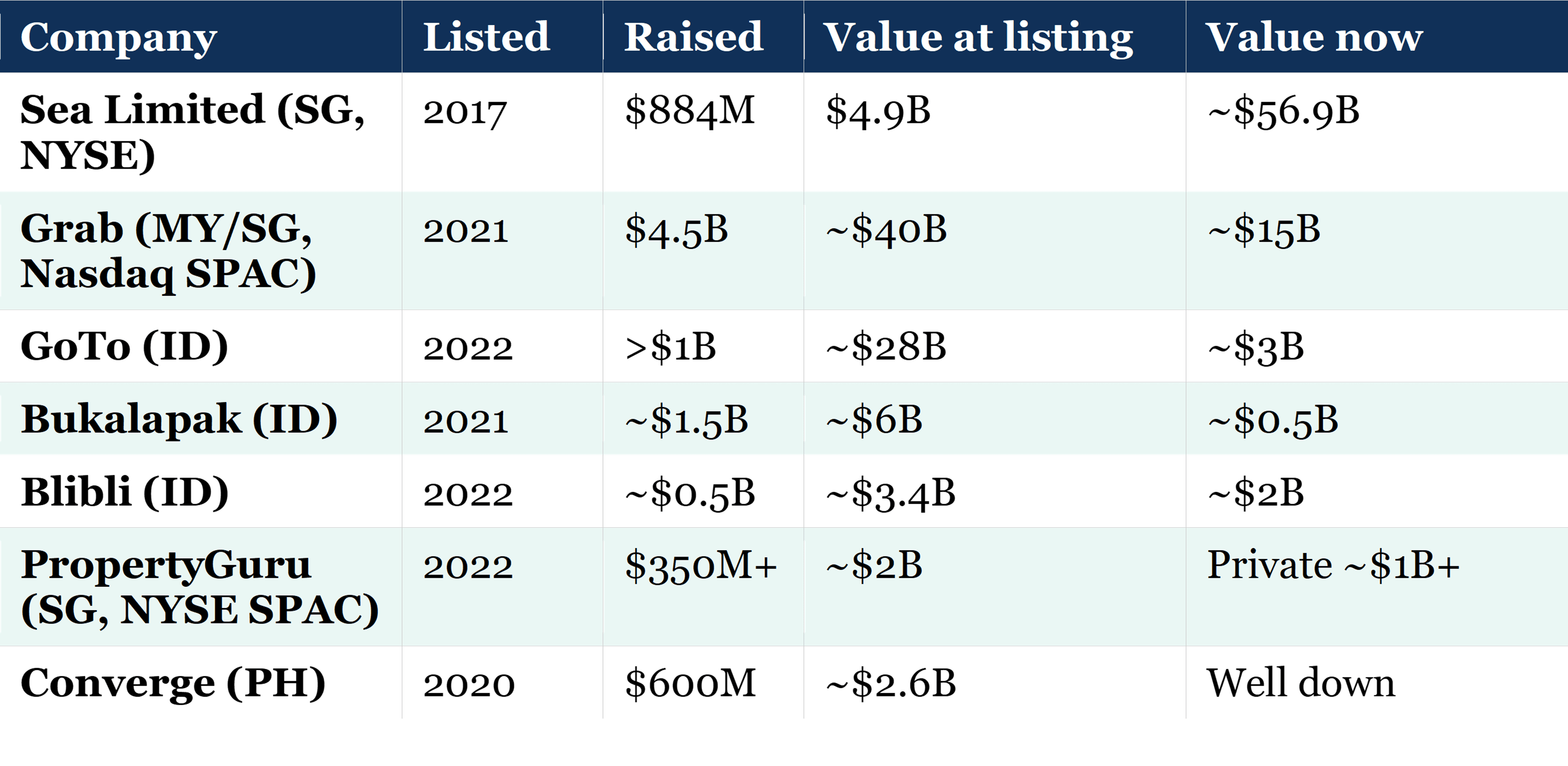 One Winner, Six Shipwrecks 01.07.2026 20pSince 2017, Southeast Asia has produced exactly one tech IPO that made public investors real money. One. And this week, the Philippines is getting ready to bet its entire year on the next one.So this week I want to talk about who is buying, who is selling, and which side of that trade you actually want to be standing on.Four stories, and they braid into one. We open with the good news, because there usually is some. Then we follow the money all the way to the part nobody puts on the deck.The smart money showed up twice in one weekStart with the hopeful, because it is real and it is specific.This week two of the most serious institutions on the planet made their first proper bet on Southeast Asia. Not a press tour. Not a memorandum of understanding. Actual money into actual companies.The first: MIT, the university, joined the cap table of a Singapore company called PVX Partners. Not a flashy name, I had not heard of them before this. They do cohort-based financing for user acquisition. In plain terms, they fund the marketing spend for mobile games and consumer apps, and they get paid back out of the revenue those users generate. It came on the back of a ten-plus-million-dollar round with names like General Catalyst, and I think a DraftKings vehicle in there too. As far as I could find, this is MIT’s first major disclosed startup bet in the region.The second, and this one landed the day before I recorded: Pfizer Ventures, the drug giant’s venture arm, made its first Southeast Asian startup investment into a Singapore biotech called Engine Biosciences. Engine does AI-driven precision oncology, hunting cancer drugs with machine learning. They just opened a Silicon Valley office to go with the Singapore base.Here is why this is not just a funding roundup. When an elite American endowment and Big Pharma’s investment arm both pick Singapore companies for their opening move, in the same week, that is not a coincidence. That is a signal about where sophisticated capital now thinks the edge is.These are not tourists chasing a hot round. PVX is unglamorous infrastructure. Engine is deep science. Both are the kind of bet you make after you have done the work.Hold that thought, because the rest of this is about what happens to the money that was already here when it tries to leave.The Philippines is betting its whole year on one listingOn the 27th, Mint, the company behind GCash, filed its registration with the Philippine SEC and its listing application with the stock exchange. The number: up to 92.3 billion pesos, roughly 1.5 billion US dollars at up to ten pesos a share, targeting a fourth-quarter debut. If it prices at the top, it is the largest IPO in Philippine history.Sit with the context. The Philippines’ IPO count for 2026 before this filing was zero. Nothing. So the country’s first listing of the year is also the biggest it has ever had. And it is a fintech, which if you have listened before you know is my home-turf bias made concrete.GCash put financial services into something like 90 million pockets. It is the rare regional company that is genuinely profitable. The pitch writes itself: the people who made GCash a habit can now own a piece of it. I want this to work. Let me say that plainly.Now the part that worries me, out loud, because that is the point of these episodes.The float is about 12%. Twelve percent of the shares go to the public market. The public is being sold a fairly thin slice while insiders keep the rest. And to fit GCash into its main index, the exchange is now considering cutting its own minimum public float rule from 20% down to as low as 12%.Take that in. The benchmark is bending its own rules to accommodate one company. When a market reshapes itself around a single listing, and that listing is carrying the whole nation’s IPO year on its back, that is not a recovery. That is concentration risk wearing a party hat.The real question: does GCash trade well enough to reopen the pipeline for everyone waiting behind it, or does one wobble set the Philippine market back another two years?To answer that honestly, you cannot just look at GCash. You have to look at what happened to the last batch of regional champions that rang the bell.Indonesia got a stay of execution, not a clean bill of healthWhile Manila is opening a door, Jakarta is trying to keep one from closing.On the 24th and 25th of June, MSCI, the index provider whose decisions quietly move billions in passive money, deferred its decision on whether to downgrade Indonesia from emerging-market status to frontier. They kicked it to November. Indonesia keeps the badge, for now.Why was it even on the table? MSCI said, in effect, that it cannot trust the market. Lack of transparency in who actually owns the shares. Suspected coordinated trading that makes it hard to know what a fair price even is, or how much stock is genuinely free to trade. And the market rallied on the news.Here is where I get off the celebratory bus. That rally is celebrating a delay, not a fix. When the index provider tells you it cannot work out who owns the shares or what they are really worth, that is not a paperwork problem. That is a governance warning about the entire market.And look at the response. Indonesia is leaning on Danantara, the sovereign fund, plus insurance and pension money, to add buying support and prop up the exchange. Think about what that means. To pass a test about transparency and genuine free float, the answer is to bring in state and pension money to hold the market up. That is close to the opposite of the thing they are being asked to prove.A frontier downgrade is not abstract. It would force passive funds to sell Indonesian equities mechanically, which raises the cost of capital for every late-stage founder in the country dreaming about an IPO on that market, especially now without the hype cycle. November is closer than it sounds.Manila might be opening up, maybe. Jakarta is one review away from being pushed out. Hope on one side, risk on the other. So let me put some numbers on which way this bet usually goes.The receiptsI promised you a number at the top. Here it is with the receipts. Since 2017, this is how Southeast Asia’s big tech IPOs have actually treated the public investors who bought in.SPAC valuations are listing marks, not day-one closes. Dollar figures are dragged by weak pesos and rupiah. Current values approximate.One winner. Sea Limited went out at a $4.9 billion valuation and trades somewhere in the $56 billion range today. Everything else is a shipwreck. Grab is down around 60% from its listing cap. GoTo lost roughly nine-tenths of its value. Bukalapak is trading below the cash it raised. Converge, the one Philippine name I could pull, is the cautionary tale sitting right next door to GCash.Now the caveats, out loud, because the show runs on honest data. The SPAC valuations were listing marks, not day-one closes, and several fell on the open. Currency matters too: weak pesos and rupiah drag the dollar figures down. On a per-share basis the returns are often worse than the market-cap numbers suggest, because of share issuances along the way.But the base rate for this region is brutal. If you bought the Southeast Asia tech IPO story over the last eight years, with one exception, you lost money.What actually breaks the curseHere is the thing that matters. Almost every one of those shipwrecks went public unprofitable, floated at the very top of the cheap-money window on a growth-at-all-costs story.GCash is not that. GCash actually makes money. That is the one real thing that could break the curse.The curse was never the business. The risk is the entry price. GCash is reportedly chasing a valuation around eight to nine billion dollars, against roughly five billion in the private market just a couple of years ago. That is the exact same “premium to the last round” framing that came right before every name on the shipwreck list.History says it is not company quality that determines whether public investors win. It is the price on the day they are let in. Buy low, sell high. If Mint prices for perfection at the top of the range, the regional base rate says the valuation compresses toward fundamentals first and compounds later, if you are patient. Converge, down 40%, is what impatience looks like.Who holds the penHere is the thread that ties the week together.This was the week Southeast Asia’s public markets stopped pretending to be a pure growth story and started behaving like state-managed plumbing. A fintech bends an exchange’s rules to get listed. A country leans on its sovereign fund to keep its emerging-market badge. And underneath all of it, the smartest new money in the world, MIT and Pfizer, is quietly buying into private companies at the early stage, where the value actually gets made, long before any of this public-market theater begins.Notice where the sophisticated capital is putting its chips. Not into the IPO. Into the cap table, years earlier.So my filter for all of it, and yours, should be the same question: who actually holds the pen here? Who decides what gets built, what gets listed, what gets propped up? More and more in this region, the answer is governments and sovereign funds, not founders and not public investors.If you are a founder who is not a conglomerate heir or a sovereign-fund favourite, that should tell you exactly where to aim, and exactly who to raise from.That is the week. If it was useful, the most useful thing you can do is send it to one founder who is about to get excited about an IPO. This is a public episode. If you would like to discuss this with other subscribers or get access to bonus episodes, visit seaofstartups.substack.com
 -
 The Mirage and the Fork in the Road 24.06.2026 27pStart with two numbers and a question.In May, startups in this region raised $472 million. More than double what they raised in April. Read only that line and you would think the drought had broken.Now the second number. That doubling was built almost entirely on two checks. Take those two out and May was thin, still down on the year before.So here is the question I want to sit inside. When you are a founder in Kuala Lumpur, or Bangkok, or Manila, which numbers are actually telling you the truth?Because two of the loudest numbers in this market, the funding headline when you raise and the IPO pipeline when you want out, are both unreliable. And they are unreliable in different ways. The money coming in is inflated. The money going out is uneven. In between sits a real company, your company, trying to make decisions on top of figures that flatter and figures that lie.The mirage: headlines that flatterThe funding rebound is a perfect little lie. Not a dishonest one. A statistically true one, which is worse, because it is harder to argue with.May 2026: $472 million across 31 deals, per DealStreetAsia. Up 104% on April. The kind of line that gets screenshotted into a pitch deck by Tuesday.Look underneath it. The jump came from the return of mega deals, transactions worth $100 million or more. A data center. An AI hardware platform. April had none. May had two. Two checks did the heavy lifting for an entire region. And even with them, May still came in 18% below the same month a year earlier. Strip the two big ones out and what you have left is quiet.This is not new, and that is the point. We saw the same shape in the first quarter: about $2.8 billion across 98 deals, the lowest deal count in at least eight years, with a single data center raise accounting for more than 70% of all that capital. Once you see the pattern you cannot unsee it. The total goes up. The number of companies actually getting funded does not. The aggregate is being inflated by hardware and data centers, while the count of real operating companies catching a check stays flat.Here is why that matters to you, and it is not academic. If you are raising right now and you benchmark yourself against the headline, you will conclude that capital is flowing and you are simply being passed over. That is the wrong lesson, and it will make you do desperate things. The right lesson is that the deal count, not the dollar total, is the honest gauge. And the deal count says fewer companies, higher bar, slower checks.The honest number is in the marginSo if the aggregate is a mirage, what is the real one? What is the number on a Southeast Asian cap table that does not lie?It is the margin. Which brings me to one of the genuinely good stories in the region this month.Respond.io, a Malaysia-based company, raised a $62.5 million Series B led by Camber Partners, with Endeavor Catalyst and existing backers coming back in, off the back of going through the Endeavor selection network. Big round. But the round is not the story. The story is what was true before the round.$35 million in annual recurring revenue. Growing over 100% a year. At a decent profit margin. Read that again, because they were already profitable. They raised growth money from a position where they did not strictly need it. That is the exact opposite of the burn-first, find-the-model-later playbook the last cycle rewarded and then punished.They run an AI-agent-powered customer messaging platform, the layer that lets a business actually hold a conversation and close a sale across the channels where commerce in this region happens. Billions of messages a quarter, more than 10,000 businesses, over 180 countries. The new money is going west, into North America and Europe, with the possibility of some acquisitions. A profitable company, quietly compounding, raising on its own terms and going on offense into the biggest markets in the world.Take one thing from this. Stop reading the league tables. Read the profit and loss. In 2026, the only honest number on a Southeast Asian cap table is the margin, because it is the one figure nobody can dress up with a single big check.The asterisk Malaysia should be honest aboutLet me complicate my own happy story, because I am not here to wave the flag.This one is close to home, and KL should be proud of it. The founder is not Malaysian. The company did not start here. It was brought here. That should be a feature, not a footnote. A founder who could base anywhere chose to base in KL, and that decision creates things you can touch: engineering jobs, payroll that gets taxed, corporate tax, office leases, local lawyers and accountants, the cafe downstairs, and a signal to the next founder weighing where to land that says people build serious companies here. Malaysia should bank that credit fully and without an asterisk.But the timing is almost too on the nose, because there is an asterisk.At the same moment, the rules on foreign talent are leaning the other way. The salary floor on the employment pass has jumped. Pass lifespans are changing. To me, though, the salary number is not the headline. The harder one is the requirement that you have a replacement plan in place for foreign talent, and some of those plans are short.Detail has been scant, but one person closer to the interpretation told me the employment is treated as tied to the company, not to the title or the role. So if you bring in a foreign hire to fill, say, a junior developer seat, and that person does well and gets promoted, it does not matter that their title has grown. What matters is that they are still there, and the requirement is that you replace them so that they no longer are.Sit with that from the talent’s side. What highly capable person takes a role knowing there is a clock on it? If they have a family, will they uproot to a market that is effectively saying we want you temporarily but not forever?I understand the intent. We do need to build local capability, and you should not let companies park expats in seats indefinitely. Fair enough. But here is the tension I cannot get past as an investor. You cannot run a “come build your global company here” pitch and a “here is your countdown timer, please train your replacement” policy at the same time. The open-door version of this works. There are countries we can point to that prove it.This is a competitive sport. The founder who chooses KL had other options, because Singapore wanted him, Hong Kong wanted him, Tokyo, Bangkok and Manila all wanted him. The risk is that Malaysia celebrates this win in the very quarter it makes the next one harder to land. If attracting mobile founders is how a small market punches above its weight, and it is, then the policy and the pitch have to point in the same direction. For this month at least, they did not.The fork in the roadNow the way out. Every founder eventually asks the quiet question. If this works, how do I get out, and where? Every investor asks it less quietly. In Southeast Asia the answer used to be a shrug. This month, three companies gave three different answers, and together they tell you more about this region than any funding total.Thailand sends its champion abroad. LINE MAN Wongnai, the app more than 10 million Thais use for food, rides and payments, is weighing an IPO, and the venues it is looking at are Hong Kong and New York, not Bangkok. The reporting cites weak domestic conditions and political volatility, with a decision expected as soon as the end of this month. Sit with that. The most-used app in the country looked at its home exchange and decided it could not get a fair hearing there, so it is shopping for a listing 8,000 kilometers away. A market that cannot list its own champions does not have a sentiment problem. It has a plumbing problem. The pipes that turn a great company into a liquid, locally owned public outcome simply have not been built.The Philippines builds a house worth staying in. In the same window, the opposite answer. Mint, the parent of GCash, the finance super app tens of millions of Filipinos live inside, has authorized the filing to go public: a registration with the regulator, a listing application with the Philippine Stock Exchange, an offer of around 12% of the company, targeting the second half of this year and possibly the fourth quarter. It is shaping up to be the largest IPO in the history of that exchange. And it is listing at home. Not Hong Kong. Not New York. The biggest fintech outcome the country has produced is choosing to be a Philippine public company. It is not alone. Maya, the digital bank, is weighing its own listing on a dual track, the local exchange plus NASDAQ, after its first profitable year. One foot at home, one foot abroad, a hedge.Look at the fork honestly. Thailand’s champion is leaving the list. The Philippines has one champion committing to the home exchange outright and another hedging across both. That is not the region as a single sound story. That is the region splitting in real time over the same question: is it worth building a venue people want to stay for? Right now, this quarter, the Philippines is making the bigger bet that the answer is yes.The caveat, because I promised it. Do not let anyone sell you Mint and Maya as a scrappy-startup miracle. Mint sits behind Globe and the Ayala group, with AMP alongside. Maya sits behind PLDT. These are conglomerate and telco children going public, which rhymes with what I said recently about Vietnam, where the giants raise and the startups starve. Hold both thoughts. The optimism is earned: a deep local public market is the single thing this region has always lacked, and the Philippines is genuinely building toward it. But the homegrown-founder fairy tale is not the right frame. Incumbents are listing. That is still good. It is just not the legend.And here is the constructive next move, the one I would want a Filipino policymaker or operator to actually hear. One record listing does not make a market. The test is the second one, and the third, and the fourth. Can the exchange turn Mint’s debut into a habit, so that the next great Filipino company does not even think about Hong Kong or the US? If it can, the Philippines stops being the market everyone underrates and becomes the market with the exit nobody else in the region has.The through lineTwo acts, the same lesson from opposite ends of a company’s life.When you raise, the headline lies. It is inflated by a handful of checks you will never be part of, and the only number that tells you the truth is your own margin. So build like respond.io. Get to profit, and let profit, not a press release, be the thing that earns you a round.When you leave, the region forks. One country will send you abroad to be valued. Another is trying, right now, to build a house worth staying in. Do not assume your exit. Choose it on purpose, the way you would choose a co-founder.In between sits the thing I keep coming back to. The capital around a Southeast Asian founder, the private money coming in and the public money you eventually exit through, is unreliable and uneven. That is not a reason to be cynical. It is a reason to be precise. Read the honest number, pick the real venue, and do not build your company on top of someone else’s headline.The markets that win the next decade out here will be the ones that do both: attract the people who create the margin, and build the place those people can cash out at home. This month, one company showed us the margin. One country showed us the door, opening it and starting to close it at the same time. And one country started building a room worth staying in.Be the reason the money stops sitting still.Real. Raw. Relatable.... --- ... This is a public episode. If you would like to discuss this with other subscribers or get access to bonus episodes, visit seaofstartups.substack.com
 -
 Ep 31 - Oil, iron, and idle money: what the war is really doing to Southeast Asia 10.06.2026 30pStart with a sliver of water between Iran and Oman. On a normal day, roughly a fifth of the world’s oil moves through the Strait of Hormuz. This year it stopped being normal. When the strait seized up, Brent jumped 10 to 13 percent in a single session into the low 80s and kept climbing to the highest level since 2022. The International Energy Agency, which does not deal in drama, called it the largest supply disruption in the history of the global oil market.I am not here to cover the politics. I am here to follow the power. Because that one shock shows up three times in the Southeast Asian startup story this quarter, wearing three different costumes. It sold electric cars. It raised the price of the electricity our data centre boom depends on. And it gave every cautious LP one more reason to keep the chequebook shut. Energy, iron, and idle capital. Follow the power and you follow the whole region.One. The war that sold a million electric carsThe lazy version of this story is “war happened, everyone bought an EV.” That is not what happened. What happened is that a fuel shock landed on top of a shift that was already moving fast, and poured petrol, pun intended, on the fire.The scale first. In 2025, EV sales in Southeast Asia more than doubled year on year to more than half a million vehicles, and more than 90 percent of those were full battery electric, not hybrids. The demand was already there. Then the petrol queues showed up. One Thai market report described long lines at filling stations on the same days that EV displays pulled the biggest crowds at the Bangkok motor show. That is the whole story in one image. One queue for the old thing, one crowd for the new one.Go around the region and the averages hide the real story. Vietnam is the outlier nobody outside Asia talks about: EV share of new cars hit close to 40 percent in 2025, ahead of the UK and the EU, almost entirely on the back of one company, VinFast, which targets 300,000 deliveries this year after 175,000 last. Thailand is the cleanest fuel link, with EV sales tripling year on year to over 44,000 units in January 2026 alone, and logistics fleets switching specifically to cut their exposure to fuel cost swings. When the fleet operators move, it is about the spreadsheet, not the planet. Indonesia crossed 15 percent EV share and passed the United States, with Chinese brands taking more than 75 percent of the market. This is not a Western EV story. It is a Chinese supply story with a Southeast Asian buyer. And Malaysia, my home market, is earlier and more honest: adoption up 14-fold since 2022, but still only about 5.5 percent of cars sold, held back by roughly 5,000 public charge points. You cannot fuel-shock your way past missing infrastructure.None of this is just consumers being noble. It is policy and cheap money. Thailand cut excise on passenger EVs from 8 percent to 2, and to zero on electric pickups. The Philippines went further, putting forward an incentive package worth around 60 billion pesos while ending subsidies for combustion engines, with the reporting tying the move directly to the oil shock. Read that again: a government using an oil crisis as cover to stop subsidising petrol and start subsidising electrons. Then the banks did the quiet part. In Singapore, UOB ran a green car loan at 1.5 percent, DBS at 2.48. When a bank prices your electric car loan below your petrol one, the moral argument is over. The maths makes the decision.The part that matters for operators is the fleet. Grab signed with BYD to put up to 50,000 EVs into its fleets across the region, with an eco-friendly toggle in Singapore and Thailand. GoTo took the other lane, going after two wheelers with a pledge to electrify Gojek’s motorbike fleet by 2030. On autonomy, be honest: the robotaxi headlines are a US and China story. Out here the fundable shift is the powertrain under the existing driver, not removing the driver. If you are pitching autonomous ride-hailing for Southeast Asia this year, the oil shock did not help you. The EV swap did.Here is where I land, and it is not the clean version. The war did not invent this boom. China did, with cheap good cars and a supply chain nobody here can match, and governments did, with subsidies written before anyone fired a missile. The shock just compressed years of slow behaviour change into a few quarters. And demand pulled forward by a price spike can snap back. If Hormuz reopens and Brent drifts back to the 60s, some of this 2026 surge was borrowed from 2027 and 2028. The companies that survive that are the ones building real local supply, financing, and charging, not the ones riding a fear premium.Two. Twenty billion lands in Johor, and DayOne raises four and a halfWe have covered the Malaysian data centre build before, so I will not reread the brochure. I want to follow the money one step further than the headlines do.Announced data centre capex across the region now runs past 20 billion US dollars over the 2024 to 2028 window, and that is committed, not deployed. AWS around 9 billion into Singapore, Google 5 billion plus 2 for its first Malaysian site, Microsoft a couple of billion more into Malaysia and Indonesia. On top of that, private money: AirTrunk alone is putting 12 billion ringgit into two new Johor campuses, taking its Malaysian commitment to roughly 27 billion ringgit, call it 7 billion dollars. And just this month DayOne, the Singapore-domiciled operator that flipped out of China’s GDS, closed a 4.5 billion dollar Series C led by Coatue and Hillhouse with Indonesia’s sovereign fund alongside. Hold that name, because it comes back in the third act.Now the question nobody asks: what is that money actually buying? Land, concrete, power, cooling, and imported chips. A hyperscale data centre is a real estate and energy project wearing an AI t-shirt. The single biggest cheque inside it goes to Nvidia. Very little of that 20 billion touches a local software founder. This is not venture capital landing in the region, it is construction capital.So what is the secondary effect on the rest of us? Three things, and I want to be balanced. First, cost. These campuses pull on the same grid and water local businesses use, and Malaysia stopped approving non-AI data centre proposals back in 2024 to keep the power for AI builds. The state is rationing power and choosing hyperscalers. When your tariff drifts up in three years, this is part of why. Other parts of the world now require operators to reinvest into the local energy and water network to offset that pressure. I have not seen that proposed seriously in Malaysia yet, and I would like to. Second, jobs. A hyperscale campus employs a crowd for eighteen months of construction, then a skeleton crew. It is not a founder-jobs engine. Third, and this is the genuine prize: if the build is done right, founders get cheaper, closer compute and local data residency, the thing that lets a regulated fintech or health startup build on sovereign infrastructure without stitching together a compliance workaround.The roads analogy is the honest one. Infrastructure is an enabler, not the destination. The data centre boom only pays off for the domestic economy if we generate the demand to use it: enterprises and government going properly digital, and a real layer of AI-native startups creating the load these campuses were built for. Lay the road, then you still need the trucks. Capital keeps flooding the iron. Whether it earns its return depends entirely on who drives on it.Three. The lowest deal count in eight years, sitting on a mountain of cashTwo facts that should not be true at once. In the first quarter of 2026, Southeast Asian startups raised about 2.8 billion dollars across 98 equity deals, the lowest quarterly deal count in at least eight years, and even that is flattered by one or two giant infrastructure cheques of the DayOne variety. Meanwhile APAC investors sit on roughly 240 billion dollars of dry powder, down from a 2023 peak near 315 but hardly an empty tank.So which is it, drought or hoard? Both, and the contradiction is the story. The money exists. It is just not moving into Southeast Asian early stage. The last clean read on region-specific dry powder was around 7 billion dollars, a couple of years old and probably overstated, but the direction is the point: funding here fell about 70 percent from the 2021 peak while the cash pile barely moved. That is not a region that ran out of money. That is a region whose investors went on strike.Where did the new money go instead? Peak XV, the old Sequoia India and Southeast Asia team, closed 1.3 billion late last year, labelled India Seed, India Venture, and APAC. India now runs hundreds of active early-stage funds and has climbed from roughly 9 percent of APAC capital markets volume toward 20. The APAC money is concentrating into India for growth and Japan for buyouts, not Southeast Asian seed. So when a Singapore GP tells you the market is tough, hear it precisely. It is not that Asia has no money. It is that the money is choosing India’s depth and Japan’s stability over our fragmentation and our weak record in the asset class. Capital is being selective, and Southeast Asia is the one being un-selected.Then layer the war back on. In March the reporting was blunt that the Iran conflict threatened to deepen Asia’s worst private equity fundraising slump in a decade. An oil shock spikes uncertainty, and uncertainty is the enemy of a new fund commitment. The same barrel of oil that sold an electric car in Bangkok made a pension fund in the West, and a high-net-worth backer here, think twice about a new Southeast Asian VC. Cash gets more cautious exactly when founders need it to get braver.So do not buy the clean drought story, and do not buy the clean abundance story either. The honest version: the tank is full, the driver is scared, and the road out, meaning exits, still looks rough. 98 deals is not a money problem. It is a conviction problem and an exit problem wearing a money problem’s clothes. And even that 7 billion dollar regional figure is fuzzy, because so much of it sits in Singapore holding structures that can deploy anywhere from Jakarta to Bangalore. When the domicile lies, the dry powder number lies a little too.The money is here. It is waiting for a reason. Your job, whether you are building or, like me, allocating, is to be the reason it stops sitting still.Sources and further reading: IEA Global EV Outlook 2026 · RECCESSARY, Thailand EV 2026 · VinFast targets, Nikkei Asia · Philippines incentives, Gulf News · Grab and BYD · AirTrunk Johor, NST · DayOne closes $4.5B, Crowdfund Insider · DayOne, the Singapore flip, Asia Tech Review · SEA Q1 2026 deal review, DealStreetAsia · APAC PE Report 2026, Bain · Peak XV $1.3B, YourStory This is a public episode. If you would like to discuss this with other subscribers or get access to bonus episodes, visit seaofstartups.substack.com
 -
 Ep. 30 - We Called It a Funding Winter. I Think We Built for an Exit That Was Never There. 03.06.2026 23pSingapore just released its report on venture funding for 2025, and almost every write-up reads the same way. Funding winter. Capital’s gone quiet. Hold the line, it’ll come back.I think that’s the wrong story.I’ve been sitting with these numbers for a few days, and the more I look at them, the more I’m convinced we’ve been telling ourselves the comfortable version. The comfortable version is that the money left and the money will return. The harder version, the one I actually believe, is that the region made a strategy bet a decade ago, the bet didn’t have an exit attached to it, and 2025 is just the year the math stopped hiding. We’ve had a few of these years where the math stops hiding. This is another one.So let me do a bit more opining than usual. This one’s a little spicy.* * *The number everyone readThe headline is genuinely rough. In 2025, Singapore recorded 472 venture deals, down 35 percent from the year before. Total capital raised came in at 4.6 billion US dollars, down 34 percent year on year. And Singapore is the strong one. Across the ASEAN-6, both deal value and deal volume hit a four-year low.Now hold that next to the United States in the same year. Silicon Valley deal value nearly doubled, to around 160 billion dollars. A lot of that was two rounds: OpenAI at 40 billion, Anthropic at 15 billion.Two companies, in one country, raised more than ten times what the entire island of Singapore raised across 472 deals all year.The easy conclusion is that capital is concentrating into American AI and starving everyone else. That’s true as far as it goes. There’s real gravity pulling allocators toward the bleeding edge, and that gravity sits in Silicon Valley.But that’s a description of the weather. It doesn’t tell you why our house is the one with the leak.For that, you have to go back further than last year, and look at what we actually spent the money on, and what we expected to get out the other side.* * *The bet we madeHere’s the part that doesn’t get said enough. For most of the last decade, Southeast Asia poured its venture money into consumer. Ride-hailing, e-commerce, food delivery, the super-app. The big, beautiful, blitzscaled consumer story where you capture a young, mobile-first population of 700 million and become the thing they open twenty times a day.I’m not mocking it. I lived through the optimism. Grab, GoTo, Sea, Lazada, Shopee. These companies built the rails the whole region runs on now. Digital payments are everywhere because of them. That’s real, and it was needed. Consumer is the precedent layer. Most maturing markets start there, build the rails, then transition. That part is natural.But look at the allocation. In 2023, more than a third of Southeast Asian venture deal value went into consumer. The honest caveat is that “consumer” is a fuzzy line, depending on whether you fold in consumer fintech, so treat the exact figure loosely. Even on the conservative read, you land somewhere north of thirty percent. Run the same count in the US that year and you’re in single digits. The number I keep landing on is around three and a half percent.Read that again. We put an order of magnitude more of our capital into consumer than the most mature venture market on earth did.And we weren’t growing out of it. We were accelerating into it. Consumer’s share of regional deal value kept climbing while software’s share fell. So while the US was doing the boring, durable thing, funding enterprise software and infrastructure, we were doubling down on the consumer copycat play right as the cheap money drained out.Why does that matter? Because of what happens at the end.* * *The door that was never thereEvery venture dollar is a bet on an exit. Money goes in, and somewhere down the line it has to come out bigger, through a sale or a listing. No exit, no returns. No returns, no next fund.So how did the region do on exits? Here’s the number that should be tattooed on every term sheet. Since 2015, the entire Southeast Asian venture market generated roughly 70 billion dollars in exit value. Sounds fine until you look underneath. More than 55 billion of that came from three exits, all in 2021. Stretch it out and nearly 87 percent of all exit value since 2015 came from six companies. Take it to the top twenty and you’re at 96 percent.Yes, there’s always a power law. Concentration is normal. But strip out a handful of unicorns and the regional market has returned almost nothing to almost everyone. The investment-to-exit ratio has run consistently above twenty to one. Twenty dollars in for every dollar that found its way out.It’s been a trap. The Hotel California of venture. You can check in, but you can never leave.And here’s the part that connects the dots. The few giant exits we did get didn’t happen here. Grab went out via a SPAC on the Nasdaq. Sea listed on the New York Stock Exchange. They had to leave to get out. The Singapore Exchange, the biggest in the region, ranks only ninth by market value in Asia-Pacific, and several regional exchanges still carry listing rules strict enough to keep a cash-burning consumer company out entirely. For a blitzscaled consumer business, the local IPO was a closed door.So put it together. We funded consumer companies built on the growth-at-all-costs playbook, and that playbook only pays off through a big public listing. We never built the public markets to list them on. We built companies for a door that, at home, was never there.That’s not a winter. Winter ends. This was a design flaw.* * *Consumer is the hardest thing to sell, everywhereThis is the part I want founders and investors to chew on, because it goes beyond us. Consumer is one of the hardest categories to exit anywhere in the world.Think about who actually buys companies. In enterprise software there’s a deep, permanent bench of buyers who do this all day. 2025 was the most active year on record for software M&A, with strategic buyers alone accounting for around 42 percent of deals. The most active software acquirers in 2024 included IBM, Cisco, Autodesk, Nvidia. There were 22 firms that each made at least five acquisitions in a single year. That’s a machine. A standing market of people whose job is to buy companies. What are they buying for? Recurring revenue, mission-critical, sticky, hard to rip out.Now ask who the standing buyer is for a regional food-delivery app, or who’s lining up to roll up consumer brands in a market where customers switch the second someone else runs a discount. There isn’t a bench. Consumer internet leans almost entirely on the IPO. And we just covered what happened to that door.Let me be fair, because the honest version is more interesting than the cheap one. Enterprise exits aren’t easy either. Only about ten percent of companies tagged as software ever get acquired. IPOs are about six percent of software exits. The median software acquisition went for roughly three times revenue, not the eye-watering multiple people imagine. B2B is not a golden ticket.What enterprise has is a functioning market of repeat buyers. Consumer mostly has the IPO. It’s a difference in optionality, in how many doors are actually open. We bet the region on the category with the thinnest exit options, and didn’t build the one exit that category depends on until recently. If you wanted to design a liquidity crunch on purpose, that’s how you’d do it.* * *The people who built it are now saying itWhat makes this report worth reading past the headline is the back half, where they ran candid pieces from a row of the region’s investors. To their credit, the honesty is right there.Vishal Harnal at 500 Global names liquidity as the clearest challenge facing the region, pointing straight at underdeveloped exit markets and the long holding periods that wear founders and investors down. Angela Toy at Golden Gate is just as direct, conceding the region still lacks depth in both M&A and secondaries to get people their money out.The one that stuck with me is from Cyril at SOSV, who lays out the question every Singapore founder eventually asks out loud. If the place you ultimately have to go for capital, scale, and an exit is San Francisco, why not just start there on day one? Why build here at all? That’s a tough one to sit with. It’s not a critic on the sidelines. It’s a GP at an active global fund saying the quiet part into a government report.Then there’s Antler. They’ve raised about 1.5 billion dollars globally, from dozens of institutions and sovereign funds. The amount that came from Singapore institutions was around 10 million. The US allocates roughly five percent of its capital to venture as an asset class. Singapore sits well below one. So even the domestic money, the money that’s right here, mostly doesn’t back the local market. The capital sits in the city. It just doesn’t believe in the thing the city keeps saying it wants to be.When this many people who built the market all point at the same missing piece, it stops being a complaint and starts being a diagnosis.* * *So what do we actually doTo be clear, Singapore isn’t sitting still. The response is substantial: an extra billion dollars into Startup SG Equity for growth-stage companies, a new 1.5 billion dollar anchor fund aimed squarely at strengthening exits, and a Singapore Exchange and Nasdaq partnership we’ve talked about here before. Almost all of it is about building the exit door now, after a decade-plus of funding companies that needed it and didn’t have it.I’m not saying that to dunk on the policy. The policy is correct. Real liquidity, a working M&A culture, a credible place to list, that is exactly the right thing to spend on. My point is that we’re building the staircase after everyone already jumped. The companies that needed this in 2018, 2021, 2023 are gone or got out somewhere else. The question is whether the next decade of founders builds for the door that’s finally going up.So here’s where I land. Stop building for the exit that doesn’t exist, and start building for the one that does.That’s been our thesis at Indelible Ventures: back the higher-probability path from where the region actually is, and keep tracking how that liquidity path shifts over time. If the dependable way out is acquisition rather than a hometown IPO, then build the kind of company that has buyers. Real revenue, defensible product, something a strategic acquirer or a private equity firm actually needs to own. Not a big user number you’re hoping a public market rewards someday. Reality over vanity metrics. Capital efficiency stops being a constraint you tolerate and becomes the strategy. The companies getting funded here, and more importantly the ones that can get out, are the ones with clean unit economics, not the steepest growth chart.I want to say something specific about the Philippines, because I’m genuinely optimistic about it and the lesson lands well there. The consumption story is real. Household spending is something like three-quarters of GDP. The young population, the digital adoption, all of it is genuine. The trap would be to look at that and run the same blitzscaled copycat playbook that just left the rest of the region holding companies it can’t sell. The opportunity is to build for that consumption with discipline, with models that travel across similar markets, and with an exit in mind from the start.Same demand, smarter strategy. The fundamentals are a gift. The old playbook was the problem.* * *What it actually saysSoutheast Asia’s problem in 2025 was never that it ran out of money. The region is full of money. Family offices, sovereign funds, the whole lot. The problem is that we built a generation of companies with no clean way to turn into returns, in the category least likely to produce them, listing on markets that mostly weren’t here.That’s fixable. But only if we’re honest that it was a choice, not the weather.The money will come back. The question is whether we’ll have built something it can actually leave through. This is a public episode. If you would like to discuss this with other subscribers or get access to bonus episodes, visit seaofstartups.substack.com
 -
 EP 29 - Chatbots to Agents and where Liability Lands 27.05.2026 36pI hopped into a taxi in Bangkok last week and the driver, a man north of fifty, spent the ride telling me what he was building with AI.Not complaining about the economy. Not asking where I was from. Telling me about his project.I’ve been turning that over ever since, because it isn’t an isolated thing. For weeks now I’ve been scanning event listings in whatever city I land in, and the pattern is hard to miss. It isn’t pitch nights anymore. It isn’t another fireside with a fund manager. It’s vibe coding meetups, agentic AI sessions, AI trainings. Paid attendance, no walk-ins, speakers who’ve shipped real apps. KL has them. Singapore has them. Bangkok and Manila have them. Go on Lu.ma or Eventbrite right now and there’s probably one happening in your city this week, maybe two.I know this firsthand because I run some of them. I host AI salon events in Bangkok, and I’ve watched the rooms change.So while the rest of the startup world argues about whether funding is back, looking at numbers that are frankly pretty dismal, there’s this whole other thing happening in cafes and malls across Southeast Asia. Regular people are learning to build software by talking to a machine.Why I trust this oneI dismiss most AI hype on reflex. My feed is littered with slop, articles that read like they were generated by the thing they’re describing, people calling everything the future. I scroll past it.This is different, and the reason is simple. People are paying to show up.And it’s a different crowd than I’m used to seeing at startup events. University students and fresh grads who can see the job market tightening and are choosing to get ahead of the curve instead of waiting it out. Founders who can’t afford a dev team. Marketers. People with an idea and no technical co-founder, who a year ago would have been stuck with that idea trapped in their head, never seeing daylight. This is the no-code, low-code movement, upgraded and supercharged into the current AI era.The category has a name now: “vibe coding”. I’m not a fan of the term, all that talk of vibes and feel grates on me, but it’s the vernacular, so I’ll use it. You describe what you want in plain language and the AI writes the code. That’s the whole thing.I do it myself. I’ve used AI coding to replace most of our software stack. Thinking back to the friction of a couple of years ago versus how good this is now, and then projecting forward to how good it’ll be as the models keep improving, is genuinely one of the more interesting arcs I’ve lived through as an operator.From apps to agents, which is where it gets seriousBuilding an app is one thing. The next rung up the ladder is building an agent, and agents are a different animal.Most people, once you get out of the tech bubble, still picture a chatbot. You type, it types back. You ask, it answers. A better Google. That’s generation. It makes text, images, words.An agent acts. It doesn’t tell you how to clear your inbox, it clears your inbox. It books the meeting. It sends the email. It runs commands on your machine. It talks to other software and gets things done with barely any input from you.That’s the entire ballgame for risk. A chatbot needs a human to type every prompt. Every harm one causes still started with a person asking for it. An agent can plan, decide, and act on its own initiative. It can cause harm nobody asked for.I want to be clear that I’m bullish on this. Hugely. But being bullish and being measured aren’t opposites, and the risk side of this deserves honest airtime.Two examples everyone in the open-source world is talking about. The first is the lobster: OpenClaw. It went viral the moment it dropped. It connects an AI model to your messaging apps and acts on your behalf, books things, browses, runs commands, manages your house. People pulled their old Mac minis out of drawers to run it. Apple caught the wave and nudged the price up. It is not a Southeast Asian product, and we should be honest about that. It went viral hardest in China, which has been well ahead on the open-source movement. Southeast Asia needs to kick into gear as a fast follower, even when we’re not the origin.The second is Hermes, out of a US research lab a few months back. What makes it different is memory. It lives on your own server, runs all the time, and gets better the longer you use it. It remembers what you told it last Tuesday. It writes down how it solved a problem so it never starts from scratch again. By this month it was the most-used agent out there by some measures, hundreds of billions of requests a day, hundreds of thousands of developers piling in within three months.Here’s the part that should make you pause. Three separate security audits this year found malicious code hiding in the add-on skills people share for these agents. Think about what that means. An autonomous thing, running constantly, on your own machine, with access to your messages and files and maybe your ability to spend money, pulling new abilities from a community marketplace that’s already been found to contain things designed to hurt you. That isn’t a future problem. It’s a this-year problem, and it’s happening on hardware people own, in their homes, outside any IT department or compliance check.A friend who’s far sharper than me on this put it well. Permissioning an agent is like onboarding a new intern. You give them enough access to act, but not enough to break things. If humans are entities of action, we have to treat agents as entities of action too, with the same scoping and the same limits. The catch is that getting that right still takes real technical skill, and most of the people downloading the lobster don’t have it.So who’s writing the rulesSurely someone’s regulating this. Here’s where it actually stands, and the answer is more interesting than “nobody is.”Three big global players, three different postures. The US is actively deregulating to keep its lead, tearing up the old safety rules and trying to stop its own states from making their own. The posture is get out of the way, though there was an executive order floated recently that would have made new models notify the government before public release, something closer to how the FDA approves a drug. It got paused, not signed. We’ll see. Europe, true to reputation, has the most serious regime, and just this month agreed to delay the hardest parts, the high-risk rules, by over a year. Competitiveness pressure. So even the strictest regulator in the world is loosening its grip right as agents arrive. And China is the strictest in practice and the only one already acting on agents specifically, real enforcement, thousands of non-compliant services shut down. Telling, the country where everyone installed the lobster also told its own government agencies and state banks not to put it on work devices. The adoption champion got nervous about its own craze.Even the deregulating US quietly started building standards for autonomous agents. So nobody actually thinks this is fine. Everyone sees the gap. They’re just moving at wildly different speeds.Southeast Asia is that same story compressed into one region, running at three speeds. Vietnam, maybe not who you’d guess, has the only real binding AI law here, passed late last year, enforced since Q1, risk-based with actual prohibited uses. It tracks, given how much of the region’s developer talent sits there. Singapore did something very Singapore: the world’s first governance framework built specifically for agentic AI, detailed and thoughtful, and deliberately voluntary. No teeth. The bet is give industry sophisticated guidance, remind everyone they’re still liable when their agent screws up, and keep the innovation onshore. They’ve already refreshed it with case studies from the likes of OCBC, Tencent and Workday. A living document, which is the right call given the pace. And then Malaysia, where I’m based, sitting on one of the most aggressive agent rollouts in the region, with its actual rules still in draft. Not here yet.Here’s the whole thing in one line. Everyone, globally and right here at home, is regulating the last war. The last war was chatbots generating bad content, the stuff you can ban after it spreads. We saw it when Indonesia, Malaysia and the Philippines banned Grok over deepfakes, including images of children. Three countries, fast, coordinated, and fully deserved. But that’s the model: react after the harm, fold quickly. And every one of those images still needed a human to type the prompt.The next war is agents taking bad actions on their own, because the black box decided that was the thing to do. That war is already shipping. Through anonymous downloads, onto personal machines, learned at meetups across the region, in a place where exactly one country has even a voluntary framework and the country with the biggest rollout is still drafting.We’re banning the thing that needs a human to ask. We haven’t started on the thing that doesn’t.What I keep coming back toI’ll be honest, I don’t have a clean answer. Part of why I raised this is that it was a quiet news week. But the bigger part is that I can’t stop noticing the trend, and I doubt I’m alone. If you’re a CISO or a CTO or sitting in a compliance function, you’re already living this, because the whole enterprise is integrating more automation and more agents by the month, and the risk side is going to drag a regulatory environment into the room whether we invite it or not. It always does, the moment a technology touches enough of society. So it’s worth thinking now about what that reaction is likely to look like, instead of being surprised by it.But I keep coming back to those meetups. To the rooms full of people building. Because that’s the real story, and it isn’t happening in a lab or a boardroom. It’s happening on your street, in cafes, in small event rooms. People in this region are adopting this faster than the people meant to govern it can keep up, and honestly that’s fine, because that’s how technology has always moved. I’m genuinely excited to see Southeast Asia stop being just a fast follower and start leapfrogging, with the macro trends, shifting supply chains, and regional growth all pointing the same way. There’s an enormous opportunity here, and I think this is going to sit at the front of it.So I’ll leave you with the question I can’t answer myself. If you’re building with these tools right now, who’s responsible when your agent does something you didn’t intend? You? The person who built the tool? The government that hasn’t written the rule yet?Right now the honest answer is nobody knows. And everybody’s building anyway.As we should. But take a beat on that one.Tell me where I’m wrong. This is a public episode. If you would like to discuss this with other subscribers or get access to bonus episodes, visit seaofstartups.substack.com
 -
 Ep. 28 - The Philippines Just Drew a Line With Washington. Malaysia Just Rewrote Its IPO Rules. And the Whole Region Is Doing Something Nobody Is Tracking as One Story. 20.05.2026 38pTwo stories from Southeast Asia this week, and almost nobody connected them.The Philippines unveiled the marker for the Pax Silica industrial hub in New Clark City. Twenty plus companies expressed interest. A dozen are billion-dollar US firms. And on the same day, Manila publicly rejected the US request for diplomatic immunity and US legal jurisdiction over the zone. The hub will operate under Philippine law.Malaysia rewrote the rules of how startups go public on Bursa. VC firms can act as listing agents. Retail investors can participate for the first time. A real funding escalator from regulated crowdfunding to LEAP Market to ACE Market.But the Malaysia story is part of something bigger. Singapore signed an SGX-Nasdaq dual listing bridge last November. The ASEAN-6 signed a cross-border depository receipts MOU in December 2024. Indonesia is tightening listing rules to chase quality. The whole region is rebuilding its public markets for venture-backed companies at the same time, and almost no one is tracking it as one story.This episode walks through the two races happening in Southeast Asia right now. The industrial race for the AI economy, and the capital markets race for venture-backed exits. Each country is making different bets. Each country is solving for a different segment. Where you build matters now in a way it didn't five years ago.I'm bullish on the Philippines. But the country has a gap on the capital markets side, and closing that gap is the work of the next two years.Real. Raw. Relatable. This is a public episode. If you would like to discuss this with other subscribers or get access to bonus episodes, visit seaofstartups.substack.com
 -
 Ep. 27 - Strip Out One Deal and SEA Raised $800M. A Chip Stock Just Got 95x Oversubscribed. And OpenAI Spent $4 Billion Admitting AI Is Hard to Deploy. 13.05.2026 38pThere’s a version of this week that looks like a good week for Southeast Asia’s startup ecosystem.The Q1 2026 funding report shows the highest quarterly capital raised since late 2022. Malaysia’s hottest IPO in sixteen years prices and lists next week. OpenAI and Anthropic both announce major new enterprise offerings backed by some of the biggest names in global private capital.Here’s the version where you actually read the numbers.One data centre deal accounts for over 70% of the quarterly funding total. The chip company getting 95 times oversubscribed has three-quarters of its revenue coming from China and a tax exemption that expired eight months ago and hasn’t been renewed. And the AI labs building $4 billion services arms are, if you read what they’re actually saying, admitting that their models are not easy to deploy in the real world.Three stories. Let’s take them properly.* * *The Real Q1 2026 Funding NumberDealStreetAsia dropped their Q1 2026 Southeast Asia funding report this week. It’s making the rounds. The headline: $2.81 billion raised, the highest quarterly total since Q4 2022.One deal, DayOne, a Singapore-based data centre operator, raised $2 billion in a Series C. I’ll put a mild caveat on that: this is a data centre, not technically a startup, and it was spun off from an existing entity. It’s in the numbers because it carries a Series C label. That’s fine. But it’s worth knowing what you’re looking at.Strip it out. You have just under 100 deals and under $800 million combined. The lowest quarterly deal count in at least eight years.That’s the actual funding market founders in this region are navigating right now. Not the headline. The actual market.On the Singapore NumberThe report shows Singapore capturing 91.5% of total capital. I’m honestly always a little skeptical of that figure in isolation, and here’s why.Singapore is the home of the holdco. If you’re a founder in Malaysia or Indonesia or Vietnam trying to raise international capital, you’re not going to stay registered in your home jurisdiction. You’re going to put a holding company in Singapore, because the legal and regulatory environment is cleaner, because international investors are more comfortable with it, because that’s just how it’s done. Your operating company may still be fully onshore in your home market.So some portion of what gets reported as “Singapore funding” is actually capital going into companies operating across the region, just routed through a Singapore holdco. How much? Hard to know. But it’s worth holding that nuance when you see the 91.5% figure.What it definitely does tell you is that the Singapore jurisdiction matters, for capital access, for legal infrastructure, for institutional credibility. That part is real regardless of the holdco effect.Malaysia: Signal or Noise?The report calls out Malaysia as a bright spot, ranking second in Southeast Asia by deal volume for the first time. Eighteen deals, the highest quarterly count since Q3 2024.I’m active in the Malaysian ecosystem. My honest read: take this with some salt. When you dig into what drove the number, a meaningful portion came from small cheques through a single accelerator programme. That’s not nothing, but it’s not the same as organic deal activity across the ecosystem.I don’t want to be the one pouring cold water on every green shoot, and I’m not saying the Malaysian ecosystem isn’t moving. But there’s a difference between an ecosystem inflection and a batch of accelerator cheques inflating a quarterly number. We’ll know more by Q3.Where the Money Is Actually GoingIf you’re a founder asking where capital is flowing: AI. Specifically agentic AI, automation of workflows, tasks that execute with limited human oversight. Not chatbots. Actual agents doing actual work.AI and ML deals came in second by volume in Q1 with thirteen transactions. The biggest was Amity’s $100 million Series D. Worth noting: Amity has a long-standing relationship with CP Group, one of Thailand’s largest conglomerates, which is the lead investor. That context matters for how you read the round. It doesn’t diminish the achievement, it’s still a strong signal of appetite in the space, but it’s worth knowing.The message for founders: if you’re building real enterprise automation, real measurable productivity gains, there is capital. Not a lot. But it exists and it’s consistent.The Quiet Problem Nobody NamesThere’s something that doesn’t get said clearly in this ecosystem, so let me say it.There is a growing number of zombie companies across Southeast Asia. Not failed companies, companies that can’t raise new capital, can’t grow meaningfully, but won’t die. They exist in a kind of operational limbo. Technically alive. Burning slowly.Part of what sustains this is that down-rounds almost never happen here. The funds across the region are still relatively young. The LP relationships are new. Nobody wants to be the one writing a markdown into their portfolio, having that conversation, taking that medicine. So instead, they hold the valuation flat, keep the paper TVPI looking reasonable, and wait.You can talk about your book value multiple all you want. If the company can’t raise and can’t grow, the number isn’t real.The downstream problem: there are cases where this dynamic is actually blocking deals. An investor who doesn’t want to see a down-round may resist a transaction that would otherwise be good for the company, because accepting it means acknowledging the valuation they’ve been carrying is wrong.Sometimes you have to take one step back to take two steps forward. That’s not a comfortable thing to do. But it’s more honest than pretending nothing is wrong until there are no options left.* * *SkyeChip and Malaysia’s Chip MomentI want to start this one with genuine enthusiasm, because it deserves it.SkyeChip Bhd lists on Bursa Malaysia’s Main Market on May 20th. The public tranche closed 95 times oversubscribed. Total retail demand hit RM 3.04 billion. The largest retail subscription in Malaysia since Petronas Chemicals in 2010, sixteen years ago.The whole AI and chip investment wave has been impossible to ignore. NVIDIA’s share price trajectory. The compute boom. The data centre buildout. And now, emerging from Penang, a Malaysian company that sits right in the middle of that stack. That’s a big deal for this ecosystem.Upfront caveat: I’m not a semiconductor expert. What follows is based on my research into the prospectus and what’s been circulating in the analyst and retail investor community. Take it in that spirit.What SkyeChip Actually DoesMalaysia’s semiconductor sector has historically been dominated by the back end: assembly, testing, packaging. Important work. But it’s the low-margin end of the chain. The government has pushed for years, through NIMP 2030, through IC design parks in Selangor and Penang, through various national initiatives, to move the industry up the value chain into front-end design.SkyeChip is the poster child for that ambition. It’s a fabless IC design company, it doesn’t manufacture chips, it designs silicon intellectual property. Reusable building blocks that chip makers integrate into their own products.Think of it this way: TSMC makes the chips, NVIDIA designs what goes on them. SkyeChip is not saying they service either of those companies, but the analogy holds, they sell the blueprints for specific components that go inside chips. Their flagship IP is HBM3E: high-bandwidth memory interface technology, the memory architecture inside the AI accelerators that run the large language models powering frontier AI.That’s the tie-in to the chip craze. And it’s why the hype is real. This isn’t fabricated. The technology is real.The National StoryThe government is leaning in hard, and in this case the support is substantive not just rhetorical. SkyeChip gets access to Arm Holdings design tokens through Malaysia’s Silicon Vision initiative, a national licensing arrangement that gives Malaysian companies access to Arm’s IP architecture. That’s a genuine strategic asset, not a marketing line.The Deputy Minister attended the prospectus launch and talked about SkyeChip potentially reaching the level of Broadcom. Broadcom is a $700 billion company. SkyeChip is listing at RM 1.6 billion. The ambition is clear. The road is long.But what matters is that this company is creating a visible proof point, that a Malaysian IC design house can be built, can reach a meaningful scale, can list on the main market, and can attract global attention. The next founder who wants to build something like this now has an example. That matters for the ecosystem in ways that go beyond the specific valuation.The Numbers Worth NotingRevenue more than doubled over two years. Profit margins around 30%. Analysts projecting roughly 31% earnings CAGR over three years, with the most bullish target price close to double the IPO price of RM 0.88.The business model, IP licensing, is a proven high-margin, scalable model. Arm, Cadence, Synopsys. These are multi-billion dollar businesses built exactly this way: create the IP once, license it repeatedly. SkyeChip isn’t reinventing the model. It’s executing on it with new IP in a hot category.The Risks That Deserve Honest AttentionChina Revenue and US Export ControlsFor the seven months ending October 2025, China accounted for 73.3% of revenue. Almost three-quarters of the company’s most recent revenue came from Chinese fabless IC companies selling advanced HPC and AI chips.The prospectus explicitly acknowledges that if any of their customers are added to the US Entity List, supply must be suspended. None are listed today, but today is a snapshot, not a guarantee. The company is also planning to open US offices, which creates a real balancing act between serving Chinese customers and operating in a US regulatory environment that is actively tightening controls on exactly this category of IP.The Tax Exemption ExpiredThis is the one I keep coming back to.SkyeChip has been operating under a Pioneer Status tax exemption, effectively a 2.7% tax rate. That exemption expired September 9, 2025. They applied for renewal. As of the last published date in the prospectus, the renewal is still under review.The IPO is priced at 44x FY2025 earnings. Those earnings use a 2.7% tax rate that no longer exists. Normalise to a standard 25% rate and you’re paying closer to 57x.Most analysts will have noted this. But it’s worth being explicit about: the multiple headline is priced on a tax rate that hasn’t been legally valid for eight months and may not be renewed. That’s a material question sitting unresolved at the point of listing.Revenue Quality and Customer ConcentrationTop three customers represent around 60% of FY2025 revenue. More importantly, the revenue model is largely non-recurring, lump-sum contracts, one-off sales, high upfront. You need to keep winning new work to replace completed contracts.Retail investors who have done deep dives on the prospectus, the i3investor and KLSE Screener community has been thorough here, have flagged that several of the largest customers from earlier years no longer appear as active. Replaced by new Chinese customers with sub-one-year relationships. Customer names are undisclosed so independent verification isn’t possible, but the pattern is worth understanding before you subscribe.Where I LandMalaysia needs stories like this. We need proof points that deep tech can be built here, that front-end design is achievable, that a Malaysian company can capture global demand in a critical technology category. SkyeChip creates that proof point. Congratulations to the team and their investors, genuinely.The technology is real. The Arm access is real. The revenue growth is real. There’s genuine substance here and, looking at comparable companies globally, there’s still room for upside even from the IPO price.The risks are also real. China concentration, an expired tax exemption, non-recurring revenue, some customer churn buried in the prospectus. None of these are necessarily deal-breakers. All of them require the optimistic scenario to hold.Watch the listing day on May 20th. The market will be more honest than any analyst note about how much of the 95x was conviction and how much was leverage-financed retail applications planning a day-one flip.* * *OpenAI and Anthropic Just Told You the Hard PartThis is the most globally significant story of the week. And I think it has the most direct implication for founders building in Southeast Asia right now.Within the same week, Anthropic first, then OpenAI, both companies announced they are building enterprise AI services companies. Not products. Not model updates. Not API pricing changes. Services companies. Engineers going inside client organisations and building AI systems for them.What They AnnouncedOpenAI announced on May 11th. They’re calling it the OpenAI Deployment Company. Launching with over $4 billion in initial investment from 19 founding partners, TPG leading, with Bain Capital, Brookfield, Goldman Sachs, SoftBank, McKinsey, and Capgemini in the group. OpenAI also acquired Tomoro, an applied AI consulting firm, and brought roughly 150 engineers into the venture from day one. OpenAI retains majority ownership.The model: Forward Deployed Engineers (FDEs) embedded directly inside client organisations. They work with business leaders and frontline teams to identify where AI can have the biggest impact, redesign workflows around it, and build production systems connected to the company’s actual data and infrastructure.Anthropic announced a week earlier, backed by Blackstone, Hellman and Friedman, Goldman Sachs, General Atlantic, Apollo, GIC, and Sequoia. Same fundamental concept. Their framing specifically targets mid-market: community banks, mid-size manufacturers, regional health systems. Companies that could benefit enormously from AI but don’t have the internal resources to build and run frontier deployments.When you look at the roster of investors across both of these efforts, you’re seeing a significant portion of global private capital touching large segments of the broader economy. This is not a side bet.The Palantir ModelTo understand why this matters, you need to understand what Palantir built over the last two decades.Palantir’s entire model was built on one idea: you can’t sell complex software to complex organisations and expect them to use it well. You have to embed engineers inside the organisation. Work through the legacy systems, the internal politics, the messy reality of how things actually get done inside a large enterprise. Build something that functions in that specific environment.That made Palantir extraordinarily sticky. Once you’ve had a team embedded inside an organisation for months, rebuilding core operational workflows around your platform, good luck ripping that out. The model is controversial. Critics call it consulting dressed as software. Believers say it’s the only honest way to sell software to organisations that don’t know what they need.OpenAI and Anthropic are applying that same logic to AI. At scale. With billions behind it.If the models were easy to deploy, these services arms would not need to exist. Full stop.The Deployment Gap Is the Real ProblemEnterprise AI has a gap that doesn’t get enough honest discussion. The models work. Claude works. GPT works. The demos are genuinely impressive. But when companies try to deploy these systems into actual operations, into fifty-year-old legacy software, complicated permission structures, compliance requirements, and workflows that have developed organically over decades, the complexity is enormous.The gap between “this model is impressive” and “this model is running reliably inside our organisation and measurably improving how we operate” is not a small gap. It is enormous. And closing it requires human expertise, people who understand the technology and the specific operational context of the organisation.The fact that both labs are committing at this scale to closing that gap is an admission. Model quality is not the bottleneck anymore. Deployment is the bottleneck. And that reframes where value sits in the AI stack.The Inversion of SaaSHere’s a framing I’ve been thinking about. The SaaS era was defined by software being light on the surface, an interface you accessed yourself. The software sat on top of your workflow but you still had to do the work. Self-service by design.What these services arms represent is something different. The model is going deep into the workflow, understanding it, rebuilding it, and then leaving behind something that runs with minimal human intervention. You’re not delivering software. You’re delivering a running operation. Services as software.If that model sticks, and the fact that it’s being backed this heavily suggests it will, the companies that win are not the ones with the best model. They’re the ones who can deploy the best model inside the most complex environments, with the most contextual understanding of how those environments actually work.What This Means for Southeast AsiaOpenAI’s Deployment Company is starting in US enterprise. Anthropic is starting in US mid-market. Neither of them is starting in Southeast Asia.That means the deployment gap in this region is not going to be closed by Silicon Valley in the near term. Someone local has to do it.The bank in KL running a fifty-year-old core banking system. The Indonesian manufacturer with warehouses of paper records. The healthcare group operating across five countries with different languages and different regulatory frameworks in each market. These aren’t problems that a foreign firm can parachute in and solve. They require local knowledge, local language, local relationships, and long-term on-the-ground presence.The two most credible AI labs in the world just confirmed there is a structural, multi-billion dollar opportunity for exactly this business. The window to build it before the global players get here is not unlimited.If you are building an AI services or implementation company in Southeast Asia right now, this week’s announcements are a green light. Pick up the pace. The clients will move slowly, that’s fine, enterprise always moves slowly. You move fast. Get embedded. Build the local relationships. Develop the deployment expertise. Because once you’re in and the workflows are built around what you’ve built, it becomes very hard to replace.And one more signal worth noting: when AI labs start building services arms, it tells you something about the model layer. If being the best model was a durable, defensible moat, you would not need a services company. You would just keep making the model better and let it sell itself. Both companies have genuinely good models. They’re still building this.The future isn’t won at the model layer. It’s won at the integration layer, the workflow layer, the trust layer. For founders building AI companies in Southeast Asia, that’s the competition you’re actually in. And it’s a winnable one.* * *What These Three Stories Say TogetherPut them next to each other and they’re telling one thing.The funding market is leaner than the headlines suggest. Capital is concentrating, in Singapore, in AI, in infrastructure. The zombie problem is real and growing quietly. There are silver linings: Malaysia is moving, agentic AI has consistent demand, and the data centre boom is real even if it distorts the quarterly numbers.SkyeChip is the most tangible proof point this ecosystem has produced in years that big, globally relevant deep tech can come out of Malaysia. Whether it becomes a durable business depends on questions the prospectus cannot yet answer. The execution has to turn the IPO moment into something lasting.And the global AI labs just spent billions telling you that the hard part of AI isn’t the model. In Southeast Asia, the opportunity to do that hard part, the deployment, the integration, the on-the-ground expertise, is wide open and freshly validated.The founders who understand that and move on it in the next twelve to eighteen months are the ones worth watching.This post accompanies the SEA of Startups episode for the week of May 13, 2026. Listen wherever you get your podcasts.Real. Raw. Relatable.SEA of Startups | Kevin Brockland This is a public episode. If you would like to discuss this with other subscribers or get access to bonus episodes, visit seaofstartups.substack.com
Hasonló podcastok


Népszerű itt:
Ez a podcast ezeknek az országoknak a podcast-listáin is szerepel.
