
Business for Good Podcast
Paul Shapiro
0
Join host Paul Shapiro as he talks with some of the leading start-up entrepreneurs and titans of industry alike using their businesses to help solve the world's most pressing problems. Whether it's climate change, unsustainable agricultural practices, cyber threats, coral reef die-offs, nuclear waste storage, plastic pollution, or more, many of the world's greatest challenges are also exciting business opportunities. On this show, we feature business leaders who are marrying profit and purpose by inventing solutions to both build a better world and offer investors a bang for their bucks.
Episodes
-
 Forty Years of Farm Sanctuary: Gene Baur on What's Worked and What Hasn't 01.10.2026 49mIn 1986, Gene Baur co-founded Farm Sanctuary with a simple theory: show people how factory farming works, and they will stop eating animals. Forty years later, per capita meat consumption in America has risen from 196 pounds to 232 pounds per person, and the number of farmed animals entering U.S. slaughterhouses has doubled from roughly 5 billion to 10 billion. In this episode of Business For Good, Paul Shapiro sits down with his longtime colleague and friend to ask the hard question: what actually moves the needle for farmed animals? Gene traces the arc from early investigations and rescues through the wave of statewide ballot initiatives banning battery cages, gestation crates, and veal crates, and explains why he now believes systemic and institutional change matters more than individual persuasion. The conversation covers why awareness campaigns alone have not reduced meat demand, how institutional reforms like default-veg programs and livestock taxes could reshape consumption patterns, and why Gene believes farm sanctuaries can evolve into self-sustaining hospitality operations that model an alternative food system. Things You Will Learn: Why 40 years of awareness campaigns have not reduced meat consumption, and what Gene Baur thinks will actually work. How institutional reforms like default-veg programs and livestock taxes could reduce meat demand without relying on individual persuasion. Why Gene believes farm sanctuaries can become self-sustaining hospitality operations that model an alternative food system. How historical patterns of technological displacement, from whale oil to horse transport, may predict the future of animal agriculture. Why Gene thinks the vegan movement's perfectionism has undermined its own goals. Tools & Frameworks Covered: Red Campaigns vs. Green Campaigns: A framework for understanding two types of advocacy. Red campaigns mobilize people through opposition to cruelty, like banning gestation crates. Green campaigns motivate through positive experiences, like community gardens, plant-based hospitality, and personal wellness. Institutional Choice Architecture: Changing default options in hospitals, schools, and public programs so that plant-based meals are the first option presented, reducing meat consumption without requiring individual behavior change. Sanctuary-as-Hospitality Model: Reimagining farm sanctuaries as revenue-generating operations that combine animal care, plant-based food production, visitor experiences, and education, enabling replication without depending solely on philanthropy. #BusinessForGood #FutureOfFood #AlternativeProtein #SustainableBusiness
 -
 Inside the Alt Protein Job Market with Noga Golan 15.09.2026 45mIs alternative protein really a failing industry, or are investors just applying the wrong timeline? Noga Golan, Founder of Food Impact Partners and Food Impact Careers, has an unusually clear view of that question. Her executive recruiting firm and free job board sit at the intersection of candidate demand and company hiring across the global food innovation landscape. In this episode with Paul Shapiro, Noga shares data from nearly 60,000 job views and 35,000 application clicks in the first half of 2026, revealing that companies are still actively hiring even as the broader narrative around alternative protein remains pessimistic. Commercial roles now account for 34 percent of job postings, a signal that the sector is shifting from R&D toward revenue generation. Candidates remain especially drawn to fermentation and cultivated meat positions, often with more enthusiasm than skepticism about the sector's future. Noga argues that much of the perceived distress stems from applying venture capital and software timelines to an industry that still has to build physical supply chains, achieve price parity, and shift consumer behavior. She compares the current moment to the dot-com correction, suggesting that the boom-and-bust cycle may look like noise over a 20- to 30-year horizon. Things You Will Learn: Why alternative protein may be suffering from a timing mismatch rather than a technology problem. How the shift toward commercial hiring signals that food tech companies are moving from invention to revenue. Why candidate interest remains strongest in fermentation and cultivated meat despite sector headwinds. Why mission-aligned employees are not automatically more productive than those motivated by other factors. How founders can avoid common hiring mistakes by focusing on execution goals rather than idealized candidate profiles. Tools & Frameworks Covered: Product Market Fit as a Hiring Lens: Evaluating startup viability and team-building decisions through obsessive focus on the end buyer, rather than leading with technology or mission as the primary filter. Goal-Based Executive Search: Structuring the recruiting process around a company's 12- to 18-month business objectives and anticipated challenges, rather than matching resumes to static job descriptions. Sector Timing vs. Technology Readiness: Distinguishing between an industry that has failed and one where investor expectations were calibrated to software-speed returns in a physical production business. #BusinessForGood #AlternativeProtein #FutureOfFood #FoodTech #FoodInnovation
 -
 How Two Grad Students Teamed Up With Sam Altman to Build an $8 Billion Nuclear Energy Company 01.09.2026 47mHow does a nuclear energy startup with roughly a million dollars in revenue become an $8 billion publicly traded company sitting on $3 billion in cash? In this episode of Business For Good, Paul Shapiro sits down with Caroline DeWitte, Co-founder and COO of Oklo, to find out what investors are betting on and why the company believes it can deliver. Oklo is building compact nuclear powerhouses that use fast neutrons to extract up to 95 percent of the energy in nuclear fuel, compared to roughly five percent in conventional reactors. The company plans to run its first plants on recycled fuel from a reactor that operated from the 1960s through the 1990s, turning what most people consider nuclear waste into a viable energy source. DeWitte explains how the system shuts itself down through natural physics if something goes wrong, eliminating the need for the layers of backup systems that drive up costs in traditional nuclear plants. The conversation traces Oklo's evolution from a one-megawatt micro-reactor concept to 75-megawatt powerhouses designed for data centers and utilities. DeWitte discusses how Sam Altman became an early backer and longtime board chair, why the company chose to go public through a SPAC during what she calls the doldrums after the SPAC rush, and how President Trump's reactor pilot program allowed Oklo to begin construction under an accelerated Department of Energy pathway. Things You Will Learn: How fast reactors can recover up to 95 percent of the energy in nuclear fuel, compared to roughly five percent in conventional water-cooled reactors. Why Oklo's reactor design shuts itself down through natural physics without any human intervention. How the company went from a grad school idea to an $8 billion publicly traded company backed by Sam Altman. Why President Trump's reactor pilot program dramatically accelerated Oklo's construction timeline. How Oklo brought a reactor from a greenfield site to nuclear criticality in under a year. Tools & Frameworks Covered: Fast Reactor Technology: A nuclear reactor design using fast neutrons and liquid sodium cooling that can fission elements conventional reactors cannot, enabling fuel recycling and dramatically higher energy extraction from uranium. Nuclear Fuel Recycling: A process for reprocessing spent nuclear fuel so that up to 95 percent of its energy content can be used, reducing the volume and half-life of remaining waste from thousands of years to a few hundred. Reactor Pilot Program (DOE Pathway): A federal framework allowing the Department of Energy to work with the NRC on reactor reviews and permit early construction, significantly compressing deployment timelines for advanced nuclear companies. #NuclearEnergy #AdvancedNuclear #CleanEnergy #NuclearInnovation #EnergyInfrastructure #Oklo #BusinessForGood
 -
 The Geothermal Startup That Made It Big 15.08.2026 44mWhat if the same drilling technology that powered the shale boom could be redirected to produce clean, carbon-free electricity around the clock? In this episode of Business For Good, Paul Shapiro sits down with Tim Latimer, CEO and chairman of Fervo Energy, to explore how a former oil and gas drilling engineer built one of the most celebrated clean energy companies in the country in under a decade. Tim started Fervo in 2017 with two core beliefs: that the world would need more reliable clean electricity, and that advances in horizontal drilling had made geothermal energy dramatically more cost-effective than anyone in the geothermal industry realized. Those beliefs led to a partnership with Google, a pilot project in Nevada that produced the first horizontal geothermal well ever drilled, and a 2026 IPO that raised over $2 billion. The conversation covers why geothermal has remained a rounding error in the energy mix for over a century, how Fervo reduced drilling times from 70 days to 21 days in just four years, why their process differs fundamentally from oil and gas fracking, and what milestones investors should watch as the company scales toward 500 megawatts at its Project Cape site in Utah. Things You Will Learn: Why geothermal energy has remained less than 1% of U.S. electricity despite being over a century old. How horizontal drilling technology borrowed from oil and gas is transforming the cost structure of geothermal power. Why Fervo's process is structurally different from fossil fuel fracking, even though it borrows similar techniques. How Fervo went from startup to a multi-billion-dollar publicly traded company in under a decade. Where the next wave of geothermal entrepreneurship opportunities may emerge across the value chain. Tools & Frameworks Covered: Horizontal Drilling for Geothermal: Applying directional drilling techniques from the oil and gas industry to access deeper, hotter rock formations and dramatically increase well productivity compared to traditional vertical geothermal wells. The Earned Secret Framework: The idea that successful startups are built on insights that incumbents have missed, whether because the timing was not right, the technology had not yet transferred across industries, or conventional wisdom had not caught up with reality. Investors Invest on a Line, Not a Point: A fundraising philosophy emphasizing consistent delivery against stated milestones over multiple rounds, building credibility that compounds with each stage of execution. #BusinessForGood #SustainableBusiness #CleanEnergy #FutureOfEnergy
 -
 The Geothermal Startup That Made It Big 15.08.2026 44mWhat if the same drilling technology that powered the shale boom could be redirected to produce clean, carbon-free electricity around the clock? In this episode of Business For Good, Paul Shapiro sits down with Tim Latimer, CEO and chairman of Fervo Energy, to explore how a former oil and gas drilling engineer built one of the most celebrated clean energy companies in the country in under a decade. Tim started Fervo in 2017 with two core beliefs: that the world would need more reliable clean electricity, and that advances in horizontal drilling had made geothermal energy dramatically more cost-effective than anyone in the geothermal industry realized. Those beliefs led to a partnership with Google, a pilot project in Nevada that produced the first horizontal geothermal well ever drilled, and a 2026 IPO that raised over $2 billion. The conversation covers why geothermal has remained a rounding error in the energy mix for over a century, how Fervo reduced drilling times from 70 days to 21 days in just four years, why their process differs fundamentally from oil and gas fracking, and what milestones investors should watch as the company scales toward 500 megawatts at its Project Cape site in Utah. Things You Will Learn: Why geothermal energy has remained less than 1% of U.S. electricity despite being over a century old. How horizontal drilling technology borrowed from oil and gas is transforming the cost structure of geothermal power. Why Fervo's process is structurally different from fossil fuel fracking, even though it borrows similar techniques. How Fervo went from startup to a multi-billion-dollar publicly traded company in under a decade. Where the next wave of geothermal entrepreneurship opportunities may emerge across the value chain. Tools & Frameworks Covered: Horizontal Drilling for Geothermal: Applying directional drilling techniques from the oil and gas industry to access deeper, hotter rock formations and dramatically increase well productivity compared to traditional vertical geothermal wells. The Earned Secret Framework: The idea that successful startups are built on insights that incumbents have missed, whether because the timing was not right, the technology had not yet transferred across industries, or conventional wisdom had not caught up with reality. Investors Invest on a Line, Not a Point: A fundraising philosophy emphasizing consistent delivery against stated milestones over multiple rounds, building credibility that compounds with each stage of execution. #BusinessForGood #SustainableBusiness #CleanEnergy #FutureOfEnergy
 -
 Did America Forget How to Build Nuclear Energy? 01.08.2026 37mNuclear energy was supposed to transform the world. Then came Chernobyl, Three Mile Island, and Fukushima, and public trust collapsed. But for 25 years, engineers across a dozen countries have been quietly designing a new generation of reactors built to fail safely without relying on human intervention or mechanical backup systems. And the target date they set back in 2000 is almost here. In this episode of Business For Good, Paul Shapiro speaks with Edward Friedman, a nuclear historian and advocate who has been writing and speaking publicly about nuclear energy since 1961. Edward walks through the misunderstandings that still shape public perception of nuclear accidents, explains why Generation IV reactor designs represent a fundamental shift in safety architecture, and lays out why the United States risks falling behind China and Russia in building the energy infrastructure the climate crisis demands. Things You Will Learn: Why Generation 4 nuclear reactors are designed to shut down on their own using the laws of physics, without relying on human operators or mechanical safety systems. How the Godzilla franchise shaped decades of public fear about radiation far beyond what the science supports. Why China has connected 55 new nuclear reactors to its grid since 2000 while the United States has connected only three. How Bill Gates' TerraPower plans to replace coal plants with sodium-cooled nuclear reactors of identical size and power output. Why training programs for nuclear technicians and support staff may be one of the biggest bottlenecks in scaling nuclear energy. Tools & Frameworks Covered: Generation IV International Forum: A multinational collaboration launched in 2000 to develop four categories of advanced nuclear reactor designs that are fail-safe, economical, and do not use water-based cooling systems. Fail-Safe Reactor Design: An engineering approach in which reactors shut themselves down through the laws of physics when overheated, using mechanisms like fluid expansion or melt plugs rather than human intervention or active mechanical systems. Coal-to-Nuclear Replacement Model: Bill Gates' strategy of building nuclear reactors sized to match existing coal plants, enabling direct replacement of fossil fuel infrastructure without redesigning the surrounding grid. #BusinessForGood #FutureOfFood #AlternativeProtein #SustainableBusiness
 -
 The Lean Startup's Eric Ries on How Good Companies Go Bad 15.07.2026 52mMost founders assume that building a great product and serving customers well will be enough to protect what they have built. Eric Ries, author of The Lean Startup and the new book Incorruptible, argues that the assumption is dangerously wrong. In this episode of Business For Good, Paul Shapiro sits down with Eric Ries to explore why successful organizations are systematically pulled toward corruption by a force he calls financial gravity. The conversation examines how short-term investor incentives, flawed governance structures, and misaligned compensation hollow out companies from the inside, often without anyone intending it. Eric explains the difference between mission-hopeful companies that merely wish to stay on course and mission-driven companies that have actually engineered structural protections into their governance. The discussion covers why independent directors have statistically failed to prevent corporate corruption, how industrial foundation structures used by companies like Patagonia, IKEA, and Novo Nordisk produce dramatically better long-term outcomes, and why tenured voting rights could realign shareholder power with genuine stewardship. Paul and Eric also explore how the same forces corrupt nonprofit organizations, using examples from animal welfare and Eric's work with Adopt-a-Pet founder David Meyer. Things You Will Learn: Why the most successful companies become the most vulnerable targets for corruption, and why it is a systems problem, not a people problem. How financial gravity collapses organizations over time, stripping away the qualities that made them distinctive. Why independent directors have statistically failed to prevent corporate corruption despite being the standard prescription. How industrial foundation structures produce companies that are roughly five times more likely to survive to year 50 than conventionally governed peers. Why tenured voting rights and multi-stakeholder governance could replace the broken one-share-one-vote model. Tools & Frameworks Covered: Financial Gravity: The systemic force transmitted by financial markets that gradually pulls companies away from their founding mission toward extractive behavior, regardless of the intentions of the people involved. Mission Hopeful vs. Mission Driven: A diagnostic framework for evaluating whether an organization has genuine structural protections for its mission or is simply hoping good intentions will be enough. Constitutional Governance / Industrial Foundation Structure: A corporate governance model where an outside nonprofit foundation or purpose trust serves as mission guardian over a for-profit operating company, used by Patagonia, Novo Nordisk, IKEA, and others, with evidence showing dramatically higher longevity and financial performance. #BusinessForGood #SustainableBusiness #FutureOfFood #AlternativeProtein
 -
 How a Biologist Built a Startup to Stop Billions of Bird Deaths with Dominique Waddoup 01.07.2026 37mEvery year, roughly a billion birds die from flying into glass windows and buildings. The problem is massive, well-documented, and largely invisible to the public. In this episode of Business For Good, Paul Shapiro talks with Dominique Waddoup, CEO and Founder of BirdShades, about how she went from studying giant honeybee behavior in Nepal to building a company that makes glass visible to birds without changing the way it looks to humans. Dominique explains how Bird Shades developed a retrofit window film that uses UV-reflective patterns birds can see but people cannot. The product applies to existing glass on homes and commercial buildings, eliminating the need to replace windows entirely. The conversation covers why birds collide with glass in the first place, how bird vision differs from human vision, and why the company is now pursuing licensing models to embed its technology in other window-film products. Paul and Dominique also explore why bird-window collisions remain an underrecognized conservation issue despite killing far more birds than hunting, how emerging building ordinances in the US, Canada, and Europe are beginning to create regulatory demand, and what it took for a scientist with no business background to build a hardware startup from scratch. Things You Will Learn: Why bird-window collisions kill roughly a billion birds per year, far exceeding losses from hunting. How Bird Shades created a window film that is transparent to humans but highly visible to birds using UV-reflective patterns. Why retrofit solutions for existing buildings could have a greater near-term impact than bird-safe glass in new construction. How building ordinances in cities like New York and Washington, DC, are creating regulatory demand for bird-safe products. What it took for a trained animal biologist with no business experience to build and scale a hardware startup. Tools & Frameworks Covered: UV-Reflective Window Film: A retrofit product that applies patterns visible to birds but transparent to humans, leveraging the broader color spectrum that most bird species can perceive. Licensing as a Scaling Model: Rather than manufacturing and distributing the end product alone, embedding patented bird-safe technology into existing window film product lines through licensing partnerships. Scientist-to-Entrepreneur Pipeline: Using accelerator programs like Rebel Bio (IndieBio/SOSV) to help scientists shift from data-heavy academic communication to investor-ready business presentations and commercial thinking. #BusinessForGood #SustainableBusiness #FutureOfFood #AlternativeProtein
 -
 Turning Waste Biomass Into Carbon-Negative Buildings with Allison Dring 15.06.2026 40mRight now, roughly 40% of global emissions come from the built environment. Most of those emissions are hidden deep within the materials themselves, in the concrete, steel, and plastics that are mined or extracted from underground at enormous energy costs. What if that model could be reversed entirely? In this episode of Business For Good, Paul Shapiro sits down with Allison Dring, CEO of Made of Air, to explore how waste biomass can be converted into carbon-storing building materials through a process called pyrolysis. Instead of mining resources from underground, the company uses sawdust and wood waste that would otherwise go to landfill, bakes it in a high-temperature, low-oxygen oven, and produces biochar, a stable form of elemental carbon that locks atmospheric CO2 away for roughly a thousand years. The conversation covers why the built environment is such a massive source of emissions, how biochar-based cladding panels can replace steel, cement fiber board, and fossil-based plastics at competitive prices, and why the real bottleneck is not the technology but industry adoption. Things You Will Learn: Why roughly 40% of global emissions come from the built environment, with about half of that embedded in the materials themselves. How pyrolysis converts waste biomass into biochar that locks carbon out of the atmosphere for approximately a thousand years. Why no building on earth today has achieved a fully carbon-negative life cycle, and what it would take to change that. How Made of Air's cladding panels replace steel, cement fiber board, and fossil-based plastics with carbon-negative alternatives. Why the company is targeting price parity with conventional building materials by the end of 2027 without any green premium. Tools & Frameworks Covered: Biochar Through Pyrolysis: A process of baking waste biomass in a high-temperature, low-oxygen oven that converts stored CO₂ into stable elemental carbon, creating a material that does not re-release carbon for roughly a thousand years. Above-Ground vs. Below-Ground Resources: A framework for rethinking where building materials come from, shifting from mined and fossil-extracted resources to biomass waste streams that already exist in agriculture and forestry. Embodied Carbon Compliance: A long-term planning approach where real estate developers evaluate building materials based on 30 to 50 year regulatory trajectories rather than current requirements alone. #BusinessForGood #FutureOfFood #AlternativeProtein #SustainableBusiness
 -
 Rebuilding the Ocean Floor with Clay Castles with Dr. Ulrike Pfreundt 01.06.2026 34mCoral reefs cover less than one percent of the ocean floor but support roughly a quarter of all marine life. They are dying fast, and in many places, the physical structure of the reef itself has already crumbled away. Without that foundation, coral larvae have nowhere to land, and marine ecosystems cannot recover on their own. In this episode of Business For Good, Paul Shapiro talks with Dr. Ulrike Pfreundt, co-founder and CEO of rrreefs, about a new approach to ocean restoration. Instead of only growing coral in labs and transplanting it, rrreefs is 3D printing modular clay structures designed to replicate the hydrodynamics and habitat complexity of natural reef systems. These structures are anchored to the seafloor in degraded areas, and within months, coral larvae settle, invertebrate populations establish, and fish biomass increases by two to ten times compared to nearby unrestored areas. The conversation covers why previous artificial reef efforts using tires and concrete blocks failed, how clay performs in acidifying oceans compared to natural calcium carbonate reef rock, and why the company chose not to patent its core design. Dr. Ulrike explains how rrreefs generates revenue through corporate biodiversity partnerships, hotel contracts, and an emerging model she describes as a precursor to coral credits. She also discusses a community-based crowdfunding round launching in June 2026 that allows everyday investors to own a stake in the company, and why the long-term market may ultimately be driven by governments activating natural assets on their sovereign balance sheets to protect coastlines. Things You Will Learn: Why degraded coral reefs often cannot recover on their own, even when water quality improves, because the physical habitat structure is already gone. How 3D printed clay structures restore hydrodynamic conditions that allow coral larvae to settle and invertebrate communities to establish within months. Why clay outperforms natural reef rock in acidifying oceans, since calcium carbonate dissolves while clay does not. How rrreefs generates revenue through corporate biodiversity contracts, hotel partnerships, and an emerging coral credit model. Why rrreefs chose open-source principles for its reef design and is pursuing a social franchise model instead of traditional patent protection. Tools & Frameworks Covered: Hydrodynamic Habitat Design: An approach to artificial reef construction that prioritizes water flow patterns, cavity diversity, and larval settlement conditions rather than simply providing shade and structure for fish. Coral Credits (Emerging Model): A biodiversity offset framework in which corporations prepay for reef restoration projects and receive quantified impact data, functioning as a precursor to standardized tradeable reef credits. Social Franchising for Conservation: A scaling strategy where proprietary methods for reef construction and anchoring are shared through trained local operators under brand and quality standards rather than locked behind patents. #BusinessForGood #OceanRestoration #ClimateInnovation #SustainableBusiness
 -
 Hannah Ritchie Has Some Uncomfortable Truths About Helping the Planet 15.05.2026 53mWhat if the things you believe are best for the environment are actually making it worse? In this episode of Business For Good, Paul Shapiro sits down with Hannah Ritchie, data scientist at Our World in Data and author of Not the End of the World and Clearing the Air, to challenge some of the most widely held assumptions in sustainability. Hannah explains why locally produced food rarely has a meaningfully lower carbon footprint than imported alternatives, why organic farming often demands more land to produce the same amount of food, and why nuclear energy is one of the safest and most land-efficient power sources available. She walks through the data behind each of these claims and explains how well-intentioned environmental orthodoxies can actually slow progress toward the outcomes they aim to achieve. Things You Will Learn: Why buying local food does not significantly reduce your carbon footprint compared to choosing lower-impact foods from anywhere in the world. How the carbon footprint of keeping a dog compares to the average American's total annual emissions. Why nuclear energy has caused far fewer deaths per unit of electricity than fossil fuels over its entire history. Why cement production and air conditioning represent some of the most neglected opportunities for climate innovation. Tools & Frameworks Covered: Food Miles vs. Production Emissions: A data-driven framework showing that transportation accounts for roughly five percent of total food system emissions, while on-farm production and land use change dominate the footprint of most foods. Land Sparing vs. Land Sharing: Two competing approaches to balancing agricultural production with biodiversity conservation, where intensive farming on less land is weighed against lower-intensity farming spread across more land. Per-Unit Safety Comparison for Energy: A method of evaluating energy sources by calculating deaths per unit of electricity generated, which consistently shows nuclear and renewables are far safer than fossil fuels. #BusinessForGood #FutureOfFood #AlternativeProtein #SustainableBusiness
 -
 Why Jim Mellon Is Still All In on Alternative Protein After Five Years 01.05.2026 51mEpisode Summary: Five years ago, billionaire investor Jim Mellon came on Business For Good and laid out his thesis that cultivated meat and precision fermentation would transform the food system. Since then, venture capital has fled the space, plant-based stocks have cratered, and many startups have gone under. So why is Jim putting even more money in? In this episode, Paul Shapiro reconnects with Jim Mellon, Author of Moo's Law and Chairman of Agronomics, to find out what has changed and what hasn't. Jim reveals that his portfolio company, Clean Food Group, is producing precision fermentation-based palm oil, olive oil, and cocoa butter at a factory near Liverpool that is already sold out to buyers, including Mondelēz. He shares how media costs for cultivated meat have dropped from nearly $1,000 per liter to under three cents, and why he expects the company to go public later this year in what could be the first IPO of a precision fermentation company. The conversation also covers why the Middle East may become the next major hub for alternative protein infrastructure, how robotics could improve agricultural yields and reduce food waste, and what Jim plans to change in the updated edition of Moo's Law. He also explains why, despite personal wealth, no single investor can fund the scale of infrastructure this industry requires. Things You Will Learn: How precision fermentation-based oils are already reaching price parity with conventional palm oil, olive oil, and cocoa butter. Why cultivated meat media costs have dropped from roughly $1,000 per liter to under three cents in just a few years. Why the Middle East could become the next major hub for alternative protein manufacturing. What Jim Mellon plans to change in the updated edition of Moo's Law. How robotics and AI could reduce crop waste and improve agricultural yields globally. Tools & Frameworks Covered: Moo's Law: The idea that the cost of producing cultivated animal products will decline on a curve similar to Moore's Law in computing, driven by advances in media formulation, facility design, and scale. Precision Fermentation for Commodity Oils: Using microbial fermentation to produce bio-identical palm oil, cocoa butter, and olive oil at competitive prices with greater supply consistency and without deforestation. Infrastructure-First Scaling: Building dedicated production facilities and securing offtake agreements before going to market, reducing capital carry costs, and proving commercial viability to attract institutional investment. #BusinessForGood #FutureOfFood #AlternativeProtein #SustainableBusiness
 -
 Investing in Biodiversity with Venture Capitalist Tom Quigley 15.04.2026 56mEpisode Summary: What if the next great venture opportunity isn't in AI or fintech but in protecting nature itself? In this episode of Business For Good, Paul Shapiro sits down with Tom Quigley, Co-founder of Superorganism, one of the first venture funds built entirely around biodiversity protection. With a freshly closed $26 million fund, Tom explains why over half of global GDP depends on healthy ecosystems, and why the degradation of those systems creates massive risk exposure for industries and supply chains worldwide. The conversation covers how biodiversity investing differs from climate tech, why cattle is among the most destructive forces for tropical ecosystems, and where venture-backed startups can intervene across areas like AI-powered wildlife monitoring, bird-safe glass, forest microbiome restoration, and silvopasture transitions. Things You Will Learn: Why over 55% of global GDP is moderately or heavily dependent on intact natural ecosystems. How biodiversity investing differs from climate tech and why it opens up categories like invasive species, bird-safe infrastructure, and soil restoration. Why cattle ranching is one of the most significant drivers of tropical biodiversity loss, hitting multiple vectors from deforestation to methane to runoff. How AI-powered camera systems are helping wind farm operators monitor and reduce bird strikes while defending against political opposition. Why bird-safe glass could prevent up to one to two billion bird deaths per year in the US alone, and what makes it an investable category. Tools & Frameworks Covered: Biodiversity Venture Thesis: A three-pillar investment framework targeting companies that disrupt industries driving biodiversity loss, operate at the overlap of climate and nature, or build enabling deep technologies for conservation. Dynamic Curtailment for Wind Farms: AI-powered camera systems that identify bird species near turbines and trigger slowdowns or shutdowns in real time to reduce strikes while maintaining energy output. Forest Microbiome Restoration: A soil treatment approach modeled on human gut microbiome transplants that restores mycorrhizal fungal networks in degraded lands to dramatically increase timber yield and ecosystem health. Silvopasture Transition: A land management strategy that integrates trees into cattle pastures, providing alternative revenue through forestry, native biodiversity plantings, and improved livestock performance through reduced heat stress. #BusinessForGood #FutureOfFood #AlternativeProtein #SustainableBusiness
 -
 Using Wildlife Intelligence to Prevent Animal Collisions with Sára Nožková 01.04.2026 35mEpisode Summary: What if AI could help prevent bird strikes, train collisions, and livestock attacks by communicating with wild animals in ways they already understand? In this episode of Business For Good, Paul Shapiro speaks with Sára Nožková, CEO and Co-founder of Flox Intelligence, about building AI systems designed to detect wildlife and guide animals away from danger. Sára explains how her company combines machine learning, wildlife science, and real-world infrastructure applications to reduce human-wildlife conflict across airports, train tracks, roads, farms, and other critical areas. Rather than relying on blunt deterrents, Flox develops species-specific audio responses and adaptive systems that learn from animal behavior over time. Things You Will Learn: How Flox Intelligence uses AI vision, sensors, and species-specific audio to keep animals away from dangerous infrastructure. Why airports, rail systems, farms, and public agencies have economic incentives to reduce human-wildlife conflict. How wildlife communication research is shaping a new category of AI-powered biodiversity solutions. Why solving physical, measurable problems may be one of the strongest long-term applications of AI. How mission-driven founders can combine software, hardware, and science to build practical climate and conservation businesses. Tools & Frameworks Covered: Wildlife Intelligence: A practical AI category focused on detecting, interpreting, and influencing animal behavior to reduce conflict with human infrastructure. Adaptive Species-Specific Playlists: Tailored sound interventions matched to species, context, landscape, and behavior, then improved through repeated interactions. AI for Real-World Physical Systems: A framework for applying AI beyond software-only use cases by combining data, hardware, and scientific expertise to solve measurable problems in the field. #BusinessForGood #SustainableBusiness #FutureOfFood #AlternativeProtein
 -
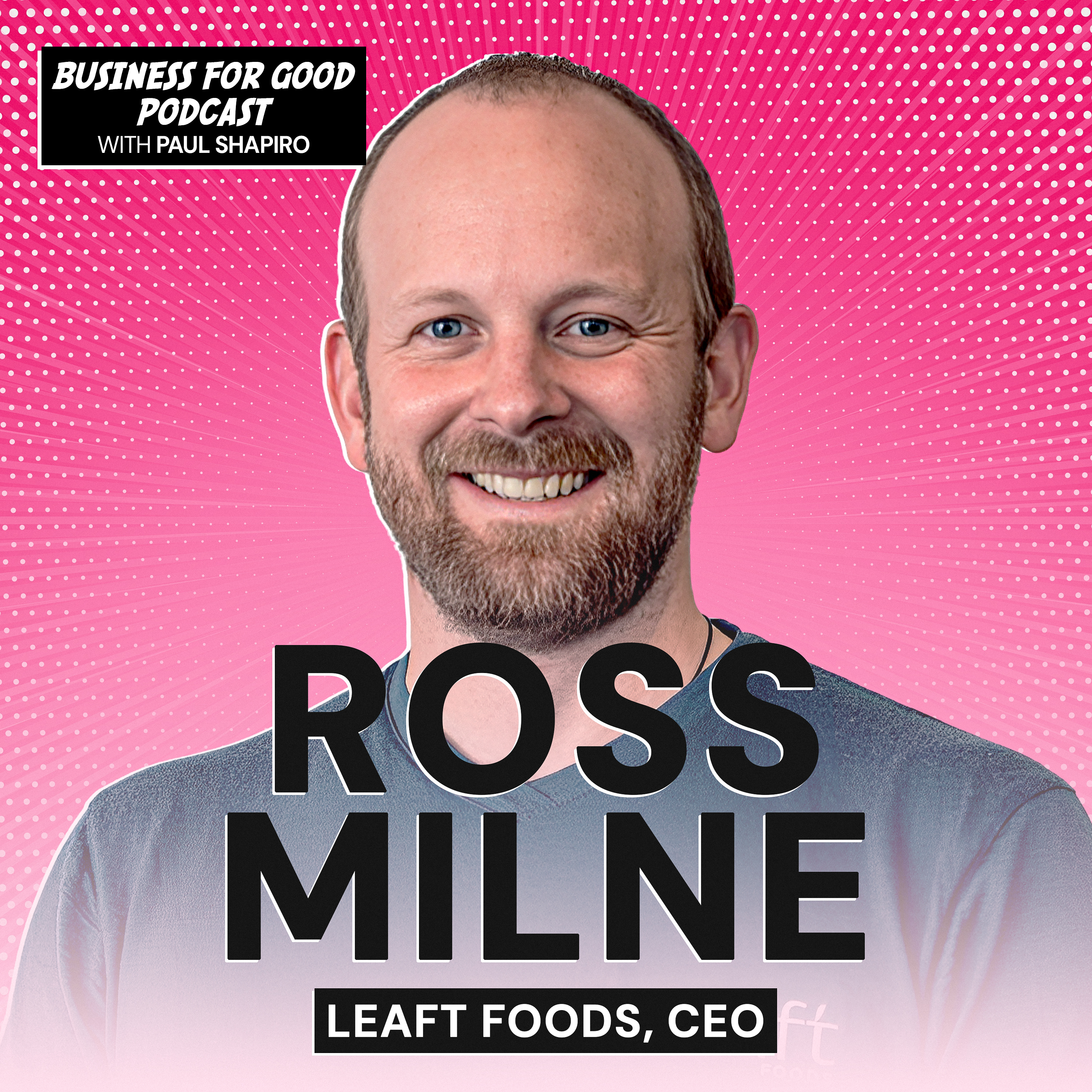 Turning Green Leaves Into High-Performing Protein with Ross Milne 15.03.2026 41mEpisode Summary: What if the most abundant protein on Earth has been hiding in plain sight inside green leaves? In this episode of Business For Good, Paul Shapiro sits down with Ross Milne, CEO of Leaft Foods, to explore how a new approach to food production could unlock massive amounts of high-quality protein directly from plants. Instead of feeding crops to animals or waiting for plants to produce seeds, Ross explains how his team isolates Rubisco, a highly digestible protein found in every green leaf, through mechanical fractionation processes that separate proteins, fiber, and carbohydrates. The conversation explores why Alfalfa is uniquely suited for this system, how Rubisco compares nutritionally to whey and egg proteins, and why leaf-based protein could become a fourth pillar of global protein production alongside meat, dairy, and seed proteins. Things You Will Learn: Why Rubisco is the most abundant protein on Earth, and why humans rarely consume it directly. How isolating protein from green leaves could dramatically increase food system efficiency. Why Alfalfa is a powerful crop for scalable protein production. How Rubisco compares nutritionally with whey, eggs, and plant proteins. Why leaf-based protein could become a fourth pillar of global protein production. Tools & Frameworks Covered: Leaf Protein Extraction: A mechanical fractionation process that opens plant cells and isolates protein, fiber, and carbohydrates for different food applications. Rubisco Protein: A highly abundant plant protein involved in photosynthesis that offers strong amino acid profiles and high digestibility for human nutrition. Systems Thinking for Food Production: Reframing the food system by removing unnecessary conversion steps (like feeding plants to animals) and extracting nutrients directly from plants. #BusinessForGood #FutureOfFood #AlternativeProtein #SustainableBusiness
 -
 Vasectomies, Family Planning, and Environmental Pressure with Dr. Douglas Stein (The Vasectomist) 01.03.2026 50mEpisode Summary: What if one of the highest-leverage climate and poverty interventions isn't a new technology, a policy mandate, or a venture-backed breakthrough, but simply making permanent contraception easier for men to choose? In this episode of Businesses For Good, host Paul Shapiro sits down with Dr. Douglas Stein, a Florida physician known as "The Vasectomist," who has performed 45,000+ vasectomies and taken his work internationally, including providing free procedures and (in some cases) small cash offsets for travel and missed wages. Their conversation moves beyond the clinic into systems: fertility rates, infrastructure strain, unintended pregnancies, cultural and religious resistance, and the practical barriers that keep men from sharing the family-planning burden. You'll also hear an honest debate about incentives, the limits of government policy, and the bigger question underneath it all: if we believe human ingenuity can solve hard problems, what would it look like to proactively reduce pressure on the planet through voluntary family planning? Things You Will Learn: Why vasectomy adoption is less about medicine and more about behavior, trust, and access. How Dr. Stein thinks about incentives, and why he frames them as cost offsets. What policy and infrastructure gaps keep family planning from scaling in lower-income regions, even when demand is high. Tools & Frameworks Covered: No-Scalpel Vasectomy Model: a simplified, low-instrument approach that enables portability and scale. Access + Friction Framework: why adoption depends on availability, education, and practical logistics (time, travel, wages). Systems Lens on Population & Biodiversity: connecting fertility trends to infrastructure strain, resource use, and biodiversity outcomes. #BusinessForGood #SustainableBusiness #FutureOfFood #AlternativeProtein #FamilyPlanning
 -
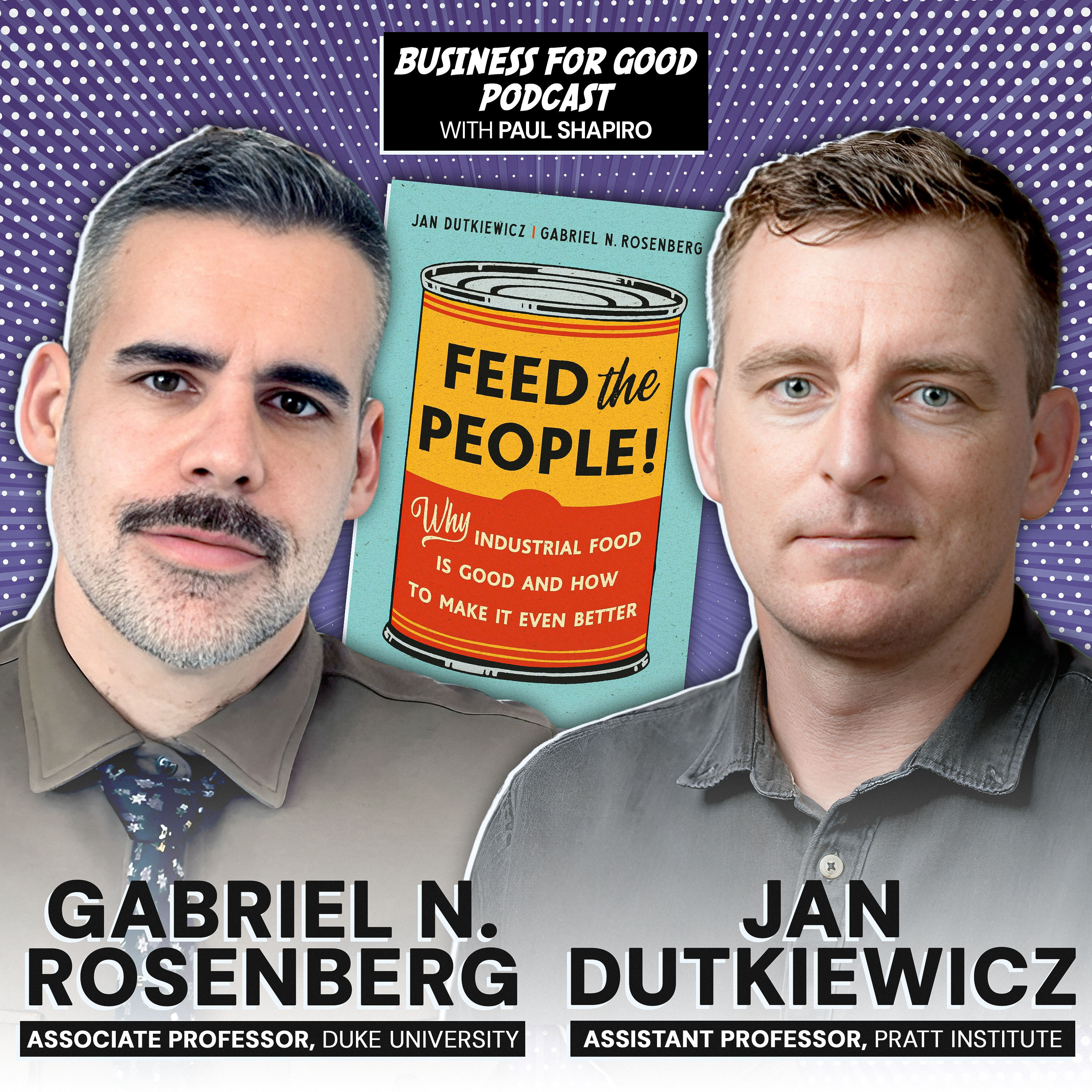 Feed the People Authors on Abundance, Food Policy, and Meat Demand 15.02.2026 50mEpisode Summary What if the global food system isn't "broken" in the way sustainability debates usually claim, and treating it that way leads to worse decisions? Paul Shapiro sits down with Jan Dutkiewicz and Gabriel Rosenberg, authors of Feed the People, to unpack how industrial scale and trade created unprecedented food abundance, why "eat local" and small-farm nostalgia collapses at 8 billion people, and what practical policy levers can improve outcomes without fantasy. They explore a clear framework, more food, less feed, no fuel, why animal agriculture remains an inefficient use of land and protein, and how public policy can reshape meat demand by changing incentives instead of accepting forecasts as fate. You'll leave with sharper systems thinking, grounded tradeoffs, and a clearer view of what scalable food system decarbonization can actually look like. Things You Will Learn How to evaluate food system claims using systems logic instead of slogans. Why meat demand rises, and how policy can bend the curve without moralizing. What "more food, less feed, no fuel" implies for land use, emissions, and investment priorities. Tools & Frameworks Covered More food, less feed, no fuel. Prioritizes crops for human food over animal feed and biofuels. Incentives over narratives. Shows how policy choices shape production, prices, and demand. Democratic hedonism. Meets people where they are, then reduces harm at scale. #BusinessForGood #SustainableBusiness #FutureOfFood #AlternativeProtein #FoodSystemDecarbonization
 -
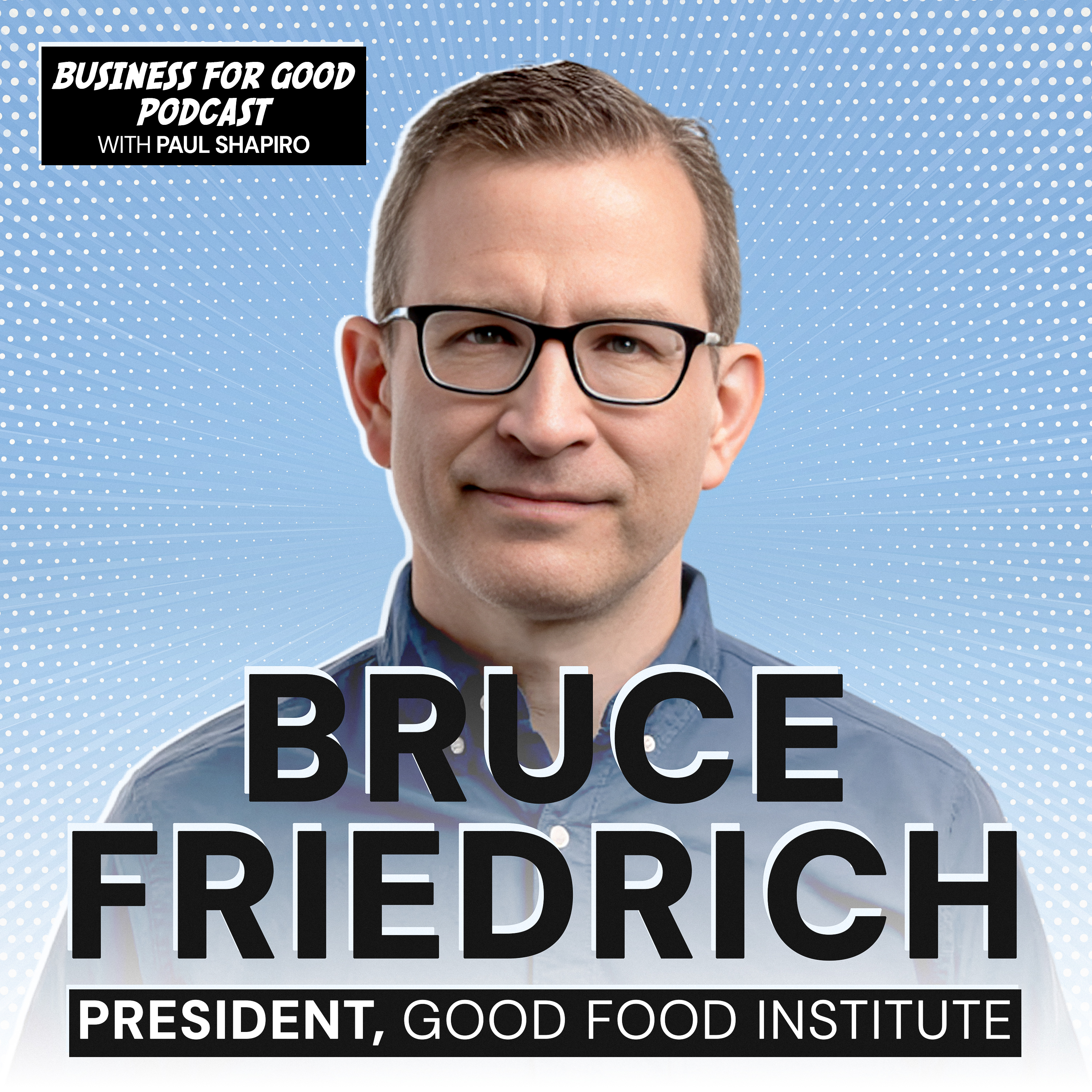 Bruce Friedrich (Good Food Institute) on Taste, Price, and What It Takes to Scale Alternative Meat 01.02.2026 58mAlternative meat looks like it is collapsing. Startups are shutting down, funding is drying up, and headlines are calling the category finished, but that reaction may reflect a misunderstanding of how technological revolutions actually unfold. Bruce Friedrich, President of the Good Food Institute and author of Meat: How the Next Agricultural Revolution Will Transform Humanity's Favorite Food and Our Future, explains why most people will not change behavior for values alone, why price and taste are the real adoption gates, and why "only" $3 billion in cultivated meat funding is far smaller than it sounds when spread across years and companies. Paul and Bruce discuss what it will take to reach taste and price parity, why governments increasingly view alternative protein as food security and national security infrastructure, and why today's failures can be a normal feature of early-stage category formation rather than proof the model will not work. You will leave with a clearer, more evidence-driven view of what is happening now and what progress actually looks like. Things You Will Learn: How taste and price parity shape S-curve adoption in food, regardless of ethics or intent Why $3B in cultivated meat investment may be insufficient relative to comparable industrial innovation cycles How food security, geopolitical risk, and economic competitiveness are driving government interest in alternative protein Tools & Frameworks Covered: S-Curve Adoption – helps evaluate whether setbacks are normal in scaling technologies Eliminating the Green Premium – helps frame what it takes for sustainable products to win at mass-market scale B2B Enablement Strategy – helps identify leverage points that unlock category-wide progress #BusinessForGood #SustainableBusiness #FutureOfFood #AlternativeProtein #PrecisionFermentation
 -
 Modern Mill's Chris Guimond on Upcycling Rice Hulls Into Low Maintenance Building Materials 15.01.2026 40mEpisode Summary A rice field does not look like the starting point for a scalable building materials company until you understand the economics behind it. In this episode of Business For Good, Paul Shapiro sits down with Chris Guimond, Founder and CEO of Modern Mill, to explore how discarded rice hulls are being transformed into ACRE, a wood like siding, decking, and trim product designed to replace old growth lumber. Chris explains why deforestation is a supply and demand problem, how Modern Mill cracked the manufacturing and adoption challenges that derail most composites, and what it takes to raise significant capital to build real infrastructure in the United States. The conversation covers circular economy manufacturing, competing with billion dollar incumbents, and why climate solutions scale only when they outperform existing systems on cost, durability, and ease of use. Things You Will Learn Why most sustainable materials fail at adoption and how to avoid that trap How supply chain location determines whether upcycling works economically What it takes to scale a hard tech manufacturing business in a legacy industry Tools and Frameworks Covered Supply chain proximity strategy to control logistics costs and reliability Adoption first product design for builders and contractors Capacity planning to scale manufacturing without breaking trust Episode Timestamps 05:10 – Why rice hulls present a hidden opportunity in building materials 08:56 – Cracking the code on turning agricultural waste into scalable products 13:20 – Why most composites fail to replace wood 25:20 – How logistics and location shape upcycling economics 35:10 – Scaling capacity before demand fully arrives #BusinessForGood #SustainableBusiness #CircularEconomy #ClimateSolutions #FutureOfFood
 -
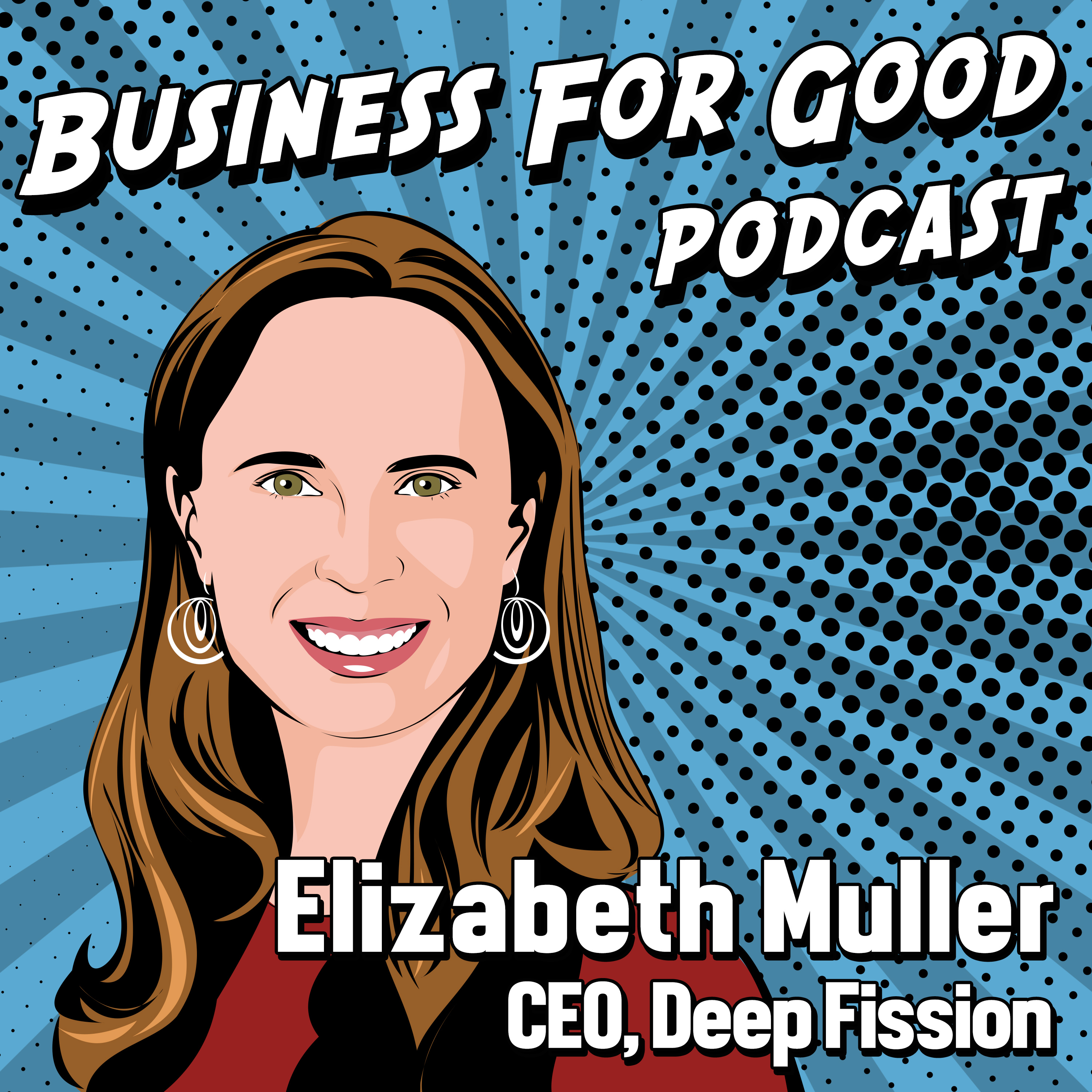 Deep Fission: Using Boreholes to Cut Nuclear Costs and Deliver 24/7 Clean Electricity 01.01.2026 32mWhat if the fastest path to reliable clean electricity is not a new reactor design, but a new place to put one? In this conversation, Paul Shapiro speaks with Elizabeth Muller, CEO of Deep Fission, about a plan to place a conventional pressurized water reactor roughly a mile underground to use geology, gravity, and groundwater for containment, pressure, and emergency cooling, potentially cutting total nuclear costs by as much as 80%. They unpack how a narrow borehole reactor could serve always-on demand from data centers and industrial users, what "proven tech combined in a new way" really means, how safety and groundwater concerns are handled through regulation and engineering practices, and the practical milestones from pilot to commercial operation so listeners can evaluate what it would take for underground nuclear to scale. Things You Will Learn How putting a conventional reactor in a mile-deep borehole can replace major above-ground systems and cut nuclear cost drivers. How Deep Fission thinks about worst-case scenarios, groundwater protection, and regulatory proof points. What milestones convert LOIs into power purchase agreements, and what timelines look like for early deployment. Tools & Frameworks Covered Geology-as-infrastructure – Uses rock, gravity, and water to replace containment and pressurization systems. Mature-tech recombination – Combines proven reactors, drilling, and geothermal heat transfer to speed time to market. Pilot-to-commercial pathway – Separates "go critical" demonstration from commercial electricity generation milestones. Episode Timestamps04:55 – Why a mile underground could cut nuclear costs by about 80% 08:47 – Borehole size, reactor dimensions, and how the hardware fits 09:31 – Replacement strategy, sealing, and stacking long-term operations 19:45 – Groundwater and safety concerns, what regulators need to see 21:43 – Timeline to power, DOE pilot program, and moving toward commercialization #BusinessForGood #CleanEnergy #NuclearEnergy #EnergyInnovation #ClimateSolutions
Similar podcasts


Popular in
The podcast also appears in the podcast charts of these countries.


