
The Anti-Architect
Christian Giordano
0
The Anti-Architect Podcast, hosted by Christian Giordano, president of Mancini Duffy, critically examines the architectural industry's relationship with clients. Through interviews with diverse voices, the show explores both successful and failed projects to improve professional practices. It aims to foster learning and innovation in architecture by sharing real-world experiences.
Episodes
-
 EP 94: Benjamin Brougham of Jonathan Adler Design Studio 06.10.2026 1h 4mIn this episode of The Anti-Architect Podcast, Christian Giordano sits down with Ben Brougham, Senior Vice President and Creative Director of Brand at Jonathan Adler Design Studio, for a conversation about creativity, brand building, design, and the evolving role of AI in the creative process.Together, they discuss what it takes to build and maintain a design identity as distinctive as Jonathan Adler’s, how Ben’s role has evolved over more than two decades with the company, and what it’s like working alongside Jonathan himself. Ben also shares his approach to creative leadership and why great design doesn’t always have to take itself so seriously.jonathanadler.comEpisode highlights:(3:18) How the Jonathan Adler creative process works(8:31) Why great design needs “5% of levity”(9:46) Collaboration between architects and interior designers(11:47) How Jonathan Adler built a recognizable design brand(12:18) Creating the identity of Parker Palm Springs(19:43) Building long-term client relationships and repeat business(21:42) Jonathan Adler’s beginnings as a potter and maker(26:25) Choosing what is right for the project over promoting the brand(30:32) Inside the design of Parker Palm Springs(38:32) Restoring the 1971 Norman Jaffe house on Shelter Island(44:52) Private equity, business growth, and creative freedom(46:40) Making high-end design accessible through brand partnerships(48:38) Benjamin Brumm’s early influences and love of antiques(53:22) From film and television props to a career in design(56:46) The moment Ben decided he wanted to work for Jonathan Adler(58:20) How AI is changing the interior design process(1:03:13) Career advice, learning new skills, and staying current
 -
 EP 93: Kellen Murphy and Chris Murphy of Murphy Schiller & Wilkes LLP 15.09.2026 1h 5mIn this episode, Christian Giordano sits down with Chris and Kellen Murphy, Founding Partners of Murphy Schiller & Wilkes LLP, for a conversation about commercial real estate, land use, entrepreneurship, and the evolving role of AI in the legal profession.Together, they discuss what it takes to move complex projects forward, from assembling the right team and navigating land use approvals to the growing politics surrounding data centers. Chris and Kellen also share how they built their Newark-based firm together, why relationships and emotional intelligence remain critical in the practice of law, and where they see AI creating new opportunities for the industry.https://www.murphyllp.com/Episode highlights:(3:04) Why the Murphy brothers’ business partnership works(11:54) How architects can give stronger planning board presentations(16:19) Politics, zoning, and getting development projects approved(28:25) Contracts, retainers, and getting paid as an architect(33:22) How tax credits and gap financing work(40:49) What is happening in the commercial real estate market(45:15) How MSW grew from zero clients into a major real estate law firm(51:22) Local attorneys versus statewide real estate law firms(1:00:30) How AI is changing law and architecture
 -
 EP 92: Timothy Greiner of JLL 25.08.2026 1h 3mIn this episode, Christian Giordano is joined by Tim Greiner, Executive Managing Director at JLL, to talk about the evolution of New Jersey’s office market and what tenants really want today.Tim shares his perspective on the shift to hybrid work and the office “amenities arms race". He also gets candid about what architects get right (and wrong) during pitches and why doing the work before you’ve won the work can make all the difference.They also explore how AI is changing commercial real estate, and the opportunity it creates for the next generation of brokers.www.jll.com (2:52) What makes long-term business relationships last(3:52) Is the office really back after COVID?(7:36) What brokers need from architects(18:44) How architects can improve their pitches(23:02) What is happening in the New Jersey office market(30:16) Redevelopment and office-to-residential conversions(33:54) Which office amenities actually matter(40:28) New Jersey incentives and the film industry(51:12) Tim’s career story and major setbacks(57:18) How AI is changing commercial real estate
 -
 EP 91: Warren Leeds and Jason Leeds of Dartcor Enterprises 05.08.2026 1hIn this episode, Christian sits down with Warren and Jason Leeds, the father-son team behind Dartcor Enterprises and Chelsea Hospitality Group. Together, they have built a hospitality-driven business that spans workplace dining, catering, and restaurant operations, with a focus on creating memorable guest experiences. Warren shares how he grew the company from a single gourmet market into a thriving hospitality enterprise, while Jason discusses his decision to leave a career at Goldman Sachs to help lead the next chapter of the family business. Together, they explore how hospitality extends far beyond food, the value of integrating operators early in the design process, and why thoughtful service and community-building are transforming the modern workplace.https://www.dartcorhospitality.com/https://www.chelseahospitality.com/https://www.theantiarchitect.com/Episode highlights:(03:10) Creating spaces where people feel welcomed and valued(07:04) Working together as father and son(11:25) What architects often misunderstand about hospitality(15:41) Why hospitality teams should join projects early(21:36) Warren’s journey from a small café to workplace dining(25:13) Surviving COVID and rebuilding company culture(30:52) Launching Chelsea Hospitality Group(34:54) Morris Proper and General Coffee Co.(38:13) Making the office worth the commute(53:20) Using AI to give hospitality teams more human time(55:55) Robotics, coffee shops, and the future of service
 -
 EP 90: Corey Hennings of dsm-firmenich 14.07.2026 1hIn this episode of The Anti-Architect Podcast, Christian Giordano sits down with Corey Hennings, Project Director for the Americas at dsm-firmenich, for a conversation about leadership, collaboration, and resilience.Together, they discuss what it takes to deliver complex projects, why communication and team fit are just as important as technical expertise, and how collaborative delivery methods can lead to better outcomes. Corey also shares how his journey in long-term recovery has shaped his perspective on building a career with purpose. Episode highlights:(0:45) The project that changed Christian’s career(6:11) Corey’s recovery story and alcohol culture in the industry(15:03) CrossFit, grief, and healthier stress relief(18:09) What frustrates owners about architects(20:30) How owners choose the right architecture team(27:47) Why design-build can improve project delivery(40:58) What makes life science and pharma projects different(43:24) CGMP, clean rooms, validation, and FDA oversight(46:18) AI, robotics, and the future of lab design(56:08) Career growth through peer networking
 -
 EP 89: Daniel Monteiro of Reidy Contracting Group 23.06.2026 51mIn this episode of The Anti-Architect Podcast, Christian Giordano sits down with Daniel Monteiro, Managing Partner of Reidy Contracting Group, to discuss a career built from the ground up. Christian and Daniel explore the lessons learned from growing alongside a company, the value of understanding every facet of the business, and how leadership evolves over time. They also discuss Reidy Contracting Group's recent recognition on ENR's Top 600 Contractors list and the firm's work on high-profile projects, including the Warner Bros. Discovery Global Headquarters, the National Urban League Headquarters in Harlem, and the American Express Centurion Lounge. This conversation offers valuable insights on growth, accountability, and what it means to earn your way to the top.https://reidygroup.com/Episode highlights:(2:18) What frustrates contractors about architects(6:32) Compressed project schedules and early bidding(12:50) What architects may find frustrating about contractors(14:01) How architects can add more value during construction(15:57) Why cost knowledge should start earlier(19:04) The value of field experience for architects(22:31) Learning from RFIs and repeated project issues(24:35) Daniel’s background and path into construction(29:29) The early days of Reedy Contracting Group(34:19) American Express Centurion Lounge project(36:42) Discovery and Food Network project work(38:19) New York and New Jersey construction market outlook(44:14) AI, scanning, robots, and the future of construction
 -
 EP 88: Rick Fourie of Fourie Consultants 02.06.2026 1h 4mIn this episode, Christian sits down with Rick Fourie, Founder of Fourie Consultants in Tampa, for a practical conversation about architecture, construction costs, and project delivery. Drawing on more than 30 years of experience across the trades, subcontracting, general contracting, cost consulting, and owner’s representation, Rick shares how his unconventional path has given him a unique perspective. Together, Christian and Rick explore why accurate estimating remains one of the industry's biggest challenges, the risks of relying on cost-per-square-foot metrics, and how procurement strategies, constructability, and early budget alignment shape project outcomes. The conversation also examines value engineering, contractor pricing, Revit, and AI, while making the case that cost should be viewed not as a constraint on design, but as a powerful tool for making better decisions and delivering more successful projects.www.fcicost.comwww.theantiarchitect.com(2:11) Why architects struggle with construction costs(3:00) The problem with cost per square foot(6:22) Rick’s start in the trades and estimating(9:10) Why early budgets are so important(17:17) Rethinking value engineering as cost changes(24:37) Constructability and field experience for architects(29:07) When architects should bring in cost experts(31:05) What quantity surveying means(38:15) The risk of free contractor pricing(55:22) AI, Revit, and the future of estimating
 -
 EP 87: Jeff Lusin of 45 Architecture & Interiors 12.05.2026 1hIn this episode, Christian sits down with Jeff Lusin, Principal and Co-Owner at 45 Architecture in Bozeman, Montana, for a conversation about leadership, entrepreneurship, and the human side of architectural practice. Jeff shares his personal path into architecture - rooted in family craft and a deep connection to community - and how those influences shape the way he leads his firm and works with clients today. Together, Christian and Jeff dig into what it takes to maintain optimism in a challenging industry and the importance of intentional growth. The conversation also turns toward the future, exploring how architects can thoughtfully adapt to new technologies and AI without losing the creativity, judgment, and human connection that define meaningful architecture.www.45arch.comwww.theantiarchitect.comEpisode highlights:(0:00) Intro(1:03) Jeff’s grandfather, shoemaking, craft, and early creativity(3:30) Leadership, optimism, and staying positive through challenges(8:09) Why not every client is the right fit(10:14) Gatekeeping in architecture and the need for more openness(16:20) How Jeff thinks about architecture fees, value, and risk(24:16) The origin and growth of 45 Architecture & Interiors(35:10) The Belgrade Community Library and local accountability(44:04) How an MBA shaped Jeff’s approach to business(49:42) AI, design, data, and the future role of architects(58:58) Final thoughts and where to learn more about 45 Architecture & Interiors
 -
 EP 86: Kara Kopach of FMERA 21.04.2026 55mIn this episode, Christian has a conversation with Kara Kopach, Executive Director of the Fort Monmouth Economic Revitalization Authority (FMERA). Kara has been leading the transformation of the former Fort Monmouth military base into a thriving mixed-use community, including residential, retail, a Robert Wood Johnson healthcare campus, and the 300-acre Netflix Fort Monmouth Movie Studio. Christian and Kara unpack the complexities of large-scale redevelopment and share how community engagement and intentional planning can create spaces that truly connect with people.https://www.fortmonmouthnj.com/https://manciniduffy.com/(0:44) Meet Kara Kopach and Fort Monmouth’s redevelopment story(4:43) Fort Monmouth history and Kara’s personal connection(12:03) FMERA’s mission, land use, and redevelopment process(18:53) How the plan changed over time(22:09) Historic preservation and design challenges(33:52) How Netflix came to Fort Monmouth(45:03) Other major projects, including the new hospital and Riverwalk(50:39) What happens when the redevelopment work nears the finish line
 -
 EP 85: Eric Edelson of Fireclay Tile 31.03.2026 59mIn this episode, Christian sits down with Eric Edelson, CEO of Fireclay Tile, to explore how a small artisan studio transformed into one of the most innovative, mission-driven tile manufacturers in the country. Eric shares the company’s evolution from a 19-person operation to a 280-employee, vertically integrated business with factories in California and Washington - all while staying true to Fireclay’s roots in craftsmanship, sustainability, and design. Christian and Eric dive into what it really takes to balance handmade artistry with modern technology, from advanced customization tools to the increasing role of AI in manufacturing. The conversation highlights Fireclay’s status as a certified B Corp and the values that drive the company’s commitment to responsible business and environmental stewardship - proving that growth and integrity can go hand in hand.https://www.fireclaytile.com/https://theantiarchitect.com/ 0:00 - Introduction to the episode and Eric Edelson0:48 - What Fireclay Tile is and how it’s different1:42 - Eric’s background before joining the company5:28 - Moving from investing into operating a business8:02 - Why craftsmanship still matters in today’s world10:36 - Standing out in a commoditized industry11:52 - The inefficiencies of traditional supply chains13:10 - Going direct to the customer and why it works15:44 - Scaling the team from 20 to 300 plus17:02 - Preserving culture during rapid growth18:21 - What becoming a B Corp actually requires19:40 - Using business as a force for good in real ways21:00 - Transitioning toward employee ownership23:42 - Sustainability inside the manufacturing process25:05 - How recycled materials are actually used27:50 - Working with major commercial clients at scale29:12 - Balancing customization with operational efficiency32:00 - Becoming a fully integrated tile company34:10 - Risks of vertical integration and how they manage them39:00 - Leadership lessons from scaling a mission-driven brand42:15 - Advice for entrepreneurs challenging legacy industries46:10 - The future of manufacturing, design, and sustainability50:30 - Long-term vision and what success really looks like55:20 - Final reflections on impact, growth, and legacy59:30 - Closing thoughts and where to learn more about Fireclay
 -
 EP 84: John Anthal of Mancini 10.03.2026 51mIn this episode, Christian is joined by John Anthal, Principal and Aviation Practice Director at Mancini. Over the past 12 years, John has built Mancini's aviation practice from the ground up, leading over a million square feet of work across major airports - JFK, LaGuardia, Newark, Boston, and Philadelphia. His portfolio includes standout spaces like the American Airlines Flagship Lounge at JFK, one of the world’s top-ranked airport lounges. John shares the complexities of airport design, the evolving needs of travelers, and how teamwork, trust, and strategic relationships drive success. A must-listen for architects, designers, and anyone curious about shaping the airports of tomorrow.https://manciniduffy.comhttps://theantiarchitect.com/(0:46) Meet John Anthal and his role at Mancini Duffy(3:02) The phone call that brought John to the firm(7:34) What annoys John about architects(15:37) Common mistakes in airport design projects(22:00) How the aviation practice at Mancini Duffy began(24:00) Building trust and long-term client relationships(39:03) Inside airport lounges and passenger experience(44:36) John’s early life and path into architecture(48:14) Advice for young architects and future leaders
 -
 Christian Welcomes Season 5 10.03.2026 3mListen as Christian reflects on starting Season 5 of The Anti-Architect Podcast - listeners can expect the same honesty, same curiosity, and conversations on the future of this profession. Season 5 launches on March 11, 2026!
 -
 EP 83: Francesca Bucci of BG Studio 17.02.2026 55mIn this episode, Christian sits down with Francesca Bucci, President and Founder of BG Studio, the architecture and design firm redefining hospitality on land and at sea around the world. Christian and Francesca explore how Bucci’s distinctive approach to hospitality design - spanning superyachts, luxury hotels, residential, and beyond - has been shaped by her global perspective. She shares the stories behind projects like the Flora, the first ship of its kind designed specifically for the Galápagos, and how designing for both land and sea requires a unique balance of elegance, functionality, and emotion.https://bgstudio.com/https://theantiarchitect.com/0:05 – Christian introduces Francesca Bucci, founder of BG Studio, and sets the stage for the episode 0:50 – Francesca’s design roots in Rome and how cruise ship work launched her firm 1:27 – How pitching one client gave Francesca the confidence to start BG Studio 2:30 – Why leadership, communication, and passion matter more than titles 3:20 – The unique opportunity Francesca received when her previous firm shut down 4:05 – Earning trust by showing up consistently at shipyards and delivering results 5:07 – What makes cruise ship architecture one of the most technical and creative challenges 6:13 – Francesca shares her favorite question: what annoys you about architects? 7:25 – Why she believes the capital-A Architect persona does more harm than good 8:00 – How studying in Italy instilled humility and a love for culture in her design process 9:09 – Coming to the U.S. to build, not just theorize, and the painful learning curve she faced 11:27 – Why Francesca values real-world experience more than perfect portfolios 13:01 – The entrepreneurial mindset she inherited from her family and how it shaped her firm 14:05 – Growing slowly by design and creating a culture of support and excellence 15:33 – Her thoughts on architecture and interior design schools staying too separate 17:06 – Why design students today lack conceptual thinking and how firms like hers fill the gap 18:59 – Francesca shares her hiring philosophy: hire people, not talent 20:03 – Balancing high design with business realities like fees, deadlines, and presentations 22:13 – How she teaches ownership and leadership across her team 23:40 – The honest truth about fees and being selective with projects after 20 years 26:43 – Spotlight on BG Studio’s global work, including Galápagos yachts and NYC condos 28:15 – How working on hospitality projects informs their approach to residential design 30:27 – Why cruise ship design sharpened their expertise in space efficiency and experience 32:14 – The key differences between designing for land and sea 34:01 – Regulations, safety codes, and the unique challenges of maritime architecture 35:03 – Who approves cruise ship designs and how IMO and Solas shape every decision 36:04 – Designing around safety and still making spaces feel luxurious 37:10 – Why Francesca gave up trying to find people already trained in cruise ship design 38:31 – How she builds and trains her team from the ground up 42:06 – Francesca’s origin story and how she stumbled into architecture after studying philosophy 43:51 – What her creative interests taught her about storytelling and space 45:00 – Behind the scenes of the award-winning Celebrity Flora built for the Galápagos 46:47 – How sustainability and local materials guided the Flora’s design 48:01 – A look at the Ultimate Family Suite and how it redefines cruise ship luxury 49:11 – Francesca explains how cruise ships are planned from scratch and designed as they’re built 51:00 – BG Studio’s luxury Long Beach development and what made it such a unique project 53:41 – Navigating COVID by relying on multifamily work and staying connected to long-term clients 56:22 – Francesca’s view on AI and technology in design: helpful, but not the driver 58:10 – Her closing message: never stop learning, reading, and building your own point of view
 -
 EP 82: Peter Bronsnick of Cushman & Wakefield 27.01.2026 53mIn this episode, Christian is joined by Peter Bronsnick, Executive Regional Director at Cushman & Wakefield, overseeing operations across New Jersey, Pennsylvania, and Delaware. Peter's career story of evolution from hands-on developer and deal maker at SJP Properties to leading one of the most powerful real estate advisory platforms in the country of Cushman & Wakefield. Over his two plus decades in the industry, he has touched on every side of the business, site selection, planning, entitlements, construction, leasing, acquisition, capital markets and marketing. Christian and Peter discuss how a developer’s mindset can sharpen leadership within an advisory powerhouse, what defines successful placemaking today, and his role in some of the region's most transformative projects, including M station in Morristown.https://www.cushmanwakefield.comhttps://theantiarchitect.com/0:00 – Christian introduces Peter Bronsnick and his role at Cushman Wakefield 1:29 – Why developers need to better understand architecture and design 2:49 – Lessons Peter learned working under Steve Pozycki at SJP Properties 4:37 – The importance of discipline, preparation, and internal expertise 5:47 – What frustrates Peter about how architects approach projects 7:07 – Why the architectural vision doesn’t always translate to real-world use 8:29 – How client collaboration has evolved in architecture and development 9:48 – The dangers of overdesign and ignoring budget realities 11:03 – Finding the balance between creative vision and financial feasibility 12:07 – Getting all stakeholders at the table from the start 13:47 – What a perfect architect developer partnership should look like 15:01 – Why architects need to be comfortable pushing back 16:11 – How to help architects better understand developer risk and mindset 18:02 – Why studying failed developments teaches more than studying success 20:05 – The red flags Peter looks for early in developer relationships 21:00 – Why architects are overworked and underpaid and how that starts 23:00 – How the urgency of capital impacts every part of the development process 24:06 – Peter reflects on his biggest lessons from a decade at SJP Properties 26:22 – The importance of sequencing and process in complex development 27:57 – Why SJP was more than just a developer and how that shaped Peter 28:58 – What inspired Peter’s leap to Cushman and Wakefield 30:07 – Building and scaling a business inside Cushman Wakefield 31:52 – Coordinating brokerage, capital markets, and internal teams 33:15 – How New Jersey real estate culture differs from New York 34:57 – Peter’s origin story and how he accidentally got into real estate 36:43 – The story of getting fired by his dad and finding a new path 38:11 – Why Peter pursued real estate at NYU after Michigan State 39:12 – Deep dive into M Station and what made it a successful placemaking case study 42:31 – The future of real estate development in downtown markets 44:01 – Why speed, innovation, and hospitality models are here to stay 46:02 – The mental health impact of placemaking and returning to the office 47:37 – The rise of AI and Cushman Wakefield’s approach to adoption 49:15 – Why future leaders will need to be AI literate 50:06 – Peter’s final thoughts on the future of cities and the importance of results 52:27 – Closing thoughts and how to connect with Peter Bronsnick
 -
 Episode 81: Antonio Scalise of Parallel Architectural Group 06.01.2026 54mIn this episode, Christian sits down with Antonio Scalise, Principal Architect and Founder of Parallel Architectural Group. Growing up in a multi-generational family of masons from Italy, Antonio's path took him from swinging a sledgehammer in New York to leading a full-service architecture firm in New Jersey. Antonio and Christian dive into why every architect should spend at least a year in the field, how Hurricane Sandy became a turning point for his firm, and how lessons from his father’s business still guide the way he leads today. Antonio also explains why being a “yes” firm - even on the $1,000 project - can open doors to lasting relationships and unexpected opportunities.https://parallelgrp.com/https://theantiarchitect.com/0:05 – Christian introduces the Anti-Architect Podcast and guest Antonio Scalise, founder of Parallel Architectural Group 1:05 – How growing up in a multi-generational masonry family shaped Antonio's work ethic 2:15 – Early jobsite memories and the hands-on lessons learned from working alongside his father 3:43 – Why field experience from a young age gave Antonio a deeper appreciation for the trades 4:59 – Antonio's father encouraged education over labor and how that led him to architecture 6:17 – The one thing that frustrates Antonio most about other architects 7:15 – Why architecture education should require at least a year of fieldwork 8:28 – The importance of building physical models and staying connected to tactile design 9:49 – Drawing by hand vs digital shortcuts and what that does to architectural thinking 11:00 – Field precision vs architectural theory and the danger of over-specifying 12:01 – How fee competition is hurting the profession and what clients often misunderstand 13:08 – Why educating clients is part of an architect’s job and how scope comparison reveals the truth 14:01 – Lessons from Antonio's dad about doing the job right, even if it takes longer 15:05 – Builders recommend architects who prevent rework and get zoning right the first time 16:25 – If not an architect, what part of the industry would Antonio be in? 17:34 – How Hurricane Sandy led to explosive growth and a rebirth of his firm 22:24 – Balancing high-end projects with smaller ones and why he never says no 24:03 – Solving problems across many project types and how versatility has been an asset 25:17 – Building trust by learning from mistakes and turning one project into 50 28:23 – What culture looks like at Parallel: humor, hard work, and setting the tone from the top 30:00 – How Antonio encourages accountability and leadership among his team 32:11 – The myth that no one will care as much as the founder, and why it’s wrong 33:04 – Antonio's origin story: from Long Island to California to New Jersey 35:04 – Starting at Brookdale and moving on to NJIT to pursue architecture 36:09 – Why Antonio considers himself a design chameleon instead of having one style 37:03 – His proudest project: a senior center that became a point of civic pride 39:01 – Residential projects that showcase adaptive design and asymmetry 42:02 – Reusing warehouse bones to create a vibrant headquarters for Partner Engineering 43:23 – Why light, proportion, and spatial feel matter more than people realize 45:19 – Thoughts on AI, concrete printers, and why human touch will always matter 48:15 – Concerns about shrinking fees, rising expectations, and retaining architectural value 50:04 – The pros and cons of remote work in a highly collaborative and creative field 51:22 – Why craftsmanship, mentorship, and presence still matter more than ever 52:17 – Antonio's advice to young architects: learn business as much as design
 -
 Episode 80: Eric Gatti of G William Group 16.12.2025 51mIn this episode, Eric Gatti, President and Managing Partner of G William Group, shares how he rose from college intern to leading a full buyout of the firm and how that journey shaped his views on leadership, culture, and trust. Eric and Christian discuss why true leadership means being at the "back of the pack" making sure no one gets left behind. Eric reveals how betting on friends with zero AEC experience built his strongest team, why ego has no place in company culture, and how empowering people to make hires, run accounts, and own outcomes has fueled G William Group's growth and success.https://www.gwgllc.com/https://theantiarchitect.com/0:05 - Christian introduces Eric Gatti, President of G. Williams Group 1:03 - Eric shares how he rose from college intern to company owner 2:38 - The story of taking over a delayed Wonder project and earning trust 4:12 - What happened when design had to take a back seat to delivery 5:23 - How Eric and Christian first met and why that project mattered 6:28 - What annoys Eric about working with some architects 8:03 - Why design isn’t "yours" it's the client’s vision brought to life 9:01 - How GWG approaches design-build differently than traditional CM firms 10:13 - Why early collaboration on pricing, programming, and priorities matters 13:01 - The problem with product reps and value engineering after the fact 14:47 - How BIM and live data could close the gap between design and cost 16:48 - Why architects need more hands-on field experience 18:08 - Debunking the myth that contractors make money from change orders 21:09 - Eric’s origin story from rugby to repurposing industrial space 24:30 - Lessons from his first project and the importance of being a sponge 28:03 - How on-site trades taught Eric more than any classroom ever did 33:04 - Becoming a partner at 23 and why he almost said yes too early 36:00 - The hard part of succession managing ego during a buyout 37:55 - Why building a strong team meant taking risks on friends with no experience 41:13 - How GWG keeps culture alive by hiring for grit not just credentials 45:13 - Eric shares how GWG is using OpenSpace Procore and AI carefully 47:03 - Why speed and polish from AI can’t replace critical thinking and context 49:02 - Christian and Eric commit to a staff exchange on a future joint project
 -
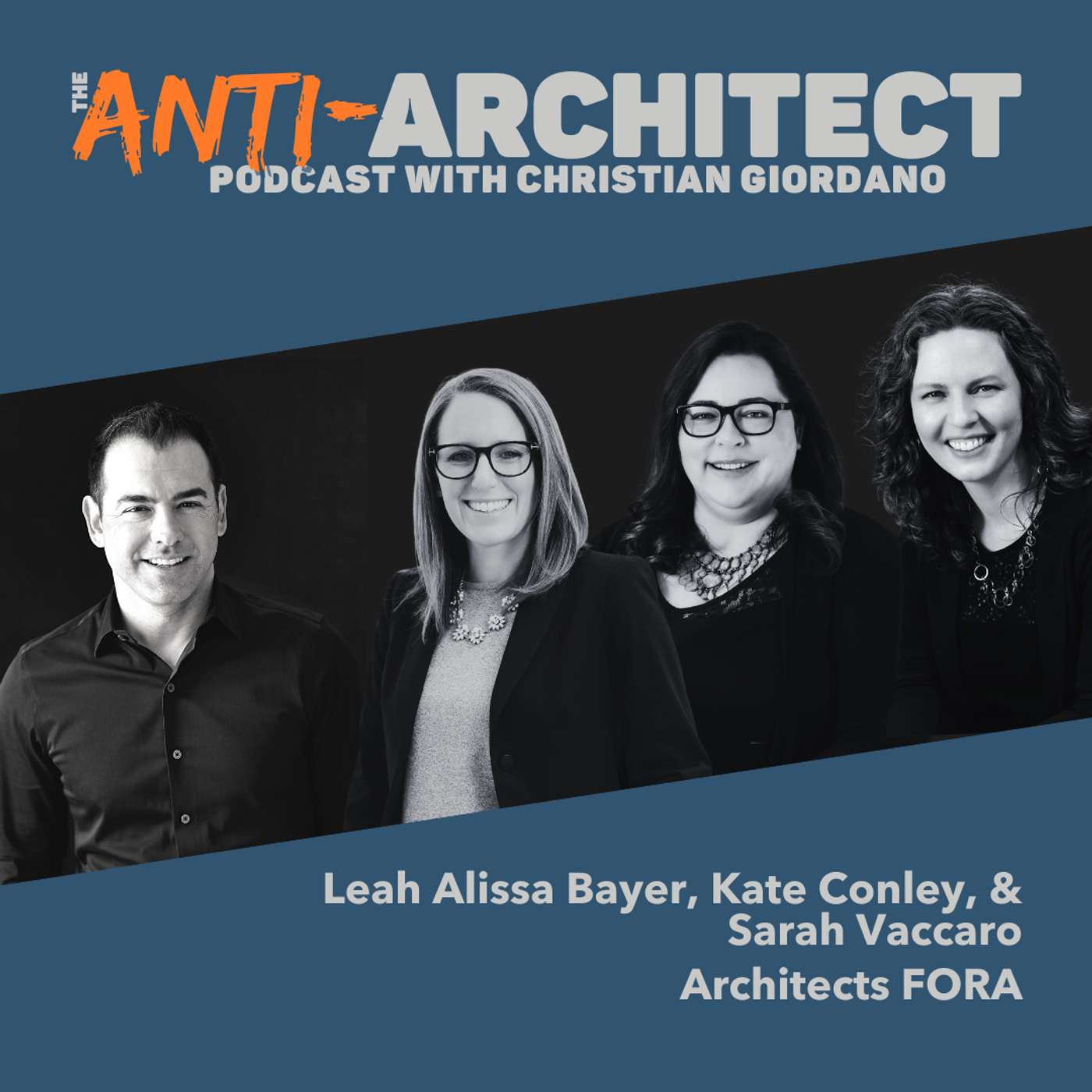 Episode 79: Sarah Vaccaro, Leah Alissa Bayer & Kate Conley of Architects FORA 25.11.2025 1h 2mIn this episode, Christian sits down with Leah, Kate, and Sarah - the team behind Architects FORA, a 100% women-owned, fully virtual practice redefining what an architecture firm can be. Their path to creating FORA grew out of a shared desire for a healthier, more transparent way of working as the foundation of the firm. They dive into how they built a practice centered on equity and trust, why affordable housing became their focus, and how projects reflect a community-driven approach. The conversation also touches on how they’re embracing AI and emerging technology to stay nimble, relevant, and impactful as the industry evolves. It’s a candid look at three architects reimagining the profession - and proving there’s more than one way to build a thriving firm.https://architectsfora.com/ https://theantiarchitect.com/ 0:00 – Intro0:42 – Meet the three leaders behind Architects FORA1:16 – A new model for architectural leadership2:06 – How their mission was sparked by a retreat3:30 – Discovering affordable housing as a calling4:14 – The moment they realized design could do more5:28 – The shift from prestigious buildings to purpose-driven work6:13 – A deep dive into housing and homelessness7:09 – How their remote collaboration began8:43 – Rethinking the value of work and space9:41 – Advice for young architects on choosing meaningful projects10:14 – Why purpose matters more to younger generations11:08 – What frustrates them most about traditional architecture culture13:26 – The danger of treating architecture as precious and untouchable14:39 – How rigidity threatens the future of the profession16:00 – Finding new areas of influence beyond traditional architecture17:20 – Why architects are overworked and underpaid18:50 – A better way to structure tasks and reduce burnout20:12 – Redundancy and team structure to protect work-life balance22:40 – Breaking generational mindsets in architectural leadership24:14 – How they use asynchronous, flexible scheduling25:17 – Can you work from anywhere, even Guam?27:04 – How they handle site visits as a remote firm28:52 – Why travel is worth the tradeoff for team happiness31:06 – How schedule flexibility supports parenting and caregiving33:28 – Intentional culture-building without being in person34:58 – Their secret to authentic team bonding remotely36:14 – What happens if someone goes over their 40 hours38:00 – How transparency prevents unrealistic deadlines39:05 – Why overwork is a leadership failure, not a badge of honor41:00 – How they designed a clear, equitable salary system43:00 – Their transparent leadership tiers and performance scoring45:00 – What “Architects FORA” actually means46:03 – Solera Apartments: Trauma-informed design in action49:27 – El Camino: Sustainability and community feedback51:59 – Lee Avenue: Senior housing with a real sense of place55:32 – Launching paid post-occupancy evaluations57:01 – Why AI is a tool, not a threat59:10 – A call to reimagine what your firm could look like1:00:44 – Final thoughts and how to learn more about Architects FORA
 -
 Episode 78: Jay Stasi of The Hampshire Companies 04.11.2025 48mIn this episode, Christian sits down with Jay Stasi, Vice President of Development at The Hampshire Companies, to unpack what really matters when he’s choosing architects and partners: from technical expertise in structural systems to the all-important “grab a beer test.” Jay breaks down the enduring demand for self-storage and multifamily housing, the challenges of rising construction costs, and why “checking the bagel”- his signature phrase for creative due diligence - is essential for successful projects. He also reflects on lessons learned from his family’s tile business, his path through construction and development, and why, no matter how demanding the industry gets, family always comes first.https://www.hampshirere.com/https://theantiarchitect.com/ 0:05 - Christian introduces Jay Stasi and sets the stage for the conversation 1:01 - Jay explains what matters most when selecting architects and partners 3:46 - The biggest frustrations developers have with architects 5:09 - Why architects often miss the mark on budgeting and communication 6:52 - Coordination challenges and the importance of complete drawing sets 8:11 - A candid story about deadline pressure and the value of honest conversations 10:00 - Why direct communication beats email in fast-moving projects 11:07 - How architects can be more helpful beyond RFPs 12:28 - Early-stage massing and feasibility feedback as a differentiator 13:36 - The architect as a potential source of real estate opportunities 14:21 - What Jay looks for when hiring an architect and why price is not the priority 16:09 - The “grab a beer” test and why personality fit matters 17:39 - Innovation in industrial and self-storage projects and what architects should bring to the table 19:02 - How to work with communities and navigate NIMBY resistance 21:22 - Overview of The Hampshire Companies and what sets them apart 23:02 - Jay shares why self-storage continues to thrive across the U.S. 25:45 - Trends in multifamily housing and how Hampshire finds new opportunities 27:04 - Evolving amenities in residential buildings and how architects can lead the way 29:45 - Thoughts on low-income housing integration and design equity 31:31 - Navigating rising construction costs and market uncertainty 34:00 - What Jay’s day-to-day role as VP of Development looks like 36:50 - Jay’s background in construction, teaching, and learning from mistakes 41:12 - The “check the bagel” rule and why small details matter 42:06 - How Jay balances career growth with being present for family 44:22 - The role of technology and AI in the future of development 46:01 - Final thoughts on why real estate development is a constantly evolving career 47:06 - A personal reflection on family and what really comes first for Jay
 -
 Episode 77: David Hart of Steinberg Hart 14.10.2025 1h 2mIn this episode, Christian is joined by David Hart, President & CEO of Steinberg Hart to discuss how architecture is evolving: from work culture to technology to firm leadership. David shares why he welcomes the new generation’s pushback on 60-hour workweeks, how the industry’s “seller-doer” model complicates ownership transitions, and why thoughtful decision-making is essential in an era of instant answers. David also takes listeners inside Steinberg Hart’s work on Cal Poly’s new modular student housing- the largest modular construction project in the U.S. - and explains how AI is already reshaping the firm’s creative process and client collaboration.https://www.steinberghart.com/https://theantiarchitect.com/ 0:00 - Intro2:23 – Christian introduces David Hart and highlights the values-first culture at Steinberg Hart 5:05 – David explains why “values” became the foundation of the firm’s design philosophy 6:50 – Why architecture should focus on inventing the future, not solving the past 7:54 – The common mistake architects make during presentations and how to fix it 9:03 – Why listening and extracting insights are more important than just sharing ideas 10:26 – How David coaches his team in real-time during client meetings 12:20 – A candid take on why the profession is overworked and underpaid 13:09 – The industry’s failure to teach the business of architecture 14:56 – Generational shifts in work-life balance and what technology changed 17:01 – Reflections on burnout, long hours, and what David would do differently 20:03 – How Steinberg Hart embeds values like design, relationships, and change in daily work 22:20 – David shares how long-term relationships and “boomerangs” strengthen culture 24:19 – Why continuous change is essential to a 70-year-old architecture firm 26:06 – How the firm approaches leadership transition with an evolving ownership model 30:59 – The challenge of the seller-doer model and its impact on succession 35:15 – Behind the scenes of Cal Poly’s modular housing project with FullStack Modular 40:14 – Why immediate design-to-fabrication workflows are the future 46:00 – David explains why decision-making, not just design is the modern superpower 57:08 – How mid-sized firms can stay relevant with AI and integrated culture
 -
 Episode 76: Christina Magrans of Studio Lourdes 23.09.2025 53mIn this episode, Christian sits down with Christina Magrans, Founder and Managing Director of Studio Lourdes. With her firm, Christina set out to build the kind of environment she never found in the corporate world - one that prioritizes people as much as projects. Together, she and Christian unpack how she’s redefining work/life harmony, balancing client demands with culture, and shaping iconic retail spaces for brands like Bape, Marc Jacobs, Longchamp, Dries Van Noten, and Aesop.https://www.studiolourdes.com/https://theantiarchitect.com/0:05 – Christian introduces Christina Magrans, founder of Studio Lourdes1:32 – Christina reflects on her early career at TSC Design and how it shaped her3:10 – How a fast promotion at Tiffany led her to manage global projects5:01 – Lessons from 9/11 and the 2008 recession that built resilience6:10 – Christina explains her personal definition of a growth mindset6:50 – Studio Lourdes uses Ivy Learning to support continuous team development7:48 – How Christina screens for cultural fit and curiosity during hiring9:20 – Why values alignment is the first step in taking on new clients10:39 – How Studio Lourdes balances passion and business when selecting projects11:36 – The growing overlap between retail, hospitality, and workplace design12:45 – Christina brings brand discovery practices into workplace projects13:36 – Why she founded Studio Lourdes to prioritize employee experience14:30 – Teaching business fundamentals to architects across all levels16:40 – Transparent goal-setting and revenue discussions as a leadership tool18:15 – Timesheets as data, not pressure—rethinking accountability in design firms19:22 – Making client service personal while keeping the team happy20:40 – What Christina learned at Harvard and IMD executive leadership programs21:47 – How Studio Lourdes builds culture through values-based retreats and rituals23:10 – Empowering staff to lead, speak up, and evaluate client relationships25:00 – Redefining work-life balance through flexibility and communication norms27:30 – Christina and Christian reflect on happiness, ambition, and evolving goals30:00 – Why Studio Lourdes pushes back on unpaid design work32:45 – The case for teaching the business of architecture early in one’s career34:00 – Christina's top advice for emerging architects and designers35:00 – The origin of the name “Studio Lourdes” and what it means to her legacy36:00 – A global design portfolio: Bape, Marc Jacobs, Longchamp, Aesop, and more.
Similar podcasts


Popular in
The podcast also appears in the podcast charts of these countries.
