
The Main Thread: Java, AI & Software Architecture
Markus Eisele
0
The Main Thread offers practical lessons on enterprise Java, software architecture, and AI coding agents for experienced developers, architects, and technical leads. Drawing on more than two decades in the industry, Markus Eisele examines what works, where tools fall short, and how to make better decisions about the software you build and maintain. The show focuses on real-world tradeoffs and actionable guidance for building and maintaining software.
Episodes
-
 Children and AI: What Schools and Families Should Teach 18.11.2026 21mSeveral international colleagues have asked whether I’m going to translate my German book, Hilfe, mein Kind hat KI!, into English. An English translation isn’t planned, so this episode takes some of its ideas into a wider conversation about children, AI, and what we should teach.I think creativity and critical thinking need to be taught differently when AI can suggest an answer or produce a polished first version. Children need practice developing an idea, choosing what to change, and explaining their decisions. With homework, we can look at the ability an exercise is meant to develop and choo...
-
 Agent Skills: From Repeated Instructions to a Reusable Procedure 12.11.2026 23mI use agent skills throughout the production process behind The Main Thread, from tutorial structure and voice guidance to technical review and publication preparation. In this episode, I explain how those instructions developed from things I kept repeating to the model, and how I decide whether a skill helps me reach something I’m prepared to publish.We start with the open Agent Skills format: what belongs in SKILL.md, how the description helps the agent select a procedure, and how references and scripts become available when the task needs them. Then we follow a pull request summary through...
-
 Automatic Model Routing: What Your Coding Assistant Chooses for You 04.11.2026 21mWhen my coding assistant shows automatic in the model selector, my reaction is mixed. I want the convenience. I also want to see and influence the decision, especially when an investigation gets stuck or a new model gives me something else to try.In this episode, I explain what would make me comfortable handing over routine model selection. A cheaper model can leave more of my budget available for a difficult task. Repeated explanations and corrections can consume that saving, along with my time. I want to compare what it costs to reach a change I can accept.I use a hypothetical Java service t...
-
 AI Context Windows: Comparing the Cost of an Accepted Coding Result 28.10.2026 24mI see two things coming up regularly in our internal IBM Bob Slack channel. People want a larger context window, and people are surprised how expensive their conversations become. Well, both make sense when you look at what the agent sends to the model with each request.In this episode, I explain what a context window contains and how IBM Bob, Codex, Claude Code, and Gemini CLI decide what goes into it. We follow twenty model requests, starting at 10,000 input tokens and adding another 10,000 each time. The last request contains 200,000 tokens, but the total across those requests is 2.1 millio...
-
 Spec-Driven Development: Why Passing Tests Can Miss a Changed Requirement 21.10.2026 20mI want coding agents to take on more of the implementation. I also want to understand what I’m accepting when they come back with a result. Writing a spec gives those decisions somewhere to happen, but it gives me another set of files to keep current too.In this episode, I revisit the trade-offs around spec-driven development and the fear that the requirements, tests, and code start describing different behavior. In the cart-policy example with IBM Bob, changing the design from 30 to 90 days left the old tests green and every requirement ID connected. Well, the links were intact. The new decis...
-
 Qwen3-TTS Voice Cloning: What I Learned Building a Local Podcast Voice 15.10.2026 19mI wanted to bring The Main Thread Podcast back, and recording the episodes myself has a few practical problems. I do my job from home, and I don’t have access to a quiet studio. The kids come in and out, there’s noise in the house, and getting a long, uninterrupted recording is a challenge.Reading a transcript also changes how I sound. It’s different from freely explaining something to another developer. So my main motivation was to put the time into writing a script and developing a narrative that’s easy to follow, then have a text-to-speech model read it in my voice.I didn’t want to go with...
-
 How to Find Regression Risks in a Quarkus App Before You Write the Feature 28.06.2026 5mUser unregistration sounds simple until you look at the rest of the system.In a booking application, “delete this user” is never just one DELETE endpoint. It touches active bookings, foreign keys, historical reads, cache state, and the uncomfortable question every senior team eventually has to answer: is this really a hard delete, or is it deactivation, anonymization, or something in between?That is why I like the workflow Alex Soto shows in the latest video. He does not start by asking IBM Bob to write the feature. He starts by asking it to map the regression impact before implementation. Tha...
-
 Using JaCoCo and AI to Prioritize Test Coverage in Quarkus Teams 22.06.2026 5mIn the latest video, my co-author Alex Soto shows a test coverage workflow I actually like. I do not care about 100% coverage as a badge. I care about whether the important parts of the system are tested. Past that point, the number gets expensive fast. In some domains you still need to hit a minimum threshold because regulation says so. Ok. That might be a real constraint.Building out tests should follow a more simpler question: where are the gaps that matter, and what should we test first? Alex uses IBM Bob with a JaCoCo report from a Quarkus backend to answer exactly that. It is a boring wo...
-
 API Versioning in Quarkus: The Part AI Doesn’t Solve 03.04.2026 11mVersioning a REST API is one of those architectural chores that everyone knows they need to do, but nobody actually wants to implement. As your data models evolve, you have to maintain backward compatibility for existing clients while serving new data structures to updated ones.Historically, this meant writing a lot of boilerplate: duplicating entities, adding routing logic, and carefully wiring fallback behavior. The problem is not that this is hard. The problem is that it is easy to get wrong, and once it is wrong, you carry that decision for years.If you want a deeper breakdown of the long-...
-
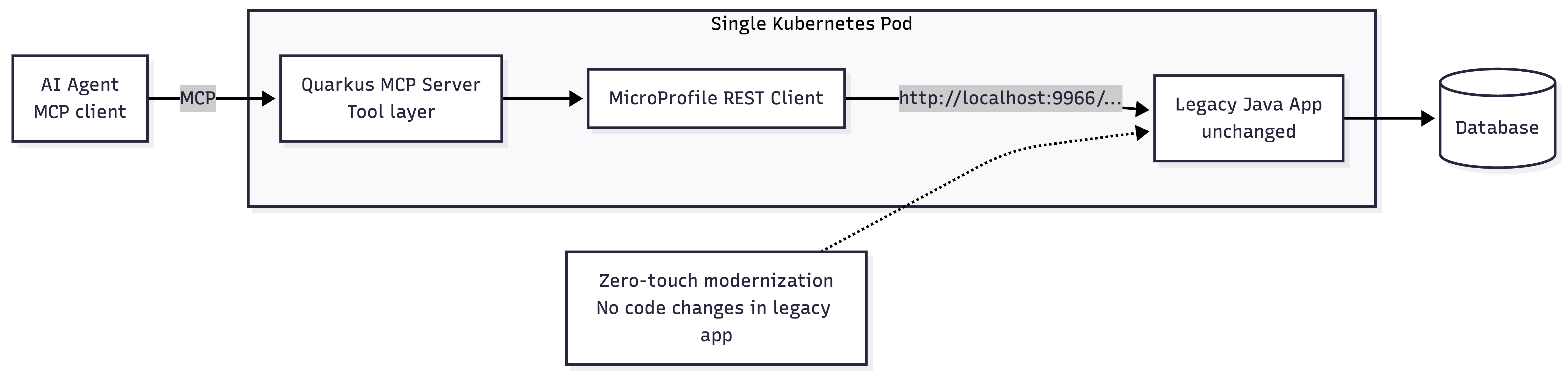 Expose Legacy Java Apps to AI Agents with the Kubernetes Sidecar Pattern 24.03.2026 10mLegacy systems are everywhere in enterprise environments. They run critical business processes, hold decades of data, and often cannot be rewritten easily. When teams start experimenting with AI agents, the first instinct is usually to expose new APIs or refactor the existing system so an LLM can interact with it.That approach breaks down quickly.Large enterprise applications have complex dependency trees, fragile integration points, and release processes that move slowly. A small change to expose a new endpoint can ripple through dozens of modules. What starts as “just one API for an agent” t...
-
 From Standard to Smart 09.03.2026 8mToday’s episode is a special one for me.I’m welcoming my friend and colleague Alex Soto to the show. If you follow the Quarkus ecosystem, you already know Alex. He has been shaping developer experience around Java and cloud-native for years. And today, he’s doing something very practical.He takes an existing Quarkus application. No greenfield. No clean slate. A real project. And he shows how to use IBM Bob to integrate LangChain4j step by step.This is important. Because most teams don’t start from zero. They have code. They have structure. They have production systems. The question is not “How...
-
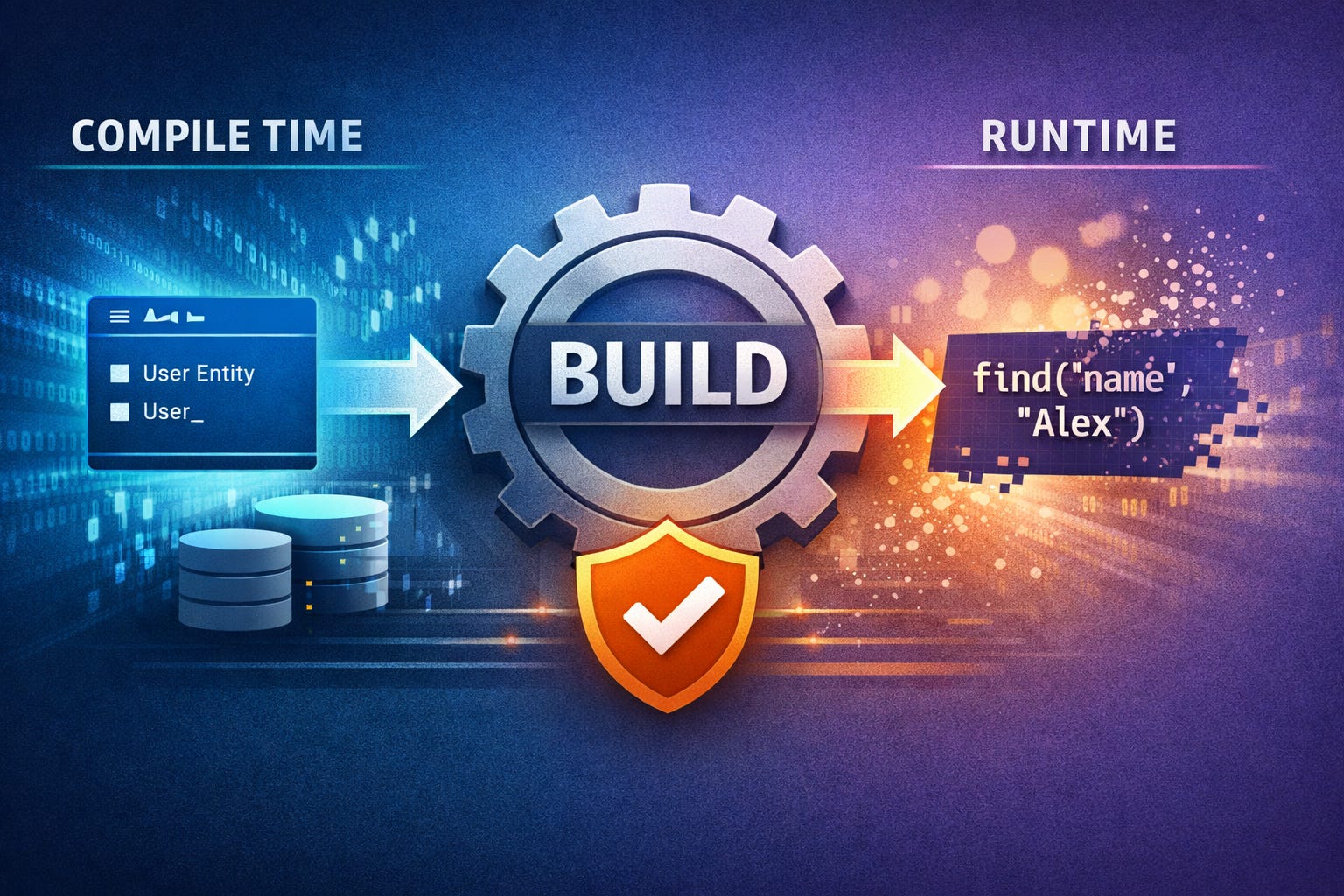 Most Java Persistence Bugs Are Boring. Quarkus 3.31 Fixes Them at Compile Time. 04.02.2026 8mWhen Alex talks about persistence, he usually does not start with syntax. He starts with consequences. In his recent deep dive on Jakarta Data in Quarkus 3.31.0, the real story is not a new annotation or another repository interface. The story is about moving database correctness from runtime to compile time.This matters because most persistence bugs are boring. They are not deadlocks or exotic transaction anomalies. They are simple things: renamed fields, broken query strings, invalid sort orders, and mismatches between entities and queries that only show up after deployment. Jakarta Data, as...
-
 What the 2025 U.S. AI Action Plan Means for Enterprise Java and ERP Systems 30.07.2025 5mThe U.S. AI Action Plan, while aiming to accelerate AI innovation by reducing "red tape" and fostering private-sector growth, explicitly states it does not override critical existing regulations like HIPAA (for healthcare) and SOX (for financial reporting). Instead, it seeks to harmonize AI adoption with these legal obligations. The plan acknowledges that complex regulatory landscapes have slowed AI adoption in sensitive sectors like healthcare and finance.I have taken a deeper look at what this means for the industry and gave both the Action Plan and my interpretation to Googles NotebookLLM t...
-
 Building Quarkus Apps With the CLI 28.07.2025 1mI just recently had a guest post up by Martin Stefanko and with Alex joining the rain, we now have a wonderful short intro up too! This is a public episode. If you would like to discuss this with other subscribers or get access to bonus episodes, visit www.the-main-thread.com
-
 Langchain4j, GraphQL, WebSocket Next and Buildpacks 27.05.2025 10mA little later than usual, but here it is. The weekly recap. Postponed due to RH Summit.NOTE: This is an AI generated Podcast with Google NotebookLM* Local AI with LangChain4j and Quarkus: Build an Email Task Extractor with Tool Calling - Published on May 13, 2025. This post introduces building a local-first AI application using Quarkus, LangChain4j, and local Large Language Models (LLMs) via Ollama. It demonstrates creating a simulation service that generates emails using one LLM and extracts tasks using another with LangChain4j's tool calling feature.* Supercharge Your Java APIs with GraphQL...
-
 From CDI Sorcery to Container Sanity: A Java Week in Review 12.05.2025 17mNOTE: This is an AI generated podcast exported from Google’s NotebookLM. I am still experimenting with this and am very excited to read about your feedback!In this packed fourth episode of Enterprise Java and Quarkus for Decision Makers, we navigate the rich terrain of modern Java development with Quarkus. From advanced CDI tricks like reactive dependency injection and custom scopes, to security-focused input validation and dynamic CSV ingestion magic — we’ve got your back.Ever wondered how to peek under the hood of your running Quarkus app? We break down Jolokia and Hawtio for real-time monit...
-
 Future-Proofing Enterprise Java: Security, Skills, and Smarter Deployments 04.05.2025 18mPlease remember: This is generated with NotebookLM from Google based on last weeks articles. Still an experiment. Feel free to give me feedback how useful this is for you and if you like it or not!This week's topics cover various aspects of modern enterprise Java development. The articles discuss practical steps for building and deploying cloud-native Java applications, particularly using Quarkus. Key areas include leveraging frameworks like Quarkus for efficient development, mastering dependency injection with CDI, and configuring applications for performance and minimal resource usage.We als...
-
 Enterprise Java and Quarkus for Decision Makers - Week in Review 27.04.2025 16mPlease remember: This is generated with NotebookLM from Google based on last weeks articles. Still an experiment. Feel free to give me feedback how useful this is for you and if you like it or not! In this week's episode, we explore key insights from the latest blog posts shaping the future of enterprise Java development with Quarkus. We start by addressing the top questions junior developers have when adopting Quarkus and what that means for onboarding strategies. We highlight the new Quarkus 3.21.3 maintenance release, focusing on stability, developer productivity, and native image improveme...
-
 Hot topics CW 15 21.04.2025 14mThis is a weekly recap of the articles published fed into NotebookLM and converted to a podcast episode of my two wonderful hosts discussing the high level implications of the individual pieces. I consider this an experiment. LMK what you think and if this is helpful or at least entertaining.Last week's articles centered around building various aspects of enterprise Java applications using the Quarkus framework. Here's a brief recap:* One key topic was setting up robust and reliable email notification systems with Quarkus. This included using the Quarkus Mailer extension, configuring SMTP, cre...
Similar podcasts


Popular in
The podcast also appears in the podcast charts of these countries.
