
Catholic Massterclass: All About Holy Mass
Father Bryan Kujawa
0
This podcast explores the Catholic Church's teaching on the Holy Mass, which it describes as the supreme form of worship for Catholics. Each episode uses brief soundbites to explain different aspects of the Mass. It is hosted by Father Bryan Kujawa and is aimed at helping listeners better understand the liturgy.
Episodes
-
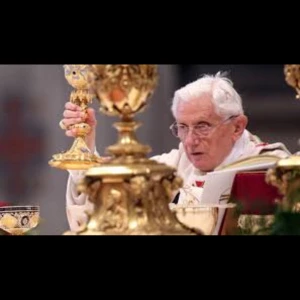 60. Eucharistic Miracles 27.04.2026 9mBig news, everyone: I think this will be our final Catholic Massterclass! I never thought it would last this long, and yet I think it could go even longer. Holy Mass is so rich! We’re going out with a mystery, which is fitting for our mysterious worship. Today we’re talking about Eucharistic miracles. A Eucharistic miracle is an extraordinary event in which God makes visible what is normally hidden. At every Mass, a true miracle takes place: bread and wine become the Body and Blood of Christ, though this change is invisible. In Eucharistic miracles, that same reality becomes visible in a way t...
-
59. Deacons 20.04.2026 9mThis week we’re going to talk about deacons. Although we don’t have any deacons in our parishes, you may attend Mass where a deacon is assisting the priest or bishop. It’s worthwhile to know what that role is all about. We have to go back to the Old Testament. In the Temple of Jerusalem, God established a clear distinction among His people. Only the priests—descendants of Aaron—could offer sacrifice. Yet they did not act alone. The Levites, drawn from the same tribe but not ordained as priests, were entrusted with assisting in the worship of God. They prepared what was needed, cared for the sa...
-
58. Bells During the Eucharistic Prayer 13.04.2026 5mToday’s Catholic Massterclass will focus on the use of bells during the Eucharistic Prayer. The GIRM provides this instruction: A little before the consecration, when appropriate, a server rings a bell as a signal to the faithful. According to local custom, the server also rings the bell as the priest shows the host and then the chalice (GIRM, no. 150). Two simple points about this: first, it is optional, not required, to use bells just before the consecration (often interpreted as the epiclesis) and at the elevation of the Sacred Host and Chalice after the gifts are consecrated; second, the c...
-
57. Bowing During Mass 06.04.2026 6mNow that we’ve completed our walk through the Mass, we’ll spend a few weeks talking about some unique topics surrounding and included in the Mass. This week’s topic is focused on the practice of bowing at the mention of sacred names and during the Creed. Bowing at the mention of sacred names is something that has largely fallen out of practice, although it is still the expected gesture (i.e. the norm) to be made at the appropriate times. Here is what the GIRM has to say about it: A bow of the head is made when the three Divine Persons are named together and at the names of Jesus, of the Blesse...
-
56. Prayer, Blessing, and Dismissal 30.03.2026 10mWe will finally reach the conclusion of Mass in this week’s Catholic Massterclass! What an incredible journey! Our final three actions to explore are the Prayer After Communion, the Blessing, and the Dismissal. All three are fairly brief, so we should be able to cover them all today. After a moment of silence, the priest offers the Prayer After Communion, which is provided in the Roman Missal. The prayer includes an acknowledgment that we have received the incredible gift of the Eucharist, while asking for that gift to bear fruit in our lives as we move forth into the world. This is a very imp...
-
55. Purification of the Vessels 23.03.2026 9mAfter the distribution of Holy Communion has finished, the priest takes a moment to purify the sacred vessels, making sure to clean and consume every crumb and every drop, rinsing them with water and making sure nothing is wasted. The principle comes from John 6 after the multiplication of the loaves, John tells us that Jesus instructed the disciples, “Gather up the fragments left over, that nothing may be lost” (John 6:12). Jesus has performed a different, better kind of miracle with bread for us, so we also want to make sure nothing of this miracle is lost. If the fragments of ordinary bread...
-
54. Reception of Holy Communion 16.03.2026 10mThis next part of Holy Mass goes beyond what words can describe. Our Lord Jesus gives Himself to us in Holy Communion. Most of this session will actually be very practical, but we first need to start with a simple reminder. We really believe the bread and wine have been changed into the living Body, Blood, Soul, and Divinity of Jesus crucified and risen from the dead. We believe it is the same Jesus on the altar and offered to us in Holy Communion that lived and walked in Israel 2000 years ago, albeit in the form of bread and wine. A miracle of God’s grace has taken place even though we can’t...
-
53. Behold, the Lamb of God 09.03.2026 10mAfter singing the Lamb of God and executing the accompanying actions and prayers, everyone kneels down again while the priest genuflects. The priest holds up the Eucharistic host and says, “Behold the Lamb of God; behold Him who takes away the sins of the world. Blessed are those called to the supper of the Lamb,” and everyone responds, “Lord, I am not worthy that you should enter under my roof, but only say the word and my soul shall be healed.” Let’s break this down a little bit. As we’ve discussed before, kneeling and genuflecting are common postures people take when recognizing the awesome...
-
52. Preparation for Holy Communion 02.03.2026 10mFor this week’s Catholic Massterclass, we’re not going to move forward just yet. Instead, I want to focus on something that most people don’t notice during this part of the Mass. Even though it often goes unnoticed, it is a critical moment — not only for the priest, but for each member of the congregation. I hope it opens your eyes in a new way to your preparation for receiving Holy Communion. Last week I spoke about the Lamb of God, the Fraction Rite, and the commingling of the Eucharistic Host and the Precious Blood of Christ. There is another part of that portion of the Mass that is easy to...
-
51. Fraction Rite and Agnus Dei 23.02.2026 10mThe next part of Holy Mass combines three different actions into one movement: the Fraction Rite, the Lamb of God (Agnus Dei), and the commingling of the Body and Blood of the Lord. Each of them reveals something distinct about what is taking place on the altar, but together they show one single mystery. Let’s take a closer look. While the Lamb of God is sung or recited, the priest picks up the Eucharistic host and breaks it. From one portion he breaks a small fragment and places it into the chalice, praying quietly, “May this mingling of the Body and Blood of our Lord Jesus Christ bring etern...
-
50. The Sign of Peace 16.02.2026 12mFollowing the Lord’s Prayer during Mass comes the Sign of Peace or the Rite of Peace. There are two places where instructions are given in the Roman Missal, once right in the Order of Mass and, before that, in the General Instruction of the Roman Missal, paragraph 82. It’s probably better to start with the paragraph from the GIRM. Paragraph 82 mentions three things about the Sign of Peace: first, it is to be understood as a preparation for Holy Communion, a time for the faithful people in the pews to express to each other that we share an ecclesial communion (we are united - hopefully we are u...
-
49. The Lord's Prayer 09.02.2026 10mThere is much more that could be said about the Eucharistic Prayers in the Roman Missal and in general, but we’ll move on to the next part of Holy Mass, which is the Lord’s Prayer. There are a few interesting points to make about the Lord’s Prayer and the surrounding text, including a surprise statement that many believe to have Protestant origins but really comes from the prayers of the early Church. The introduction to the Lord’s Prayer during Mass states: “At the Savior’s command and formed by divine teaching, we dare to say…” The Lord’s Prayer (often called the Our Father) is the only pray...
-
48. Eucharistic Prayer IV 02.02.2026 10mThe final of the primary Eucharistic Prayers, Eucharistic Prayer IV (EPIV) is easily the least used of them all. In fact, I wouldn’t be surprised if none of you had ever been at a Mass when EPIV was used. It’s a little strange to me why it isn’t used often, but it could be that it sounds a little different from the others and is a bit on the longer end of the spectrum. Here are some unique features of it: Eucharistic Prayer IV has its own Preface, which must be used whenever EPIV is used. The reason for this is that the Preface and the first half of the Prayer give a beautiful summary of Salva...
-
47. Eucharistic Prayer III 26.01.2026 8mFor many priests and laypeople alike, Eucharistic Prayer III settles as a nice middle ground between the Roman Canon and Eucharistic Prayer II. The General Instruction of the Roman Missal (GIRM) suggests that Eucharistic Prayer III is most appropriately used on Sundays and Holy Days of Obligation and many priests follow that suggestion. Here are some unique features of this Eucharistic Prayer: The very first paragraph after the Sanctus states that the Lord “never cease[s] to gather a people to yourself, so that from the rising of the sun to its setting a pure sacrifice may be offered to your n...
-
46. Eucharistic Prayer II 19.01.2026 10mLast week we looked at the longest Eucharistic Prayer (The Roman Canon) and this week we will look at the shortest Eucharistic Prayer (Eucharistic Prayer II). As I have mentioned the past couple of sessions of our Catholic Massterclass, there is controversy over the reality of options for the Eucharistic Prayer. Nonetheless, we have a variety and each of them has unique characteristics and often rich imagery in the prayers. Here are some unique characteristics of Eucharistic Prayer II (EPII): The first unique feature of Eucharistic Prayer II is that it includes its own proper Preface, though i...
-
45. Eucharistic Prayer I (The Roman Canon) 12.01.2026 12mWe’ll spend the next four weeks looking at each of the primary Eucharistic Prayers provided by the Church in the Roman Missal. The first one - Eucharistic Prayer I or the Roman Canon - is the longest and most connected to history. Many of us are aware that the look and sound of Mass was changed in the 1960s, going from Latin to the vernacular language of any given place. In the Traditional Latin Mass (TLM), there was one Eucharistic Prayer that was prayed at each and every Mass. If you were to translate that one Eucharistic Prayer into English, you would end up with something very similar to E...
-
44. The Eucharistic Prayer 05.01.2026 13mAfter the Holy, Holy, Holy (the Sanctus), the Mass enters its most sacred moment: the Eucharistic Prayer. Everything we have done so far has been leading to this prayer, and everything that follows flows from it. This is the prayer in which Christ’s sacrifice on the Cross is made present to us sacramentally. Although there are several Eucharistic Prayers, they all share the same essential structure. Understanding these common parts helps us recognize that we are participating in one great act of worship, not a series of separate prayers. The Eucharistic Prayer is always directed to God the Fat...
-
43. Holy, Holy, Holy 29.12.2025 8mThe Holy, Holy, Holy—the Sanctus—comes directly from Sacred Scripture. In Isaiah 6, the prophet hears the seraphim crying out “Holy, holy, holy is the LORD of hosts,” and in Revelation the same hymn resounds in the worship of heaven. This is the song of heaven itself. When we sing it at Mass, we are not merely recalling a biblical moment—we are entering into heavenly worship. The liturgy lifts us beyond time and space and unites us to what is always happening before the throne of God. Immediately after this hymn, we kneel. That posture is not accidental. In the Gospels, kneeling is one of the...
-
42. Prayer Over the Offerings and Preface 22.12.2025 8mOnce the gifts are prepared, the priest prays the Prayer over the Offerings. This prayer does not consecrate the gifts; rather, it formally offers them to God and asks Him to receive and sanctify what has been placed on the altar. This reflects a basic rule of biblical worship: offerings are never simply placed before God—they are named, offered, and prayed over. In the Temple worship, the priest did not improvise a new meaning for the gifts; he asked God to accept what He Himself had commanded. The Church does the same. The Prayer over the Offerings acknowledges that what lies on the altar is...
-
41. The Offertory 15.12.2025 12mEvery Sunday, after the General Intercessions, something quiet but deeply meaningful happens: the Offertory. Bread and wine are brought forward either by the people or by the servers, a song is sung, and the priest begins a series of prayers at the altar. As usual, there is a nice connection with Old Testament worship that has been brought up through Christian history. In the Temple, God commanded Israel to bring their gifts forward before the sacrifice was offered (see Lev 1; Lev 2; Deut 26). The people approached with their offerings—animals, grain, bread, wine—and placed them into the hands...
Similar podcasts


Popular in
The podcast also appears in the podcast charts of these countries.
