
Contemplating Culture: A Missionary Walk Through A Secular Age
Contemplating Culture
0
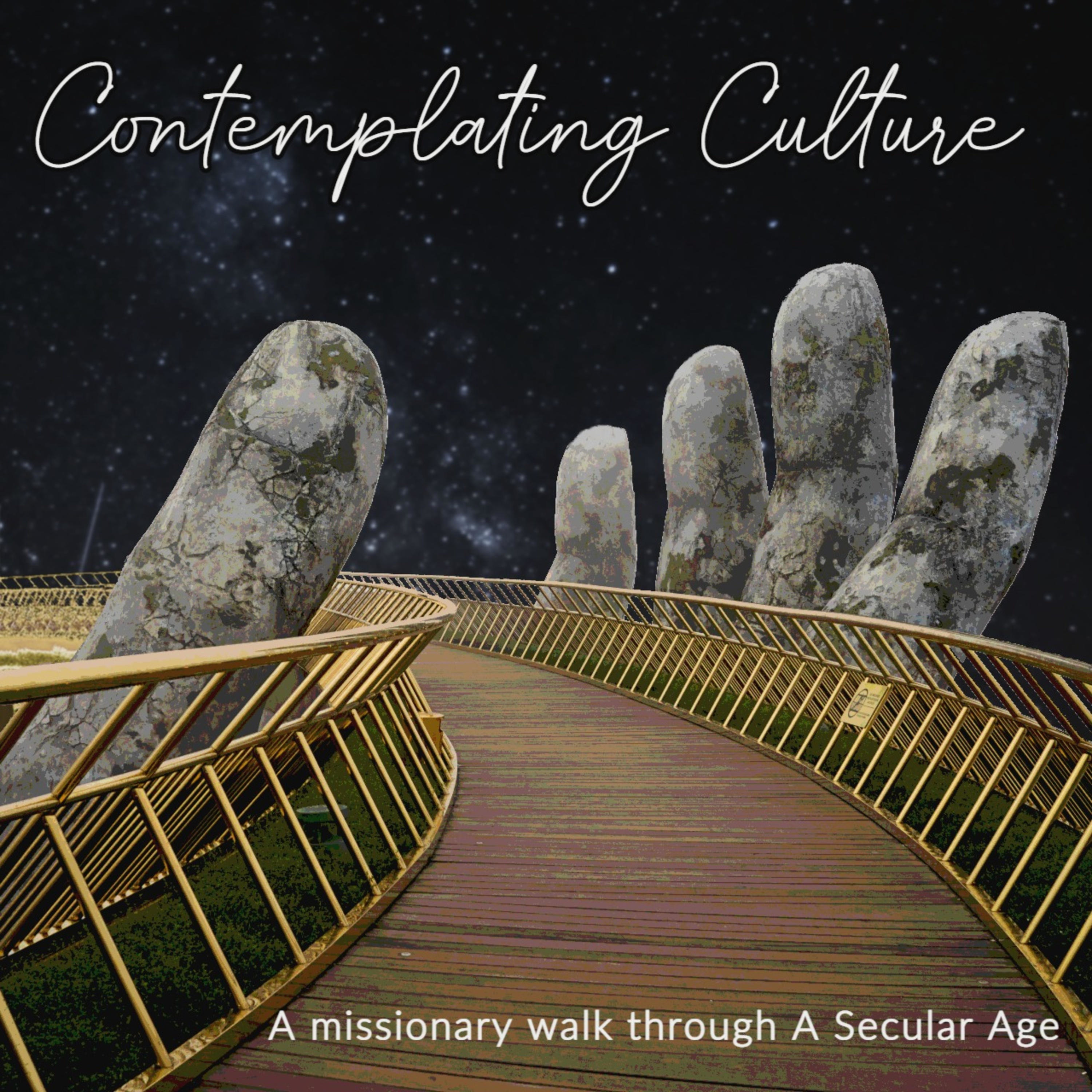
Part book-club, history lesson, philosophical pondering, sisterly conversation, launchpad for reflection, our hope beyond anything else is that Contemplating Culture blesses you. A Secular Age by Charles Taylor is a big fat book full of good stuff that most of the world's population will never read. So we're doing it for you. Kathryn is reading through the book and cartooning as she goes, taking these into conversations with Katherine. Together, we explore the state of contemporary culture, how we got here, and what this all means for us as missionaries in the world today.
Episodes
-
 52. The Spiritual Landscape of the Age of Authenticity 27.10.2026 37mIn this episode we look at the age of authenticity through the lens of its spiritual landscape. Key elements of this landscape that faith in our western world exists in include the shift of religion from something that actively shaped society to something that passively sits as a memory, the decreased influence on external factors for drawing someone into practice of religion, a strongly individualistic mindset, and lessened intergenerational continuity of religious affiliation and allegiance.References-A Secular Age by Charles Taylor (p. 513-535)
-
51. Post War Religion 25.08.2026 31mIn this episode we look at the changing shape of religion post WWII, taking the American case as an example. Here we see the interlocking and reinforcing interplay of family/church/state start to unravel in favour of the seeker, who has no set beginning, end, or path. We note that whilst this search is often seeking fullness in terms of humanism (for the good of the human person), this doesn't always have to be at odds with a genuine faith in the transcendent.References-A Secular Age by Charles Taylor (p. 505-513)
-
50. The Marketplace of Faith 21.07.2026 44mIn our milestone 50th episode we set about delivering a summary of the nature, rules, and people that can be found in the Age of Authenticity's marketplace of faith.Listen through for a special memento to celebrate the milestone with us!References-A Secular Age by Charles Taylor
-
49. The Sexual Revolution and the Shifting Place of the Sacred 07.07.2026 24mWhat impact did the sexual revolution of the 1960s and 1970s have on how people understood and interacted with the sacred? What has the response of the faith been to this dramatic shift in the western world?Together we explore these questions, and look ultimately to the teaching of Pope St John Paul II as a treasure trove the Age of Authenticity in understanding the beauty of the sexual ethic of the Catholic Church.References:-Pages of A Secular Age, Charles Taylor (pp 486-504)-https://www.youtube.com/@TheologyoftheBodyInstitute-https://www.youtube.com/@jasonevert
-
48. The Age of Authenticity 10.06.2026 41mLike every other age, the Age of Authenticity has its own set of ethics and goals. In this episode Kat opens up what it is like being a formator in a religious community and a spiritual director in the midst of this age, particularly when elements of the age seem at odds with the nature of religious life or Christian discipleship.References:-Pages of A Secular Age, Charles Taylor (pp 473-486)
-
47. Enduring Impacts of Mobilisation 26.05.2026 30mWith the rise of migration from rural areas into cities, people were displaced from community and there was a felt lack which provided the perfect ground for the emergence of the Age of Mobilisation. Many societal structures and efforts of evangelisation were based around the needs and nature of this Age. In this episode we explore what some of the elements of the Age of Mobilisation were, and the enduring impacts of it into Western society today.References:-Pages of A Secular Age, Charles Taylor (pp 437-472)
-
46. The Building of Secularisation 09.04.2026 27mIn this episode we begin a new section of A Secular Age, looking at how various parties construct their narratives of secularisation and the impact this has.There is a pervading notion that religion is either false, irrelevant, or unattractive, and that secularisation is a simple transfer of this reality via diffusion and differentiation. The narrative would say that those wishing to sustain religion must find new purpose to give it.We would say that it's the other way around- faith sustains us, and is the truest, most relevant, most attractive thing.References:-Pages of A Secular Age, Charles...
-
45. The Impact of the World Wars on Faith 26.03.2026 31mIn this episode we explore how the British synthesis of duty and altruism fared through the world wars. As faith was shaken, numerous options emerged (or were forged) to help people find a meaningful way forward.References:-Pages of A Secular Age, Charles Taylor (pp 407-419)
-
44. Duty, Discipline, and the Need for God 11.03.2026 28mIn this episode we examine the British ethic of the 19th century that arises with its principles of being British, decency, Protestantism, and civilisation. These values are embedded into schooling, and find their peak heading into the First World War. As always, a pendulum swing comes in the other direction advocating for the redemption of spontaneity and freedom, and a gamut of positions emerge as viable options. All positions will find something missing once they have removed the transcendent and tried to make sense of things without God.References:-Pages of A Secular Age, Charles Taylor (p...
-
43. New Paths in the 19th Century 25.02.2026 25mIn this episode we follow some of the cases of the increasing number of expressions of belief/unbelief that emerge in the 19th Century. The old faith is considered unbelievable, but much of what it offered comes to be seen as somewhat essential. It is a period of exploration, with many different trajectories emerging in the pursuit of something plausible.References:--Pages of A Secular Age, Charles Taylor: (377-390)
-
42. The Maturing of Unbelief 27.11.2025 27mAt the turn of the 19th century, two factors rise as influential in maturing the nova of unbelief that emerged in the 18th century, namely i) the scientific stance as a higher standard, and ii) the continued unfolding of the new cosmic imaginary that had little place for a personal God. Faith came to be seen as childish and immature, and even standard exclusive humanism came to be seen as not far enough in affirming the human person and their fulfilment.How are we called to respond as missionaries in this space? In this episode we explore the power of self-reflection, patience in accompaniment...
-
41. The Neutral Space of Beauty 06.11.2025 33mIn this episode we track the development of art as opening up a space of mystery and intrigue that comes to be a neutral space for unbelief to land in the Romantic era. While at first the arts largely captured inherently beautiful things and expressed them in the appropriate public context, the context was first removed and later the subject, such that art could then just be beautiful and about nothing in particular. Further, we posit that the next development has been that art no longer even has to be beautiful. But if beauty is something that naturally leads us to God, what does all this mea...
-
40. Deep Time and the Sublime 16.10.2025 38mWhat happens to our understanding of our world and who we are within it when we start to realise that there is a mystery surrounding the physical origins of humanity and the world?Charles Taylor highlights three themes that can emerge with this line of questioning:i) ruins and deep time (time), the sense that there is an unrecoverable past that we have emerged fromii) the sublime (space), the sense of the infinite expanse of nature at both the universe and microscopic levelsiii) the dark genesis of humanity (existence), the sense that our origins are mixed up mysteriously with that of the natu...
-
39. Marvel and the Modern Cosmic Imaginary 24.09.2025 27mIn this episode we explore two shifts that occur at the turn of the 19th century that start to provide meaningful shape to the experience of living at the time: i) the shift from a cosmos to the universe, ii) an understanding an acceptance of the evoluntionary process.As limits start to fade into a distant past, the imagination of the ordinary person slowly becomes more and more open to possibilities. Rather than despair, this should be a moment of hope for Christians as we realise that imaginations everywhere are open for the rich reality of the Gospel.References:-Pages of A Secular Age, Char...
-
38. Dissatisfactions with the Buffered Identity 04.09.2025 41mIn this episode we explore with Charles Taylor some of the felt dissatisfactions that begin to arise with the emergence of the buffered identity.In the realm of resonance, these include i) the notion that Deism is too tame and that we must take love seriously, ii) a revulsion at goodness being only at the level of self-interest, and iii) the feeling that life within the immanent order is too easily reduced to a code.In the realm of the romantic, these include i) the felt alienation of the self from the senses, ii) the felt alienation of the self from others, iii) the felt alienation of the sel...
-
37. Modern Objections to Christianity 16.07.2025 29mIn this episode we look at the objections of the Modern Moral Order to Orthodox Christianity:i) it offends reason by holding a place for mysteryii) it is authoritarian by holding an Almighty above us, offending both reason and freedomiii) it poses impossible problems of theodicyiv) it threatens the order of mutual benefit.Of these, we take a particular look at theodicy, and the range of responses people might take.References:-Pages of A Secular Age, Charles Taylor: (304-310)
-
36. The Malaise of Modernity 18.06.2025 28mIn this episode we enter into the halls of Part III of A Secular Age - The Nova Effect. Once there is one viable option of unbelief, more and more become available and viable, as do ways of believing, as well as options at every point in between - an explosion of options for belief and unbelief.Part III begins with Chapter 8 - The Malaises of Modernity, where Charles Taylor looks at what it feels like to be in a world so "progressed" and "free" but feeling like something isn't quite right.We take time to note where we see the malaise in the world around us, and the response it draws out.Refere...
-
35. Understanding Reality and Freedom 20.05.2025 32mIn a world where freedom has become such a key value, and in many ways is aligned with human dignity, does believing in God offend our freedom, or does it in fact provide a foundation for it?In this episode we explore the implications of "I think, there I am" both in terms of how we view what is and could be real, and how we understand our freedom. With the glorification of disengaged reason, we can be fooled into thinking our mind is the sole maker of meaning in the universe."Disengagement may be quite the wrong way to go about increasing understanding" (p. 285)"The prestige of the stance beg...
-
34. Tensions Between Classical Thought and Christianity 06.05.2025 40mIn this episode we look at 6 tensions between classical Greek thought and Orthodox Christianity as they played out in the aftermath of the Enlightenment: i) the importance of the body, ii) what of our lives is important when we reach our ultimate end, iii) the sense of the individual in eternity, iv) the importance of contingency and the unfolding of history, (v) the importance of the emotions, and vi) the human person as one who is capable of divine communion.For each of these, we've formulated a reflection question for you to think and/or discuss and/or pray about:i) Is the body part of the...
-
33. From God as Agent to God as Architect 22.04.2025 23mWith this episode we begin to look at the chapter 'The Impersonal Order'. As the exclusive authority of reason applied to the natural sciences starts to be applied to other fields, the communal image of God starts to shift. God is relegated to the sidelines with the Deist notion that he has set up the world and it is now left to humanity to make of it what we will.Taylor claims that this movement was powered not only by reason, as some would posit, but an emerging distaste for 'old religion':"The slide to Deism was not just the result of 'reason' and 'science', but reflected a deep-seated mora...
Similar podcasts


Popular in
The podcast also appears in the podcast charts of these countries.
