
Vanishing Gradients
Hugo Bowne-Anderson
0
A podcast for people who build with AI. Long-format conversations with people shaping the field about agents, evals, multimodal systems, data infrastructure, and the tools behind them. Guests include Jeremy Howard (fast.ai), Hamel Husain (Parlance Labs), Shreya Shankar (UC Berkeley), Wes McKinney (creator of pandas), Samuel Colvin (Pydantic) and more.
Episodes
-
 The Science and Engineering of Agent Work 12.10.2026 2h 22mHilary Mason, CEO of Hidden Door, works with agents across software development and creative projects. Drawing on Richard Hamming’s distinction between science and engineering, she describes agents as “bringing the science back into the engineering and the engineering back into the science.”When you can build and test more ideas, how do you decide which ones are worth keeping? A plausible analysis still needs scientific judgment, creative output needs taste, and a chart needs to preserve its meaning when an agent revises it.In this second episode of Show Us Your Agent Skills, Thomas Wiecki & I...
-
 The State of Agentic Data Science 05.10.2026 59mAgents can write the code, run the analysis, and produce a convincing explanation. How do you check that they’ve answered the right question, used the data appropriately, and reached a conclusion you can act on?I joined Gaël Varoquaux (scikit-learn, Inria, and Probabl), Shipra Arora (Bain & Company), and Luca Fiaschi (PyMC Labs) to explore how data scientists are delegating work to agents and building verification into that process: combining programmatic checks, agents critiquing other agents’ work, and human judgment about the problem and its consequences.That changes where we spend our time...
-
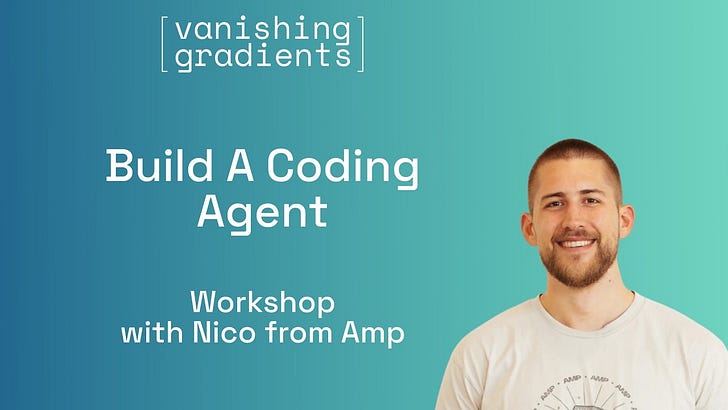 How to Build a Coding Agent with Nico (Amp Code) 15.09.2026 1h 52m“It’s an LLM, a loop, and enough tokens.”—Nicolay Gerold, Amp CodeSo why does a coding agent forget your instructions, keep reading tiny pieces of a file, or struggle with an edit another model handles easily?Nicolay Gerold (Amp) joins Hugo to take that loop apart and explain the harness around it: the software that executes tools, manages context, and lets you steer the agent’s work. Nico builds this machinery for Amp, a coding agent that works across software projects.“Every component in a harness is basically an assumption the model can’t do it on its own. This expires over time.”— Nicolay...
-
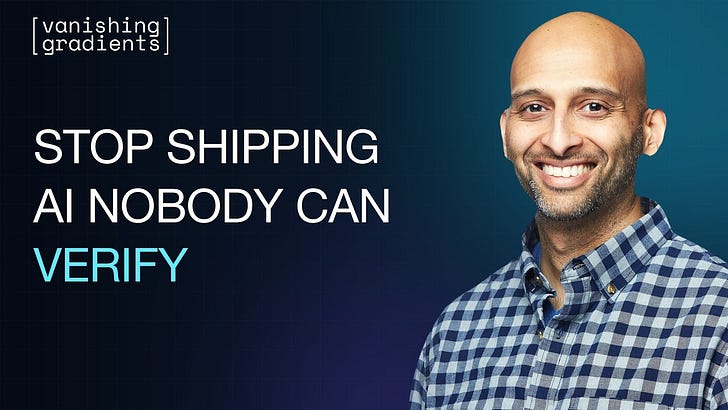 The Rise of the AI Scientist 04.09.2026 1h 10m“If you feel that a product is hard to eval, or you feel like, ‘I don’t even know how to eval this,’ it’s a strong smell that your product isn’t good.”— Hamel Husain, on AI product designAn AI data agent tells you last quarter’s net revenue. It doesn’t show the metric definition, source tables, filters, query, intermediate calculations, or assumptions. You can’t trust the answer without asking a data scientist to reproduce it.Hamel Husain argues that the eval problem is evidence of bad product design. If the user can’t inspect the work well enough to decide whether the answer is right, another...
-
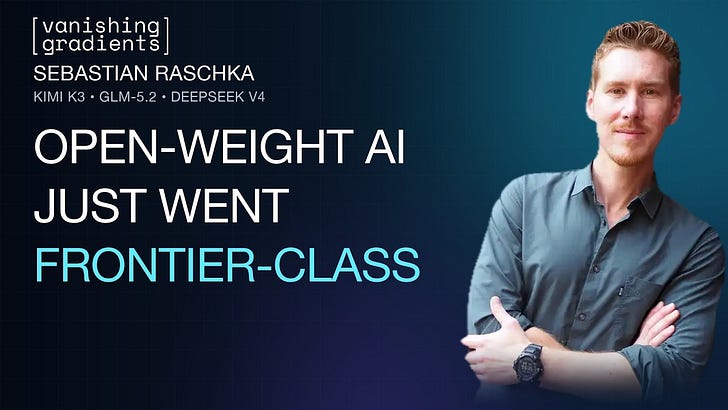 If Developers Build on Chinese Open-Weight Models, Who Leads AI? 03.08.2026 1h 18m“It would be sad if local models were not an option and there were only proprietary models. It’s good to have alternatives. Competition is good for business.”— Sebastian Raschka, on open-weight AIKimi K3’s weights landed about an hour before Hugo Bowne-Anderson and Sebastian Raschka went live. Sebastian had already updated his architecture diagram. That speed captures his approach to the current model wave: wait until the weights exist, run the model in the harness where it will actually work, then inspect the architecture closely enough to understand what changed.The conversation arrived duri...
-
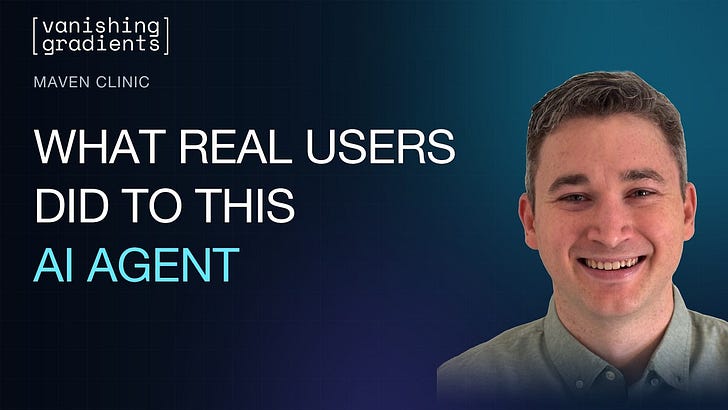 Four Months Inside a Production AI Agent: What Real Users Changed 25.07.2026 1h 4mWhen ML/AI Engineer William Horton last joined me, Maven Assistant had reached its first external users the day before. The healthcare AI agent was available to 20 percent of Maven Clinic’s users, and the team had deliberately withheld answers about benefits. A wrong response could shape a decision involving $15,000 of fertility coverage, and the evals had not earned the right to ship it.Four months later, Maven Assistant is available to 100 percent of users, benefits answering is live, and weekly conversation volume has grown by roughly ten times. Real usage also overturned part of the roadma...
-
 Building an Enterprise AI Agent for Healthcare 17.07.2026 1h 8mEvery capability in an agent needs its own evidence and release bar. A model-provider slip, an incorrect tool call, and a wrong fertility-benefits answer should not be held to the same pass rate.William Horton, Staff AI Engineer at Maven Clinic, joined us the day after Maven Assistant reached its first external users. The agent helps members inside Maven Clinic’s women’s and family healthcare platform find providers, manage appointments, navigate Maven, and get basic health information. William had spent much of launch day reading chat traces and turning the surprises into product decisions an...
-
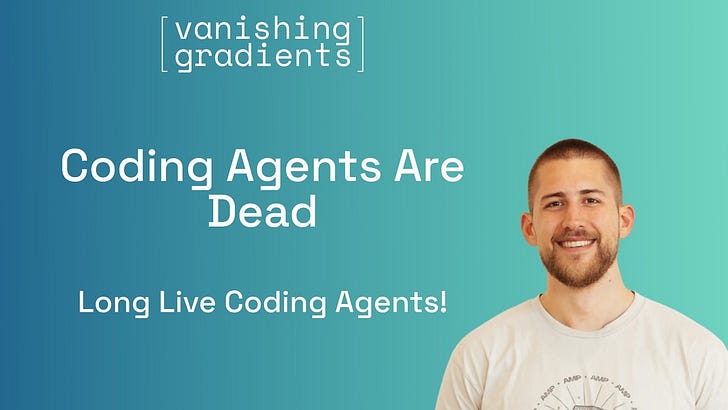 What Claude Fable Means for Coding Agents 08.07.2026 1h 2mNicolay Gerold works all day and night on AMP, one of the most interesting coding-agent harnesses out there.If you’re building with coding agents, this conversation will help you understand: * when to trust the model, * when to build harnesses around it,* which model is worth paying for, * which programming languages gives the agent better feedback, and * when to take the keyboard back.Coding-agent products are living inside a blender. Opus 4.8 to Fable changes what the model can be trusted with, eats a workflow, and suddenly the best product decision is to delete code.AMP had handoff because...
-
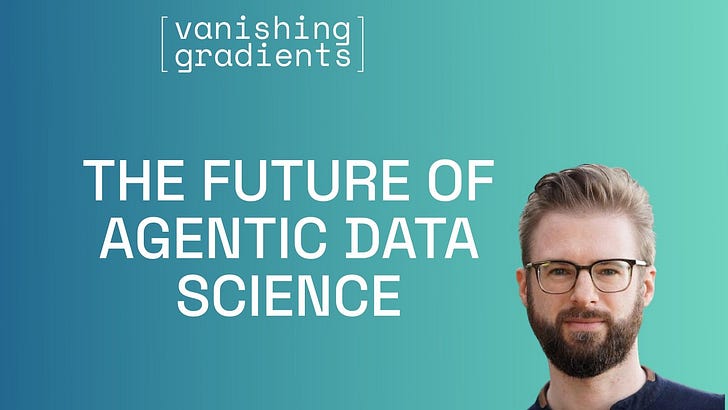 The Future of Agentic Data Science 25.05.2026 1h 4mSo I think we’re really at a historical moment, and the opportunity is massive. Almost 15 years ago, we were promised that data science was going to be this incredible thing and create all this value for people. And I think nowadays it’s mostly viewed as a cost center in most companies. I think we can really now fulfill that original promise with agentic data science. Thomas Wiecki, Co-creator of PyMC and Founder at PyMC Labs, joins Hugo to talk about how agentic data science is finally fulfilling the promise of Decision Intelligence.We Discuss:* Decision Engines: Transform data science from a...
-
 Agent-Harness.ipynb* 20.05.2026 1h 19mOne thing that I don’t like about Claude is that you get into this weird mental state: oh, I think I trust the model. Let’s do the slot machine. Hit click, which puts you in an inactive mode of thinking. Maybe it’s better to use a worse model….Vincent Warmerdam, senior data professional and prolific open-source maintainer (some packages with over a million downloads), now Engineer at marimo, joins Hugo to talk about how the Python notebook is evolving from a static scratchpad into a working agent harness, and what it takes to stay in the loop as a developer when agents are writing most of the...
-
 Agentic Engineering and the Lost Art of Verification 12.05.2026 1h 32m> I almost don’t read code now. My approach with Roborev is it’s like my code reader. The mantra is: Roborev reads every line of code that is generated. It gets read multiple times. And so, whenever I push up a pull request, the branch gets re-reviewed. And so by the time I’m merging a pull request into a repository, the code has all been read by agents four or five times minimum. I look at the code in terms of structural detail: does it look right?— Wes McKinney (creator of pandas, POSIT)Wes, Jeremiah Lowin (Prefect), and Randy Olson (Good Eye Labs) join Hugo and his cohost Thomas Wiecki (PyM...
-
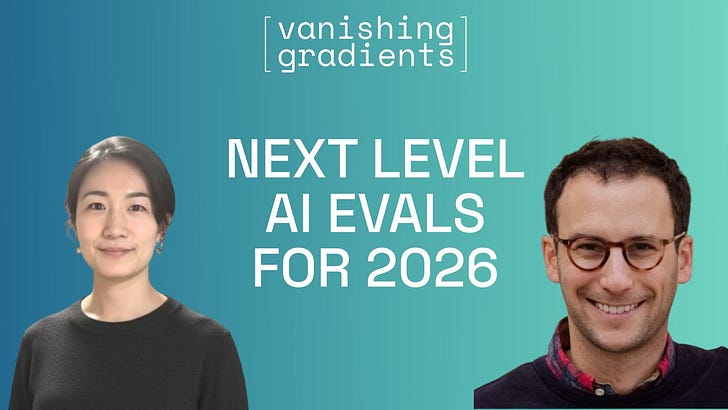 Next Level AI Evals for 2026 23.04.2026 53mThere are a lot of reasons why we should do AI evals. For many companies doing AI evals is the way to build the feedback loop into the product development lifecycle. So it is like your compass. We’re using AI evals as a compass to guide product development and also product iteration. And also, many times we need evals to function as the pass or fail gate in release decisions. Whether this product is good enough for release or whether it is good enough for experiment, evals are also used in that.Stella Wenxing Liu, Head of Applied Science at ASU, and Eddie Landesberg, Staff Data Scientist at Go...
-
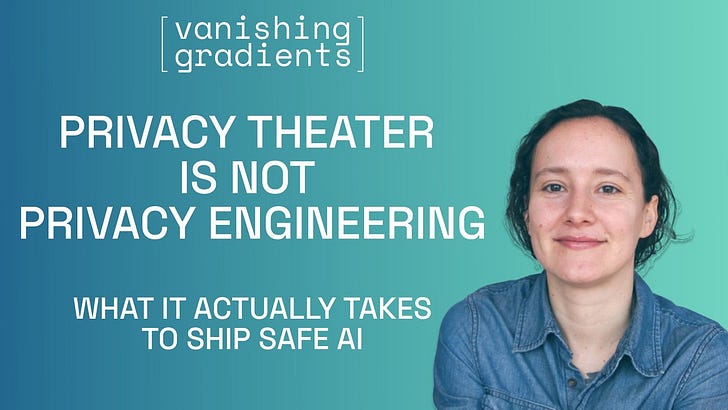 Privacy Theater Is Not Privacy Engineering: What It Actually Takes to Ship Safe AI 15.04.2026 1h 6mKatharine Jarmul, Privacy in ML/AI Expert & Author of Practical Data Privacy, joins Hugo to unpack why most AI privacy advice is theater: and what technical privacy actually looks like when you’re shipping LLMs, agents, and multimodal systems into the real world.In this episode, we dig into how to build defensible systems in an era of AI agents and multimodal models: why system prompts (and your entire agent harness!) should be considered public by default, and why “privacy observability” is as critical as data observability for anyone building with LLMs today. Multimodal is what changes the t...
-
 LLM Architecture in 2026: What You Need to Know with Sebastian Raschka 13.04.2026 1h 18mIf you take a model release as an anchor point, let’s say Nemotron 3 or Qwen 3.5, you can go in both directions: You can either plug them into an agent and play around with that, or you can look, okay, what does the model look like under the hood? What are the ingredients? What type of attention mechanism do they use? What are currently research techniques that could make that even better in the next generation of models? What can we swap out, basically? And I’m interested in both of these!Sebastian Raschka, Independent AI Researcher and author of Build a Large Language Model from Scratch, joi...
-
 Episode 72: Why Agents Solve the Wrong Problem (and What Data Scientists Do Instead) 20.03.2026 1h 33mI often see what I would consider to be b******t evals, especially in data, like write this dumb SQL. Almost every one of these dumb SQL questions that I’ve seen for benchmarks are just so either obviously easy or overwhelmingly adversarial. They just, they don’t feel valuable as a data scientist, it’s something that you probably would never ask a real data scientist to do. So I went out my way to create real ones. Let me read one to you.Bryan Bischof, Head of AI at Theory Ventures, joins Hugo to talk about what happened when 150 people spent six hours using AI agents to answer real data scien...
-
 Episode 71: Durable Agents - How to Build AI Systems That Survive a Crash with Samuel Colvin 18.02.2026 51mOur thesis is that AI is still just engineering… those people who tell us for fun and profit, that somehow AI is so, so profound, so new, so different from anything that’s gone before that it somehow eclipses the need for good engineering practice are wrong. We need that good engineering practice still, and for the most part, most things are not new. But there are some things that have become more important with AI. One of those is durability.Samuel Colvin, Creator of Pydantic AI, joins Hugo to talk about applying battle-tested software engineering principles to build durable and reliable AI a...
-
 Episode 70: 1,400 Production AI Deployments 12.02.2026 1h 9mThere’s a company who spent almost $50,000 because an agent went into an infinite loop and they forgot about it for a month.It had no failures and I guess no one was monitoring these costs. It’s nice that people do write about that in the database as well. After it happened, they said: watch out for infinite loops. Watch out for cascading tool failures. Watch out for silent failures where the agent reports it has succeeded when it didn’t!We Discuss:* Why the most successful teams are ripping out and rebuilding their agent systems every few weeks as models improve, and why over-engineering now...
-
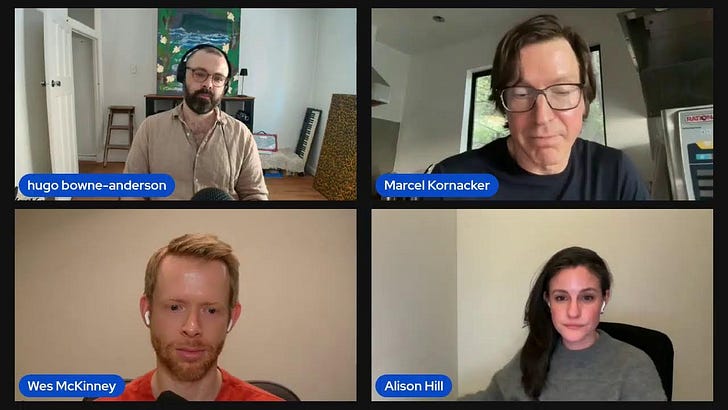 Episode 69: Python is Dead. Long Live Python! With the Creators of pandas & Parquet 03.02.2026 55m> It’s the agent writing the code. And it’s the development loop of writing the code, building testing, write the code, build test and iterating. And so I do think we’ll see for many types of software, a shift away from Python towards other programming languages. I think Go is probably the best language for those like other types of software projects. And like I said, I haven’t written a line of Go code in my life.– Wes McKinney (creator of pandas Principal Architect at Posit),Wes McKinney, Marcel Kornacker, and Alison Hill join Hugo to talk about the architectural shift for multimodal AI, the...
-
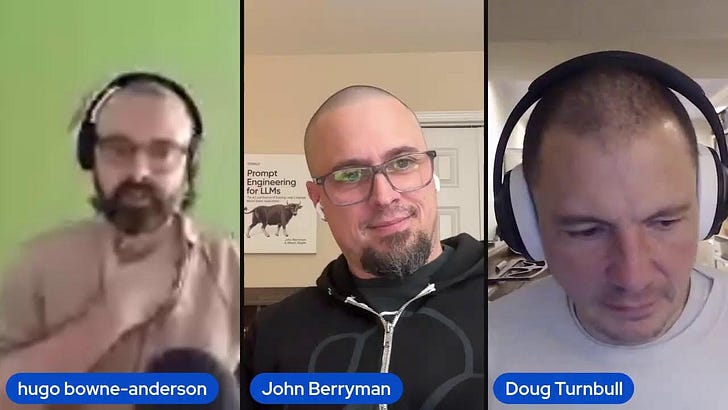 Episode 68: A Builder’s Guide to Agentic Search & Retrieval with Doug Turnbull & John Berryman 23.01.2026 1h 28mThe best way to build a horrible search product? Don’t ever measure anything against what a user wants.Search veterans Doug Turnbull (Led Search at Reddit + Shopify; Wrote Relevant Search + AI Powered Search) and John Berryman (Early Engineer on Github Copilot; Author of Relevant Search + Prompt Engineering for LLMs), join Hugo to talk about how to build Agentic Search Applications.We Discuss:* The evolution of information retrieval as it moves from traditional keyword search toward “agentic search“ and what this means for builders.* John’s five-level maturity model (you can prototype today!)...
-
 Episode 67: Saving Hundreds of Hours of Dev Time with AI Agents That Learn 14.01.2026 1h 18mThis is continual learning, right? Everyone has been talking about continual learning as the next challenge in AI. Actually, it’s solved. Just tell it to keep some notes somewhere. Sure, it’s not, it’s not machine learning, but in some ways it is because when it will load this text file again, it will influence what it does … And it works so well: it’s easy to understand. It’s easy to inspect, it’s easy to evolve and modify!Eleanor Berger and Isaac Flaath, the minds behind Elite AI Assisted Coding, join Hugo to talk about how to redefine software development through effective AI-assisted codin...
Similar podcasts


Popular in
The podcast also appears in the podcast charts of these countries.


