
Angela Watson's Truth for Teachers
Angela Watson
0
Truth for Teachers is a podcast designed to speak life, encouragement, and truth into the minds and hearts of educators. It aims to energize teachers for the week ahead with practical advice and inspiration. The show is hosted by Angela Watson, an experienced educator and author.
Episodes
-
 EP357 6 ways to prime students' brains for learning 27.09.2026 30mYou've probably heard the phrase "activate prior knowledge" a million times. It shows up in every lesson plan template, every observation rubric, every methods textbook. And teachers are good at it. But the behavioral science on how priming actually works in the brain goes way deeper than asking kids what they remember from yesterday, and once you understand it, you start seeing opportunities to prime learning in places you probably weren't looking. In this episode, I walk you through six research-backed ways to prime students' brains for learning, all grounded in cognitive science, and most of them are things you can try this week without changing your curriculum, your schedule, or anything about your school's expectations. We get into what priming actually is (and I'm honest about which parts of the priming research have held up and which parts haven't), and then I share six specific strategies with classroom examples for every grade level. We cover how to use the 60-second window before class actually starts, how to treat your opening hook as instruction rather than just engagement, how to use prequestions the way the 2024 ManyClasses study suggests they actually work, how to prime the emotional state kids walk in with, how to prime the cognitive mode you want them in (scientist, historian, writer), and why the last 30 seconds of class matter more than most teachers realize. If you've ever felt like a great Monday lesson somehow evaporated by Tuesday, this episode gives you a clearer lens for evaluating what you're already doing and where you might tweak. You don't need to overhaul anything. You just need to start noticing the priming that's already happening in your classroom and making more deliberate choices about what you're priming kids for. LIsten on or read: https://truthforteachers.com/truth-for-teachers-podcast/6-ways-to-prime-students-brains-for-learning/
 -
 EP356 The digital delusion: Is classroom tech hurting how kids learn? (with Dr. Jared Cooney Horvath) 13.09.2026 1h 16m"My toaster has undergone more safety and efficacy testing than any piece of ed tech that's been put in front of our kids in the past 20 years." That's according to Dr. Jared Cooney Horvath, a neuroscientist, university professor, and former classroom teacher whose book "The Digital Delusion" has become the center of a national conversation about screens in schools. He's testified before the U.S. Senate, and parents are handing out copies at school board meetings. Jared's argument is that we've spent decades and $400 billion building an ed tech industry on a promise that never materialzed, and that the tools we've handed kids are working against the way human beings actually learn. I came into this conversation agreeing with a lot of his premise and pushing back on some of it, particularly the reliance on standardized test scores as evidence of learning outcomes and the assumption that school was working well before devices showed up. Jared took the pushback seriously, and what came out of it is one of the deepest (and certainly lengthiest!) conversations I've had about whether the ed tech promise keeps failing and what teachers can actually do about it. We dig into: Why the work of learning goes against our natural human biology, and what that means for a tool designed to remove friction What "engagement" means at the level of the brain, and why gamified learning keeps kids entertained without teaching them much The only two use cases where the research shows ed tech genuinely works (and why neither are very exciting) The difference between what a tool could do and what kids will actually do with it -Whether school was actually working better before devices, and what we lost that's worth going back for Jared makes the case for reintroducing friction and eliminating tech as the default rather than banning it outright, and shares what to say to admin and parents when you want to teach differently. Most importantly, Jared makes the case for teacher autonomy and why you need to trust your own expertise about student learning. This conversation ended in a more hopeful place than I expected, and I hope you'll carve out some blocks of time to go deep with us on this topic. It takes time to tease out the nuance, and that's where the most important takeaways are. LIsten on or read: https://truthforteachers.com/truth-for-teachers-podcast/the-digital-delusion/
 -
 EP355 A short history of the 8-hour workday (and how to protect yours) 30.08.2026 23mA third of your day (apart from work and sleep) is supposed to be yours. So where does it go? In 1817, labor movement activist Robert Owen coined this rallying cry: "Eight hours for work, eight hours for sleep, and eight hours for what we will." But if you've ever tried to make that math work as a teacher, you know the catch. In those "eight hours for what you will," we have to fit commuting, cooking, cleaning, errands, caregiving, homework help, and all the invisible labor of running a life. How do we actually make space for the things that bring us joy? In this episode, I unpack the labor history most of us were never taught, and why I find it a little ironic that I now run a program called the 40 Hour Teacher Workweek. I also talk about the gendered piece of this history that rarely gets named. Women were absolutely part of the labor movement (Frances Perkins literally drafted the Fair Labor Standards Act), but they still ended up with the second shift waiting for them at home. And teachers, who are still overwhelmingly women, are living that reality every single day. I share three practical things I've learned from Katrina Onstad, author of The Weekend Effect, about how to actually reclaim some of that "what you will" time. I also talk about why I refuse to frame rest as a productivity tool, and what I think we owe the workers who fought and died for the protections we now take for granted. This Labor Day, I hope you'll listen to this one somewhere restful. And I hope it gives you permission to protect your time, not because it makes you a better teacher, but because you're a person who deserves a life outside of school. Listen in. Or read the transcription here.
 -
 EP354 You don't have to teach like an influencer. 16.08.2026 20mIf you scroll social media right now, you'll probably land on a teacher revamping their reading corner like it's a home renovation reveal, then a TikTok Shop haul of classroom must-haves you didn't know you needed nine seconds ago, then someone who built an entire year's curriculum with AI in under a minute. And somewhere underneath all of it is this creeping feeling that you're already behind, and the school year has hardly even started. In this episode, I'm telling a story about a veteran teacher I worked next door to early in my career, and why I think about my mistake in emulating her every time some new pendulum swing happens in education. And, I discuss how a lot of what shapes our thinking about teaching no longer originates from trainings or mentors or our own gut instincts and professional expertise. It's coming from whichever five seconds of video happened to outperform in an algorithm built to sell ads, not to teach well. The truth is that you don't have to teach like the teacher down the hall, and you don't have to teach like an IG influencer. You just have to keep asking the question I had to learn the hard way: is this authentic to my teaching philosophy, or am I performing someone else's idea of what a good teacher looks like? Listen in. Or read the transcription here.
 -
 EP353 Think out loud: teaching the hidden skills of planning and prioritizing 02.08.2026 25mYou make dozens of invisible decisions every class period. Should I squeeze in one more activity or leave time for questions? Do I spend more time on this concept or move on? Is this the best use of our remaining five minutes? You weigh options, estimate time, and reprioritize on the fly, and you do it so automatically that you barely notice anymore. But here's the problem: your students have no idea any of this is happening. They just see you move seamlessly from one thing to the next. If kids never see how you plan, prioritize, and adjust, how are they supposed to learn to do it themselves? In this episode, I'm talking about how to make your thinking processes visible to students, and why it matters so much. We'll cover how to talk through your weekly overview so kids learn to anticipate where their time and energy should go, how to involve students in prioritizing decisions (like "We have five minutes left, should we do X or Y?"), how to model breaking down projects into manageable steps, why most people are bad at estimating time and what to do about it, and what to say when things go off track and plans need to change. These are teachable skills, but kids won't pick them up through osmosis. They need to see it modeled, and even better, they need to be invited into the process. Listen or read the episode here: https://truthforteachers.com/truth-for-teachers-podcast/think-out-loud-teaching-the-hidden-skills-of-planning-and-prioritizing/
 -
 EP352 Why distress tolerance is the missing piece in classroom management 19.07.2026 25mDo your students seem less and less able to sit with anything uncomfortable, whether that's boredom, confusion, frustration, or the feeling of not immediately knowing the answer? The research backs up your anecdotal evidence: distress tolerance in young people is measurably declining. In this episode, I dig into why this is happening and what teachers can actually do about it. We'll talk about the biology behind why comfort reduces resilience (and why that's not anyone's fault), why our students are more stressed than ever but building less capacity from it, and practical strategies for building distress tolerance in the classroom without being dismissive of real struggles. I also get into how this applies to us as adults, because we're dealing with their own version of this. Listen in to hear: Why distress tolerance is declining in young people, and why it's a predictable biological outcome rather than a character flaw The difference between chronic, overwhelming stress (which breaks people down) and acute, manageable stress (which builds capacity), and why modern life has gotten this equation backwards How stress inoculation works in the classroom, including specific strategies for gradually building students' ability to sit with discomfort The tension teachers feel between "tough it out" and "honor every feeling," and why both extremes fail How to help students distinguish between "I can't" and "I don't want to" Why normalizing the feeling of not knowing might be one of the most powerful things you can do Where teachers can apply this same thinking to their own lives Listen in. Or read the transcription here.
 -
 EP351 What does learning science actually say about AI in the classroom? (with Erin Mote) 28.06.2026 47mEveryone has an opinion about AI in classrooms right now, but very few of those opinions are grounded in what we actually know about how kids learn. In this episode, I sit down with Erin Mote, CEO and founder of InnovateEDU and co-founder of Brooklyn Laboratory Charter School, to cut through the noise and talk about what the evidence actually shows about AI as a learning tool. This isn't a conversation about ChatGPT, cheating, whether to ban devices, or what kids are doing with AI at home on their own time (which are separate topics worthy of their own discussion). We're talking specifically about AI-powered tools designed for classroom use that are being pitched to your district and showing up in your school, and whether they hold up when measured against what we know about how kids learn. In this episode you'll hear Erin share her thoughts on: Why "good enough" consumer tech is not good enough for students, and what to look for in tools that are actually built around learning The difference between sycophantic AI and Socratic AI, and why it matters for student outcomes What the early research is showing about AI as a learning tool, including what's promising and what we still don't know What to ask for and advocate for at the school and district level so these decisions aren't made without you If you've been feeling overwhelmed by the pace of change and unsure what to actually do, this episode will leave you with more clarity, and more confidence in what you already know about how kids learn. Listen in. Or read the transcription here.
 -
 EP350 The power of regret: using hindsight as a tool for growth 14.06.2026 25mTeaching gives you a lot of opportunities to look back and wish you'd done it differently, and most of us carry those regrets way longer than we need to. In this episode, I'm sharing what I learned from Daniel Pink's book The Power of Regret: How Looking Backward Moves Us Forward, and how his research applies to the unique kind of regret that teachers carry. I'll walk you through the four categories of regret most people have, the difference between "if only" and "at least" thinking, and a three-step process for actually processing a regret instead of just ruminating on it at 2 a.m. I'll also share the line from Pink's book that hit me hardest, the one that completely changed how I think about looking back: If you know what you truly regret, you know what you truly value. Your regrets aren't proof you've failed this year. They're a map of what you care about. If you've been carrying something from this school year and you're not sure what to do with it, this episode is for you. Listen in. Or read the transcription here.
 -
 EP349 Re-awakening kids' curiosity & connection to real food through sensory learning (with Bee Wilson) 31.05.2026 35mFood writer Bee Wilson has been in classrooms across the UK, and what she's discovered is startling: many children have completely lost their sensory connection to real food. They know the peach emoji but not the fuzzy feel of actual peach skin. They recognize mint from shampoo but have never smelled a fresh mint leaf. When asked where food comes from, kids used to say "the supermarket." Now they say "mommy's iPad." This slow shift is revealing a new gap in child development that affects how kids observe, describe, and engage with the world around them. In this episode, Bee explains what's lost when children grow up disconnected from real food. And she explains what can happen when you put fresh produce in their hands and simply ask: What do you see? Bee shares how these lessons build scientific observation skills, spark rich oral language, and get even the most reluctant writers eager to put words on paper. Kids speak in vivid similes and metaphors. They notice details they've never noticed before. And, teachers report some of the most meaningful classroom experiences of their careers. Bee is the co-founder of TastEd, a charity offering free sensory food education resources now used in over 1,800 UK schools: tasteeducation.com She's a fascinating guest sharing practical ways any teacher can bring this into their classroom, including a simple lesson you could try tomorrow. Listen in. Or read the transcription here.
 -
 EP348 Stuck in survival mode? Here's how to calm your nervous system. 17.05.2026 18mMost of us are walking around in a low-grade state of fight-or-flight all the time, and we don't even realize it. It looks like the tight jaw in the morning, the exhaustion that doesn't lead to sleep, or the feeling of being on edge even on a good day. These are signs of a nervous system that never got the signal that it's safe to come down. In this episode, I'm sharing a lesson from my new free video course called Everything is Terrible: An Anxiety Toolkit for the Age of Doomscrolling. It's a five-lesson toolkit for people who care deeply about the world and are quietly exhausted by the weight of it. Each lesson is a standalone tool you can use when you need it. This episode shares an excerpt from one of these lessons, covering: -What's actually happening in your body when you're stuck in fight-or-flight -How to manually activate your parasympathetic nervous system even when the external world is still chaotic -Two specific breathing techniques you can use anywhere to send your body the "all clear" signal -Grounding phrases for when your body has settled but your brain is still spinning. Check out the full Everything is Terrible toolkit FREE on my Substack. You can also: Read the blog post for this episode Learn about upcoming teacher retreats Join The Reset, a free at-home nervous system reset retreat June 26-28
 -
 EP347 An artful approach to exploring identity and fostering belonging (w/ Rebecca Bellingham & Veronica Scott) 03.05.2026 49mWhen the world feels this heavy, this broken, it can feel almost frivolous to make space for art. And in the classroom with so much content to cover, can we really slow down enough to create and take an artful approach to learning with students? Who has time to write poems or pause over a beautiful image when we're al barely keeping our heads above water? But think about what we're left with if we don't. If we strip away beauty and creativity and connection, all we have left is the grind. The compliance. The systems that are exhausting us in the first place. I recently talked to Rebecca Bellingham and Veronica Scott about this. They're educators, writers, artists, and the co-founders of Artful Belonging Studio. They're also the authors of the new book, "The Artful Approach to Exploring Identity and Fostering Belonging." Listen as we discuss: What does an artful lesson look like when you have content standards to cover and no time? How do you do cultural heritage months in ways that invite all students in instead of making them feel obligated? And where should teachers start if they want to try this work? Rebecca and Veronica brought so much warmth and wisdom to this conversation. Listen in. Or read the transcription here.
 -
 EP346 Feeling tied to your phone? These 3 habits can help you take control. 19.04.2026 36mI picked up my phone to check the weather the other day, and twenty minutes later I was still standing in my kitchen, having bounced from app to app through a chain of perfectly legitimate tasks that I never actually chose to do in that moment. I wasn't scrolling mindlessly. I was checking my steps, signing up for a yoga class, responding to my husband's text, following up on a bank alert. And I still lost the thread of my own day. That's what makes our relationship with phones so hard to examine. It's not all mindless scrolling. Our phones are genuinely useful tools, and that's exactly why we never put them down. We've adapted so completely to being constantly tethered to our devices that we've forgotten what it feels like to have a mind that isn't always being filled with input. We reach for our phones in every spare moment, not because we need to, but because we have two minutes to kill and our brains have been trained to say "phone" before we've made a conscious decision. Something interesting has shifted in recent years, too. A lot of us have pulled back from posting on social media, but we haven't pulled back from our phones. We've just become passive consumers instead of active participants, and the tethering hasn't loosened at all. I've explored this on my YouTube channel, So What Are We Doing Here, in two video essays I'll link in the show notes. In this episode, I walk through three simple habits that have helped me reclaim my time and attention, habits I still have to practice every day. I'll share the most recent data on phone usage from the 2026 Reviews.org report, explain how our apps are engineered to keep us engaged through intermittent rewards, personalization, and instant gratification, and talk about why mindfulness, which just means paying attention to how you feel, is the foundation for lasting change. I also share why I believe doing this work alongside our students is far more powerful than just enforcing phone policies at them. When students see that their teacher is honest about struggling with the same thing they do, it stops being about compliance and becomes about awareness and choice. I reference high school teacher Ashly Hilst's approach from Episode 306, where her message "Phones don't make good moments, people do" stuck with students in a way that traditional policies never had. Whether you want to start with your own habits or bring this conversation into your classroom, this episode will give you a framework for helping yourself and your students take back control of how you spend your time and attention. If you want to put these three habits into practice for yourself, I have a free 21-day Intentional Connectivity Challenge. It's one email per week for three weeks, each one focused on building one of these habits, with a follow-up check-in to help you stay on track. If you want something more personalized, Motivation Lab is my coaching app that helps you understand how your brain works and build strategies that fit your natural tendencies. There's a module called Take Control of Your Phone Habits that walks you through exactly what I'm describing here, and it also covers motivation, focus, and procrastination, because our phone habits are tangled up with all of those things. And if you want to bring this work into your classroom, my Finding Flow Solutions curriculum has a full unit on healthy phone habits with student journals, slideshows, and discussion activities that are no-prep for you. There are versions for elementary, middle, and high school. Get the shareable article/transcript for this episode here.
 -
 EP345 The brain isn't separate from the body–here's what that means for learning (with Caroline Williams) 05.04.2026 36mWe've been taught to think of the brain as the control center, the part of us that really matters for learning. But the body isn't just along for the ride, carrying our brains from place to place. Caroline Williams, science journalist and three-time author (including of the book Inner Sense) has spent years digging into the research on how our brains and bodies actually work together. Turns out they're in constant conversation, sending signals back and forth in ways that shape how we think, feel, learn, and remember. And that means the brain isn't calling all the shots from up there in your head: your body has a lot more to say than we've been giving it credit for. Caroline and I talk about why we've been trained to override our body's signals, what happens when kids learn to tune in instead of push through, and how this changes what it means to teach the whole child. This conversation might shift how you see everything from behavior issues to why certain kids struggle to focus. You'll learn: Why emotions don't actually start in your brain How body awareness connects to emotional intelligence and self-regulation What's really happening when we say "trust your gut" Why teaching kids to tune into their bodies might be one of the most important things we can do How understanding this changes the way we think about learning If our bodies are constantly feeding information to our brains, then a lot of what we do in classrooms starts to make less sense...and there are easy, small shifts that can help. Article/Transcript for this episode: https://truthforteachers.com/truth-for-teachers-podcast/the-brain-isnt-separate-from-the-body-heres-what-that-means-for-learning/
 -
 EP344 So what are we doing here? Expanding into retreats, video essays, mindfulness, and more 15.03.2026 54mAfter 20+ years of creating exclusively for educators, I'm expanding into some new creative spaces. In this podcast episode, I share the "why" behind my new YouTube channel ("So What Are We Doing Here?"), my Substack publication, my free guided meditations on Insight Timer, and some other fun new places to find me. I also talk about how my own work has shifted more toward adults, and why so much of what I've always talked about on this podcast (productivity, mindset, burnout, boundaries) goes way beyond the classroom. Then I get into something I've been wanting to demystify for a while: the restorative practices that are at the heart of my retreats. I break down what forest bathing, sound baths, and restorative yoga actually are, what the research says about why they work, and what it felt like to lead these sessions at my Books in the Wild retreat last month. I also make a case for planning your year around restorative practices instead of around work, and using the concept of "due season" to build intentional periods of rest into your calendar before the busyness fills it up. Truth for Teachers isn't going anywhere. But you're not JUST a teacher, and I want to create for ALL of you, not just the part of you standing in front of a classroom. Article/Transcript for this epsiode: https://truthforteachers.com/truth-for-teachers-podcast/so-what-are-we-doing-here-expanding-into-retreats-video-essays-mindfulness-and-more/ Retreats: https://dueseasonpress.com/ Insight Timer: https://insighttimer.com/AngelaWatson YouTube: https://www.youtube.com/@sowhatarewedoinghere Substack: https://angelaswatson.substack.com/ Motivation Lab: https://studio.com/apps/angela/motivationlab
 -
 EP343 The truth about AI's environmental impact: Finding your ethical stance as an educator 01.03.2026 55mIs AI using a bottle of water every time you make a query? Are you a bad person if you use it in your classroom? Should schools ban it entirely—or go all-in? If you've felt confused or conflicted about AI ethics, this conversation is for you. I sit down with Dr. Karen Boyd, an AI ethics consultant who works with schools and nonprofits, to get real answers about the environmental impact of AI—and to talk through the much bigger ethical questions educators are wrestling with. In this episode, we cover: The truth about AI's water and energy use (spoiler: Netflix is way worse) Why "just don't use it" isn't realistic anymore in 2026 The spectrum from AI enthusiasts to conscientious objectors—and why most of us are somewhere in the middle 6 strategic stances beyond refusing: wait and see, constrain, compensate, rethink the work, and shape the ecosystem How to identify which specific values feel threatened to you (intellectual property? authenticity? effort and craft?) Practical ways schools can build ethical AI policies through knowledge sharing instead of top-down rules Different ways to use AI beyond shortcuts: as a thought partner, adversary, assistant, or accessibility tool Why understanding how AI works matters even if you choose not to use it Karen offers a nuanced, inclusive approach that validates different perspectives while helping educators move from "this feels icky" to "here's exactly what bothers me and what I can do about it." This isn't about convincing you AI is good or bad. It's about having the informed, thoughtful conversation we all need to be having. Resources mentioned:' Get the shareable article/transcript for this episode here. Dr. Karen Boyd's Mission First AI Starter Kit (free vendor rubric for schools): https://drkarenboyd.com/blog/introducing-the-free-mission-first-ai-starter-kit Get the sustainability chapter of Karen's book for free at ddrkarenboyd.com/freechapter No sign up is required, but you can get updates on AI in mission-driven work in your email about once per week if you select "sign up for news and updates" there. My "Stay Human: Protect Your Brain Power in an AI World" curriculum (mentioned in this conversation) https://shop.truthforteachers.com/products/ai-literacy-lessons-teaching-students-why-writing-and-thinking-matter
 -
 EP342 The hidden curriculum: getting real about the values we teach 15.02.2026 23mEach time we decide which history gets a full unit and which gets a mini-lesson… Each time we choose whose stories to showcase in classroom libraries while others gather dust on shelves … Each time we select which family structures and cultures to represent in class and which we quietly pretend don't exist … We're teaching whose voices matter, what counts as normal, and how power works. That's the hidden curriculum. And it's been operating in classrooms since the first schools were founded. This episode is about uncovering the hidden curriculum in your own teaching, so you can make conscious choices about the values you're reinforcing. And, it's about empowering public schools to be unapologetic in their stance about a core piece of the hidden curriculum that should be underlying our work: Every child who walks into our classrooms deserves to see themselves reflected there, to have their existence treated as welcome, and to leave knowing their life has inherent value. This episode is a call to remain steadfast in your commitment to care for (and be actively inclusive of) all families in your school community. We need to proudly own our commitment to teaching kids empathy, curiosity, and the ability to understand–and collaborate with–people who are different from them. This episode is a rebuke of a coordinated attempt to paint these values as controversial, "political" or "a radical left wing agenda." They are not. They are educational best practices, backed by long-standing research, that teachers have implemented for decades in schools across the country. It's time to stop playing defense and speak plainly about how we do what's best for kids. Get the shareable article/transcript for this episode here.
 -
 EP341 Everything all at once: what it's like to be a teacher with ADHD (with Andrew Gardner) 01.02.2026 47mWhen he got his ADHD diagnosis at age 30, the first thought Andrew Gardner (https://www.agardner.com/about) had was, "Okay, now what? I'm still an idiot." That negative voice had been with him his entire teaching career, driving him to work 80-90 hour weeks trying to prove he wasn't failing at the basics everyone else seemed to handle easily. In this conversation, Andrew walks us through what it's actually like to teach with ADHD. He shares the invisible struggles no one could see from the outside, the white-knuckling through administrative tasks, the depression that came from years of that critical inner voice telling him he couldn't do basic things that weren't actually that hard … and eventually, the reframing that changed everything. Andrew now has over 25 years experience innovating in teaching, learning, facilitation, technology and management. He's taught students from preschool through post-graduate at Yale, Columbia, NYU, and Harvard, advising on and evangelizing the use of technology to help students and teachers become future-ready. He spent over a decade building and leading a professional learning department, certification program, and teacher community at BrainPOP (where he and I were coworkers!) Since then, Andrew has combined his passion for organizational alignment with his foundation in constructivist teaching and learning into coaching leaders, professionals, and parents. As an ADHD coach, Andrew is especially attentive to supporting the needs and strengths of neurodiverse clientele. Andrew shares how ADHD shows up differently in the classroom (spoiler: "attending to everything all at once" has some serious superpowers), the link between undiagnosed ADHD and depression in adults, and what it takes to start seeing neurodivergence as a strength rather than something to overcome. Andrew also shares practical insights on what schools could do differently, how to help students with ADHD build metacognitive awareness, and why getting on the balcony to observe your own thoughts might be the most important skill for managing ADHD as an adult. Get the shareable article/transcript for this episode here.
 -
 EP340 Stay human: Teaching students to protect their brain power in an AI world 18.01.2026 26m"If AI can write my essay in 30 seconds, why should I spend 30 minutes doing it myself?" I believe students asking this question deserve a thoughtful response ... or even better, an invitation to think critically about their own values and personal philosophy around artificial intelligence. In this episode, I'm offering some tools to help you facilitate these conversations with students, breaking down the neuroscience of why writing matters in ways AI can't replicate. We'll explore three core principles: 1) Writing is brain-building: When students write, they create neural pathways through neuroplasticity. Every time they struggle to find the right word or rewrite a sentence, they're strengthening cognitive infrastructure they'll use for life. When AI does the writing, those pathways never form. 2) Writing is thinking: Writing isn't just a way to show your thinking—it IS the thinking itself. The act of translating thoughts into words forces a level of clarity that thinking alone doesn't require. 3) Writing is uniquely human: Students are still discovering who they are as thinkers and writers. They haven't written enough to find their unique voice yet. When they default to AI, they skip the process of discovering their authentic perspective. I also address the question teachers hear constantly: "Why can adults use AI but students can't?" The answer lies in understanding the critical window of adolescent brain development and why students need to build these skills before they can effectively use AI as a tool. If you're looking for language to help students understand what they're losing when they default to AI—and a framework for teaching them why their thinking and voice matter—this episode is for you. Resources mentioned: "Stay Human: Protect Your Brain Power in an AI World" 3 lesson mini unit https://shop.truthforteachers.com/products/ai-literacy-lessons-teaching-students-why-writing-and-thinking-matter Get the shareable article/transcript for this episode here.
 -
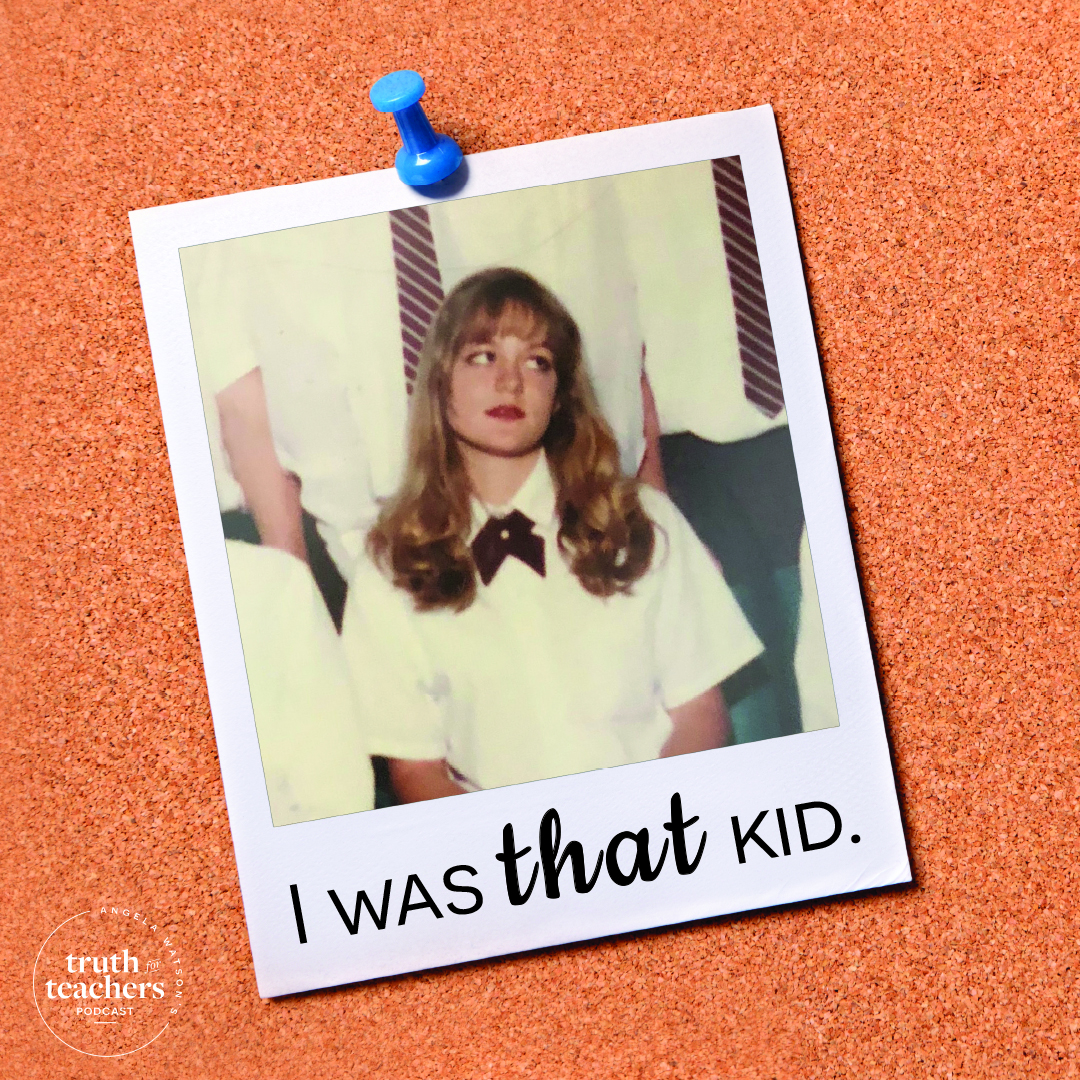 EP339 It took me years to realize I'm not lazy. I'm neurodivergent. 04.01.2026 21mGrowing up, every report card comment and parent conference involved my teachers expressing some version of the following: "Angela is smart, but not working to her potential." "Angela needs to focus and apply herself." "Angela is a capable student but does not put forth effort." "Angela could do the work if she wanted to but she appears lazy and unmotivated." I shared a little of this story a few years back, and how I was labeled as gifted at first, and then diagnosed with a learning disability in math: EP163: I was a disengaged student who nearly failed high school For years, I believed something was fundamentally wrong with the wiring in my brain. Despite everything I'd accomplished, I felt inconsistent, unfocused, and unable to just ... do the thing like everyone else seemed to. Normal adulting tasks felt like they required herculean effort. It took decades to understand: I'm not lazy. I'm neurodivergent. And that changes everything. In this episode, I'm sharing my journey of understanding my brain, from my bipolar diagnosis in my early 20s to discovering CBT and mindset work, to finally creating the resource I wish I'd had all along. I'll tell you about Motivation Lab, a new coaching app I've built that translates the neuroscience principles from my Finding Flow curriculum into a format for teens, young adults, and anyone who's ever felt like traditional productivity systems just don't work for their brain. This is the story of why I created Motivation Lab, who it's really for (hint: maybe not you, but possibly someone you care about), and why I'm asking for your help in getting it to the people who need it most. If you've ever wondered why consistency is so hard, why motivation feels unpredictable, or why no single productivity system works for everyone, I think you'll relate to what I'm sharing. Check out Motivation Lab here: studio.com/motivationlab/ Read or share the blog post. The first official podcast ep of 2026 will be out on January 11th. Thank you for listening to this interlude / announcement!
 -
 EP338 Looking ahead to 2026: A new direction beyond Truth for Teachers 16.11.2025 34mIt's the final episode of the 2025 season, and I want to leave you with something meaningful. I'm sharing some personal thoughts as I prepare to step away for my December internet sabbatical. I'm thinking deeply about alignment, presence, and what it means to move forward with clarity and purpose. If you've been feeling the tension between what you have to do and what you're called to do … this episode might resonate. Key highlights: Why I'm shifting directions in 2026 to focus on deeper connections with educators (and serving more than just folks in K-12) How my personal life has come into greater alignment after moving and establishing new daily practices My launch of teacher retreats after years of dreaming and planning (you're invited!) An introduction to Due Season Press, my new website showcasing retreats, retreat/event planning services, editing and publishing support for authors, and more Opportunities for schools and districts to host custom retreat experiences Reflective questions to help you find your own alignment and mission heading into 2026 Get the shareable article/transcript for this episode here. This episode is brought to you by MiaTiagoBooks.com. P.S. If you'll miss having new episodes to listen to from now until January, here's a way to work back through the archives without having to scroll endlessly through episode titles. I have a set of recommended Truth for Teachers playlists you can access. They're a careful curation of the episodes I'm most proud of—and that I think will help you most—from my ten years of podcasting. I've organized the playlists around four topics: The Encouragement Playlist, if you need a boost of inspiration and motivation The Productivity Playlist, if you want practical strategies for time management and getting things done The Student Engagement Playlist, if you want tools for building relationships with students and enhancing your lessons The Greatest Hits Playlist, which covers a wide variety of topics that have been really popular over the years but aren't necessarily connected to any larger theme. The Greatest Hits playlist offers a really nice variety of episodes. If you're a longtime listener and accessed one of these playlists a while back, know that I updated them this month so they include newer episodes, too. Go to TruthforTeachers.com/playlists and enter your email address to receive the playlist you want. I'll send you a PDF with a description of each episode, a link to its blog post/transcript, and a link to the MP3 file for listening. It also shares some special bonuses and other related resources I think you might like.
Similar podcasts


Popular in
The podcast also appears in the podcast charts of these countries.


