
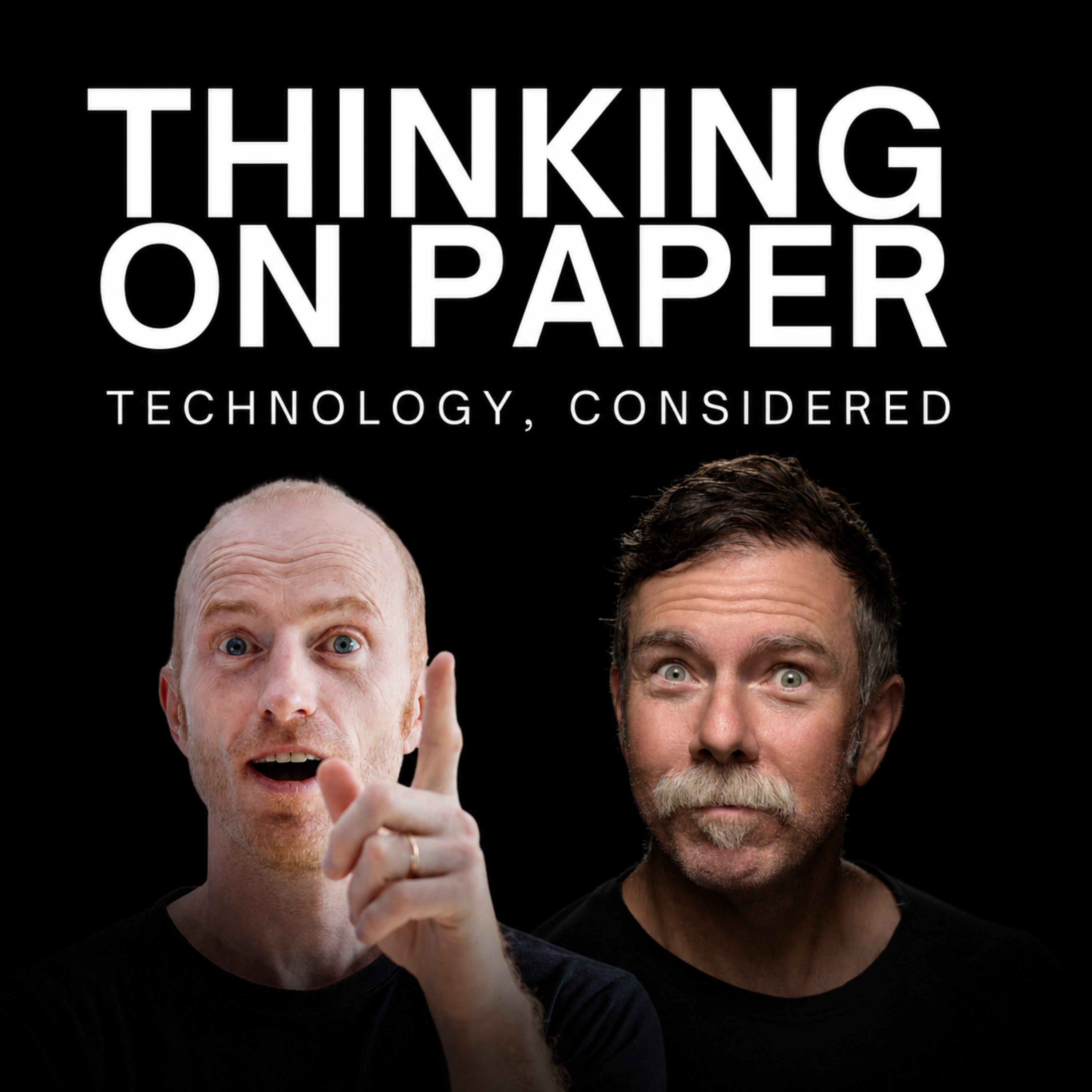
Thinking On Paper: Technology, Considered
Mark Fielding and Jeremy Gilbertson
0
Conversations with founders, CEOs, writers and outliers on how AI and emerging technology are reshaping business, society and human life. Thinking On Paper is a weekly technology podcast hosted by writers and systems thinkers Mark Fielding and Jeremy Gilbertson. It covers the convergence of AI, quantum computing, robotics and space infrastructure. The show is for professionals, parents, creators and curious minds who want to think for themselves about AI and technology. All original. All human.
Episodes
-
 Why Is Anthropic's AI Called Claude? 21.11.2026 2mWhy is Anthropic's AI called Claude? Jimmy Soni, Claude Shannon's biographer, believes the name is a homage to Shannon, the Bell Labs mathematician who founded information theory.In 1948, Shannon published A Mathematical Theory of Communication, the paper that laid the groundwork for the information age decades before it arrived. He also built Theseus, a mechanical mouse that could solve mazes, invented a rocket-powered frisbee. By most people's reckoning, at least those who worked and shared time with him at Bell Labs, say Shannon's intellect was on par with Albert Einstein's or Richard Feynm...
-
AI Is Making Writing More Important Than Ever - Medium CEO Tony Stubblebine 17.11.2026 59mMedium CEO Tony Stubblebine on writing with AI, Medium’s new agentic notebook TK, and why he believes AI is making writing more important.Disruptors and curious minds™, there’s a war out there, and Medium CEO Tony Stubblebine is in the middle of it: writers who use AI on one side, purists on the other. What’s the truth? Where is the reality? Can both sides co-exist?I approach this conversation from the inside. I was a freelance writer until a perfect storm of the crypto crash and AI (and some indecision) took the work away.Jeremy’s writing background is different. He says writing is supposed t...
-
IBM Take Us The Inside The World's Most Powerful Quantum Computer 14.11.2026 5mScott Crowder, VP of Quantum Adoption at IBM, shows us what’s inside a quantum computer, from the hardware that hangs inside the fridge where the qubits live to IBM’s System One from 2018.He shows how the hand-wired early machines gave way to superconducting flex cables carrying thousands of signals, and what IBM’s 2029 fault-tolerant quantum computer will look like. It fits in a room, not a football field.📺 Watch our full conversations on IBM’s road to 2029: https://www.youtube.com/watch?v=pigjajbkFXw&t=1204s
-
Who Owns the Riches of the Asteroid Belt? - AstroForge CEO, Matthew Gialich 03.11.2026 7mThere's enough gold, platinum, and rare earths hurtling around our solar system, to sink global economies. Asteroid mining could invalidate the US dollar, says AstroForge CEO Matt Gialich.It's also an indication of what all the fuss is about. So, trillion-dollar asteroids... who actually owns them? U.S. space law essentially says companies can keep the material they bring back, but they do not own the asteroid itself.Legally, AstroForge doesn't own the rock.But realistically, as Matt says, who else is going to mine them?“If I can go mine the universe and I am the sole supplier of resources fro...
-
Could a Copy of Your Brain Be Conscious? 30.10.2026 18mAnders Sandberg expects computers to run human-sized brains within a few decades. In 2008, he and Nick Bostrom wrote Whole Brain Emulation: A Roadmap, which put the most likely date at around 2060.And before you say, "There's no way I'll upload my brain to the internet in twenty years," Anders is confident about the computing power. The open question is getting your scanned brain data to behave like a real brain. As if the rest is easy.He explains how far a simulated fruit fly has already got, why AGI might arrive before brain emulation, and what scanning the brain of a philosopher who doubts...
-
China V America: Who Writes the Next Space Treaty? 24.10.2026 6mWho writes the next space treaty? We put the question to Harvard economist Matthew Weinzierl and Blue Origin's Brendan Rosseau, co-authors of Space to Grow. Neither wants a master plan.Weinzierl would start by gathering 25 to 30 leading thinkers from start-ups, government and non-profits. Yet he is sceptical that any room can design the future of space from the top down. He prefers order that emerges on its own.Rosseau begins with the end state: competition that drives progress, no military conflict, and rules of the road like those that govern the sea. He doubts one grand treaty could deliver...
-
Does AI Make You Less Creative? 22.10.2026 13m"AI is a very poor writer," says celebrated author, hip-hop historian, and Bruce Lee biographer Jeff Chang.While large language models can mirror sentence structures or copy paragraphs, Chang argues that the raw output is garbage.He also shares insights from his interview with legendary hip-hop producer DJ Shadow on his KALW radio show, Notes from the Edge.Shadow calls generative AI music "corny" and warns that those hyping artificial intelligence tools are usually the ones profiting from them.This leads to the ultimate question for modern creators: If you rely on AI for ideation, are you actu...
-
The Next Step To Superintelligence - Yann Lecun's World Model - Part 1 20.10.2026 7mIf you want superintelligence inside robots and autonomous agents, a Large Language Model (LLM) isn't enough, AI needs a true world model. In this episode of Thinking On Paper, Mark and Jeremy get their heads around world models, how they work, and why they represent the next frontier of superintelligence.Pim de Witte, CEO of General Intuition, recently sat down with Meta Chief AI Scientist Yann LeCun at Station F in Paris to frame the limits of current AI. De Witte compared LLMs to a snowball rolling downhill: it can't see the crash coming because "its entire world is just itself." Meanwhile,...
-
Scaling Quantum Computing Starts Here 15.10.2026 54mYou don't need a PhD to enjoy learning about quantum computing. This is the proof. Johannes Pollanen, CTO of EeroQ, thinks on paper about quantum computing, electron spin qubits, and scaling the future of quantum technology.EeroQ has its chips made in commercial semiconductor foundries, coats them in a thin layer of superfluid helium, and floats single electrons about 10 nanometres above the surface.Without a PhD, you'll learn:• Why quantum computers already exist, and why they aren't the machines we need yet• Superconducting circuits, trapped ions, neutral atoms, silicon spins, photons and el...
-
How Bruce Lee Brought Asian Philosophy to America - Jeff Chang 10.10.2026 55mBruce Lee’s cultural legacy shapes modern world culture like few others. Alongside icons like Bob Marley and Muhammad Ali, his legend continues to influence action cinema, hip-hop, and martial arts philosophy. In Water Mirror Echo: Bruce Lee and the Making of Asian America, celebrated cultural biographer Jeff Chang joins Thinking On Paper to explore kung fu, mindset, Asian American empowerment, and the pop-culture history behind the man.In the second half of the show, we shift to artificial intelligence, music sampling, and the creative act. How does Jeff Chang view generative AI? What does hi...
-
Quantum Computers Need Bob Dylan 07.10.2026 47mWhat would a gamer do with a quantum computer? Or a musician? Harry Kumar, co-founder of Moth Quantum, argues that quantum computing needs creativity and art to push the industry forward, so we’re going to find out.Moth built Quantum Backrooms, a video game where a quantum computer builds the maze. Each tile on the map is a qubit, and the correlation between two neighbouring qubits decides whether a wall stands between them.The game shows no quantum advantage and runs no faster than a classical computer. It certainly isn’t GTA 6. So why build it?Look at early AI: image generation was no better...
-
AI Data Centers Don't Need As Much Water as You Think 28.09.2026 41mData centers use vast amounts of water primarily to cool air, not chips. Evaporative cooling systems chill the air that gets blown across server racks—and that evaporation is where the water loss occurs. Remove the air, and you eliminate the majority of water consumption.In this episode of Thinking On Paper, Simon Jesenko, CEO of Iceotope, explains how fanless, precision liquid cooling is revolutionizing AI data center infrastructure. By circulating 15 to 20 liters of dielectric fluid—a highly refined, safe liquid—inside a sealed chassis, Iceotope cools every single component directly without...
-
He Quit SpaceX to Make Wood 16.09.2026 48mNathan Silvernail quit SpaceX to make wood from grass. Building the first part of a rocket SpaceX ever reused—the nose cone—wasn’t enough.After a decade working for Elon Musk, he quit, took everything he had learned, and started Plantd.The plan? Make carbon-negative engineered lumber from fast-growing perennial grass. Climate tech meets space tech.Wood, without trees.Plantd's panels replace OSB, the oriented strand board that sheathes the floors, walls, and roofs of almost every new American home.In this hotly anticipated episode, Nathan joins Thinking On Paper to talk about his SpaceX journey...
-
The US Wants 1,000 Rocket Launches a Year - America’s New Space Transportation Policy 04.09.2026 22mA new White House memo wants America able to launch within 48 hours of need. It’s in the National Space Transportation Policy, and it’s why we got held up at the Department of War. We read every line.The memo revokes the 2013 policy and sets a target of more than 1,000 launches and reentries every year by 2030. The US flew roughly 200 last year, so that’s about a fivefold jump in four years. The Secretary of War and NASA run the federal launch and reentry ranges, and the War Department has to work out what’s stopping launches at 48 hours’ notice for high-priority civil and national security mi...
-
30,000 Questions Later and You're Still Scared 03.08.2026 4mWhy do we stop asking questions as adults? Philosopher and researcher Pia Lauritzen has analyzed over 30,000 questions and discovered a striking reality: our innate curiosity never actually disappears.The ability to wonder stays intact. What changes as we grow up is the social price tag. Every question requires you to admit you don't know something, and in corporate culture, nobody gets promoted for sounding ignorant. Ask the wrong question in the wrong room, and harmless curiosity starts to feel like a high-stakes interrogation—which is why most of us learn to keep our thoughts to ourselves.L...
-
AI Music Isn't For Music Lovers 28.07.2026 5mNicholas Ponari says AI music makes live performance more valuable, not less. Mark calls the same future a hellscape.Ponari's scenario: by 2045 his son types a script into a generator, gets a feature film in the style of Kubrick crossed with Tarantino, and hits publish. Everyone becomes a creator in every medium. Nobody can consume a fraction of it, so AI becomes the largest curator in history.Mark's objection is that shared culture dies with it. No song anyone else has heard. No film anyone else has seen. Nothing left to talk about.Ponari's answer is scarcity. When everything is generated, th...
-
The Hard Question of AI Has a Very Simple Nuclear Answer 22.07.2026 50mThe U.S. and China are racing to build artificial intelligence systems that could lead to machine superintelligence before anyone fully understands the consequences. The risk? Global economic meltdown and existential threat. Not on our watch.In this episode of Thinking On Paper, Mark and Jeremy examine "The Hard Question of AI," a thought-provoking essay by Planet CEO Will Marshall. Marshall argues that frontier AI governance now requires the same strict verification, trust, and global non-proliferation frameworks historically reserved for nuclear weapons.That means moving far beyond voluntary...
-
The Hidden Cost of Your AI Subscription 14.07.2026 41mAI companies are splashing billions on more GPUs before they use the ones they already have. Many sit idle, others use a fraction of their potential. For the hyperscalers, cloud providers and AI companies, buying more GPUs does not solve much if the GPUs already in the rack spend too much time waiting for the rest of the system.The next battle in the AI infrastructure wars is efficiency: GPU utilization, NICs, memory movement, networking, CPUs and software that keeps expensive hardware doing useful work.Moshe Tanach runs NeuReality AI, a company building infrastructure for AI inference. In thi...
-
Cultivated Meat Has Passed the BBQ Taste Taste │Bruce Friedrich, Good Food Institute 08.07.2026 53mBruce Friedrich, founder of the Good Food Institute and author of Meat, explains why the future of food may depend less on changing human behaviour and more on changing how meat is produced.For more than 12,000 years, humans have relied on animal agriculture to produce meat. Bruce argues that this system is reaching its limits. We explore how cultivated meat is made, why it is attracting support from governments and major food companies, and why some of the biggest meat eaters are also the most open to the technology.Along the way, we discuss the environmental cost of livestock, antibiotic res...
-
Asteroid Mining is F**king Awesome │ Matt Gialich, Astroforge 23.06.2026 51mAsteroid mining sounds insane until you speak to AstroForge CEO Matthew Gialich. Matthew’s team at AstroForge builds spacecraft to mine metallic M-type asteroids for platinum group metals, the unglamorous but essential metals inside phones, cars, chips, electronics and much more.AstroForge is one of the few companies trying to make space mining real, targeting metal-rich asteroids that could contain platinum, palladium, iridium and other PGMs.Why? Earth’s resources are getting harder, deeper and more expensive to reach. The good stuff is not sitting neatly on the surface. A lot of it is buried...
Similar podcasts


Popular in
The podcast also appears in the podcast charts of these countries.


