
SEA of Startups
Decoding the Pulse of Founders, Capital & Conviction in Southeast Asia.
0
Real, raw, relatable takes on Southeast Asian startups. One investor, the week's news, no script.
Episodes
-
 One Market on Paper. Six in Real Life. 11.11.2026 34mPresented by YourCFONext week there is going to be a very big press release.From the 15th to the 17th of November, ASEAN’s leaders meet in Manila for the 49th ASEAN Summit. The Philippines is chairing this year, and the headline deliverable, the thing everyone has been working towards, is that they are due to sign something called DEFA: the ASEAN Digital Economy Framework Agreement.You are going to see the photos. Leaders in a row, matching shirts, pens on the table. You are going to see the phrase “world’s first region-wide digital economy agreement.” And you are going to see a number: that this deal could take the region’s digital economy from about one trillion dollars to two trillion by 2030.I want to get to this before the ceremony, not after. Because once the photos are out, everyone will tell you this is the moment Southeast Asia became one market for startups. It isn’t. I don’t say that to be cynical. There is something real in this deal, and I will tell you exactly where. But if you are a founder planning your expansion around a signing ceremony, you are going to plan it wrong.One. What they’re actually signingThe short version: DEFA is a regional agreement that tries to make it easier to do digital business across all ten ASEAN countries. Payments that work across borders. E-invoices and trade documents one country accepts from another. Digital identity. Rules for moving data across borders. Cybersecurity. E-commerce. And some newer ground: AI, fintech, and protection for your source code, so a government cannot make you hand it over as a condition of doing business.The longer version, because the timeline matters. Negotiations launched in September 2023 and concluded at the end of May this year, at a meeting of senior officials in Manila. Every member state has since been doing a legal review of the text. Signing is scheduled for next week. After signing, each country has to ratify it, with a target of 180 days.So best case, you are looking at the middle of next year before it is even in force across the region. And in force is not the same as your customer’s bank, your customer’s tax office and your customer’s regulator all changing how they work. That is implementation, and implementation is where the real time goes.Two caveats. First, the final text is not public yet. Civil society groups have complained about exactly that, and they have a point. Most of what you will read next week, including from me, is built on summaries, law-firm notes and what officials have said in public. Hold it all a little loosely.Second, that two-trillion-dollar number. It comes from a study done for the negotiations. I am not saying it is wrong. I am saying a study that tells the people who commissioned it that their project will double the economy is not the most independent research you will read this year. It’s a slide, not a forecast.Here is what is genuinely good about it, and I want to be fair. This is ten very different countries agreeing, in writing, on the direction of travel. Data should flow. Payments should connect. E-invoices should be recognised. Source code should not be a bargaining chip. For a region that has historically agreed on very little in tech, that matters. It tells regulators which way to lean when they write the next rule. This is a fragmented market, and anything that defragments it is welcome.But direction is not the same thing as a market.Two. We’ve signed this beforeIf you have been around this region long enough, this will feel familiar. The ASEAN Economic Community launched at the end of 2015: a single market and production base, free flow of goods, services, investment and skilled labour. I remember the conference panels. I remember the decks. It was going to change everything.In 2019 the region signed an ASEAN agreement on electronic commerce. That one took until the end of 2021 to come into force.Now ask yourself honestly. If you are a founder in Kuala Lumpur selling software to a customer in Jakarta today, how much did either of those agreements change your week? Your contracts, your tax, your payment collection, your data setup?For almost every founder I know, the answer is: not much. Not because the agreements were bad, but because an agreement between governments sets the direction, and then every country implements it through its own laws, its own regulators and its own politics. The treaty is the easy bit. The six separate rulebooks underneath it are the hard bit.Three. Six rulebooks, six lawyersHere is the detail I really want founders to hear. From the legal analysis I have seen, DEFA does not automatically override national data rules, and it does not override data localisation. Each country keeps its own. That is how treaties usually interact with national law, and there is no sign this one is different.Two examples, used as a regional pattern, not to pick on anyone. Indonesia has had a regulation since 2019 that separates public and private system operators, with local storage requirements on the public side and real fines behind its rules. Vietnam’s cybersecurity framework can require certain online services, including foreign ones, to store Vietnamese users’ data in Vietnam for at least 24 months and to set up a local presence. These are sovereign choices, and governments have their reasons. But if your product touches user data, and almost every product does, those rules do not disappear because a treaty was signed in Manila.So your expansion cost is still six legal opinions, six data setups, six tax registrations, maybe six local entities. The founder who reads next week’s headline and thinks “great, one market now” is going to be very expensively surprised in month four.Make it concrete with a made-up but very typical company. You are a B2B software company in Kuala Lumpur selling HR and payroll tools to small businesses. A few hundred paying customers in Malaysia, the product works, and your board says it is time to go regional. Indonesia is big, the Philippines is growing, let’s do both.Here is your next twelve months. A local entity in each country, or a partner who will act as one. A local lawyer to tell you whether payroll data has to stay in the country. Working out whether your cloud setup is fine, or whether you need a second region or a local provider. Tax registration in each market, and learning how e-invoicing works there, because it works differently in each one. A way to collect money from customers who pay by bank transfer in one country and by e-wallet in another. And payroll itself is regulated differently everywhere, so your product needs local rules built in before anyone can use it.None of that is exotic. None of it is fixed by next week’s signing. All of it costs money and months before you have earned a single dollar of new revenue. That is what six markets means. Not six flags on a slide. Six sets of paperwork, each with its own queue.ASEAN is about to sign a single digital market, but your startup still needs six lawyers.A business survey cited in some of the coverage puts numbers on it: about two thirds of firms said uncertainty over cross-border data rules was an obstacle, and about two thirds of those using cross-border digital payments reported delays, with a similar share complaining about costs. I could not see the original survey, so treat the exact figures carefully. But it matches every founder conversation I have had about going regional.Four. The part that’s actually workingSo if the treaty is not where integration happens, where does it happen? This is the part I am genuinely optimistic about, and it gets almost no airtime.Real integration in this region is already happening. Just not on a stage. It is happening in payments plumbing, built quietly by central banks, one link at a time.Start with QR payments. Since 2022, a regional payment connectivity initiative has linked the QR systems of Indonesia, Malaysia, Thailand, Singapore and the Philippines. Vietnam has offic… This is a public episode. If you would like to discuss this with other subscribers or get access to bonus episodes, visit seaofstartups.substack.com
-
 Big Isn't Rich. Rich Isn't Investable 04.11.2026 31mPresented by YourCFOIn about five weeks, Southeast Asia’s two biggest growth stories swapped places.Vietnam got promoted by one of the big index providers. Indonesia got told by another that it might be pushed out of emerging markets altogether, and its stock market fell 11% in a day. Right in the middle of that, the IMF put out a forecast that says Vietnam’s income per person will pass Indonesia’s this year. First time ever.Meanwhile in Malaysia, where I’m based, the economy is growing at about five and a half percent. If you’re a founder in KL, you would never know it. And in the Philippines, the economy is having one of its worst years in a while, exports just hit an all-time record on AI chips, and the startup activity on the ground is better than the numbers suggest.None of that lines up the way you’d expect, and that’s the point. The size of an economy, the growth of an economy, and whether a startup in that economy can actually get funded and get bought are three different questions. We spent ten years treating them like one question.If you write cheques or raise them, this matters. Every seed round in this region is a bet on a buyer seven years from now. This month we got a clear look at who that buyer is, and where it’s getting harder to find.1. The crossoverThe IMF’s October World Economic Outlook projects Vietnam’s GDP per capita at about $5,260 this year, against about $5,150 for Indonesia. Last year Indonesia was about $250 ahead, and as of April the IMF still had Indonesia in front. In six months, the forecast flipped.The caveats, properly. These are nominal dollars, and the rupiah has been weak, so Indonesia looks a little worse after conversion. The gap is tiny, about two percent. This is a photo finish, not a lap. And Indonesia’s economy is still almost three times the size of Vietnam’s: about $1.5 trillion against about $540 billion. Indonesia isn’t shrinking into irrelevance.All true, and none of it changes the direction. Vietnam is growing a lot faster, and the IMF expects it to stay ahead next year. When you’re betting seven years out, direction matters more than size.Here’s why this one hits me personally. I have sat through hundreds of pitches where slide three is the market slide, and for Indonesia that slide wrote itself. 280 million people. Young. Mobile first. Every fund that raised for this region in the last decade had some version of it in its own LP deck.The thing that slide never said was how much money those 280 million people actually have. And whether there’s anyone at the end of the road who’ll buy the company you build to serve them.Big isn’t the same as rich. And it definitely isn’t the same as investable.Vietnam never had that slide. People called it the next China, but it ended up benefiting from the less sexy story: factories, the manufacturing shift, China plus one. The less sexy story compounded.2. Promoted and demotedNow the part that actually decides whether startups get paid: the markets.The quick version of how index providers work. MSCI and FTSE Russell sort every country’s stock market into buckets: developed, emerging, frontier, and a few that don’t fit anywhere get labelled standalone. Trillions of dollars of passive money, the index funds and ETFs, follow those buckets automatically. If you’re in the emerging bucket, emerging market funds have to own a slice of you. If you get moved out, they have to sell. No opinions involved. It’s the rule.So these aren’t academic labels. The bucket decides whether a huge pool of money is even allowed to show up.Vietnam first. FTSE Russell’s upgrade from frontier to secondary emerging took effect on 21 September and phases in through September 2027. MSCI hasn’t moved yet, but there’s a real chance it follows. How much money does it bring in? Estimates run from about one billion dollars to about six. When estimates are that far apart, nobody really knows. The direction isn’t in doubt: money is coming in, not going out.And that upgrade wasn’t luck. Vietnam spent years doing the boring work the index providers kept asking for: how foreign investors get access to the market, how trades settle. Nobody throws a party for the plumbing of a market. Vietnam did it anyway, and it got rewarded.Then Indonesia. On 15 October, MSCI opened a consultation on moving Indonesia from emerging to standalone. Not down to frontier. Standalone, below frontier, where almost nobody gets put.MSCI didn’t just say it didn’t like the vibes. It wrote down its reasons. Free float that isn’t really free: shares counted as being in public hands but actually held by people connected to the owners. Ownership structures you can’t see through. Trading in some stocks that looked coordinated. None of this came out of nowhere. MSCI froze changes to its Indonesian index back in January over the same concerns. Indonesia has been working on reforms all year, and MSCI acknowledged some progress in April. In October it said, basically, not enough and not fast enough. It will decide by the end of June 2027, and it expects to go ahead with the demotion unless it sees clear evidence of material improvement.The day after the announcement, the Jakarta Composite fell about 11%.Then it got political. A former trade minister claimed Singapore’s sovereign funds, Temasek and GIC, had pressured MSCI so they could buy assets cheap. Both said the claim is untrue. Another former official called the whole theory nonsensical. There was a theory blaming the US too.I understand why “blame Singapore” plays well. It’s still noise. MSCI wrote down its reasons. If you want to argue, argue with the free float numbers, not with Singapore.Put the two side by side. Same region, same few weeks. Vietnam fixed its plumbing and got a promotion. Indonesia let its plumbing clog and got a warning letter. And the bigger economy is the one on the wrong side of it.Markets get promoted for plumbing, not for population.3. Why a seed investor cares about index committeesBecause of the chain.Index funds and big institutions buy listed shares. Because they’re there to buy, an exchange can price IPOs. Because IPOs can happen, the growth funds who write the big late cheques know they can get out. Because they can get out, they’ll pay up at Series B and C. Because there’s a Series B, the Series A investor can get paid. And because there’s a Series A, someone like me can write a seed cheque and believe there’s a road to a return.Every link depends on the one after it. The index money is the last link. Pull it out and every price upstream turns into a guess.So what does it look like when the chain starts breaking? Look at Indonesian startups this year. I’m not going to throw totals at you, because aggregates mislead. Here’s the shape. In the first nine months of the year, one single deal made up about three quarters of the money that went into Indonesian tech. Seed, the very first cheques, has almost vanished. There were zero tech IPOs. A couple of big companies can still get money. Everyone underneath them can’t.When I price a seed round, I’m really pricing what the exit might look like years down the road. In one of these two markets, that buyer is getting closer. In the other, it’s walking away.To be fair to Vietnam: I’m not telling you Vietnamese seed is booming because of an index upgrade. The startup numbers there are messy and don’t agree with each other. It may take years to trickle down to seed. But it’s an indication that the chain is getting stronger, not weaker.4. GDP doesn’t fund startupsYou’d think the lesson is simple: fast-growing economy good for startups, slow economy bad. The rest of the region says that’s wrong too.Malaysia. My home base, and the economy is doing properly well. The advance estimate for the third quarter came in at 5.3%, ahead of expectations, and the first nine months are at about five and a half percent, up from 4.8% a year ago. Given the global disruption, that’s a strong economy.Now ask a founder in KL whether t… This is a public episode. If you would like to discuss this with other subscribers or get access to bonus episodes, visit seaofstartups.substack.com
-
 The Exits Are Back. Who Actually Gets Paid? 28.10.2026 29mPresented by YourCFOThe biggest company the Philippines has ever floated went public last week. A homegrown name that sits on tens of millions of phones. And when I read the terms, the first thing I felt was not pride. It was a very specific, very familiar itch.Because the deal priced well below where it was pitched. And most of the money did not go into the company at all. It went to the people who already owned it.So here is the week in one sentence. The exit door in Southeast Asia has finally swung open after years of being stuck shut. That part is real, and it matters. But a door swinging open tells you nothing until you watch which way people are walking through it. This week, a lot of them were walking out with their coats on.Three stories, and they rhyme. A giant Philippine IPO and the exit market reopening around it. A fast-growing Manila lender raising a headline that is not quite what it looks like. And the big annual report that says this region is using artificial intelligence faster than almost anyone on earth. Put them side by side and you get one question. Who actually gets paid? The company, or the people cashing out of it. The founder, or the lender. The region, or someone flying in from very far away.One. The biggest bell in Philippine historyOn 20 October, Mynt, the company behind GCash, listed on the Philippine Stock Exchange under the ticker GCASH. It is being called the largest IPO the country has produced. For public markets that have spent years being described as sleepy, that is a genuinely big moment, and I want to be clear about why it is good before I get to why it is complicated.GCash is not a toy. It is how a huge number of Filipinos move money, pay bills, buy load, borrow small amounts and save. A domestic financial app grew up inside the Philippines and then listed on the Philippine exchange, rather than quietly disappearing into a foreign holding company. That is the kind of outcome this country has been owed for a long time. Credit where it is due. Build more of these.Now the terms. The deal priced at 6.60 pesos a share, a third below the 10-peso ceiling in its filings. The base offer came to about 53 billion pesos, rising to about 60.9 billion if the overallotment is fully exercised. Call it roughly $845 million, reaching toward a billion if everything clears.A low price is not a scandal. Markets are cautious, rates are still biting, and a disciplined price that clears beats a greedy price that flops on day one. But price is information. It is the market telling you, in public, what it thinks the growth is worth today. When a company prices at the top of its range, the buyers are fighting to get in. When it prices at the bottom, the sellers are relieved to get it done. Those are two very different rooms, and you should always know which one you are standing in.And here is the part I want you to sit with. Most of this offering was not new money for the company. It was secondary: existing shareholders selling their stock. Reports put the company’s share of the proceeds at about 30 percent. The rest goes to selling holders, including Ant Group and private equity backers, who say they are trimming rather than exiting.So when the headline says record raise, read it twice. A record amount of money changed hands. Most of it moved from new public investors to early backers ready to take money off the table. That is not a growth round dressed as an IPO. It is a liquidity event with a bell ceremony attached.First-day moves tell you about sentiment, not about the business. Ask me again in a year.Two. The window is open. Look who is walking through itMynt did not happen in a vacuum. The exit market across Southeast Asia has quietly come back to life. Deloitte counted 47 IPOs in the region in the first half of 2026, raising more than $3 billion, more than double the same period a year earlier, with Malaysia leading on deal count and Singapore climbing the table.So the door is open. After years of founders being told there was nowhere to list, there is somewhere to list again.But look at what is actually going public. Property. Financial services. Consumer names. Established businesses with real cash flows that public investors understand. What is mostly not going public is the venture cohort: the unicorns and soonicorns that raised at a billion dollars or near it in the free-money years, on a promise of growth that would justify the price later.Those companies are caught in a very specific trap. Their last private valuation is a number the public market will not honour. Raise again at a lower price and crush everyone who came in at the top, which founders and their existing investors will do almost anything to avoid. Or sit still, burn down the runway, and hope the market comes up to meet them, which it mostly will not.Make it concrete. Say you raised your last round at a billion dollars in 2022 on the promise that revenue would quadruple. Revenue doubled instead, which is a very good outcome in any sane world. But the public market now prices a company like yours at four or five times revenue, not twenty. Do the arithmetic and your honest public value is a few hundred million, not a billion. So you cannot list, because listing crystallises a number your early investors and your own team will treat as a failure, even though the company is healthy. You are trapped by your own headline, and the headline was never real. That is the hangover from the free-money years, and this is the year a lot of people wake up to it.Spare a thought for the retail buyer too. When an IPO prices low and sells mostly secondary, the ordinary investor putting in a month of savings is, in plain terms, buying the stock the insiders are selling. Sometimes that is a fine trade. Insiders sell for all sorts of reasons, and the people who built GCash are entitled to take some money off the table after years of work. Just enter with your eyes open, knowing who is on the other side.And the constructive piece, because I mean it. A public GCash is a disciplined GCash. Once you are listed you report every quarter, you answer to investors who can sell you, and you cannot hide a soft number behind a cheerful blog post. That discipline is the best thing that could happen to Philippine fintech. The milestone is real. I just want the whole country watching the structure, not only the bell.Three. Two animals wearing one headlineWe stay in Manila, because Manila owned the week. On 19 October, consumer lender Salmon announced $140 million in new financing. On its face, a big vote of confidence in lending to underbanked Filipinos. And the market is one I like. Tens of millions of people here have thin or no formal credit history and real demand for small, fair credit. A disciplined lender serving them well is a good business and a good thing. I am rooting for the mission.But read the structure. That $140 million is $90 million in equity commitments and a $50 million public bond. Two completely different animals wearing one headline. Equity is money investors put in believing in the upside, money the company never has to pay back. A bond is borrowed money. It has to be repaid, with interest, on a schedule, whether the business thrives or not.For a lender, debt is not a sign of weakness. It is the raw material. A lender borrows at one price and lends at a higher one, and the gap is the business. So a bond is normal, even healthy. But stacking a $50 million bond on a $90 million equity number and announcing one combined figure makes the raise sound larger and more growth-flavoured than it is. When you see a blended number, split it in your head before you react.This follows a similar package in April: $60 million of equity and a $40 million bond. Inside one year, about $240 million across these structures. Impressive momentum. Also a lot of capital flowing into a loan book very quickly, and speed is exactly what should make you ask more questions, not fewer.Four. Profitable… This is a public episode. If you would like to discuss this with other subscribers or get access to bonus episodes, visit seaofstartups.substack.com
-
 I Still Can’t Find My Driver 21.10.2026 32mPresented by YourCFOI need to be honest with you before we start, because otherwise this whole piece reads like a man with an axe to grind.I do have an axe. Let me show it to you first.I do not like Grab. I am not going to be coy about it. For my money it is one of the most frustrating companies to actually use in this part of the world, and frustrating precisely because there is often no other option. The app fights me. The map sends my driver in a slow circle around the block. Support, when something goes wrong, is a maze designed so you give up before a human ever appears. And all of it sits on top of a market position so dominant that none of it has to get better.So this is not a neutral host reading you the news. I want that on the table up front.Why give a company I cannot stand a whole week? Because this week Grab did something that fits the pattern I have been chasing for a month. The $13 billion funding number wearing the costume of a boom. Exit figures wearing the costume of liquidity. Seed rounds wearing the costume of a Series A. Real numbers, dressed up as something they are not.This week the costume was not on a spreadsheet. It was on a company. In seven days, Grab put on a lab coat and announced to Southeast Asia, twice, that it is now an artificial intelligence company. I looked at the thing wearing the lab coat and I knew its face, because I argue with it in traffic every week.I will be fair. Grab earns some credit here and it will get it. But the costume is coming off.One. Two announcements in seven daysThe facts first, clean, before I say a single sharp thing.Announcement one. On 8 October in Kuching, SoftBank, Grab and PETROS, the Sarawak state energy company, signed a framework agreement to explore an AI and digital infrastructure platform in Sarawak. The scope, as described, could stretch across AI compute and services, advanced technologies, robotics, and local workforce and community development. SoftBank brings its AI infrastructure and computing expertise. PETROS brings energy. Grab, per the release, brings its Southeast Asian digital platform, its “applied AI capabilities” and its regional customer and partner networks.Hold on to that last line. We are coming back to it, because it is the most honest sentence in the announcement.Announcement two. Six days later, on 14 October in Bangkok, Grab stood up with OpenAI and launched GO Forward with AI: practical AI training for more than 3,000 drivers, riders and merchants in Thailand, with three months of free ChatGPT Plus for those who attend the workshops in person. It is the first step in a plan to reach more than 30,000 workers and small operators across the region within two years. Grab’s chief executive, Anthony Tan, framed the point well: access alone is not enough, the question is whether the training turns into earnings.Now the fair hearing I promised.The gig worker programme, at its best, is a genuinely good idea. A while back I got into a Grab car, mentioned what I do, and the driver spent the ride telling me what he had built on the side with AI tools. The people driving these motorbikes and cars and packing these bags are some of the most capable, hustling operators in the region. A driver who learns to use these tools to run a side business, market it and manage the money is a real thing. They are also the people most exposed if autonomy and automation arrive in their line of work. Teaching that class of worker to use the most powerful general tool of a generation is not nothing. I am not going to sneer at it.And the Sarawak plan points at something the region genuinely needs. Sarawak has been thoughtful and aggressive about making its own moves. Real computing capacity, built here, with local energy behind it, is a serious ambition. No quarrel with the ambition, none with Sarawak wanting it, none with a local energy firm backing it. Build it.So here is the question for the rest of this piece. Two announcements, both with the letters A and I stamped all over them, and one company at the centre of both, suddenly presenting itself as an engine of Southeast Asian intelligence. What does either of these actually require Grab to build? What does Grab have to deliver, and by when, or it has failed?I went looking for the answer and found a lab coat with nobody inside it.Two. The map in my pocketLet me explain why I cannot take Grab seriously as an AI company, using the least glamorous technology in the world. A map.A few years ago Grab decided to move off the outside mapping providers that powered its navigation and build its own, GrabMaps. The logic was reasonable on paper. Southeast Asia is genuinely hard to map. Alleys with no names. Addresses that are really a landmark and a vibe. Whole neighbourhoods the big global maps render as a grey blank. Grab said it had millions of drivers on these roads every day and could map them better than anyone. Good story.Here is the part that is not on paper. It is on my phone, several times a week.In my own daily use, since that switch, the experience has got worse. Type in an exact address and it cannot find it. The pin lands on the wrong side of the building, or the wrong side of the road. The driver is routed to a phantom entrance. I watch the little car on the screen drive past me, turn away and loop the block while the arrival time climbs, and the arrival time had no basis in reality to begin with.I am not giving you a statistic. This is me, a regular user, telling you what the product does in my hand. The reporting on whether drivers are happier since the switch is thin, so I will not dress my annoyance up as data. But I will tell you what it did to my behaviour. I have cut my usage sharply and started using other providers for most of my travel, out of sheer frustration. It did not get better. It got worse, and then it stayed worse.Three. The dominance pays for the mediocrityWhy would a company let its core product get worse and just leave it there? That is the real question, and it has nothing to do with AI.A company that wins on the quality of its product cannot let the product rot. If you have three real competitors and your map sends people to the wrong door, you lose them by the end of the week. A company that wins on dominance, on the simple fact that there is nowhere else to go, can let the product sit at good enough forever. There is no punishment. The customer grumbles, screenshots the circling car, posts it, and opens the same app the next morning.The map is just the part I can see. Try reaching a human when an order arrives wrong, or when the pizza box arrives tipped on its side with everything piled in one corner, which has happened to me more times than I can count. The support experience feels less like help and more like a series of locked doors, each one hoping you give up before you reach the next. That is not the accident of a young company still figuring things out. Grab is not young. It is a design choice a dominant company can afford, because the cost of your frustration is carried by you, not by them.That is what sits underneath the costume. In my experience Grab is not a technology company that wins because its technology is excellent. It is a distribution position. It got big first. It bought its position with capital, got the drivers, got the merchants, got the habit. From inside that fortress, mediocre tech, a clumsy interface and poor customer experience are not a crisis. They are the resting state. Competing against that dominance costs too much, so the dominance pays for the mediocrity.And notice who absorbs the resting state. Not only the irritated rider. The driver whose map sends him the wrong way and whose time is eaten by the loop around the block. The small merchant who lives inside an app she does not control and cannot meaningfully complain to. The people most dependent on Grab pay the quiet tax of a product allowed to stay just good enough.So forgive me if I am slow to believe the fix is… This is a public episode. If you would like to discuss this with other subscribers or get access to bonus episodes, visit seaofstartups.substack.com
-
 The $13 billion costume 14.10.2026 29mIn the first nine months of this year, startups in Southeast Asia raised more than $13 billion. A record. Depending on whose tracker you believe, that is somewhere between a 120% and a 170% jump on last year.Hold on to that range for a second. Two serious data providers, looking at the same region over the same nine months, cannot agree on the number. That is not an accident, and we will come back to it.Here is the second number, and it is the one I want you to actually feel. Of that $13 billion, seed and angel rounds, the first real cheque a brand new company gets, came to about $270 million. Spread across roughly 90 companies.Sit with the gap. $13 billion at the top of the page. Ninety founders at the bottom, splitting $270 million between them. The money in this region has never been bigger, and it has almost nothing to do with the founder in Manila, KL or Bangkok trying to make payroll this month.I have watched the money here change shape about four times in a decade. Every time, it arrived looking like the boom had finally come. Every time, the headlines said we had arrived. And every time, when you followed the money to the end, it was not here to build a Southeast Asian company at all. It was here for something else.So this week I want to follow the money through all four of its disguises. Then, at the end, I will tell you why, after taking a blowtorch to all of it, I am more bullish on this region than I have been in years. I mean that. This is not a sad story.One. The headline is the trickThirteen and a half billion dollars, nine months, a record. If that is the only line you read, the drought is over and it is time to go out and raise again.Here is what the line does not tell you. Three deals were 54% of that number. Three. Widen the lens to every round of a billion dollars or more, and four deals were about 63% of all the money raised in the entire region this year. Before we have even started, nearly two thirds of Southeast Asia’s record year is a handful of enormous cheques going to a handful of enormous companies.So here is the one habit that will protect you from almost every misleading funding headline about this region. When a number says funding hit a record, your first question is never how much. It is how many. How many companies? Here, more than almost anywhere, one or two giant transactions can carry the whole number and make a starving market look like it just ate a feast.Look at where the money actually sat. Late stage, the Series C and beyond, the pre-IPO money, more than tripled to over $10 billion. Early stage, the seed and Series A, the part of the market where companies are actually born and where the next decade here gets decided, barely moved.Data centres alone were about 35% of all the money. I would love to know when we started counting data centres as startup funding. Video generation tools took another big slice on top.Think about what a data centre is. Power, concrete, cooling, and rack after rack of servers. It is a real estate and energy play with a technology label on the front. Perfectly good business, and we need them. It is just not a Southeast Asian founder with an idea and a laptop. The single biggest category in our record year is, quite literally, buildings.So the record is not founders getting funded. The record is a small number of very large, very late cheques going into physical infrastructure and a couple of foreign technology giants, sitting on top of an early stage market running on fumes. That is not a recovery. That is a costume. A big, shiny, $13 billion costume.To understand the costume, you have to understand the waves that came before it, because each one taught us a bad habit. We are still paying for all of them at once.Two. The hype moneyMost of you lived through this one. Rates were on the floor, capital was effectively free, and it flooded into Southeast Asia from big global funds that had made a fortune in China and were hunting for the next one.The instruction attached to that money was simple. Grow at all costs. Buy the users, buy the market share, buy the headline. Worry about a business model later, or frankly never.For a while it worked the way a sugar high works. Valuations went vertical. Everyone was a soonicorn. The pitch stopped being “here is a company that makes money” and became “here is a rocket, get on before it leaves the ground.” Burn was no longer a warning sign. Burn was the strategy. You were supposed to lose money faster than the next guy, because that proved you were winning the land grab.I sat in rooms where a founder losing $10 million a year was treated as more investable than one quietly making $1 million, because the one making money was clearly not thinking big enough.Then the free money ended. Rates went up, the global funds pulled back, and reality walked in through the front door and turned the lights on.You know the wreckage, because some of it made headlines around the world. eFishery in Indonesia, the poster child for aquaculture meets technology, hundreds of millions raised, a genuine darling until it was not. According to reports, a very large share of its revenue turned out not to be real, inflated to feed a valuation that had become the whole point. Zilingo raised enormous money, scaled hard across the region, and came apart on governance and burn before it could grow into the price tag it had been given.Underneath those two famous names sits a long, quiet graveyard. Companies that raised a monster round at a monster number, then went silent. Shut two or three country offices. Laid off most of the team. Then did a down round so brutal, or a bridge on such ugly terms, that they simply stopped sending press releases. You only find out when you check the cap table a year later.But here is what I think wave one really did, and it is worse than the billions it burned. It rewired a generation of founders. It taught them that the core skill of building a company was fundraising, not building. That the most important customer was the investor, not the human being using the product. It trained people to run their companies like they were preparing to sell them to a greater fool, because for about five years the greater fool kept showing up on schedule with a bigger cheque.When the greater fool stopped showing up, a lot of those founders did not know what to do next, because nobody had ever asked them to. I have watched genuinely talented people spend three years becoming world class at exactly one thing, raising money. When the market turned, that skill was worth nothing, and there was nothing underneath it.That is the quiet tragedy of wave one. Not the companies that died loudly. The founders who were patiently taught the wrong trade, and the LPs, angels and fund managers who walked away with a damaged view of the whole region. Disguise number one: money that came to inflate a story into a bigger story and flip it before the music stopped.Three. The grant moneyWave two is gentler, and in some ways it did more lasting damage, precisely because it showed up wearing the nicest costume of all. This money came to help.When the hype money left a crater, two kinds of capital stepped into the gap. Both arrived with genuinely good intentions and genuinely terrible incentives. Hold both ideas at once.The first is grant money. To be clear, this is everywhere, not one country: the US, Europe, Seoul, Japan, right across Asia. Governments decided they could build a startup scene by writing cheques directly to startups. Grants, matching funds, innovation programmes, disbursements tied to milestones. On paper it sounds wonderful. Free, non-dilutive capital for founders. What could go wrong?Here is what goes wrong. That money does not select for the best company. It selects for the best grant application.Think about who approves these grants. Usually a panel. Often very few of the people on it have ever built or sold a piece of technology. They sit in a room with a scoring… This is a public episode. If you would like to discuss this with other subscribers or get access to bonus episodes, visit seaofstartups.substack.com
-
 Seed is booming. Not here. 07.10.2026 32mLet me describe a company to you. Real revenue. Customers who pay every month, on time. A product that works and a team that ships. By every standard that mattered three years ago, this is a fundable company. Three years ago it raises a Series A without breaking a sweat. Today it cannot get a second meeting.Nothing about the company changed. The bar moved underneath it while the founder was busy building. That is happening everywhere, in San Francisco, London and Bangalore. But if you are building in Southeast Asia, here is the part almost nobody says out loud. The bar did not move once here. It moved twice. And the second move is one no venture podcast in San Francisco will ever explain to you, because none of them has had to raise a round across six countries at once.So this week I want to walk all the way through it. Why your next round is harder than your last one had any right to be. What it costs in months and in cash. And what I would do on Monday morning if I were sitting where you are.One. The seed mirageThe headline going around is that seed funding in Southeast Asia is up this year. On paper, true. DealStreetAsia’s half-year numbers have seed dollars up 128% year on year to $328 million. Read only the top line and you would think the taps are open and the hard years are behind us.Now look at who got the money. In the first half of 2026, 63 companies in the entire region received their first institutional cheque. Sixty-three. Across six countries, 680 million people and six months. That is not a wave of new founders getting funded. That is a number you could seat on one decent coworking floor in Singapore.Here is the part that should make you suspicious. While the seed total went up, the number of deals across the region fell to its lowest level since at least 2018, and the typical seed cheque got bigger. Hold those two facts together. Bigger cheques, fewer of them than in nearly a decade. That is not money spreading out to more people. That is money piling up on fewer of them.Who gets the fat cheques? Overwhelmingly AI and deep tech. A normal software seed in this region is still one to three million dollars. The AI rounds run at roughly double that and climbing, and they are the ones dragging the average up and making the chart look healthy. The chart is not lying exactly. It is letting you believe something that is not true. When you hear “seed is back,” the honest follow-up is “back for whom.” The honest answer is: for a small number of companies that probably do not look like yours.One more number, same story at a bigger scale. The region raised $7.25 billion in the first half, the strongest half since 2022. Almost all of it was one data centre raise, DayOne’s $4.5 billion Series C. Take that single deal out and the region raised about $2.75 billion, down on the half before and below the same period a year earlier. One deal, one building full of servers, is doing the work of making an entire half-year look like a recovery. I made the same point about exits a week ago. The discipline never changes: how many deals?So here is where we stand. The money that exists is real. It is also concentrated, going to a narrow slice of companies, and the breadth a healthy early stage is supposed to have is not there. The costume says boom. The body underneath says something much tighter.Two. The bar moved, and the Americans admit itNow the thing that actually decides your future: the bar for your next round.Listen to the American shows, 20VC, SaaStr, the ones every founder here has on in the background, and the same confession comes up every few weeks. A partner gets comfortable in the chair and says the quiet part out loud. The bar to raise a Series A today would have been a Series B three years ago. They say it the way you mention the weather, and then they move on.Here are the numbers behind the anecdote. The revenue a company needs to clear a US Series A has roughly tripled. A few years ago, about $1 million of annual recurring revenue got you a serious conversation. In early 2026 the figure doing the rounds is closer to $3.5 million. Not double. More than triple.Graduation fell off a cliff too. Carta, which sees a huge slice of American cap tables, tracks the share of seed-stage companies that go on to raise a Series A within two years. For companies that raised seed in early 2018, that was about 31%. For the early-2022 cohort it was about 15%. One in three became one in six. And it takes longer. The median walk from seed to Series A is now past two years, against roughly a year and a half in the late 2010s.Put those together and you understand what people mean when they say a stage of the market got deleted. Seed became the new Series A. Series A became the new Series B. The old Series A, the round you raised on promise and early traction, quietly stopped existing. The companies standing on it got no warning. They raised their seed, hit the milestones that used to be enough, went out for the A, and found the floor had moved while they were heads down. Pre-seed founders are discovering the same thing one step earlier: the seed bar is far higher now unless you are spinning out of a frontier lab.That is the American story. It is brutal on its own, and it is the story your foreign investors carry in their heads whether they say so or not, because the serious players read the market globally. Hold onto it. Now the Southeast Asian version, which is worse.Three. One company, one raiseNumbers in the abstract do not land, so let me walk you through a raise.Invent a company. Call the founder Mei. She is in Kuala Lumpur, where I am based, and she has built B2B software for mid-sized logistics operators. It is good. Two years in, she is at about $1.5 million of annual recurring revenue, almost all of it in Malaysia. Her customers renew. Her churn is low. Her team is lean. By the standard of 2021, Mei is a textbook Series A. She did everything the playbook told her to do.So she goes out to raise. Meeting by meeting, here is what happens.The local funds take the meeting, because they know her, they are polite, and they like the business. But the ones who would have led her A two years ago are either not raising a new fund right now or have quietly moved upmarket, chasing bigger, later, safer deals. They tell her she is a little early. Early, at $1.5 million of revenue and two years of history. That word is the sound of the bar moving.Then the regional funds out of Singapore. The first serious question is not about her revenue. It is about her map. How many markets are you in? When she says one, Malaysia with a little spillover, she watches the temperature in the room drop. What they are really asking is whether she is a Malaysian company or a Southeast Asian one. A Malaysian company at $1.5 million is not a regional Series A. It is a nice local business they no longer know how to underwrite, or no longer want to.Then, if she is lucky, a foreign fund. Now she is being measured, silently, against the American number. $3.5 million, growing fast, in a market the investor understands. She is at $1.5 million in a market they would need a fourteen-hour flight to visit. She does not lose that meeting because her company is bad. She loses it because she is graded on a curve drawn in another part of the world.Mei, who did everything right, walks away from a month of meetings with no term sheet, a lot of “keep us posted,” and a dawning understanding that the round she was told to raise does not exist for her at her size. That is not a failure of the company. That is three versions of the bar stacked on top of each other, all moving, and she walked into all three at once.Four. The border taxThe second move of the bar, the one San Francisco never has to explain, is what I call the border tax.A software company in San Francisco proves one market. The United States is one language for business, one currency, mostly one set of rules, one enormous wallet. A founder there c… This is a public episode. If you would like to discuss this with other subscribers or get access to bonus episodes, visit seaofstartups.substack.com
-
 Twelve doors out: Southeast Asia's exits are back, and the buyers are flying in 30.09.2026 19mThere are two ways out of a company in Southeast Asia.One of them is loud. On 20 October, GCash will ring the bell at the Philippine Stock Exchange in the biggest listing that country has ever done. Cornerstone investors with names like BlackRock and T. Rowe Price. A valuation that starts with a number most Filipino founders will never see in their lifetime.The other is quiet. A few weeks earlier, on 8 September, private equity firm Navis Capital closed the sale of a chain of premium Malaysian supermarkets, Village Grocer, Ben’s Independent Grocer and a few others, to a Thai retailer. No bell. No cameras. Just a wire transfer and, reportedly, around five times the money they put in more than a decade ago.For years the complaint about this region was that there were no exits. Great companies, nowhere to sell them. That complaint just stopped being true. The door is cracking open. But before anyone pops the champagne, walk through it with me and look at who is standing on the other side. Because it is almost never a Southeast Asian.One. Six and a half times the money, four more companiesHere is the number that made me put this on the docket. In the first half of this year, venture-backed companies in Southeast Asia returned $5.65 billion in exits, per DealStreetAsia. Trade sales, listings, the lot. In the first half of last year, that figure was $856 million.Call it a six and a half times jump in twelve months. Hear only that and you would think the drought is over, and the region has finally figured out how to give investors their money back.Here is the part that gets buried. That $5.65 billion came from twelve exits. Twelve. The year before, it was eight. The value went up more than six times. The number of companies actually getting out went up by four.Sit with that, because it is the whole story of this market right now. The money is real. The breadth is a mirage. Twelve companies is not a wave of liquidity. Twelve companies is a handful of very large outcomes, and everybody else is still sitting in the waiting room.We saw the same trick with funding. The region raised $7.25 billion in the first half, the strongest since 2022. Sounds fantastic, until you notice that deal volume fell to its lowest level since at least 2018, and a single data centre deal carried the headline. Strip that one out and regional funding actually fell. The median Series A cheque shrank. The average founder is not living in the record. The average founder is living in the drought.When you see “exits are back” or “funding hits a record,” your first question is always the same. How many deals?Two. The loud door, and who already has a keyThe public market. The listing. The dream. And in the Philippines, that dream is about to come true in a very big way.GCash, the wallet on almost every Filipino phone, is going public through its parent, Mynt. The offer could raise around 80 billion pesos, roughly $1.4 billion, and closer to $1.6 billion with the overallotment. At the top of the range, Mynt is worth 669 billion pesos, about $11.5 billion. It is the largest listing in the history of the Philippine Stock Exchange, and it beats the old record, Monde Nissin, comfortably. More than 20 cornerstone investors are in, BlackRock and T. Rowe Price among them. The offer period opens on 6 October. Trading starts on the 20th.I want to be genuinely positive here, because this matters and I am on record as bullish on the Philippines. For a decade, the knock on Manila was that it could not host a listing like this. Any serious technology company would have to go to Singapore or New York to find money deep enough. GCash is proving that wrong on home soil. That is a real milestone, and Filipino founders should take a moment with it.Then I put the investor hat back on and read the cap table out loud, because Real. Raw. Relatable. means I do not just clap at big numbers.GCash is not a scrappy startup three friends built in a Makati garage. Mynt is a joint venture between Globe Telecom and the Ayala group, one of the most powerful families in the country, and Ant Group, the fintech affiliate of China’s Alibaba. The anchor buyers flying in are the giant American asset managers. So the biggest technology listing in Philippine history is, honestly described, a telco and a Chinese fintech giant selling a slice of their joint venture to Wall Street.That is not a criticism of the deal. It is a great deal, and GCash is a great company. It is a question about the pattern. If the only way to a landmark listing is to already be owned by a conglomerate and a foreign tech giant before you start, what exactly does that prove for the founder with no conglomerate behind them?Across the region in the first half, there were 47 listings raising about $3 billion. Healthy on paper. But reliable public liquidity for a venture-backed technology company still exists on a very short list of exchanges. Malaysia will point out that Bursa has been busy, and SkyeChip showed a local chip designer can list at home. Fair. It is still the exception. For most of the region, the loud door is not actually on offer.The public door is open. Just notice how narrow it is, and who already has a key.Three. The quiet door is a grocery aisleMost exits here do not happen with a bell and the start of public trading. They happen with a strategic buyer writing a cheque and quietly absorbing your company. Trade sales are the workhorse. And the clearest picture of this entire market I have seen is a story about groceries.Back to Navis. More than a decade ago, they started putting together a group of premium Malaysian supermarkets under a company called The Food Purveyor: Village Grocer, Ben’s Independent Grocer, BSC Fine Foods and a couple of others. This month they closed the sale for about RM1.66 billion. Good outcome, clean exit, the kind of return that keeps a fund alive.The buyer? CP Axtra, the Thai company that runs Lotus’s. And this is where one deal stops being one deal and starts being a pattern, because this is not the first time CP has gone shopping in Malaysia.Rewind to 2020. CP Group bought Tesco’s entire business in Thailand and Malaysia for $10.6 billion, one of the biggest deals in Asia that year. The Malaysian piece alone was valued at around $3 billion. Seventy-four Tesco stores were rebranded as Lotus’s.Follow the timeline. In 2020, CP buys the value end of the market, the big hypermarkets. In 2026, CP buys the premium end, the shops where the affluent city crowd does its weekly run. Put them together and one Thai conglomerate now has more than 120 outlets across Malaysia, covering everyone from the most price-sensitive shopper to the most comfortable. Top to bottom. The whole aisle.And it is not only CP. The other big premium chain in Malaysia is Jaya Grocer. Grab bought a majority of it at the end of 2021, in a deal reported at RM1.5 to 1.8 billion, roughly $400 million. Grab is a Singapore company. Some Malaysians will argue that point with me, and I am going to keep calling it Singaporean anyway.So let me say the thing plainly. Malaysia’s two leading premium supermarket chains are now both foreign-owned. One Thai, one Singaporean. Malaysian operators and Malaysian investors built these businesses into category leaders, and when it was time to sell, the buyer flew in from Bangkok or Singapore. Each time.That is the exit market in one shopping trip. You build it here. You sell it there.Four. The pattern holds in techWiden out from groceries and the data backs it up. In the first half, technology M&A in the region fell to 41 deals, down 37% on the year before, according to DealStreetAsia. So even while exit value went up, the number of tech deals went down. Fewer transactions, bigger cheques. The same concentration we started with.And who did the deals that did happen? Foreign buyers completed 30 of the 41. Nearly three in four. Domestic acquirers managed eleven. Japanese corporates, Chinese groups, regional conglomerates l… This is a public episode. If you would like to discuss this with other subscribers or get access to bonus episodes, visit seaofstartups.substack.com
-
 Count who gets paid: the least glamorous AI money in Southeast Asia 23.09.2026 36mSomebody is going to stand on a stage in Singapore this month and tell you two things. Southeast Asia now has more than 60 profitable tech startups. And the region is in the middle of a $4 billion AI boom.Both numbers are true. Both are also lies. Not made up. Lies the way your uncle lies at dinner, where every word checks out and the whole thing is still nonsense.So I am going to tell you up front where this lands. The most profitable AI business in Southeast Asia is not building the model. It is not even the thing people are calling the AI boom. It is teaching people how to actually use it. That is a services business. It gets paid on day one, or net 30. And it is the one lane where being a follower is not a weakness. It is the strategy.I am writing this from KL with the haze back, the Twin Towers invisible from three streets away and a throat that sounds like I gargled a satay grill. We cannot see through the sky this week. We can still see through the press releases.One. The 40 people who never logged back inThis did not start with a report. It started with watching the same movie play out across my portfolio and my network.A company I am close to spent good money last year buying every AI tool you can name. Seats for the whole team. I did the same thing myself. I had so many subscriptions I lost count, and I justified every one as my R&D budget.Fast forward to today and ask how it is going. Past the slides, the honest answer is this. A handful of people went fully red-pilled and got the lift. The rest logged in once, maybe twice, felt a bit confused or a bit silly, and quietly went back to doing the job the way they already knew how.Nothing was wrong with the tools. The tools are incredible. What was missing was the boring part. Nobody sat down with 40 people and taught them, in plain language, for their actual job, how to make the thing useful before nine o’clock on a Monday.Once you see it, you see it everywhere. Startups, SMEs, corporates. The gap is not the model. The gap is the person in the chair who was never taught, and was too embarrassed to say so.Multiply that person across 680 million people and you do not have a technology problem. You have the biggest teaching job this region has ever faced. And where there is a job that big that nobody has done yet, there is money.Two. Take a wrench to the headline numbersFirst, the 60-plus profitable startups. It comes from a single list, quoted everywhere, and nobody says who is on it or how profitable is defined. I sanity-checked it against my own portfolio and I would apparently be a meaningful chunk of the region’s total. I am a good solo GP. I am not that good.Here is what I will concede. Directionally, it is right. I sit across from early-stage founders every week, and genuinely profitable venture-backed companies are less rare than they used to be. The capital drought forced it. Treat the number as a direction, not a fact.The second one is worse. Native AI startups in the region raised about $4.1 billion so far this year, roughly double all of last year. Pop the champagne.Now pull the thread. Kling AI, the video generation unit of Beijing’s Kuaishou, raised a $2.8 billion Series D. That one round is about 68 percent of the entire “boom.” Strip it out and you are looking at a fraction of the headline. The number of rounds actually fell, from 41 last year to 23 this year. That is not a boom. That is one cheque and a thinner deal count.Of what is left, almost all of it lands in Singapore. With the usual caveat I will keep repeating until it stops being true: half the region is incorporated in a Singapore holdco, so the geography in these tables is partly an accounting artefact.So put both numbers down. Neither tells a founder in Manila or Bangkok where to make money in AI this year. Here is the rule I want you to carry for the rest of this piece:Do not count logos on a slide. Do not count dollars in one giant round. Count who sells a thing and collects cash.Three. AI projects do not fail. They stall on people.We have all seen the MIT-style reports on enterprise AI projects that never deliver a return. I do not think most of them fail, exactly. They stall. And not because the model is not smart enough, or the tool is badly designed. They stall because nobody knows how to use it, nobody trusts it, and the pilot dies quietly in a slide deck.If you have ever rolled out a CRM at a growing company, you know this movie. The software was never the hard part. Changing the daily habit was.Research on the roughly $400 billion corporate learning market lands on the same point: workforce readiness, not technology, is what blocks most enterprise AI. One survey has three in four companies saying they cannot keep up with their own demand for new skills. They have the tools. They have the budget. They do not have the drivers.That flips the story. If the model is not the moat and the model is not the blocker, the bottleneck in the entire AI economy is human. It is a teaching problem. A change management problem. A get-accounts-payable-to-trust-the-tool problem. That is not a San Francisco problem. That is an on-the-ground, local, human problem. And being close to the ground is one of the few things we are genuinely good at.Four. Sell shovels, not a prayerThe AI training and enablement slice of corporate learning is somewhere in the six to seven billion dollar range today, heading toward something like 18 by the end of the decade. Estimates vary and I am not going to pretend to precision. Every serious forecast points the same way: up and to the right, fast.Here is why I care. Teaching people is a services business, and services get paid differently. No eight-year burn. No praying you hit an inflection before the money runs out. A company signs a purchase order, you deliver, you invoice, you get paid. Assuming a good payer. We have all met the other kind.This is the picks and shovels trade of the AI era. You can run at the hills and maybe strike gold. Or you can sell shovels to everybody running, and get paid whether they find gold or not. You do not need a frontier lab or a $200 million round. You need expertise, a curriculum, a customer and a purchase order.That is a business. Not a bet.Five. Three kinds of buyer, all moving at onceDemand for this is not spread evenly around the world. It is concentrated here. Surveys have roughly 96 percent of Southeast Asian employers prioritising upskilling, against around 85 percent globally. Young workforce, fast adoption, hundreds of millions of people who came online mobile-first and now have AI in their pocket from day one. The instinct that let this region skip the desktop and skip the credit card is now pointed at AI.And this is not a prediction. Two of these moves landed this month while most people were not looking.Individuals. On 16 September, Singapore rolled out more than 200 AI courses under SkillsFuture, and citizens who take one get six months of a premium AI tool for free, so they can actually practise. A government putting shovels directly in people’s hands.Educators. ASEAN education officials endorsed AI Ready ASEAN, backed by Google.org and the ADB, moving from awareness into applied learning with a target of more than 1.7 million students and teachers by the end of 2028. That is not a webinar. That is a regional workforce being built on purpose.Governments. Here at home, Malaysia’s national AI skilling push with Microsoft, Microsoft Elevate, has already reached 80,000 learners from its pilot. The part I like is who it includes: educators, small business owners, civil servants, even retired servicemen and women. That is a whole-of-country bet that the bottleneck is people and the fix is teaching.A word to my friends in the Philippines, because this one is yours to win. The youngest population, the strongest English, and a workforce that already trains and supports the rest of the world for a living. You have done the BPO. You have done the data annota… This is a public episode. If you would like to discuss this with other subscribers or get access to bonus episodes, visit seaofstartups.substack.com
-
 Exposing the AI panic: who actually profits? 16.09.2026 35mThis week a guy who, as far as anyone can tell, had never posted anything in his life put up a thread about artificial intelligence and got 170 million eyeballs on it in five days.A former Anthropic employee, or so the byline says. Within 48 hours you had Senator Bernie Sanders talking about banning superintelligence, market people calling for a bloodbath on Monday morning, and half my group chats forwarding the same screenshot to each other.Then, almost on cue, the chief executive of one of the biggest AI labs on earth published an essay saying, and I am paraphrasing, we need to slow this thing down before it gets away from us.And then China told him to get lost.So here is the question I want to sit with. Not “is AI going to kill us all.” That is the wrong question, and frankly it is the question everybody wants you asking, because it sells. The question is this. When the most powerful people in the most powerful technology of our lifetime suddenly all agree you should be afraid, or suddenly all agree you should not be, who actually benefits from that?And the second one, the question that matters if you are reading this from KL, Manila, Bangkok, Jakarta or Singapore. While the big boys fight about the brakes, are we building this future, or are we just being told what the rules are?One. Where I stand, so you knowLet me put my cards on the table before I say another word, because I am about to be skeptical of a lot of people in this piece, and you deserve to know where I am coming from.I am an optimist on AI. Full stop. I invest in it. I use it every single day, in my fund, in my other businesses, in how I read the market. I think it is one of the best things to ever happen to a small team trying to compete against a large incumbent. If you are a founder in this region with four people and a good idea, this is the closest thing you have ever had to a fair fight.So I am not here to scare you.But optimism is not the same thing as being naive, and this is the part people get wrong. Every powerful technology in human history arrived with bad actors attached to it. Every single one. Fire, gunpowder, nuclear fission, the internet. Even the ATM got used for fraud. Cheques got used for fraud. The tool does not decide. People do.There will always be rogue states. There will always be criminals. There will always be somebody who wants to take the sharp end of a good thing and hurt someone with it. That is not an AI problem. That is a human problem, and it is as old as we are.So hold both of these at once, because I am going to keep coming back to it. I am bullish. I am also clear-eyed. Those are not opposites. Anybody telling you that you have to pick one is selling you something.Two. Panic has sponsors nowBack to our mystery man and his 170 million impressions.Here is what should bother you about that thread, and it has nothing to do with what he actually said. Multiple outlets that dug into it came away thinking the virality itself was manufactured. An account with basically no history, suddenly spiking on numbers that do not behave the way organic posts behave.In plain language: somebody may have paid to make you panic.I do not know that for certain, and neither does anyone else, and that is exactly the point. We now live in a world where the fear itself is a product. Somebody can build it, ship it and sell it. Whether the goal is attention, influence, or moving a stock on a Monday morning, panic has sponsors.So when a piece of content seems engineered to make your stomach drop, the correct response is not to feel the fear and forward it to the family group chat. The correct response is to ask a boring question. Who wanted me to feel this way, and what do they get if I do?That is not cynicism. That is media literacy in 2026. And it applies just as hard to the calm, reassuring voices as it does to the scary ones. Keep it in your pocket, we need it in about two minutes.Three. Sincere and self-serving are not oppositesOn 12 September, Dario Amodei, chief executive of Anthropic, published an essay called “We Must Pace the Frontier.” Just under 4,000 words, which by the standards of this genre counts as restraint.The core argument is reasonable on its face. He is not saying stop, and he is careful about that. He is saying slow the rate at which these models get more capable, so that the safety work and the outside checking can keep up. His worry is recursive self-improvement, which is a fancy way of saying an AI that gets good enough at building the next AI that the whole thing starts accelerating on its own, faster than any human can supervise it. His ask is that each generation gets aligned and checked by independent evaluators before anyone sprints to the next one.Honestly, as reasoning, that is not crazy. If you were building a bridge and you had a machine that could design the next, taller bridge by itself, you would want to inspect a few of them before you drove your family across.But here is where you put the glasses back on.When the leader of one of the two or three companies out in front says we should all slow down, bring in third-party evaluators and regulate this properly, what world is he also describing? He is describing a world where the companies already ahead get to lock in their lead. Where the rules get written around the way the current leaders already do things. Where it becomes a lot harder and a lot more expensive for a challenger to catch up. Regulation is a wall, and walls protect whoever is already inside the castle.I am not accusing him of dishonesty. This is the nuance I actually want you to take away. He can be completely sincere about the safety risk, and it can also happen to be extremely good for his business. Both of those can be true at the same time. Sincere and self-serving are not mutually exclusive. Grown-ups can hold that.So I do not clap and I do not boo. I note it. A safety argument from a company that benefits from a safety regime is still worth listening to. It is just not scripture.And by the way, some of the reporting says other lab bosses nodded along with him. Be careful there. “Signalled agreement” is doing a lot of work in those headlines, and I have not seen anything I would put my name to on exactly who endorsed what. So I am going to leave it alone rather than build a story on a soft source. You should demand the same from anyone reporting this to you, including me.Four. The paragraph the Western coverage walked pastHere is the part of that essay most of the Western coverage glided over, and it is the part that matters most for us out here.The same essay that says let us all slow down together for safety also says, and I am being fair to the text, that a Chinese lead in AI would be a grave danger, and that the United States should keep restricting the sale of the most advanced chips and chipmaking equipment to China.Read those two things back to back. Slow down, everybody, in the name of global cooperation and safety. And also, we should keep choking off one specific competitor’s access to the hardware.China noticed. Of course China noticed. Their foreign ministry called it fearmongering and said, more or less, that confrontation and vicious competition will wreck any chance of real global cooperation on AI. Global Times called the essay a Cold War playbook dressed up as safety. The commerce ministry said the real game is the US trying to hold a monopoly on the industry.Now, same rules apply. I am not going to sit here and tell you Beijing is the innocent party and the noble truth-teller. A government framing a safety debate as an anti-China containment plot is also incredibly convenient for that government. It rallies their own industry. It plays well across a developing world that already carries some anti-American sentiment. And it lets them skip straight past the actual substance of whether frontier AI is dangerous. A rebuttal can be fair and strategic at the same time. Again, hold both.And while we are … This is a public episode. If you would like to discuss this with other subscribers or get access to bonus episodes, visit seaofstartups.substack.com
-
 The tourists went home: who is actually left to fund Southeast Asia 09.09.2026 31mLast week one of the firms that taught this region what seed capital even looks like quietly admitted that it will not raise another Southeast Asia fund.500 Global showed up in KL, in Jakarta, in Bangkok more than a decade ago, when honestly almost nobody in the Valley could find these cities on a map, let alone wire money to them. They ran the accelerators. They wrote the small early checks that nobody else was writing at the time. For a lot of founders here, a 500 check was the first time a real Silicon Valley name said yes.DealStreetAsia reported on 31 August that they are not raising another dedicated Southeast Asia fund. Future bets here come out of the global pool. A smaller local team, mostly managing and winding down what they already own.To be fair, and I am going to try to be fair the whole way through this, Khailee Ng pushed back a few days later. Still committed to the region, still managing the existing funds, still looking at new mandates. I believe him. He is tied to this place far more than I am, because I was not born here. And both things can be true at once. You can be genuinely committed to a region and still decide you will not raise a dedicated fund for it.Hold that thought, because the gap between what people say and what they will actually write a check for is the entire point of this piece.And this is not a 500 story. That is just the way in.One. Two canaries, one coal mineRewind and look at Y Combinator, the most famous accelerator on the planet. In 2021 and 2022 their batches swelled to something like 400 companies. Founders from everywhere, checks everywhere, the whole world invited.Then under Garry Tan they cut the batch back to roughly 100. They stepped back from late stage. And they pulled back from the rest of the world. The Winter 2023 batch was about 21% international. The batch right before it was 42%. Cut in half. Today something like 80% of the batch is an AI company, which surprises nobody.Now look at what those two decisions have in common. The biggest early stage machine in the United States, and one of the most important funds this region ever had, a decade apart, looked at the whole wide world and reached the same conclusion. Smaller. Closer to home. Pointed straight at AI.That is the tide going out. Two canaries in the same coal mine, singing the same note. This piece is about what the tide leaves behind here.Two. The boom is four companies wearing a trench coatStart with the number everybody is celebrating, because that number is part of the tell.Global venture capital just had a record six months. Around $510 billion in the first half of 2026. That is more than all of last year in half the time. If you only read that one headline, you would think we are living through the single greatest funding boom in the history of the industry.Put your skeptical hat on with me, because here is the number that actually matters. Artificial intelligence took roughly 77% of all global venture dollars in that half year. Two companies you already know, OpenAI and Anthropic, raised somewhere around $217 billion between them.Say that a different way so it lands. Two companies, essentially in California, took about 43% of all startup funding on planet Earth. The US on its own was about $412 billion, and 86% of that went to AI.Now the caveat, because I promised I would and because the whole brand of this show is that I do not read you a number without telling you what is wrong with it. These figures move depending on who is counting and what they choose to count. Different reports land on slightly different numbers, so treat them as directionally correct rather than precise. And the definition of an AI company right now is extremely generous. Anyone with an API wrapper and a login screen qualifies. Out here we are throwing data centres and chip companies into the same bucket, and it is a fair question whether hardware belongs in an AI funding total at all.Every version of the number tells the same story anyway. The money is concentrating into the US. Inside the US it is concentrating into AI. Inside AI it is concentrating into about four companies, mostly the two I just named.So when a fund manager gets on a stage and tells you venture is back, ask the simple question.Back where?Strip out those few mega rounds in San Francisco and the rest of the planet is not in a boom. Some markets are recovering. That is not the same thing. The oxygen got pulled into one room, and we are not in that room.Three. This time they have something better to do at homeHere is the part that should sting, because it is a change from the old story.This is not the usual complaint where American money ignores us because it does not understand us. This time the US money has something better to do at home. So ask yourself honestly: why would capital that has that choice get on a 14-hour flight to underwrite a logistics startup in Kuala Lumpur, when it can walk three blocks from the office and put a check into a frontier lab that might be worth a trillion dollars?It would not. It is not. That is not a slight against Southeast Asia. That is gravity. The returns moved, so the money moved. Capital is not loyal and it never was.Even the money that does show up in our numbers is not always what it looks like. You will hear that Singapore now captures something like 78% of all Southeast Asian startup funding. Seventy-eight percent, one city. Be careful with that figure too, because a chunk of it is not activity, it is address. Companies born elsewhere domicile a holding company in Singapore for the tax and the safety, and the raise gets counted as Singapore.Strip out the holding company effect and the infrastructure deals, and the amount of genuine early stage, founder-led money landing across the rest of this region is thin. Thinner than the conference panels will tell you.Four. Nobody is funding the fundsWhich brings me to the question the rest of this is really about. If the tourists have gone home to chase AI, and the money that stayed is huddled in one city, who is actually left to fund the next founder in Manila, in Ho Chi Minh, in Kuala Lumpur, in Bangkok?So I went looking at who is raising money to invest in this region. Not investing. Raising. That is the leading indicator, and almost nobody talks about it, because a lot of it is non-public by regulation and quite a lot of it is non-public by design. A fund that cannot raise cannot write checks next year, no matter how confident it sounds or how good the website looks.Here is what you find, and it should stop you.In the first half of 2026, I could not find a single dedicated Southeast Asia fund that reached a final close. Not one. Only one Southeast Asia focused venture fund closed at all in that window. And as of August, no Southeast Asia headquartered venture manager had reported a final close for the year.My data set may well be incomplete. Some of the paid sources I do not subscribe to will show something I cannot see. But the word on the street matches the numbers I can get to. It is tight.Let me translate that out of finance language. The machine that raises the money, that then funds the founders, has basically stopped for the year.Think about how a fund actually works. A general partner goes to family offices, pension funds, high net worth individuals, sometimes corporates, and at the larger end the sovereigns. That is the raise, and it takes a year, two, sometimes three. Then they spend the following years deploying it into startups.So if nobody is closing a fund in 2026, that is not a bad year. That is a hole in the checks founders will feel for the next several years. Regional deal value is already down, and the tank that is supposed to refill it is running close to empty.Keep that one in your pocket for the next time somebody at an event talks glowingly about this region’s bright future. Bright futures are funded in advance, and right now almost nobody is funding the funds.And before you te… This is a public episode. If you would like to discuss this with other subscribers or get access to bonus episodes, visit seaofstartups.substack.com
-
 Southeast Asia's Superapps Finally Made Money. Do Not Copy How. 02.09.2026 24mThree of the biggest companies this region has ever produced just did something they had never done before. They made money.Sea, the Singapore company behind Shopee and Garena, posted a net profit of 487 million US dollars in a single quarter, on 7.8 billion dollars of revenue. GoTo, the Indonesian giant behind Gojek and Tokopedia, booked its second profitable quarter in a row. And Grab, maybe my most hated company in Southeast Asia but the ride hailing app none of us can avoid, is now profitable for a full year and buying back its own stock.If you are a founder, the obvious temptation is to take one lesson from that. Burn. Burn hard, burn big, buy the market, and the profit comes later. That is what the superapps did, and look at them now.I want to talk you out of it. The real story of Southeast Asian tech in 2026 is not that burning worked. It is that Southeast Asia grew up. And the strategy that got these three to profit is the single most dangerous thing a normal founder can copy.THE SHORT VERSION· The burn is not what made them profitable. Discipline in the last two or three years did. The burn is just what they survived.· Two ingredients made it work, and you have neither. A once in a generation land rush, and a backer deep enough to outspend everyone until they died.· Read past the adjusted number. Sea still carries a 6.6 billion dollar hole. GoTo’s real quarterly profit is about 15 million dollars. Grab trades at under a third of its listing price.· Payments is becoming a loss leader for lending. Which means the profit engine of regional fintech is a bet on the credit cycle.· The funding window is not shut. It got selective. That is good news, if you are building something that actually works.1. The scoreboard nobody reads past the headlineStart with the good news, because it is genuinely good.For a decade the knock on Southeast Asian tech was simple. These companies do not make money. They set investor cash on fire to buy growth, and one day the music stops and there is nothing underneath. I said versions of that myself. A lot of us did. Well, the music got quieter, and they adapted.Sea is the cleanest win. Full year 2025, just under 23 billion dollars of revenue and about 1.6 billion dollars of net income. Not adjusted, not massaged. Actual net income. The stock ran from around 102 dollars in late July to about 130 on the back of the quarter. If you held Sea through the pain, you got paid.Now read the fine print, because the fine print is the whole point.SeaThe headline: 487m US dollar net profit in the quarter. 1.6bn net income for FY2025 on about 23bn of revenue.The fine print: Accumulated deficit still around 6.6bn dollars. Two great years have refilled a bit more than 2bn of the hole they dug.GoToThe headline: Second straight profitable quarter. First time crossing 1 trillion rupiah of adjusted profit.The fine print: Actual bottom line net income for the quarter was about 252bn rupiah, roughly 15m US dollars, on a company that size.GrabThe headline: Just under 1bn dollars of quarterly revenue, up 22 percent. Adjusted profit up more than half. 750m dollar buyback.The fine print: Trades around 3 dollars and change against a listing price near 11. Day one shareholders are still deep underwater.The number the headlines love is adjusted, and adjusted quietly removes things like share based compensation and financing costs before it shows you the shiny figure.The burn was vindicated at Sea. It was survived at Grab. It is still being paid off at GoTo. Three outcomes from one strategy, and only one of them is the fairy tale.2. Why the burn worked, and why you have neither ingredientEven for Sea, burning only worked because two things were true at the same time. You need both. You almost certainly have neither.One, this was a genuine land rush. A region of more than 600 million people came online, on mobile, all at once, in categories that really are winner take most. Ride hailing. E commerce. Food delivery. When the prize is a whole region and the market collapses to one or two winners, spending to be that winner can make sense. Most businesses are not like that. Most markets have room for several healthy players, and there, buying share with subsidies just trains your customers to leave the moment you stop paying them.Two, and this is the one people forget. The burn was funded by a capital pipeline almost no founder on earth can access. Sea had Tencent. Grab had SoftBank. GoTo had SoftBank, Alibaba and the biggest names in Indonesia. These companies did not out innovate their rivals. They out funded them. They raised so much, from backers so deep, that they could afford to lose money for longer than the competition could stay alive. The capital was the moat, not the app.So when a founder tells me they are going to run the Grab playbook in their category, I ask one question.Who is your SoftBank?If you do not have a backer willing to fund losses all the way to the horizon, and a market that pays exactly one winner and kills the rest, you are not running the Grab strategy. You are running the part of the Grab strategy that bankrupts everyone who is not Grab.Here is the quiet irony in the numbers. What actually turned these three profitable was not the eight years of losses. It was the last two or three years of doing the opposite. Cutting the burn. Killing the vanity lines. Focusing.For 99.9 percent of founders here, growth at all costs is not a strategy. It is a faster way to die.3. The same pitch is back, with AI on the labelI am banging on about a decade old strategy this week for a reason. It is being sold again, right now, with AI on the front. Same pitch. There is a land grab, get big fast, spend whatever it takes, profit is a later problem. Globally the frontier labs are raising tens of billions for the model race. In this region the AI funding year is basically one giant cheque.For a lab with a bottomless backer, fine. Maybe that is a real land rush, and there is going to be a lot of lost capital when the winner take most reality arrives. But if you are a founder in KL, Manila or Bangkok, building a product on top of somebody else’s models and burning your seed round on compute to grow before you charge, hear me clearly. You are copying the one part of the playbook that only ever worked for a tiny handful of companies with sovereign sized money behind them. That is land grab cosplay without the balance sheet to survive it.The lesson from Sea, Grab and GoTo is not burn to win. It is get disciplined and survive long enough to matter. Bank that one. Throw the other one away.4. Payments finally makes money. Just not from payments.The most useful signal in the whole quarter, read properly, is where GoTo’s profit came from. Not ride hailing, which is now under pressure from pricing regulation anyway. It came from fintech. GoTo’s fintech arm overtook the on demand business to become the single biggest profit contributor in the company, with adjusted profit in that unit up more than 400 percent year on year. Law of small numbers, sure, but the direction is clear.It is not just the giants. In the Philippines, PayMongo hit breakeven early this year with gross profit up 240 percent, a company that was bleeding cash a couple of years ago and turned itself into a real business under new leadership.Easy headline: fintech is booming, payments won. Here is the trap inside it.The actual fee on a payment in this region is collapsing, by design. In Indonesia the QR standard, QRIS, charges a merchant about 0.3 percent, and the central bank waived the merchant fee entirely on transactions under 500,000 rupiah at the end of 2024. Compare that to a Visa or Mastercard swipe at one and a half to three percent. Governments across the region, and globally, are building payment rails that are near free on purpose, because they want financial inclusion, not fee income. Add stablecoins. Add cross border interoperability, my Maybank QR working in Thailand, the… This is a public episode. If you would like to discuss this with other subscribers or get access to bonus episodes, visit seaofstartups.substack.com
-
 Next, Owned by Whom? 26.08.2026 26mAs you read this, thousands of people are in a convention hall in Bangkok. Techsauce Global Summit, 26 to 28 August, at the Queen Sirikit National Convention Center. Three hundred sessions, hundreds of exhibitors, and one word on every lanyard and every panel title. The word is next. The race to the next model, the next unicorn, the next Thailand.So I want to be a little contrarian this week and not talk about next. I want to talk about what Thailand has already won, because it has won real things and nobody on that main stage is going to say them plainly. And then I want to ask the only question that actually matters when the music is this loud and the capital is this cheap.Not what is next. Next, owned by whom?Because here is the number I cannot get out of my head. This year Thailand pulled in more than two billion US dollars of AI data centre money. Microsoft, Google, ByteDance, the whole parade. Thai AI startups, the actual companies with founders and cap tables, raised about four million.Same country. Same year. Two billion and four million.Say those back to back and you barely need the rest of this piece. But stick around, because the gap between them explains almost everything about Thai tech right now.The country is the host, not the guest of honourStart with the money, because a lot of it is real. Microsoft has committed over a billion dollars to Thai cloud, AI and data centres running from 2026 through 2028. Google opened a Bangkok cloud region in January and put a number on it, forty billion dollars of economic value over five years. ByteDance is building too. National IT spend this year is heading toward 1.1 trillion baht.If you are the Thai government, this looks like winning. The photos are great. Prime minister, hard hats, ribbon, a rendering of a big grey building with a lot of cooling on the roof.I want to be fair, because this is not nothing. Data centres mean construction, power upgrades, some high-skilled jobs, a reason for engineers to stay in the country. Real assets get built. That matters.But I have been doing this long enough to have one reflex when a big number lands on the table. I ask who owns the thing the number is attached to. So let us do that. Who owns the compute in those buildings? Microsoft, Google, ByteDance. Who owns the models running on it? The same names. Who owns the margin, the recurring, high-fat software margin that compounds for twenty years? The same names again.And what does Thailand own? The land. The power lines. The water. The local joint venture partner who helped with the permits. The electricity bill.There is a phrase for this and it is not AI hub. It is compute arbitrage. Thailand is renting out cheap power, cheap land and a plugged-in population of seventy million to companies headquartered eight thousand miles away. The country is the host. It is not the guest of honour.Now hold that against the four million dollars that actual Thai AI founders raised this year, per DealStreetAsia data. A country can host the entire weight of global AI on its soil and fund almost none of its own.Capex or equity: the question to ask all weekHere is the part I want founders to hear, because it is where this gets useful and not just cynical. When you are at Techsauce this week, or reading about it afterwards, and somebody says Thailand’s AI investment hit record levels, stop and ask them one thing. Capex or equity?Data centre capex is offshore-owned infrastructure. Startup equity is Thai-owned companies. They are two completely different things, and this week they will be blended into one flattering headline every single time.Capex builds someone else’s asset on your land. Equity builds your asset. Full stop.The win for Thailand is not the ribbon cutting. It is the day a Thai company owns a real layer of this, something above the substation and the security fence. Until then, be honest about what you are celebrating. You are celebrating being a very good landlord.There is nothing wrong with being a landlord. Ask Singapore. But a landlord does not get wealthy the way the tenant does, and the tenants here are trillion-dollar American software companies. Just know which side of the lease you are on.The champion, and the question underwriters will circleIf the hyperscalers own the infrastructure, where is the Thai champion? Where is the homegrown AI company we can actually point to? There is one. It is called Amity.And it is genuinely impressive, which is what makes this interesting. I am not here to knock it. I am here to hold it up to the light.Amity raised a hundred million dollar Series D in March, one of the largest generative AI rounds in all of Southeast Asia. Revenue over a hundred million a year, up more than tenfold since 2022, targeting two hundred million by the end of this year, and lining up an IPO in 2027. Enterprise AI, chatbots and agents for big organisations: banks, government, retail. By any measure this is a real company. Not a deck and a dream. Revenue.Now here is the detail that tells you a lot about how Thai tech actually works. Amity was founded by Korawad Chearavanont, grandson of the founder of CP Group and son of CP Group’s current chief executive. CP is the largest private company in Thailand. It owns 7-Eleven across the country. It is the majority owner of True, one of the two big telcos. It is in food, agriculture, retail and property, and basically everything you touch in a Thai day.So picture the founding conditions of this startup. You are building an enterprise AI company, and your first potential customers include the biggest convenience store operator in the country, one of the two largest telcos, and a web of banks and companies that all sit inside or next to your family’s group. CP All, the 7-Eleven operator, True and PTT all show up as Amity clients.I need to be precise here, because the lazy version of this take is wrong and I do not want to do the lazy version. The lazy version is that it is just selling to daddy’s companies. That is not accurate. Reporting is clear that only about 35 to 40 percent of Amity’s revenue is generated in Thailand at all, and the company says the majority of its revenue and customers are now outside Thailand entirely. So it is not a captive shell. It has gone and won business in other markets.Credit where it is due, and the accurate version is more interesting than the lazy one anyway. Amity may have been born captive and then grown out of it. A family conglomerate handed a young founder the one thing no other founder in Bangkok can get at any price: a guaranteed home market. Banks, state enterprises, 7-Eleven and True as your first reference points, all while you are still figuring out the product. In enterprise software, a trusted first customer who will not churn while you learn is extremely valuable. He got a whole portfolio of them at the birth of the company.And look, if I am the investor writing that Series D cheque, I do not hate this. A de-risked launch market is a feature. It is plausibly why the thing scaled from ten million to a hundred million of revenue in two years, after taking almost a decade to reach the first ten. The family base was the launch pad.But here is the question I would put on the table if I were sitting across from them, and it is the question underwriters are going to circle before that 2027 IPO. How much of that hundred million plus is arm’s length, won on the merits from customers who could have picked anyone? And how much is related party, business that flows because of the name on the building?That is not an attack. That is diligence. It is the single most important number in the whole story and it is the one that never makes the press release. If most of it is arm’s length, Amity is a genuine Southeast Asian software champion, and I would love to say that loudly. If a big chunk of it is the family buying from the family, then the valuation is telling you a story the revenue quality does not back up.I do not kn… This is a public episode. If you would like to discuss this with other subscribers or get access to bonus episodes, visit seaofstartups.substack.com
-
 Industrial Policy in a Startup Jersey 19.08.2026 29mThere is a company in Singapore that has raised close to half a billion US dollars and has never sold a single thing. Not a small amount of revenue. None.It has a chip. It has a box. It has a founder story, a serious set of engineers, and one of the bigger names in Singaporean venture writing the cheque. What it does not have is a customer you can name or a price you can look up.And here is the part that should make you sit up. That is not a scandal. In 2026, that is a business model.So this one is about a Singapore chip company called Acrab. But Acrab is really just the door. Behind it sits the question every founder and every investor in this region needs an answer to. When a company raises hundreds of millions before it has a product in the market, is that smart money seeing the future early, or is it the dumbest money in history dressed in a lab coat? And underneath that, something more practical. This whole idea of running powerful AI on a small box on your desk instead of in the cloud. Is it real, or is it a slide in a deck?The boxOn 6 August, Acrab closed a $130 million Series B led by Vertex Ventures SEA and India, together with Vertex Growth. Hold that name, Vertex, in your head. We are coming back to it, and it turns out to be the most interesting thing in the whole story.That round took Acrab past $480 million in total funding. The company was founded in 2024 and only came out of stealth this year. By its own description it has visible paths to industrial deployments and expects revenue within 2026. Read that last part again. Expects revenue within 2026 is a very polite, very well lawyered way of saying we have not made any money yet.So what did they build? This is where it gets genuinely interesting, and I do not want to be cynical about the engineering, because the engineering looks real. The chip is called GELIX 1. It is a system on a chip built on a 5 nanometre process, which is a serious modern manufacturing node, pairing a 20 core Arm CPU with a dedicated neural processing unit and 273 gigabytes per second of unified memory bandwidth. If none of those words mean anything to you, here is the translation. This is a real piece of high end silicon, not a science project.Around it they built a product called Agent Box. Think of it as a small computer that sits on your desk and runs AI models locally, on the device, without sending your data off to a data centre somewhere. Acrab says it is designed to support models in the 100 billion parameter class, with persistent memory, multimodal input, and agents that actually do things, all running on the box in front of you. That is the pitch.Now let me do the part I actually get paid to do, which is not believe the pitch.The headline number is a benchmark. Acrab claims its chip processed a prompt at 1,416.8 tokens per second, against 188.9 on a Mac Mini with an M4 Pro. Roughly seven and a half times faster than a high end Apple machine. Sounds incredible. It might be. But let me tell you what that number actually is, because this is where you earn the right to have an opinion.That measurement is something called prefill. Prefill is the speed at which the machine reads and digests your question before it starts answering. It is the reading phase, not the writing phase. It is genuinely useful, and it is exactly one half of the job. The other half, where the machine generates the answer token by token, is called decode.Acrab has not published its decode rate. It has not published time to first token. It has not published power consumption. It has not published thermal data. And crucially, nobody independent has verified any of it. Every one of these numbers comes from Acrab. Even the tech press covering the launch flagged this openly. The claim is prefill only. It is not proof the chip is seven and a half times faster at everything. It is proof it is fast at one specific thing, in one specific test, that the company designed.And the 100 billion parameter claim, the one doing the work in every headline, notice the wording. Designed to support. Not runs. Not we measured it running a 100 billion parameter model at this speed while drawing this many watts. Designed to support is a target, not a result.I am not saying anyone is lying, and I want to be clear about that. I am saying that as of today, GELIX 1 is in validation. It is chasing its first industrial adoption. The first market is the smart cockpit inside cars. No named customer, no public price, revenue as a forecast.So here is your honest scorecard on the product. Real chip, real team, one genuinely fast benchmark on the reading half of the task, and the entire set of numbers that would tell you whether this actually works quietly missing.Half a billion for nothing is now normalBefore you laugh at half a billion dollars for a company with no revenue, look at what is happening everywhere else. Acrab is not the strange one. Acrab is the small one.San Francisco. Safe Superintelligence, founded by Ilya Sutskever, formerly chief scientist at OpenAI, raised $2 billion at a $32 billion valuation. Around 50 employees. No product. No published research. And it has said out loud, on purpose, that it does not intend to ship anything until its mission is complete. Nvidia is one of its backers. Two billion dollars, fifty people, nothing to sell, by design.Thinking Machines, founded by Mira Murati, formerly chief technology officer at OpenAI, raised roughly $2 billion at a $12 billion valuation, then another $5 billion at $50 billion. To its credit it did finally ship a model in July. But it raised the first two billion on a founder name and a thesis, not on a product.And this is not fringe. In 2025, OpenAI and Anthropic between them absorbed around 14 percent of every venture dollar invested anywhere on earth. Anthropic was valued at $965 billion by May this year. The money is not spread out. It is piling into a handful of bets on faith.That is America. Here is where I actually wanted to take this, because Asia is running the same playbook with local accents, and almost nobody here describes it that way.Tokyo. Sakana AI raised $135 million at a $2.65 billion valuation, making it the most valuable startup in Japan. And here is the elegant part. Sakana’s entire philosophy is small. Cheap, efficient models trained on small datasets, tuned to the Japanese language and Japanese business. One of its founders, Llion Jones, co-wrote the original research paper that created the modern AI boom. Rich valuation, thin revenue, sold on pedigree and a thesis that says bigger is not always better. Sit with that, because it is the same bet Acrab is making. The anti-giant bet. Do more with less.Beijing. Moonshot AI raised $2 billion at a $20 billion valuation and is reportedly chasing $30 billion. But here is the twist, and this is the one that should sting. Moonshot is not pre-revenue. Its annualised recurring revenue passed $200 million in April. Its rivals Zhipu and MiniMax already listed in Hong Kong in January. The Chinese champions are not raising on faith. They are raising, making money, and ringing the opening bell.Bangalore. India has decided AI is a sovereignty question. Sarvam raised $234 million at a $1.5 billion valuation, led by the Indian IT giant HCLTech. And Ola’s founder Bhavish Aggarwal is building Krutrim, which is not just making models but building its own chips and its own computing infrastructure. That is a direct echo of what Acrab is doing, wrapped in the flag of national self-reliance.Put the map together. Silicon Valley is doing pre-product on pure faith. Japan is pricing efficiency on pedigree. China is already making money and ringing the bell. India is treating this as national security. And Southeast Asia’s entry into the contest is a box from Singapore that runs AI models on your desk.Pre-revenue is not pre-productOne distinction, and it is the difference between a lazy take on this and a correct one.Pre-revenue is not the same as pre-produ… This is a public episode. If you would like to discuss this with other subscribers or get access to bonus episodes, visit seaofstartups.substack.com
-
 A salary is not ownership 13.08.2026 31mIn 2022, at the Vietnam Venture Summit, forty one funds stood up and pledged one and a half billion dollars for Vietnamese startups. The pledge covered the three years from 2023 to 2025.Through May of this year, Vietnamese founders raised twenty eight point eight million dollars. Ten rounds.And next month, on the twenty first of September, FTSE Russell reclassifies Vietnam from a frontier market to a secondary emerging market. FTSE’s own estimate is that about six billion dollars of passive index money follows it in.Six billion dollars, arriving on a scheduled date, into the stock exchange. Twenty eight point eight million, across five months, into companies.So I do not want to hear that Vietnam has a funding problem. Vietnam is about to be soaked in money. It is just the wrong money.I will defend this next line anywhere. Vietnam has the best engineering talent base in Southeast Asia. It also spent recent years being told it was the next China, then the next India, then the next Indonesia, then whatever the next thing was that year. Every one of those labels pulled in capital. Not one of them pulled in the kind of capital that funds a company and then hangs around for eight or ten years to find out whether it worked.This is not about how much money there is. It is about what kind. The amount was never the problem.* * *One. Four taps, and the one that is offThere are four ways money flows into Vietnam right now. Three of them are running hard. One has been turned off. Almost every story you read about the country confuses them.Tap one is venture capital, and that is the one that is off. Through May, Vietnamese startups raised twenty eight point eight million dollars across ten equity rounds. In the same period last year it was two hundred and twenty seven million across fifteen rounds. Deal count barely moved. Deal value fell about eighty seven percent. Those are Tracxn numbers and they run through May, not through the full year, and I am going to keep saying that, because a five month figure is not a year.Let me be fair about the baseline, because this is where people overcook the story. Vietnam was never a billion dollar a year venture market. Full year 2024 was four hundred and ninety four million dollars across sixty eight deals. So this is not a collapse from a great height. It is something more boring and more serious. Sixty eight deals a year became ten deals in five months. That is roughly one venture round every two weeks, in a country of a hundred million people, with the deepest engineering talent pool in the region.And Vietnam is not alone in it. Across Southeast Asia the first half was thin. The regional dollar totals held up because people keep stuffing them with data centre deals that should never have been in a startup funding report in the first place. Strip those out and it is down across the board. Vietnam is the sharpest version of a regional problem, not a Vietnamese peculiarity.Tap two is index money, and it is running hard. In April, FTSE Russell confirmed the upgrade, effective the twenty first of September and phased into the global index series through next year. FTSE estimates about six billion dollars of inflows from passive trackers. The World Bank puts near term flows at about five billion and says the long term potential could reach twenty five billion by 2030. Those are their numbers, not mine, and both institutions have an interest in the story being good, so hold them loosely. Even at half those figures it is the largest single capital event in Vietnam’s modern financial history.Here is the part nobody says out loud. Ask what passive money actually does.It buys the index by a pre-designed weighting. It does not read a deck. It does not take a meeting. It does not care who the founder is or what the product does. It buys the listed companies in proportion to their weight, which in Vietnam means banks, property and retail. And when it leaves, it leaves the same way, by weight, on a rebalance date, regardless of how good your quarter was.Not one dollar of that six billion is available to a founder with a working product and eighteen months of runway. Not one. It is not that kind of money.Tap three is borrowed retail money, and it is running very hard. Margin lending at Vietnamese brokerages hit about four hundred and forty five trillion dong at the end of the second quarter, roughly sixteen point nine billion dollars. At the start of 2023 it was one hundred and twenty five trillion. Three and a half times more borrowed money in three years.This is the bit that should make you sit up. That borrowed money is now the main thing absorbing foreign selling. When overseas funds sell Vietnamese stocks, it is domestic retail investors, on credit, taking the other side.The counterargument is a real one. The prevailing view among Vietnamese analysts is that this is not yet a problem: brokerages have strengthened their buffers, July’s margin calls were localised, forced selling did not spread. That is the majority position, held by people who know that market far better than I do.My read is simpler. When the buyer holding your market up is borrowing to do it, your market is not deep. It is propped. Contained and safe are different words, and the gap between them is where people lose money. Borrowed positions unwind faster than anyone models them.Tap four is public listings, and it is reopening hard. Four Vietnamese IPOs raised more than eight hundred and thirty million dollars in the first half of this year, at a combined market value just under seven billion. I am going to hold that one, because tap four tells you the most and it deserves its own section.Put the four side by side. Vietnam has built a functioning machine for turning domestic savings into listed equity. It has built almost nothing for turning savings into new companies. Both get called a capital market. Only one of them compounds into industries that did not exist before.Think about what that does to a talented twenty seven year old in Hanoi who wants to build something. The shortest path to capital is not a seed round, because there are ten of those a year. It is a salaried job at a multinational, a role inside a listed group, or a family business with a balance sheet. Every one of those choices is rational. Individually they are all the right call. Collectively they are how you end up with a country that has world class engineers and no company anyone outside the country can name.* * *Two. The world found Vietnam’s engineers and decided to rent themVietnam has more than eighteen thousand four hundred specialised AI engineers, the largest pool in Southeast Asia. Demand for them is running at about two and a half times where it was in 2023. On technical and system design assessments, the top tier score within about eight percent of their American peers, at sixty to eighty percent lower cost.Disclosure on those figures, because it matters. Most of them come from recruitment firms and offshore advisory shops, which are businesses that exist to sell you a Vietnamese engineering team. Take the direction as real and the decimal places as marketing. Even discounted heavily the picture holds. This is a deep, cheap, genuinely excellent engineering base, and the world knows it. Vietnam is an exporter of talent.Look at what the world is doing with it. Nvidia has been expanding its hiring in Vietnam across manufacturing and operations roles tied to high end GPUs, with Foxconn reported as a possible partner, and it keeps AI model development roles in Hanoi and Ho Chi Minh City.Be careful here, because this is exactly the kind of story that gets inflated in a group chat by Friday. Nvidia has not announced a factory in Vietnam. What is reported is hiring, in roles consistent with more advanced work. That is a signal, not an announcement. But take the signal seriously, because it tells you the whole story in one move. The world found Vietnam’s engineers, and it decided to rent t… This is a public episode. If you would like to discuss this with other subscribers or get access to bonus episodes, visit seaofstartups.substack.com
-
 Malaysia does not have a money problem 05.08.2026 30mOn the twenty seventh of July, in a bank tower in Petaling Jaya, the Malaysian government announced more than five billion ringgit of financing for Malaysian startups.It has been a week. I still cannot tell you who is giving it.Not because it is a secret. Because nobody published the list. The minister said fifteen organisations. The fullest account any newspaper ran named twelve, and it introduced them with the word “among”. So somewhere out there are three institutions holding a share of five billion ringgit for Malaysian founders, and not one outlet in the country can tell you their names.Now, I am not going to spend this piece telling you Malaysia has no money. That is the lazy version and it is not true.Malaysia has enormous amounts of money. Thirty billion ringgit sits in committed venture and private equity funds, according to the Securities Commission. A hundred and sixty billion ringgit of data centres is going up in Johor. And two weeks before that press conference, Malaysian retail investors queued up with one point four billion ringgit in cash to buy shares in one small AI company on the ACE Market.One point four billion. For a company raising about twenty million.So the money is here. The appetite for risk is here. Malaysians will absolutely gamble. What almost nobody in this country will do is write a two million ringgit cheque into a company with no revenue and then wait eight years to find out if they were wrong.That is not a funding gap. That is a temperament gap. And you cannot fix a temperament gap with a press release.One. Fifteen organisations, twelve namesStart with what was actually announced, because the detail is better than the headline.The event was called TechnoMART Malaysia: High Tech Financing 2026. It was run by MOSTI, the Ministry of Science, Technology and Innovation, and launched by the minister, Datuk Chang Lih Kang, on the twenty seventh of July at Menara MBSB Bank in Petaling Jaya.His words, and I want to be fair and quote him properly: “We have connected fifteen organisations, including funding agencies and financial institutions. Together, they provide funding worth about five billion ringgit to support our startups and innovators.”Four things about that sentence.First, the verb. He said connected. Not allocated. Not committed. Not budgeted. Connected. And he was straight about it when a reporter pushed him, because a reporter did ask whether the five billion was for this year alone. His answer was that it is an aggregated funding pool from the participating organisations, covering about a year and a half.Aggregated is doing a lot of work there. It means nobody created a fund. Fifteen institutions added up the financing capacity they already had on their books, over eighteen months, and someone put the total on a banner. Not one ringgit changed hands on the twenty seventh of July.Second, and to his credit, the minister said the quiet part himself. He said the financing is not distributed automatically, and that it is subject to each institution’s own eligibility requirements. That is an honest caveat and he did not have to offer it. Credit where it is due.But sit with what it means. There is no single door. There are fifteen doors, and behind each one is a different credit committee with a different form, a different collateral test, and a different definition of the word startup.Third, TechnoMART is not new. It has been running since 2018 and has delivered more than thirty programmes. It is a matchmaking platform. It puts technology companies in a room with financiers. That is a genuinely useful thing to do, and I want to say so plainly, because the commercialisation gap in Malaysia is real. The minister called it the valley of death, and he is right that it exists.It is just not a new pot of money. It got reported like one.Fourth, the list. This is where it stops being funny.New Straits Times named three participants: MRANTI, MBSB Bank and EXIM Bank. Business Today added MIDF. Malaysia Tribune ran the longest list and named twelve: Cradle, SME Bank, Malaysia Debt Ventures, Permodalan Negeri Selangor, MRANTI, Bioeconomy Corporation, ADFIM, EXIM Bank, MTDC, Venture Tech, Kumpulan Modal Perdana and PMB Tijari.Put every outlet together and you get fourteen distinct names, and not one of those reports claims to be the complete list.Look at what is on it. SME Bank. EXIM Bank. Malaysia Debt Ventures. MBSB. MIDF. Those are lenders. Development banks. Institutions whose entire discipline is getting the principal back.There is real equity in there too, and I am not going to pretend otherwise. Cradle, MTDC, Venture Tech and Kumpulan Modal Perdana are equity vehicles. The minister himself listed the instruments: grants, equity, debt, guarantees, blended finance and working capital. Equity is in the mix.What nobody has published is how much of the five billion is equity. There is no split. Not by instrument, not by institution, not by stage. You are told the total and asked to be impressed.And one of the fifteen is ADFIM, the Association of Development Finance Institutions of Malaysia. It is a trade body. It represents lenders. It does not lend.So we are already at fourteen funders and a members’ club.Two. The bank in the lobbyHere is the part that actually changed how I read this story.Five days later, the same New Straits Times reporter filed a second piece on a different subject. MBSB Bank, the bank that hosted the event in its own tower, announced it is committing four billion ringgit to what it calls high growth, high value industries. One billion each for rail, aerospace, automotive and renewable energy.And the chairman gave that quote, in the paper’s own words, “on the sidelines of the TechnoMART Malaysia: High Tech Financing 2026 event”.Same room. Same day.I want to be careful here, because this matters and I am not going to overstate it. Neither article says MBSB’s four billion is part of MOSTI’s five billion. No source links them. I chased this and could not close it, because MOSTI never published a breakdown.So there are two possibilities, and you can pick either one.Possibility one. The four billion is inside the five billion. In which case eighty percent of Malaysia’s headline startup financing pool is one bank’s sector lending strategy, and the startups in question are rail suppliers and solar farms.Possibility two. It is separate. In which case MOSTI’s five billion is spread even thinner across the other fourteen institutions than it already looked.There is no third possibility where this number means what the headline said it meant.And one more detail, because it is the most telling sentence in the whole story. MBSB described this push as diversifying beyond its traditional strength in property financing.A property lender is moving into industrial lending. That is a perfectly sensible corporate strategy and I have no quarrel with it. It is just not startup capital, and it got filed under startup capital.Three. Thirty billion committed, 2.8 billion out the doorSo much for the announcement. Now ask what happened last year, with the money that already exists.The Securities Commission published its capital market masterplan in March. In it is a number that should be the headline of every Malaysian startup story for the next twelve months, and I have seen almost nobody use it.At the end of 2025, Malaysian venture capital and private equity together held thirty point one billion ringgit in committed funds.In that same year, venture and private equity together deployed two point eight billion ringgit, across a hundred and seventeen deals.Thirty billion committed. Two point eight billion out the door. That is under ten percent.And be careful with that two point eight, because I am going to be careful with it. That is venture and private equity combined. The venture slice on its own is smaller. Of the thirty billion committed, only about six billion is venture at all. The other twenty four is private equity, whic… This is a public episode. If you would like to discuss this with other subscribers or get access to bonus episodes, visit seaofstartups.substack.com
-
 When the bust ends in a courtroom 29.07.2026 24mFor a decade, Indonesia was not a story about Southeast Asia. It was the story. Two hundred and eighty million people, most of them young, most of them coming online for the first time with a phone in their hand. Gojek, Tokopedia, a parade of unicorns. Every global fund with a Southeast Asia slide put Jakarta in the middle of it, and everybody wanted in.In 2021, at the peak, Indonesian startups raised about $6.9 billion. Not the region. Indonesia by itself.Last year, the whole country raised $355.7 million across 91 deals.That is roughly five cents on the dollar. Indonesia, the giant, the centre of the entire regional pitch, now raises less venture money in a year than Vietnam does, and less in a year than Singapore raises in a month.The music stopped and the bubble burst. That part is not the interesting part. Bubbles burst everywhere. What is interesting is what comes next, and in Indonesia three things arrived at once. The courts came for the founders. The regulator came for the funds. And the smart money quietly started packing its bags.That is the reckoning. Let us walk through it.One. How the balloon got that bigBefore we bury this thing, we have to be honest about how it got so big in the first place, because a bubble this size is never one person’s fault. It is a whole system agreeing not to look too closely.I am going to be honest about my own side of the table, because that is the only way this ends up being fair.You back a startup. Six months later, twelve months later, eighteen months later, another fund puts money in, hopefully at a higher price. And just like that, on your books, your stake is worth more. You have made money on paper. You did not sell anything. You did not return a cent to anyone. But the number on your page went up.That paper number is the single most valuable thing you own, because it is what you carry into the room when you go and raise your next fund. A bigger fund. And a bigger fund pays you a bigger management fee, in cash, this year, whether or not a single rupiah ever comes back to an investor.So let me say the quiet part plainly. These funds spent years marking their own books up to prices that only ever lived on paper, because that paper is what raises a bigger fund and pays a bigger fee. Every asset class on earth plays some version of this game. Private equity plays it. Hedge funds play it. Real estate plays it. Indonesian venture’s bad luck was that here the bubble actually burst, so everyone found out at once.And when everyone marks everything up, nobody wants to be the person who checks. When eFishery was carried on everyone’s books at unicorn prices, every investor holding it got to wave that markup around and raise more. The number made everyone richer on paper. So who exactly was going to drive out to the fish farms and count the feeders? Nobody did.That is how a balloon gets this big. Real founders, real ambition, a genuinely enormous market: all of that was true. But wrapped around it was a thick layer of paper valuation that everyone had a reason to believe and nobody had a reason to test.Then the cheap money went away. Global rates went up, the free-flowing capital dried up, and the next round at a higher price simply stopped coming. The moment the markup stopped going up, the whole thing had to be repriced down to whatever was actually there. Sometimes that is a smaller, real business. Sometimes it turns out there was nothing there at all.As Buffett put it, when the tide goes out you find out who has been swimming naked. In Indonesia, when the tide went out, the state did not shrug. It reached for a hammer.Two. The hammer lands on the frauds, and it shouldStart with the clearest case.eFishery, the internet-connected fish feeder company that sold itself as the future of aquaculture, turned out to be one of the largest frauds this region has ever produced. Two sets of books. The company claimed roughly $752 million in revenue when the real number was nowhere close, and claimed a profit while it was losing tens of millions. The founder was sentenced to nine years, reduced to six on appeal. Two of his executives are going to prison alongside him. The investors who got fooled were not amateurs.Then there is Investree, a fintech lender and at the time one of the respected pioneers, run by a genuine star of Indonesian finance. The regulator says Adrian Gunadi collected around Rp2.7 trillion, about $164 million, from the public without the licence to do it, and routed money through shell companies. When the investigation closed in, he left for Qatar. Interpol red notice, extradition, and he landed back at Soekarno-Hatta in handcuffs in September last year. He faces up to ten years.So far this is a clean story. Frauds exposed, frauds punished. Good. If that were the whole thing I would be telling you the cleanup is working.But the hammer did not stop at the frauds.Three. Four venture capitalists went to prison for a startup that failedThere was a startup called TaniHub, an agritech connecting farmers to buyers. It failed the way startups fail. Two investors had put about $25 million in between 2019 and 2023: MDI Ventures and BRI Ventures.Here is the detail that changes everything. MDI is owned by Telkom Indonesia. BRI Ventures is owned by Bank BRI. Both parents are state-owned. So in the eyes of the law, the money that went up in smoke was state money. And in Indonesia, a loss of state money can be prosecuted as corruption.The man who ran TaniHub, Ivan Arie Sustiawan, did divert funds for himself. That was a fraud. He got nine years, plus a fine and restitution, and according to the court record that is a thief getting what a thief gets. No argument from me.Then the court turned to the investors and convicted them too.Donald Wihardja, former chief executive of MDI Ventures: five years. Nicko Widjaja, former chief executive of BRI Ventures: three years. Two more investment executives, Aldi Adrian Hartanto and William Gozali: two years each.Four venture capitalists in prison for backing a startup that failed.I want to be precise here, because this is the part that made every investor I know, inside the region and outside it, sit up. The court record noted there was no personal gain. These men did not steal. What they were convicted of was approving an investment that lost money. Their own defence was the most basic rule in the whole business: a decision made in good faith that happens to lose money is not a crime, it is the risk you were hired to take. The court did not accept it.I told you the funds were not saints and I meant it. The markup game, the fee game, all of it. I have called parts of my own industry a grift and I stand by that. We earned plenty of the anger coming our way.But there is an enormous gap between you pumped your paper numbers to raise a bigger fund and you belong in a prison cell because a startup failed. The hammer stopped drawing that distinction. It came down on the thieves and on the losers with roughly the same force.Four. And it reached the very topThen there is Nadiem Makarim, co-founder of Gojek and former Minister of Education. At the time he built it, Gojek was the most successful startup this country had ever produced.I am going to be exact, because it matters. He was not convicted of enriching himself, and the court specifically found that he did not. The conviction, on 30 June, was for abuse of authority in how his ministry procured school laptops, and for favouring Google, which had been an early Gojek investor. The court put state losses at Rp1.57 trillion, roughly $88 million, on the basis that the Chromebooks could not be used in regions without internet access. He got ten years, a fine, and an order to pay restitution. He says the deal saved money. He is appealing.I am not going to opine on guilt. That is what the appeal is for, and I have no interest in convicting anyone from behind a microphone. The only thing I can talk about is the picture this makes from the … This is a public episode. If you would like to discuss this with other subscribers or get access to bonus episodes, visit seaofstartups.substack.com
-
 Just passing through: how Malaysia keeps funding the people who leave 22.07.2026 34mOver the past few weeks, three Malaysia stories hit the news that, on the surface, have nothing to do with each other. A government pension fund answered in Parliament for nearly RM200 million lost in a fish farming startup that turned out to be a fraud. A celebrity founder and her husband sat in a courtroom over money that came from two of the biggest state funds. And a quasi-crypto commune in Forest City had its license pulled by the local council and announced it was leaving.A fraud, a trial, and a controversy. Three different casts, three different genres. And underneath all three sits one uncomfortable pattern about how Malaysia spends its public money and who actually ends up on the receiving end of it.Here it is in one line, and the rest of this post is me proving it: when the Malaysian state goes looking for the future, it keeps handing its money and its land to people who are just passing through. And the ones who stayed, who put down roots and built something here, are the ones it keeps overlooking.One. Four audit firms, and nobody counted the feedersStart with the pension fund, because this is the one that should make you angriest, and not for the reason you think.The fund is KWAP. It manages the retirement savings of Malaysian civil servants: teachers, nurses, clerks, the people who keep the country running. About RM195 billion under management, more than RM8 billion in investment income last year. A serious, professional institution.In July 2023, KWAP put nearly RM200 million, call it US$47 million, into eFishery, the Indonesian startup that made internet-connected fish feeders and sold itself as the future of aquaculture in Southeast Asia. You already know how this ends. eFishery was one of the biggest startup frauds this region has ever produced. The company kept two sets of books. It claimed roughly 400,000 smart feeders deployed in the field. The real number was about 24,000. The fleet was inflated more than fifteen times over, and revenue was inflated to match. The founder was sentenced to nine years in an Indonesian prison, since trimmed to six on appeal.The story is back in the news because the Prime Minister stood in the Dewan Negara this week to answer for it, and the anti-corruption commission has opened a probe. The easy story, the one a lot of people wanted, is that somebody was lazy or asleep at the wheel. I do not think that is what happened, and the truth is far more useful.KWAP did not skip the diligence. It was part of a consortium that included SoftBank and Temasek, serious money with serious teams. Between them, the investors hired four separate audit and diligence firms: PwC, Grant Thornton, EY, and KPMG. They hired six more firms to survey the market and validate eFishery’s position in it. They hired Kroll, the corporate investigations outfit, to run background checks on the founders. That is millions of dollars of the most reputable professional diligence money can buy.Every single one of them missed it. Because all of that diligence was done on paper. Financial statements verified, documents cross-checked, management interviewed, the numbers in one data room matched against the numbers in another. As far as I can tell, nobody got in a car and drove out to the fish farms to count the feeders. If a single one of those firms had spent one week doing what any private equity analyst is taught on day one, go to the site, walk the floor, talk to the actual customers, they would have found 24,000 machines where the company promised 400,000. The fraud was not hiding in the accounts. It was sitting in plain sight in the fields, where nobody bothered to look.Every founder and fund manager reading this should burn that in: diligence on documents only tells you the documents are consistent. It does not tell you the documents are true. The cheapest, most boring check in the entire toolkit, physically going and looking at the thing, is the one nobody did.Two fairness notes. RM200 million against a RM195 billion fund is a rounding error, one tenth of one percent. Nobody’s pension is at risk, and when you hear the political noise, keep it in proportion. This is embarrassing, not an emergency. But it is exactly because the money was small that the failure matters. This was not a bet that went wrong. It was a bet that was never really examined, waved through on the strength of who else was in the round. SoftBank is in, Temasek is in, the auditors signed off, so we are in. That may pass in public markets. In private investing it is not investing, it is following. And when a Malaysian pension fund follows a crowd of foreign funds into a foreign fraud, you have to ask the question this whole post is about: what did any of it have to do with building Malaysia?Two. They bought the face, not the businessI am going to be careful here, because this is a live trial. The founders have pleaded not guilty, and I am not here to convict anyone from a microphone. Everything about the alleged conduct is exactly that, alleged, and the courts will decide in due process. But the investment itself, the money going in and the money coming out, is a matter of public record, and that part is fair game.The company is FashionValet, the Malaysian fashion e-commerce startup founded by Vivy Yusof and her husband. Vivy was, and is, one of the most recognizable entrepreneurs in the country, a genuine influencer before that word got cheap, with a modest wear brand, dUCk, that people genuinely loved. She became the face of a certain kind of Malaysian success story. In 2018, two of the largest state funds invested: Khazanah put in RM27 million and PNB put in RM20 million. Call it RM47 million of public money into a homegrown fashion brand.Here is the number that should stop you. When the two funds eventually sold their stakes, they got back a combined RM3.1 million. A loss of roughly RM44 million, confirmed by the Ministry of Finance.Startups lose money, understood. But the losses were visible before anyone wrote a check. FashionValet lost money every single year it operated, and the losses grew from a few hundred thousand ringgit to more than RM10 million a year. Six straight years of red ink, and the funds looked at that and invested anyway.So the obvious question is why. I was not in the room, and I arrived in Malaysia around that time without the context to judge it then. But I do not think the honest answer has much to do with the business. I think the honest answer is worse, because it is a pattern rather than a one-off. They did not buy a business. They bought a face. A narrative, a following, the magazine covers, the idea that if you back the most famous young founder in the country, some of that shine rubs off, and the national funds get to say they are backing national icons. It feels modern. It ticks the marketing boxes. It photographs well.But an icon is not a business model, and a following is not a balance sheet. When the thing you actually bought is a personality, you bought a fragile asset, because the moment public sentiment turns, and in the influencer game it always eventually can, your investment turns with it.And here is the detail that tells you this is a real lesson and not just hindsight dressed up as insight: Khazanah itself, after the whole thing blew up, publicly warned about the risk of what it called icon-driven businesses. The fund said the quiet part out loud. Betting on personality is a structural mistake.Now put the two stories side by side, because they rhyme. In eFishery, the funds bought a foreign founder’s story and never checked the fields. In FashionValet, they bought a local founder’s story and never respected the profit and loss statement. One was a fraud, one was just a bad business, and those are very different things. But the investor mistake underneath both is the same: fund the narrative, skip the boring verification that would have told you the narrative was hollow. In both cases, public money went in on the strength… This is a public episode. If you would like to discuss this with other subscribers or get access to bonus episodes, visit seaofstartups.substack.com
-
 The $7.4 Billion Lie 15.07.2026 20mYou have seen the number this week, probably five or six times, from five or six people who all copied it from the same report. Southeast Asian tech funding hit 7.4 billion dollars in the first half of 2026. More than double last year. Recovery is here, the drought is over, break out the good coffee.It is true. It is also one of the most misleading true things I have read all year. Because 4.5 billion of that 7.4 billion went to a single company. One. A data-centre operator. Take that one company out, and on the exact same set of numbers, the region did not double. It went sideways, and depending on how you count, slightly down.And while we are here: when did we start counting data centres as startup funding at all? That is a genuine question, and it is going to matter more than it sounds.One landlord, not a regionHere is the full picture, because the detail is where the headline falls apart. First half of 2026, 7.4 billion raised across Southeast Asia, against 3.2 billion in the same six months last year on the same source. On paper, up 130 percent.Now pull the thread. Of that 7.4 billion, 4.5 went to DayOne, a Singapore-registered data-centre operator, across two Series C rounds to fund a build-out. That is more than 60 percent of everything that flowed into the entire region, in one company, for concrete and cooling and racks.This is not a knock on DayOne. They did nothing wrong. Raising four and a half billion dollars is not a crime, it is a very good year. The problem is not the company. The problem is that we take their balance sheet and hand it to founders across five countries as if it were their momentum. Strip DayOne out and the region raised roughly 2.9 billion in six months, which is less than the 3.2 billion it raised the year before. The honest headline is not “funding doubled.” It is “one landlord had a great six months, and everything else went slightly backwards.”It gets worse when you look at where the money sat. Singapore captured 6.9 of the 7.4, over 90 percent, and still climbing. So this is not a Southeast Asian story. It is a Singapore data-centre story. And even that is a little bit of a fiction, because much of the physical build is not in Singapore at all. It is in Johor, across the causeway in Malaysia. The concrete goes up in Johor, the capital gets booked in Singapore, and the statistics tell you Singapore is booming. The map and the money have stopped agreeing with each other.One caveat to hold onto, because it trips people up. Around the same time, KKR and Singtel bought ST Telemedia’s data-centre business for about 5.2 billion. Huge, and real, but that is mergers and acquisitions. One company buying another. It is not venture funding and it is not in the 7.4 billion. If someone stacks the two and tells you data centres pulled in ten billion, they are double-counting.The money went into concrete. Whether a founder in KL, Jakarta or Ho Chi Minh City ever sees a cent of it is a separate question, and so far the answer is no.And here is the part that should sting. Fintech. Payments. The thing this region was supposed to be about, the super-apps and the wallets and the great Southeast Asian consumer story we told for a decade. Fintech raised 685 million dollars in the first half. Not a slow year. A sector that is basically over as the headline act, and nobody held the funeral.So the founders leave, into a narrower doorNow widen the lens, because the timing matters. The same six months that Southeast Asia congratulated itself on 7.4 billion, global venture funding hit a record 510 billion, a record half driven almost entirely by the AI hype. Of that 510 billion, two companies, OpenAI and Anthropic, raised 217 billion between them. Two American AI labs pulled in 43 percent of all the startup funding on Earth in six months.Put the numbers side by side. All of Southeast Asia raised 7.4 billion, and ex-landlord, call it 2.9. Two AI labs in San Francisco out-raised our entire region by something like 75 to one. We are a young market, I get that. But 75 to one, two companies against a region, is not a gap you shrug off.So what does a smart, ambitious founder do with that information? Some of them are already answering it. They are leaving. Founders who launched in Singapore in 2025 packed up in April and May and moved to the Bay Area. This has always happened, but it is becoming a steady trickle, which is worse, because a trickle does not make the news. It just quietly drains the pool.Here is where I want to be careful, because there is a lazy version of this story. The lazy version is: the money is in San Francisco, so move there and get funded. That is not true anymore. The money in the US has concentrated too, and not just by geography. It has concentrated by story. Look inside that record US number and 86 percent of it went to AI. The same brutal filter is running there, just on a different axis. In Southeast Asia the filter is one landlord. In the US it is one narrative, and if you are not telling it, the cheque book stays shut.Think about what that does to the bar. There used to be a respectable way to raise. You grew triple, triple, double, double, double. You built a business that compounded, showed durable revenue, and that was a clean Series A. That founder today walks into a room in San Francisco and gets a polite no, because the person across the table is not looking for durable. They want a thousand-x. They want the AI story that eats a category in eighteen months, and a healthy business that doubles every year sounds boring next to it.You did not escape the filter. You swapped a filter you understood for one that is even harder to clear.And I want to be fair, because it would be easy to turn this into a loyalty test, and that is not honest. The founders who leave are not traitors. They are moving toward the center of gravity, and San Francisco genuinely is the center of gravity for building right now, especially in AI. But nobody should sell you the fairy tale that the flight to SFO ends with a term sheet. The center of gravity is also the most crowded, most selective room on the planet, and this year it is writing cheques for exactly one kind of story.Whether the founder stays or goes, the answer is the same shape. Here, the money went to a building, not a founder. There, the money goes to one narrative, not a founder. Either way, the ordinary, good, growing company, the backbone of any real startup scene, is the thing nobody is funding. We built a region that funds the warehouse and exports the talent, and the place we export it to only wants that talent if it can promise a miracle.Fewer deals, but not better onesThere is a comeback I always get here, and it is a fair one. Deal count is down, sure, but that is discipline. The market matured. Fewer, bigger, better deals. Quality over quantity. This is healthy.I would love to believe that. In the first half of 2026 there were 127 funding rounds across the region, down from 153 a year earlier. Fewer deals, yes. But look at where the money inside them went. Six billion of the 7.4 went into just twelve rounds of a hundred million dollars or more. Twelve rounds took six billion. The other 115 rounds, every seed cheque, every Series A, every founder not raising nine figures, split roughly 1.4 billion between them.That is not discipline. Discipline is looking at a hundred good companies and carefully backing the best thirty. This is a hundred companies looking up at twelve giants eating almost everything, and scrapping over the crumbs. When the top twelve deals take 80 percent of the capital, that is not a mature market. It is a bare cupboard with one very full shelf.And before anyone tells me last year was some golden baseline we have fallen from, no. Last year was the same shape. In the first half of 2025, fintech was carried by three deals that made up more than half of all fintech funding, and Singapore took over 90 percent of the pie even then. The concentration is… This is a public episode. If you would like to discuss this with other subscribers or get access to bonus episodes, visit seaofstartups.substack.com
-
 Who Owns the Scarce Thing? 08.07.2026 23mThis week the two biggest stories in Southeast Asian tech were not a funding round or somebody’s ninth super app pivot. They were a government chip program in Penang and 3,600 kilometres of fibre being dropped on the seabed between India and Singapore.Two boring stories. Laid side by side, they are the most honest picture of this region you will get right now. Both are asking the same question, the one I ask in every partner meeting at Indelible, the one that decides who gets rich over the next ten years and who just gets used:Who owns the thing that is actually scarce?Malaysia tries to climb a rungOn 1 July, MTDC, the Malaysian Technology Development Corporation, launched the first cohort of Semicon Start Malaysia. Ten companies picked from 39 applicants. A pot of RM10 million for the first phase, up to RM1 million per company, call it US$250k apiece, with Khazanah money in the mix.If you have been in this region as long as I have, your first reaction to “government launches program to build high-tech industry” is a small, tired sigh. We have seen this film. Malaysia has a graveyard of these: grand corridors, MOU signings, innovation valleys, state venture funds that wrote checks into slide decks and got slide decks back. Big announcement, ribbon, photo, handshake. Two years later you go looking for the companies and nobody is home.I had that sigh ready. Then I stopped, because this one has the potential to be different, and the reason why is the whole point of this piece.This time there is a real industry underneath the program. Penang is not a hopeful press release. Penang has been doing semiconductor assembly and testing for decades. A serious slice of the world’s chips passes through Malaysian hands on the way to being packaged and tested. That is not a pitch. That is payroll. Factories that have run for thirty years, and a workforce that already knows the difference between a good die and a bad one.So the bet is not “let’s conjure a chip industry out of nothing.” The bet is much narrower, and potentially much smarter: we already own one rung of this ladder. Can we climb one step up into design, where the money actually sits?The climb has already started without the program. SkyeChip, a homegrown Penang design house doing genuinely hard work (high bandwidth memory, chiplets), listed on Bursa’s Main Market. Before recording this week’s episode I saw a report suggesting Cerebras, the US chip company that also just went public, may be tapping SkyeChip for design work. I have not verified that, so hold it loosely. But the proof point stands either way: a local company has already climbed the exact rung the government now wants ten more companies to climb. Add the National Semiconductor Strategy from a couple of years back, Penang’s own chip design academy, and Selangor standing up a state fund, and you have something rarer than a press release. You have momentum with an industry underneath it.The timing is as good as it has ever been, too. The world wants to diversify where its chips come from. Nobody wants every advanced part made in one strait that could close on a bad Tuesday. Malaysia is neutral, capable, and already in the supply chain. If there was ever a decade to attempt this climb, it is this one.Now the hard part, out loud, because that is what this show is for. Money was never the thing missing here. What has been missing, every single time, is patience and expertise arriving in the same envelope as the cash. A million ringgit and a short program do not build a chip design house. Chip design is a long-term sport played by people who have failed at it a few times first. If Semicon Start is a check and a demo day, it joins the graveyard. If it comes with real design mentors, real customer introductions, and follow-on money that does not vanish when the photo op ends, it has a shot.So the thing to watch is not the RM10 million. It is whether anyone attached to the program has real operating expertise. Money is easy. Knowing what to do with it is the scarce part. Hold that thought.The cable, and what it actually isNow to the seabed. This week it was reported that Microsoft, together with Singapore’s Lightstorm, is leading a consortium building a new subsea cable called I2C: roughly 3,600 kilometres of fibre linking India to Malaysia to Singapore, targeted to go live around 2029, built for AI and data centre demand.Standard disclaimer, because I read these announcements the way I read a pitch deck: this is a 2029 project, consortium details on these things move around, and I have not seen final paperwork, just a news story. Treat the specifics as direction, not gospel.But the direction is what matters. Every few weeks now there is a story like this. A new cable, a new hyperscaler campus, somewhere with cheap power and a friendly minister. And every one of them gets written up as billions pouring into Southeast Asian digital investment. Celebrations all round.Here is what I actually see, and maybe I am a bit cynical: the region being wired up as a very good place to host other people’s compute. The fibre lands here. The data centres sit here. They use our power and our seabed. That is real economic activity and I am not pretending it is nothing. But ask the only question that matters. Who owns the compute? Who owns the demand sitting on top of that cable? Generally, not us. The demand is offshore, the models are somebody else’s, and the margin, the part where value actually compounds, is in Seattle and San Francisco, not Johor.We are the landlord renting out the ground floor, being told to feel grateful for the rent.I am a capitalist. Rent is not a dirty word. It is a perfectly good business, and Singapore has run that playbook for fifty years. But do not confuse being the landlord with owning the building. A region cannot tell itself it is climbing the value chain when what it is actually doing is leasing the basement to the people who own the value chain.This is where the cable and the chips rhyme. Same story, pointed in opposite directions. Malaysia’s chip program is a country trying to own more of the building. The cable is the region agreeing to stay one rung down. One is a strategy. The other is a lease dressed up as a strategy.What is actually scarceValue flows to whoever controls the scarce thing. It always has, AI or no AI. Find what is scarce, own it, and the money flows to you. Own something abundant and you compete it down to nothing.So: in Southeast Asia right now, what is actually scarce?I will tell you what is not. The technology is not scarce. The model is not scarce. Models are commoditizing in front of us, between the big labs’ price war and open source, and they will get cheaper and better every quarter whether you do anything or not. Building your moat on the model is building your house on the tide.Here is what is scarce. The customer who already trusts you. The physical network that took years and real pain to build. The license from a regulator who does not hand them out twice. Distribution into the towns and small shops that no hyperscaler in the world will ever bother to map. The workflow nuance that took ten years of unglamorous work and cannot be copied in a weekend of clever prompting.That is the scarce layer. That is the thing worth owning.Where the winners come fromLook back at the two stories through that lens and they light up. Malaysia is trying to move from an abundant thing (cheap, capable labour, which everyone has) to a scarce thing (design capability, which very few have). Right instinct. Own the scarce rung.The founder version of the same move: the winner is not the one who owns the AI and goes hunting for a customer. The winner is the one who already owns the customer and quietly adds AI on top. The lending business that already has the borrowers and now underwrites them better. The logistics operator that already owns the trucks and the routes and now runs them tighter. The distributor who already rea… This is a public episode. If you would like to discuss this with other subscribers or get access to bonus episodes, visit seaofstartups.substack.com
-
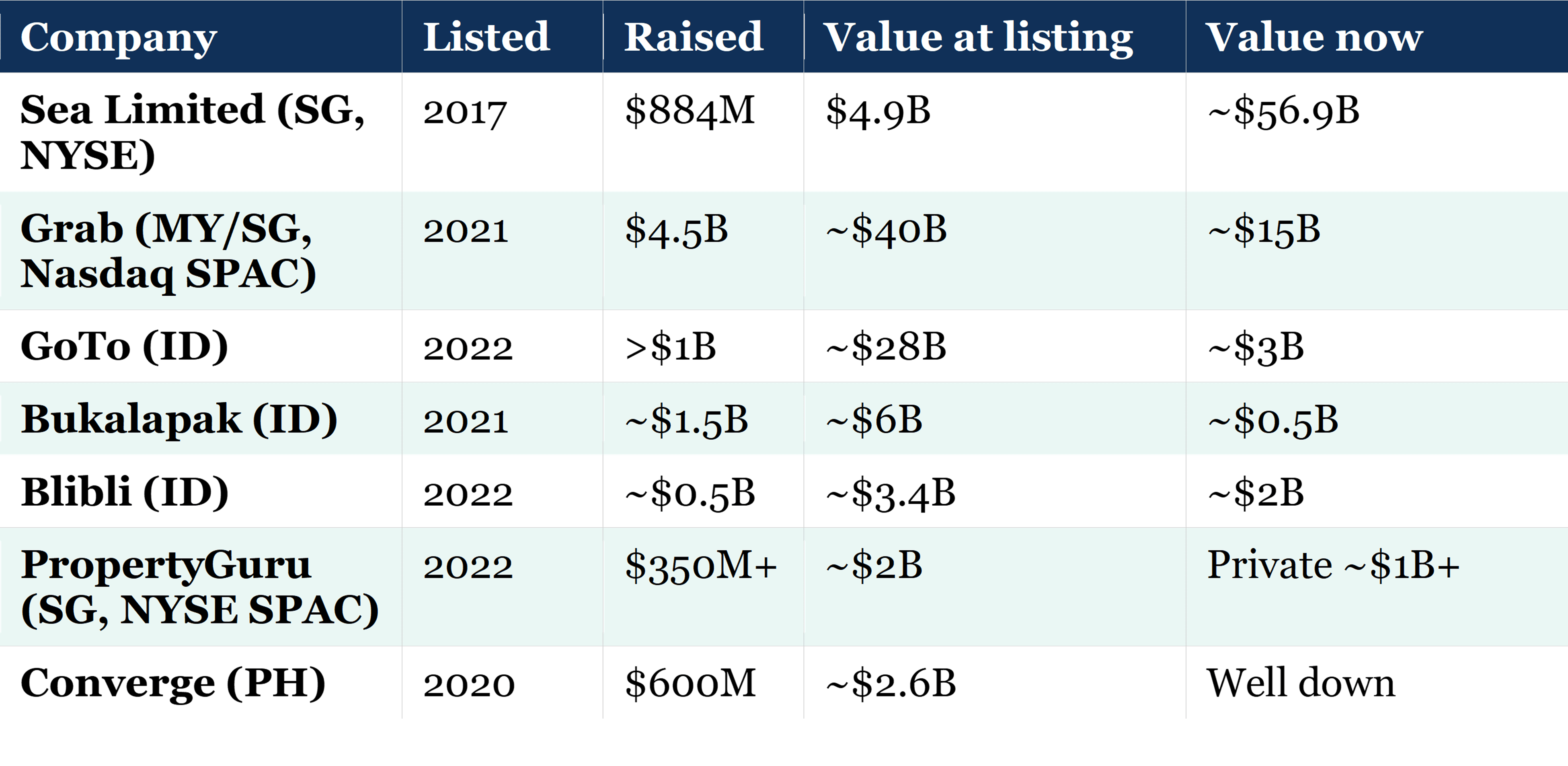 One Winner, Six Shipwrecks 01.07.2026 20mSince 2017, Southeast Asia has produced exactly one tech IPO that made public investors real money. One. And this week, the Philippines is getting ready to bet its entire year on the next one.So this week I want to talk about who is buying, who is selling, and which side of that trade you actually want to be standing on.Four stories, and they braid into one. We open with the good news, because there usually is some. Then we follow the money all the way to the part nobody puts on the deck.The smart money showed up twice in one weekStart with the hopeful, because it is real and it is specific.This week two of the most serious institutions on the planet made their first proper bet on Southeast Asia. Not a press tour. Not a memorandum of understanding. Actual money into actual companies.The first: MIT, the university, joined the cap table of a Singapore company called PVX Partners. Not a flashy name, I had not heard of them before this. They do cohort-based financing for user acquisition. In plain terms, they fund the marketing spend for mobile games and consumer apps, and they get paid back out of the revenue those users generate. It came on the back of a ten-plus-million-dollar round with names like General Catalyst, and I think a DraftKings vehicle in there too. As far as I could find, this is MIT’s first major disclosed startup bet in the region.The second, and this one landed the day before I recorded: Pfizer Ventures, the drug giant’s venture arm, made its first Southeast Asian startup investment into a Singapore biotech called Engine Biosciences. Engine does AI-driven precision oncology, hunting cancer drugs with machine learning. They just opened a Silicon Valley office to go with the Singapore base.Here is why this is not just a funding roundup. When an elite American endowment and Big Pharma’s investment arm both pick Singapore companies for their opening move, in the same week, that is not a coincidence. That is a signal about where sophisticated capital now thinks the edge is.These are not tourists chasing a hot round. PVX is unglamorous infrastructure. Engine is deep science. Both are the kind of bet you make after you have done the work.Hold that thought, because the rest of this is about what happens to the money that was already here when it tries to leave.The Philippines is betting its whole year on one listingOn the 27th, Mint, the company behind GCash, filed its registration with the Philippine SEC and its listing application with the stock exchange. The number: up to 92.3 billion pesos, roughly 1.5 billion US dollars at up to ten pesos a share, targeting a fourth-quarter debut. If it prices at the top, it is the largest IPO in Philippine history.Sit with the context. The Philippines’ IPO count for 2026 before this filing was zero. Nothing. So the country’s first listing of the year is also the biggest it has ever had. And it is a fintech, which if you have listened before you know is my home-turf bias made concrete.GCash put financial services into something like 90 million pockets. It is the rare regional company that is genuinely profitable. The pitch writes itself: the people who made GCash a habit can now own a piece of it. I want this to work. Let me say that plainly.Now the part that worries me, out loud, because that is the point of these episodes.The float is about 12%. Twelve percent of the shares go to the public market. The public is being sold a fairly thin slice while insiders keep the rest. And to fit GCash into its main index, the exchange is now considering cutting its own minimum public float rule from 20% down to as low as 12%.Take that in. The benchmark is bending its own rules to accommodate one company. When a market reshapes itself around a single listing, and that listing is carrying the whole nation’s IPO year on its back, that is not a recovery. That is concentration risk wearing a party hat.The real question: does GCash trade well enough to reopen the pipeline for everyone waiting behind it, or does one wobble set the Philippine market back another two years?To answer that honestly, you cannot just look at GCash. You have to look at what happened to the last batch of regional champions that rang the bell.Indonesia got a stay of execution, not a clean bill of healthWhile Manila is opening a door, Jakarta is trying to keep one from closing.On the 24th and 25th of June, MSCI, the index provider whose decisions quietly move billions in passive money, deferred its decision on whether to downgrade Indonesia from emerging-market status to frontier. They kicked it to November. Indonesia keeps the badge, for now.Why was it even on the table? MSCI said, in effect, that it cannot trust the market. Lack of transparency in who actually owns the shares. Suspected coordinated trading that makes it hard to know what a fair price even is, or how much stock is genuinely free to trade. And the market rallied on the news.Here is where I get off the celebratory bus. That rally is celebrating a delay, not a fix. When the index provider tells you it cannot work out who owns the shares or what they are really worth, that is not a paperwork problem. That is a governance warning about the entire market.And look at the response. Indonesia is leaning on Danantara, the sovereign fund, plus insurance and pension money, to add buying support and prop up the exchange. Think about what that means. To pass a test about transparency and genuine free float, the answer is to bring in state and pension money to hold the market up. That is close to the opposite of the thing they are being asked to prove.A frontier downgrade is not abstract. It would force passive funds to sell Indonesian equities mechanically, which raises the cost of capital for every late-stage founder in the country dreaming about an IPO on that market, especially now without the hype cycle. November is closer than it sounds.Manila might be opening up, maybe. Jakarta is one review away from being pushed out. Hope on one side, risk on the other. So let me put some numbers on which way this bet usually goes.The receiptsI promised you a number at the top. Here it is with the receipts. Since 2017, this is how Southeast Asia’s big tech IPOs have actually treated the public investors who bought in.SPAC valuations are listing marks, not day-one closes. Dollar figures are dragged by weak pesos and rupiah. Current values approximate.One winner. Sea Limited went out at a $4.9 billion valuation and trades somewhere in the $56 billion range today. Everything else is a shipwreck. Grab is down around 60% from its listing cap. GoTo lost roughly nine-tenths of its value. Bukalapak is trading below the cash it raised. Converge, the one Philippine name I could pull, is the cautionary tale sitting right next door to GCash.Now the caveats, out loud, because the show runs on honest data. The SPAC valuations were listing marks, not day-one closes, and several fell on the open. Currency matters too: weak pesos and rupiah drag the dollar figures down. On a per-share basis the returns are often worse than the market-cap numbers suggest, because of share issuances along the way.But the base rate for this region is brutal. If you bought the Southeast Asia tech IPO story over the last eight years, with one exception, you lost money.What actually breaks the curseHere is the thing that matters. Almost every one of those shipwrecks went public unprofitable, floated at the very top of the cheap-money window on a growth-at-all-costs story.GCash is not that. GCash actually makes money. That is the one real thing that could break the curse.The curse was never the business. The risk is the entry price. GCash is reportedly chasing a valuation around eight to nine billion dollars, against roughly five billion in the private market just a couple of years ago. That is the exact same “premium to the last round” framing that came right before every name on the shipwreck list.History says it is not company quality th… This is a public episode. If you would like to discuss this with other subscribers or get access to bonus episodes, visit seaofstartups.substack.com
Similar podcasts


Popular in
The podcast also appears in the podcast charts of these countries.
