
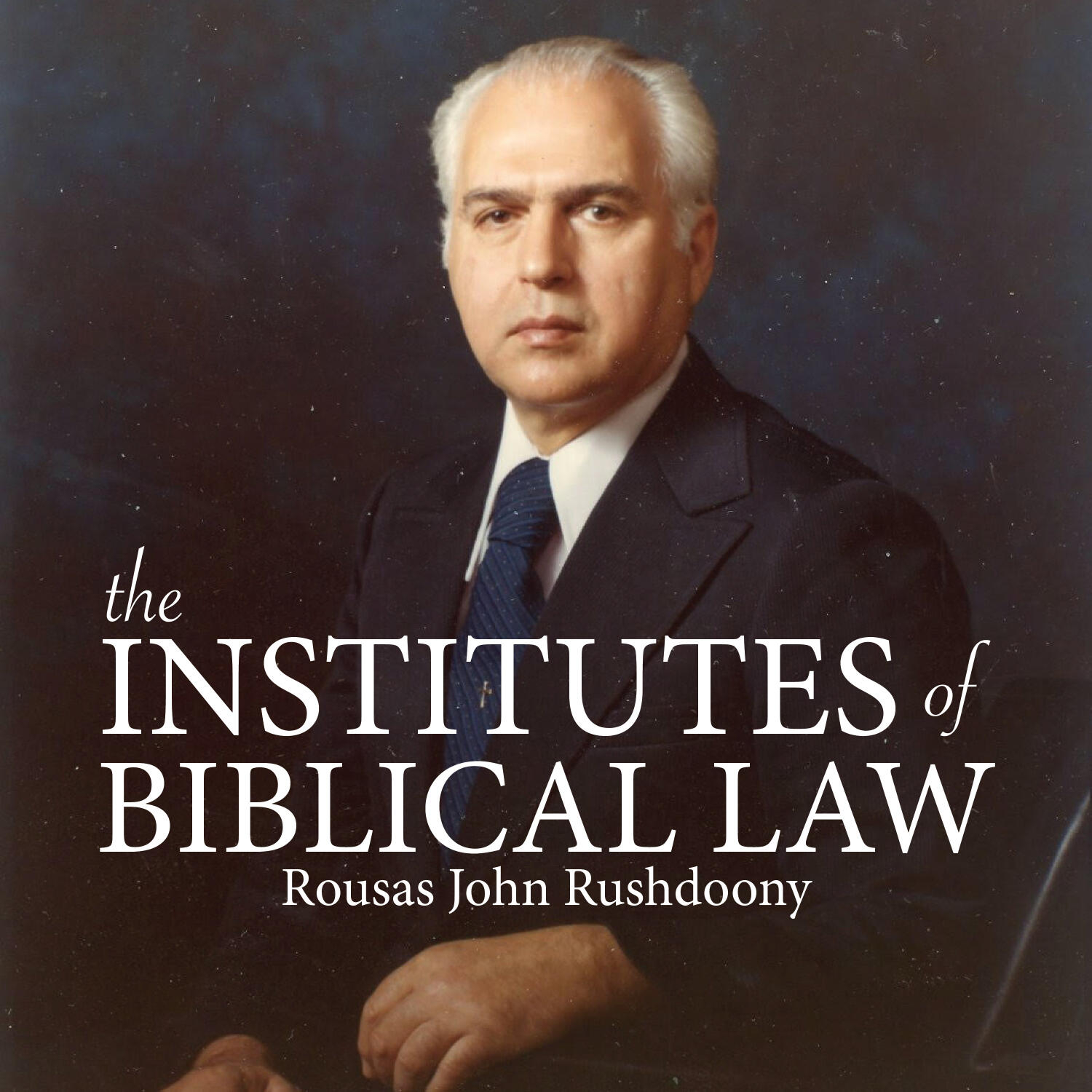
The Institutes of Biblical Law
R. J. Rushdoony
0
This podcast examines the theological importance of biblical law, arguing that studying Scripture inherently requires studying its legal teachings. Hosted by R. J. Rushdoony, it explores how these laws should govern both personal conduct and the broader structures of society. Episodes offer a detailed analysis of scriptural principles and their application to modern life and governance.
Episodes
-
 Appendix: Law in Western Society (Remastered) 21.06.2026 57mNotes on the Law in Western Society – The early church regarded biblical law as binding on believers, applying Levitical regulations to clergy, observing sabbath and moral law, and enforcing discipline, penance, and restitution (Ancyra, Basil, Gregory Thaumaturgus). Canon law reflected Scripture even while navigating Roman law, bureaucracy, and societal decay. The Theodosian Code and later Justinian’s Corpus Juris Civilis integrated Christianity with Roman law, while common law, medieval codes, and urban law drew heavily on biblical principles. Jewish communities, grounded in Scripture, contri...
-
Peace (Remastered) 14.06.2026 52mPeace in the biblical sense is the wholeness, prosperity, and well-being that flow from reconciliation with God and restoration under His order. It is more than the absence of conflict; it encompasses peace with God, with oneself, with others, and with creation, reflecting the Edenic harmony lost in the Fall and progressively restored through Christ. Messianic prophecies, such as living under one’s vine and fig tree (Mic. 4:4; Zech. 3:10), symbolize this holistic peace, encompassing security, prosperity, and personal fulfillment, while Jesus Himself embodies and grants this peace (John 14:27)....
-
Power and Authority (Remastered) 07.06.2026 56mPower and authority are inseparable from God’s law: power is mere force, but authority is the lawful right to rule, and only where both are grounded in God’s word can true order exist. Scripture teaches that the saints are called to govern the world not through humanistic coercion, miracles designed to compel belief, or institutional dominance but through obedience to Christ’s law and faithful self-government under Him. Humanism offers only two outcomes, anarchism or totalitarianism, because it lacks a transcendent law; biblical authority alone restrains both chaos and tyranny. Christ possesse...
-
Rebuke and Excommunication (Remastered) 31.05.2026 46mBiblical rebukes and excommunication are not institutional tools to protect the church’s prestige but covenantal acts aimed at restoring God’s order in faith, morals, and authority under His law. Rebuke is the first step of correction, grounded in Scripture and applied relationally, while persistent rebellion whether false doctrine, immorality, or refusal to fulfill basic covenant duties like family provision and just wages leads to rejection and excommunication. The church’s discipline addresses real-life obedience, not merely church offenses, because God’s Kingdom, not the institution, is th...
-
Discipline (Remastered) 24.05.2026 48mTrue discipline is not punishment but systematic training under God’s authority, producing learning, growth, and submission to His law-word; chastisement is only a corrective tool when discipline has failed. Churches often confuse the two, boasting of “strict discipline” while neglecting faithful teaching of Scripture, which alone empowered by the Holy Spirit creates real discipleship. Matthew 18 does not define discipline itself but tests whether a person is subject to God’s Word and therefore capable of correction; refusal to hear that Word reveals apostasy and leads to separation. Without t...
-
The Priesthood of All Believers (Remastered) 17.05.2026 41mThe priesthood of all believers is not a New Testament novelty but an Old Testament doctrine rooted in God’s covenant declaration that His people are a kingdom of priests (Ex. 19:5–6), a royal calling conditioned on obedience to His law and directed toward the establishment of His Kingdom. This priesthood is not sacerdotal or sacrificial in the atoning sense Christ alone fulfills that but royal and practical: every believer is called to rule under God as His vicegerent, exercising dominion in family, vocation, and society according to God’s law. Worship is not confined to church services but p...
-
Circumcision and Baptism (Remastered) 10.05.2026 45mBaptism succeeds circumcision as the covenant sign, preserving the same covenantal meaning while unfolding it in Christ: both testify that fallen human nature cannot save itself, that salvation comes only through death and regeneration, and that covenant membership brings both blessing and judgment. Circumcision symbolized the cutting off of the old nature and pointed forward to Christ’s atoning blood; baptism now proclaims participation in Christ’s death and resurrection, entrance into the new creation, and incorporation into the covenant people. As a sign and seal not grace itself baptism wi...
-
The Christian Passover (Remastered) 03.05.2026 53mThe Lord’s Supper is the Christian Passover, deliberately instituted within the Jewish Passover to proclaim the continuity of God’s covenant and to declare salvation as victory: just as Israel celebrated deliverance from Egypt and the death of the firstborn, so the church celebrates Christ, God’s Firstborn, who bears the covenant death-sentence to deliver His people and inaugurate the new creation. Both Passovers are covenantal and family-centered, designed to instruct children, require preparation through self-examination (the purging of leaven), and celebrate election by grace with sanctific...
-
Office of Elder in the Church 26.04.2026 53mThis section contends that the biblical office of elder has been hollowed out reduced from an active, pastoral arm of Christ’s kingship into a largely passive, managerial, or judicial role whereas in Scripture and the early church elders functioned as extensions of the pastor/bishop, advancing the gospel, caring for souls, and governing Christ’s people under His authority. Drawing on Ignatius, Polycarp, Irenaeus, and later Reformed standards, the argument shows that early bishops were essentially missionary pastors, presbyters were local ruling shepherds, and deacons served under them, all wit...
-
The Eldership (Remastered) 19.04.2026 40mThis section argues that eldership is an older, covenantal office that the church inherits rather than invents rooted in Israel’s family-and-tribal order, where “elders” governed household, synagogue, and civil life under the one standard of God’s law. In the New Testament, elders (presbyters) become the governing-teaching officers of the “new Israel,” marked by ordination/laying on of hands (1 Tim. 4:14) and qualified especially by proven household rule (1 Tim. 3:2–5). Because persecution and pagan courts made the church function as a “total society,” elders also served as a court of discipli...
-
Law in Acts and Epistles (Remastered) 12.04.2026 52mThis section argues that the New Testament never buries God’s law but repositions it: the Decalogue and moral demands are reaffirmed and intensified (especially inwardly, as Watson notes), while the church rejects only the misuse of law as a means of justification. Acts 15 is framed not as abolishing the law, but as refusing circumcision and rabbinic “law of Moses” as a saving yoke, while still presupposing obedience and issuing boundary instructions to Gentile converts for holiness and fellowship. Paul’s “not under law but under grace” (Rom. 6:14) means believers are no longer under the law a...
-
The Cultural Mandate (Remastered) 05.04.2026 55mThe cultural mandate isn’t a distraction from the gospel it’s the outworking of Christ’s victory in the world. From Genesis to the Great Commission, God calls His covenant people to subdue the earth under His law, not surrender it to chaos, empire, or fate. To deny this calling is to hand culture, law, education, and nations over to humanism and statism and then to wonder why disorder follows. In Christ, the Second Adam, the mandate is restored: regenerate men, tear down rebellious ideas, disciple nations, and bring every sphere of life into obedience to Him. This is not empire-building or wor...
-
The Tribute Money (Remastered) 29.03.2026 45mThey thought they had Jesus trapped with a political “gotcha”: Is it lawful to pay Caesar’s tax or not? Say no, and Rome arrests Him. Say yes, and the crowd calls Him a fraud. But Jesus flips the trap back on them with one coin. Whose image is on it? Caesar’s. Then His answer lands like a thunderclap: Give back to Caesar what’s owed and give back to God what’s owed. In other words: yes, pay the tax, because you’re living under Rome’s real-world rule by God’s providence but don’t confuse taxes with worship. Caesar may claim authority, even divine pretensions, but God’s claim is absolute: everyt...
-
The Kingdom of God (Remastered) 22.03.2026 50mThe Kingdom of God teaches that Christ’s proclamation of the Kingdom does not abolish the law but confirms it in its fullest authority, revealing the law as the rule of the reigning King. When Jesus declared that “the law and the prophets were until John,” He marked not their expiration but the transition from promise to presence the Kingdom is now preached because the King Himself has come, summoning all peoples to press into His rule. Far from relaxing God’s standards, Christ affirmed that it is easier for heaven and earth to pass away than for the smallest part of the law to fail, exposing...
-
The Transfiguration (Remastered) 15.03.2026 32mThe Transfiguration reveals the unbreakable unity of Christ with the law and the prophets, identifying Jesus unmistakably as the Greater Moses and the incarnate Lawgiver. On the mountain echoing Sinai Jesus is transfigured in glory alongside Moses and Elijah, showing that the law and the prophets do not stand apart from Him but bear witness to Him in perfect harmony. Their conversation about His coming exodus at Jerusalem declares that Christ’s redemptive work fulfills the true deliverance of God’s people, not by abolishing the law but by accomplishing its purpose through atonement and resurre...
-
Antinomianism Attacked (Remastered) 08.03.2026 1hAntinomianism Attacked shows that Jesus’ conflict with the religious leaders centered on their substitution of human tradition for God’s law, a move that He identified not as faithfulness but as lawlessness. By exposing ceremonial washings and practices like Corban as man-made commandments that nullified God’s Word, Jesus declared that only laws planted by the Father have authority, and that both antinomianism and legalism rejecting God’s law or replacing it with human rules stand condemned. Against the Pharisaic belief that defilement comes from the environment, Christ taught that lawlessness...
-
The Woman Taken in Adultery (Remastered) 01.03.2026 53mThe Woman Taken in Adultery demonstrates not the setting aside of God’s law but its decisive confirmation by Christ, who exposes the hypocrisy and antinomianism of the scribes and Pharisees while upholding the law’s full authority. By invoking the requirements of Numbers 5 and demanding honest witnesses, Jesus placed the accusers themselves on trial, affirming the death penalty in principle while showing that no lawful case could proceed once the guilty witnesses withdrew. His refusal to condemn the woman was therefore judicial, not moral: the law stood, the charge collapsed, and the woman was...
-
Christ and the Law (Remastered) 22.02.2026 45mChrist and the Law explains that Jesus did not come to abolish the law but to fill it full to establish it in its true force and carry it forward as the abiding standard of God’s kingdom (Matt. 5:17–18). In the Sermon on the Mount, Christ speaks not as a commentator but as the King and Lawgiver “I say unto you” reinforcing that even the “least commandments” matter, and that kingdom citizenship is proven by doing and teaching His words (Matt. 5:19–20; 7:24). His resistance to Satan is framed by direct appeals to Deuteronomy, showing that history and righteousness must be governed by God’s law,...
-
The Law and the Covenant (Remastered) 15.02.2026 53mThe Law and the Covenant presents Scripture’s unified testimony that God’s law and covenant are inseparable and universally binding on all men and nations, whether in blessing or judgment. From Isaiah to Malachi, from Jeremiah and Ezekiel to Hebrews, God indicts individuals and empires alike not merely for immorality but for covenant-breaking rejecting His law and attempting to live as though meaning, causality, and authority can exist apart from Him. The covenant of grace brings life, order, and an unshakable kingdom in Christ, while the covenant of death man’s attempt to escape God’s law res...
-
Natural and Supernatural Law (Remastered) 01.02.2026 52mAccording to Scripture, the result isn’t neutrality it’s chaos. When man’s reason, experience, or majority opinion becomes the source of law, God is quietly dethroned, the state takes His place, and truth is reduced to compromise and expediency. This episode exposes how even well-meaning theologians traded Moses for Plato, revelation for rationalism, and ended up empowering statism, relativism, and moral collapse. The Bible offers no middle ground: either God’s revealed law governs life, society, and science or there is no law at all. To reject Moses is to reject the God who orders the world....
Similar podcasts


Popular in
The podcast also appears in the podcast charts of these countries.
