
Dino Quest
Fun Kids
1
Dino Quest is a children's podcast from Fun Kids, the UK's children's radio station. Each episode, Lauren and Cassius choose one dinosaur speciality, such as the fastest legs or sharpest teeth, and explore it in depth. They speak with palaeontologists and other scientists who study dinosaurs, including researchers working with fossils and computer models. Across the series, they build an imaginary perfect dinosaur using one real feature from one real fossil at a time.
Episodes
-
 The dinosaur family found in their own burrow, with David Varricchio 17.11.2026 27mNobody pictures a dinosaur spending the afternoon down a damp, dark hole, but a hole in the ground is one of the best ideas in the animal kingdom. Go down half a metre and the temperature barely changes all day: cooler than the surface at midday, warmer at night, which is free air conditioning in a super greenhouse world. If the hole is exactly your size, nothing bigger can follow you in. And it keeps your babies away from the many, many things that would like to eat them. Burrows still came as a surprise, because we picture 40-tonne sauropods and seven-tonne T. rexes, and none of those is goi...
-
 Most dinosaurs walked at about your speed, with Peter Falkingham 10.11.2026 28mA skeleton is what’s left after something died. A footprint is a moment from a living animal: it pressed its foot into the mud, lifted it out and carried on, and then the mud set. One dinosaur might take a few thousand steps a day for twenty years, so there are vastly more footprints than dinosaurs, and they turn up where no bones survive, because a bone needs burying fast while a footprint needs to dry slowly and be covered gently. They also answer a question a skeleton can’t. Not how fast dinosaurs could go, which was episode one, but how fast they were actually going on an ordinary Tuesday....
-
 Why Allosaurus had a surprisingly weak bite, with Emily Rayfield 03.11.2026 36mT. rex’s arms are the joke everyone makes, but each one was about a metre long, thick and muscular, and by some estimates could lift around 200 kilograms. They only shrank compared with the head, which grew long, wide and strong enough to do the catching and the killing on its own. Other dinosaurs went the opposite way. Megaraptorans had huge arms with claws so big that the first one found was thought to belong on a foot. This week’s word is palaeobiology. Professor Emily Rayfield, who has clearly been asked at a lot of parties, calls it “the biology of long dead extinct animals”. It’s the dif...
-
 Dinosaurs had bones in their eyes, with Stephan Lautenschlager 27.10.2026 32mDinosaurs had bones in their eyes. You don’t, and nor does any other mammal, from dogs to whales to elephants. We’re the odd ones out. Birds, lizards, turtles and fish all have a ring of thin bony plates sitting in the white of the eye, holding a big eyeball steady so it can focus. Because it’s bone, it sometimes fossilises, and that matters, because the age of the dinosaurs lasted around 160 million years and roughly half of it happened in the dark. This week’s word is sclerotic ring. Sclerotic comes from a Greek word meaning hard, and the ring is usually made of 10 to 15 overlapping plates,...
-
 Why you can’t hide from a T. rex, with Jared Voris 19.10.2026 43mThe most important part of your nose is inside your brain. Your nose catches the smell, but it’s a lump at the front of your brain that works out what it is: sweet, horrible, or dangerous, like gas in the kitchen. Humans tend to put smell near the bottom of their list of senses. For most animals it’s essential, for marking territory, finding each other and sniffing out food. This week’s word is olfactory bulb. That’s the lump. The bigger it is for your size, the better your nose, and because it takes up room in the skull, it leaves a space scientists can measure. But room in a head is a trade-...
-
 Dinosaur chicken nuggets with Jingmai O’Connor 12.10.2026 36mLoads of dinosaurs had wings, but not many of them could fly. There’s a dinosaur in your garden right now, probably the one that keeps stealing your chips, because a seagull is a dinosaur, and so is every robin, pigeon and chicken. Feathers turn up again and again across the dinosaur family tree, and most of them had nothing to do with flying. Oviraptors spread their feathered arms over their nests to keep their eggs warm, and some parents have been found still sitting on them. Others used feathers for showing off and for keeping warm in the cool forests of north-east China. This week’s word i...
-
 Why dinosaurs never dragged their tails with Pasha van Bijlert 05.10.2026 33mA dinosaur’s tail could be a third of the whole animal, about as heavy to lug around as a concrete block, and for well over a century people drew dinosaurs dragging theirs along the ground. They didn’t. Palaeontologists have found thousands of dinosaur footprints and almost no tail marks, so a healthy dinosaur held its tail up and out behind it. The tail-dragging monsters in old paintings and old films were what scientists thought at the time, and that’s fine. Being wrong and then finding out is how science works. This week’s word is counterbalance. It’s the seesaw, the tightrope walker’s long...
-
 Life in a super greenhouse with Kirsty Edgar 28.09.2026 31mThe dinosaurs had around 160 million years on Earth, so there was never just one dinosaur climate. There were deserts, volcanoes and jungles, and there were forests at the North and South Poles, because for most of that time there was no permanent ice anywhere on the planet. Britain was subtropical to tropical. If you were packing for a trip, you would want a raincoat and an autumn jumper, not a snowsuit. This week’s word is super greenhouse. A greenhouse lets the sun’s heat in through the glass and makes it hard for it to get back out, and carbon dioxide in the air does the same thing to the...
-
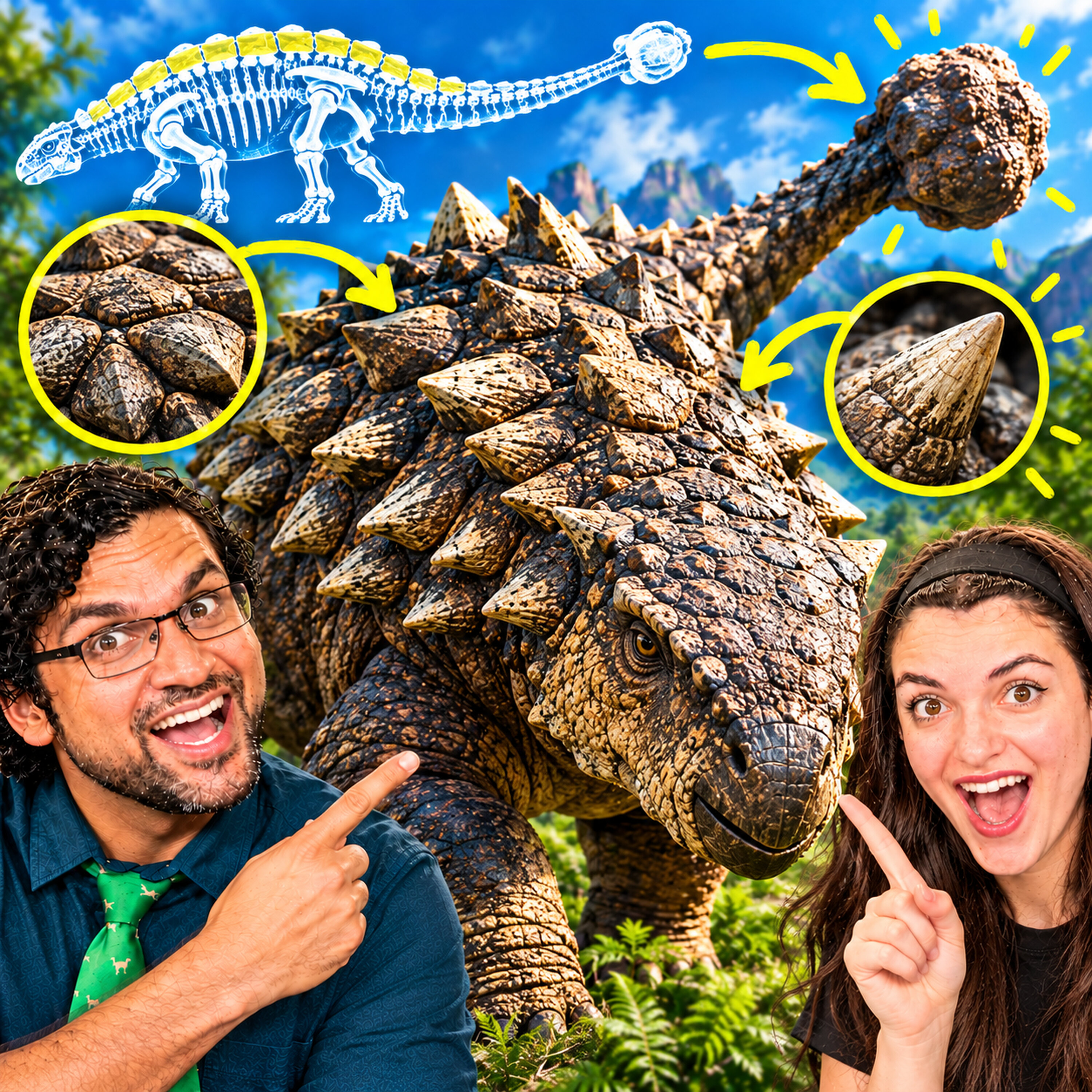 What the thagomizer?! with ReBecca Hunt-Foster 21.09.2026 32mIf something wants to eat you, you have three options: get so big that knocking you over is not worth the trouble, get fast enough to leave, or make yourself so expensive to attack that nobody bothers. Plenty of dinosaurs took the third one, and they did it by growing bone inside their own skin. Not armour they put on, but armour they were, down to bony eyelids in the case of Ankylosaurus. This week’s word is thagomizer, the cluster of spikes on the end of a Stegosaurus tail, and it is the only piece of dinosaur anatomy named by a newspaper cartoon. Gary Larson drew one in The Far Side in 1982...
-
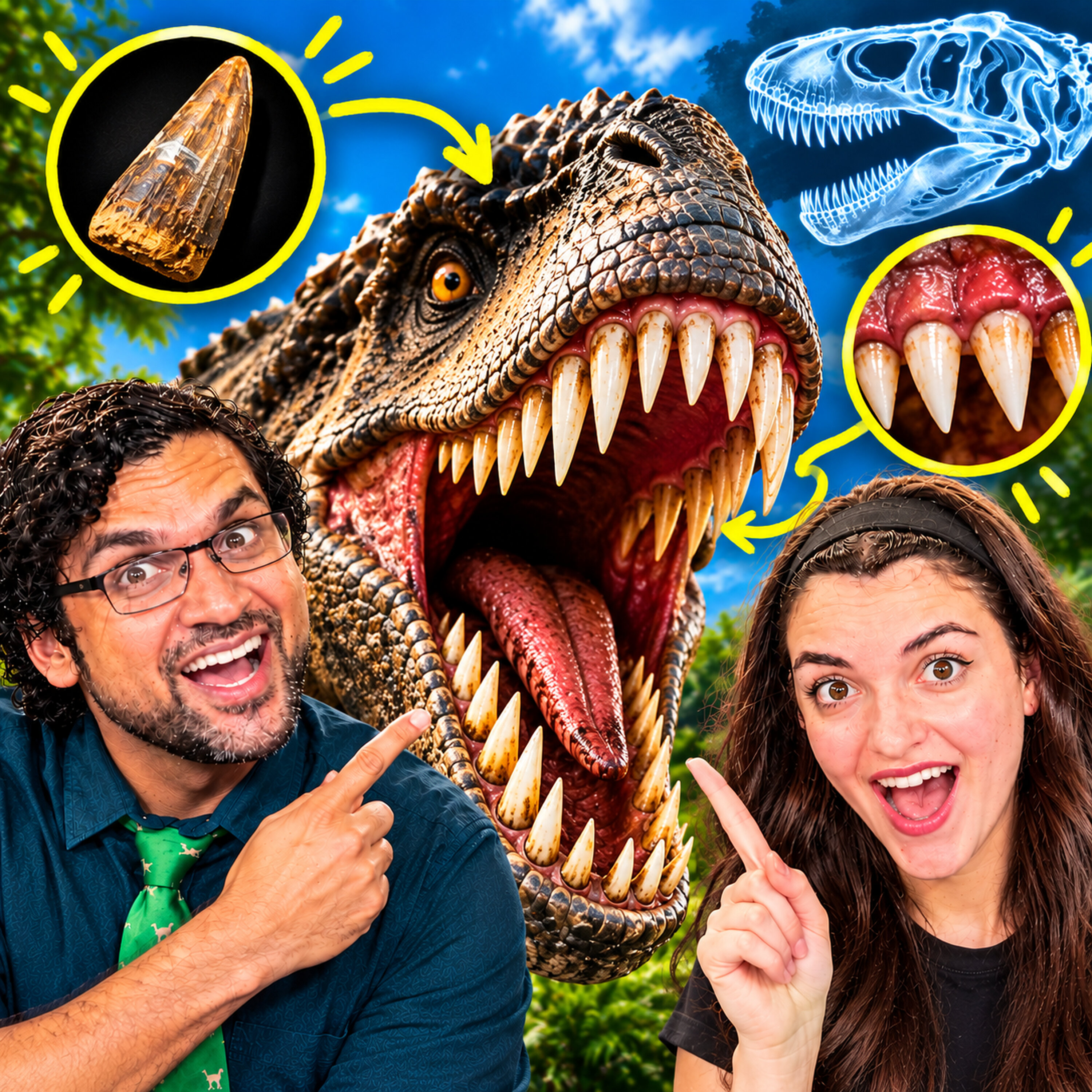 Dinosaurs never needed a dentist with Emma Nicholls 14.09.2026 38mNigersaurus grew around 500 teeth and replaced the whole lot roughly every two weeks. It never brushed them, never had to be careful with them and never once saw a dentist, because there was always another tooth coming up behind. The word for that is polyphyodont, and it is this week’s word. Humans get two goes. Milk teeth, then the set we are stuck with. Sharks, crocodiles and most dinosaurs are on a conveyor belt instead, and that changes what a tooth can be. If breaking one costs you nothing, your teeth are free to evolve into exactly the right shape for the job rather than something built...
-
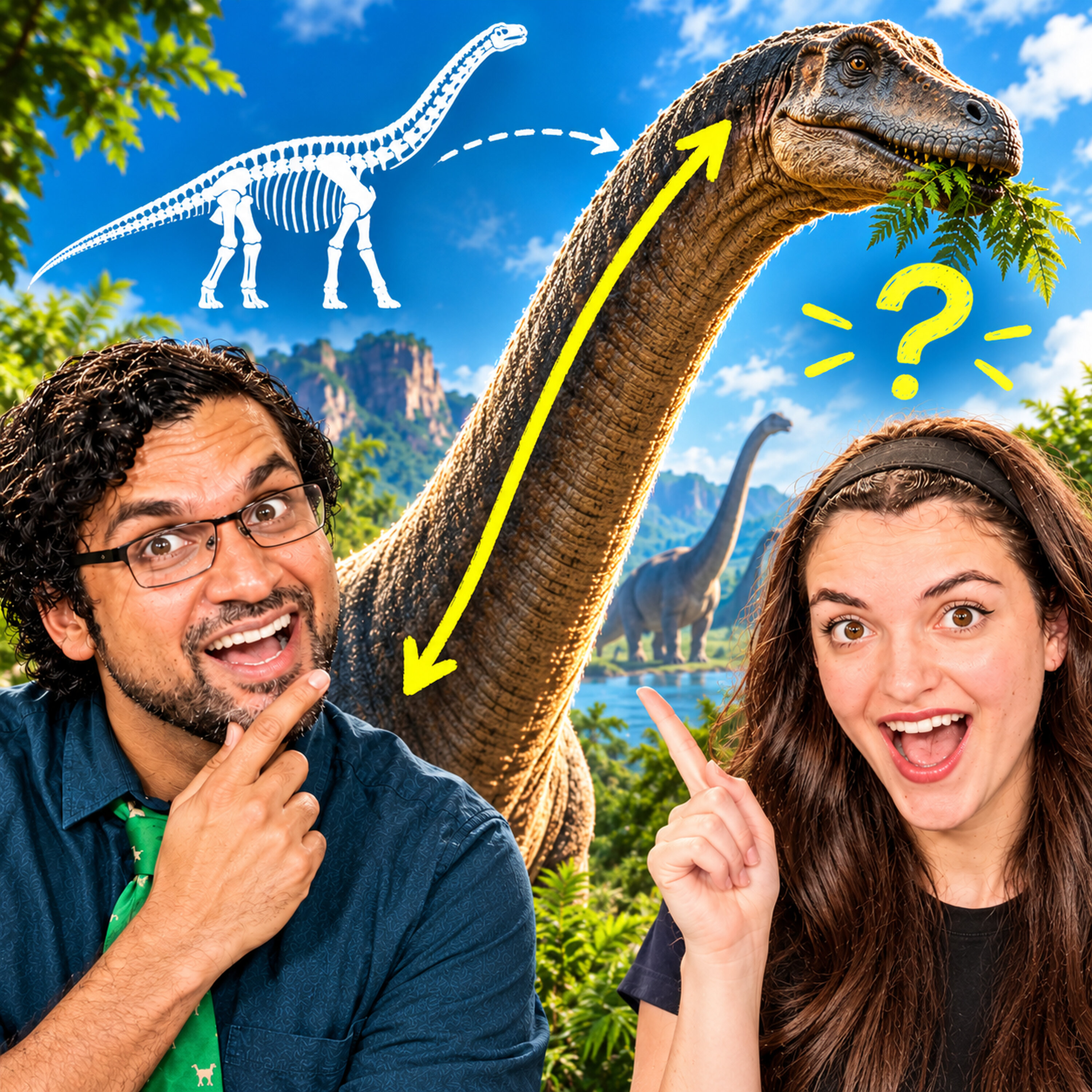 Dinosaurs with necks full of air with Mike Taylor 07.09.2026 32mThe longest neck any animal has ever grown belonged to Mamenchisaurus, and the neck on its own was more than 15 metres, longer than a school bus before you even get to the rest of the dinosaur. Which raises the obvious question: how do you hold something like that up? The answer is that mostly you don’t have to, because sauropod neck bones were never solid. They were full of air. That is this week’s word. Pneumatic bone is built like a honeycomb, riddled with air spaces a millimetre or two across, which makes it far lighter and, oddly, no weaker at all. Birds have the same trick, which is part...
-
 The dinosaurs that ran faster than Usain Bolt with John Hutchinson 31.08.2026 29mDinosaurs ruled for 160 million years, and the thing that made them a runaway success was where their legs went. Not out to the side like a crocodile, but straight down underneath them, a stance that costs less energy and frees the arms up for other work. So how fast could they actually go? Footprints in Inner Mongolia, laid down 120 million years ago, put a medium-sized meat eater at around 45 kilometres an hour, quicker than Usain Bolt at his peak, and trackways in La Rioja in Spain clock theropods at almost exactly the same speed. A quarry in Oxfordshire turned up a dinosaur highway of near...
-
This is Dino Quest 24.08.2026Legs that could outrun the fastest human alive. A neck longer than a double-decker bus. A tail people were once sure could crack like a whip. Every week Lauren and Cassius Morrison dig up one brand new, completely true fact about dinosaurs, and use it to add one piece to a dinosaur they are building themselves, one bone at a time. They call up real scientists, get into discoveries that are barely out of the ground, and answer the questions listeners send in. Along the way: why the pigeon on your windowsill counts as a dinosaur, and why you have almost certainly eaten part of a T. rex. Dino Que...
Similar podcasts


Popular in
The podcast also appears in the podcast charts of these countries.

