
GreenSpacealien — Quiet Cosmos
GreenSpacealien
0
GreenSpacealien — Quiet Cosmos is a calm, chaptered astronomy documentary podcast that explores the universe at an unhurried pace. Each episode journeys through topics such as stars, black holes, planets and the space systems that shape everyday life. The show follows the evidence behind big scientific questions while remaining relaxing enough to unwind to. It is original space storytelling aimed at curious minds and quiet nights, with companion video episodes and science shorts available on YouTube.
Episodes
-
 The Universe Our Eyes Miss: How Astronomers Read Invisible Light 16.11.2026 2h 5mExplore the universe through light beyond human vision. The Crab Nebula guides a journey from radio antenna correlations and infrared spectra to filtered optical images, X-ray events and gamma-ray pulses. Hear how detectors, calibration, observing dates and uncertainty help researchers connect these records into a physical account. Independent Fermi and AGILE observations of the 2010 Crab flare provide a focused example of a changing source.Chapters00:00 Reading the Crab in Two Bands01:42 Ordering the Spectrum08:04 From Detector Signal to Measurement16:12 Reconstructing Radio Images21:58 Compa...
-
 Could We Stop an Asteroid? From Detection to a Response Decision 13.11.2026 2h 2mFollow a fictional asteroid exercise from the first moving point of light to a response decision. Hear how observations constrain an orbit, how size and mass affect an assessment, what DART measured, and why a proposed intervention needs post-action verification. The episode combines clearly labeled teaching examples with results from published planetary-defense exercises. The episode reports no live asteroid alert or impact prediction.Chapters00:00 The moving point05:09 What the word “hazard” asks11:22 Searching a moving sky18:33 Give the point a track29:23 A corridor of possible orbits36:40...
-
 Why Do Worlds Have Rings? 10.11.2026 2h 4mTravel through the ring systems of Saturn, Jupiter, Uranus and Neptune. Follow orbiting particles through collisions, tides and moon interactions, hear how a disappearing star reveals a ring profile, and explore how researchers use spacecraft measurements to test the history of Saturn’s rings. Each chapter connects a visible pattern with the evidence and assumptions behind its explanation.00:00 A Line Across the Planet04:27 One Plane, Many Orbits11:43 Reading Light Through the Rings20:42 A Disk With Texture27:03 Sources and Origin Stories40:07 The Roche Competition45:57 The Moon Writes a Wave5...
-
 How Did We Measure a Ripple in Spacetime? 07.11.2026 2h 18mHow do scientists find a gravitational wave in detector data, and how do they infer what produced it? This 16-chapter series follows the evidence from interferometer strain, calibration and noise checks through searches, sky localization and waveform-based inference. It then connects gravitational-wave detections with merger light, pulsar timing arrays and the designs of future observatories.The evidence has layers. Calibrated detector strain is not a direct picture of a source. Source properties, sky maps, neutron-star matter and population conclusions are inferred using data and stated model...
-
 What Did Voyager’s Two Crossings Reveal About the Heliopause? 04.11.2026 2h 18mVoyager 1 crossed on 25 August 2012, identified by particles, magnetic context and later plasma waves; its Plasma Science could not measure a local profile. Voyager 2 crossed on 5 November 2018 with Plasma Science measuring local plasma. Two samples cannot map it globally.The heliopause separates solar-wind-shaped from local interstellar plasma; it is not the Sun’s gravitational boundary or the estimated Oort Cloud’s outer edge.NASA’s 17 April 2026 instrument table and 4 August 2026 power update describe dated status, not live telemetry. IMAP works near Earth: launched 24 September 2025, reach...
-
 Venus: What Happened to Earth's Twin? 31.10.2026 2h 13mVenus is close to Earth in size, yet its surface and atmosphere followed a very different path. This 13-chapter series follows the evidence from radar mapping and impact craters to reported changes at a volcanic vent, atmospheric chemistry, isotope measurements, and competing models of how climate and water may have changed through time. It separates measured quantities and mapped features from interpretations and model outcomes.An impact-crater count is not a date for every rock or proof of one global resurfacing event. The deuterium-to-hydrogen ratio records an isotope comparison; by itself...
-
 Cosmic Dawn — Evidence from the First Galaxies 28.10.2026 2h 19mA quiet longform journey through the evidence for cosmic dawn: the galaxies we can measure, the hydrogen between them, and the questions that remain in their spectra.The film follows infrared color selection, spectroscopic redshifts, neutral hydrogen, quasar sightlines and the photon budget behind reionization. Each method brings its own selection limits and model assumptions.Early galaxies remain unresolved sources. Their measured light can constrain gas and stellar models, but does not directly identify the first stars. A radio upper limit is not a detected cosmic signal; a local sightline i...
-
 How We Know Other Worlds Are There 25.10.2026 2h 19mHow do astronomers find planets around other stars when most are too faint to image directly? This series follows the clues: a star’s motion, a repeating dip in its light, checks against false positives, and other methods such as direct imaging, microlensing and atmospheric spectroscopy. Each method answers a different question, and each depends on what the telescope can measure and the model used to interpret it.A candidate is not automatically a confirmed planet. A measured mass or radius is not a complete map of an interior, and atmospheric signals depend on wavelength, observing conditions...
-
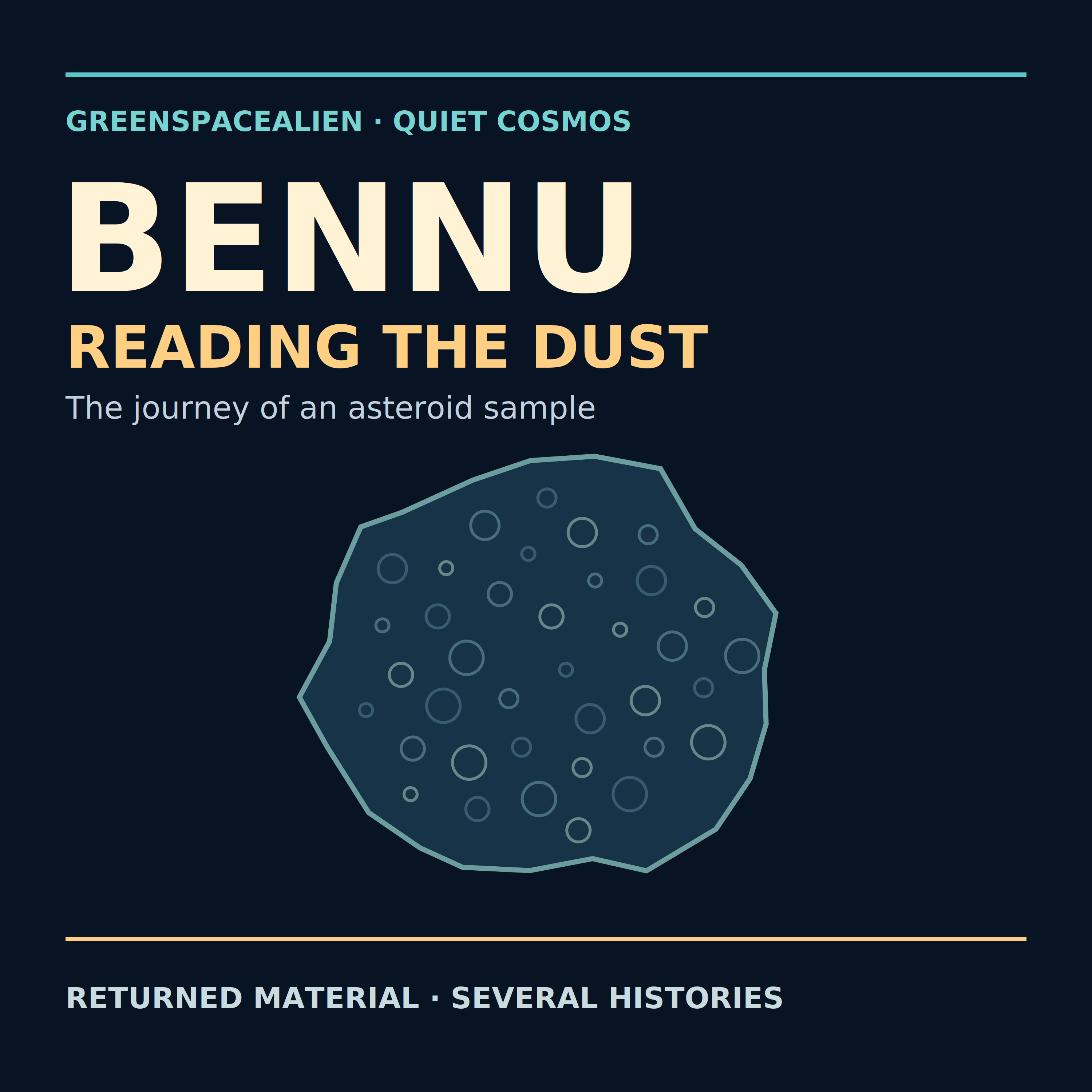 Reading Bennu: The Journey of an Asteroid Sample 22.10.2026 2h 23mNASA’s OSIRIS-REx mission returned 121.6 grams of material from asteroid Bennu. This episode follows what scientists can learn from a returned sample: how it was collected and curated, what its minerals and isotopes record, and how comparisons with Ryugu, Itokawa, and meteorites help test ideas about the early Solar System.Each result applies to particular samples and measurements; no whole-asteroid census is claimed. Proposed parent-body settings are reconstructions from evidence, not a direct map of an ancient orbit. Organic chemistry informs prebiotic possibilities; the data do not establis...
-
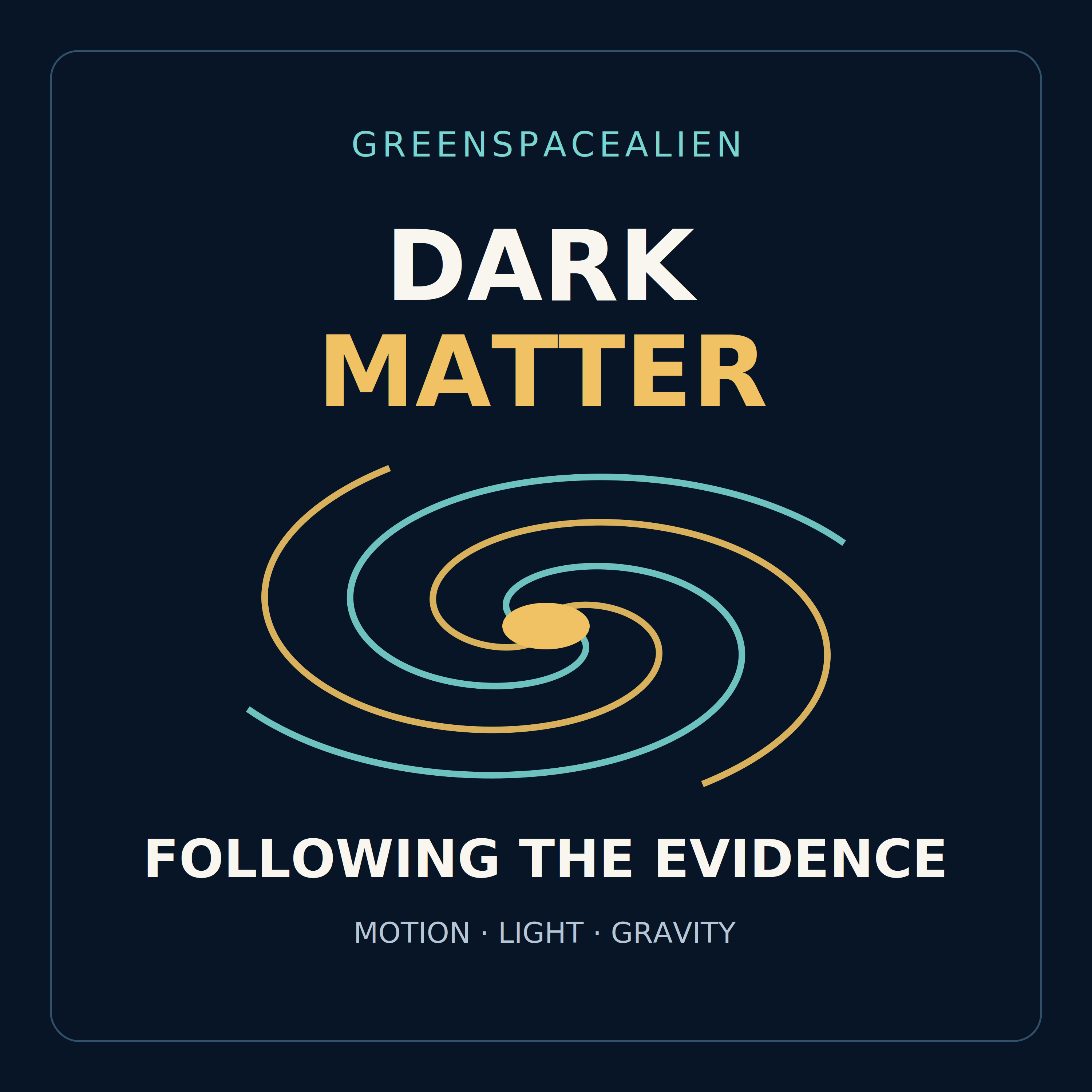 Dark Matter: Following the Evidence 20.10.2026 2h 19mA galaxy’s outer regions can keep moving faster than a calculation based on its visible stars and gas predicts. That difference begins a careful journey through the evidence for unseen gravitating matter—and through the places where the explanation remains open.We follow how spectral shifts become rotation curves, how many faint shape distortions become a statistical lensing profile, and why the Bullet Cluster’s displaced hot gas matters when compared with a lensing reconstruction. The oldest-light matter fit, primordial deuterium and fast-radio-burst dispersion add different constraints, each...
-
 How Far Can We Actually See? | Calm Space to Fall Asleep To 04.10.2026 2h 18mWhat can we see when light has crossed an expanding universe, and what does “distance” mean in that setting? This quiet journey separates light-travel time, lookback time, present distance, and cosmological horizons.In the selected flat Planck-baseline ΛCDM model, the particle-horizon radius today is about 46 billion light-years. This is a model estimate of causal reach, not a directly seen object at that distance or a physical edge. Other distance definitions give different answers.Selected sources and credits- Planck Collaboration, 2018 cosmological parameters (https://doi.org/10.1051/0004-6...
-
The Moon Changed Earth—and Earth Changed the Moon | Calm Space to Fall Asleep To 03.10.2026 2h 11mEarth’s spin, lunar orbit, and oceans have changed together over deep time. This calm documentary traces evidence from competing Moon-formation accounts through tides and incomplete geological records to today’s laser-ranging measurements.The current average recession rate is about 3.8 centimetres per year; it has not been constant through Earth’s history. Ancient sediment preserves local, incomplete records. The Moon affects Earth’s tides and axial dynamics, but the evidence does not show that it was required for life.Selected sources and credits- NASA, Moon facts (https://science.nasa.gov/mo...
-
Why Venus’s Sky Outruns Its Planet | Weather Beyond Earth | Calm Space to Fall Asleep To 02.10.2026 2h 15mVenus offers a striking opening: its cloud tops circle the planet in roughly four to five days while the solid world turns much more slowly. From that contrast, this calm documentary asks how energy, chemistry, rotation, and measurement shape weather on other worlds.The journey compares Venus, Titan, Mars, Jupiter, Saturn, and distant exoplanets. It distinguishes measured motion and instrument readings from inferred maps and model explanations. A reconstructed exoplanet temperature pattern is not a photograph.Selected sources and credits- Venus rotation and cloud tracking: NASA Venus Facts (ht...
-
How Do We Map a Galaxy We Can’t Leave? | Calm Space to Fall Asleep To 01.10.2026 2h 16mThe Milky Way is all around us, but we observe it from within its disk. This quiet journey combines Gaia’s sky map with distances, stellar motions, spectra, and evidence of past encounters to reconstruct our Galaxy’s structure and history. Every method adds evidence, and every map carries uncertainty.The final chapters compare published forecasts for the Milky Way–Andromeda system. They do not promise a collision.Selected sources and credits- ESA, Gaia EDR3 all-sky map (https://www.esa.int/ESA_Multimedia/Images/2020/12/Interactive_map_of_the_sky_from_Gaia_s_Early_Data_Release_3), Gaia DR3 Milk...
-
The Sun Reaches Far Beyond Daylight | Solar Wind, Auroras, and Space Weather | Calm Space to Fall Asleep To 30.09.2026 2h 14mThe Sun’s influence reaches Earth as light, particles, and magnetic fields. This quiet journey follows solar energy from the visible surface through the solar wind, Earth’s changing magnetic environment, aurora, forecasting, and the larger heliosphere.A flare is not a coronal mass ejection, and an eruption does not automatically mean an Earth impact. The episode separates observations from forecasts and explains why technology effects depend on the event and pathway.Selected sources and credits- NASA, solar irradiance (https://earth.gsfc.nasa.gov/climate/projects/solar-irradiance/science), the...
-
The Oceans We Cannot See: How We Find Hidden Seas Beyond Earth | Calm Space to Fall Asleep To 29.09.2026 2h 15mAn icy moon can look quiet while its interior leaves clues in a changing magnetic field, a measured wobble, or material that escapes into space. This calm, evidence-led journey compares possible oceans from Europa and Enceladus to Ganymede, Callisto, Titan, Mimas, Ceres, Pluto, and Triton.Some conclusions are stronger than others. Titan’s proposed global water ocean is contested by analyses of the same Cassini archive. Measurements, models, and interpretations stay distinct, and habitability stays separate from life. No life has been detected in the evidence discussed here.Selected sources and...
-
The Entire History of Mars | Calm Space to Fall Asleep To 25.09.2026 2h 19mMars is more than the red world we see today. Its rocks preserve clues to a young planet shaped by impacts, a changing interior and magnetic field, water, and the gradual loss of atmosphere.Follow Mars from its early formation to the missions studying it now. This documentary separates direct observations from geological interpretations, climate models, and open hypotheses—including what the search for past habitability can and cannot tell us.This is the video edition of GreenSpacealien — Quiet Cosmos. The accompanying narration is at natural speed.Manual chapters:(00:00:00) A World Written in...
-
How Satellites Quietly Shape Your Day | Calm Space to Fall Asleep To 25.09.2026 2h 10mYour phone’s blue dot may rely on satellite signals, but satellites do not photograph your street. This Quiet Cosmos documentary follows the less-visible systems behind everyday services: how receivers use satellite timing, why clocks in orbit need relativity corrections, how weather and land observations become measurements, where satellite relay can extend a connection, and what crowded orbits mean for astronomy and stewardship. Each part separates what satellites measure from the work done by receivers, ground networks, algorithms, and people. Coverage and capabilities vary by system, devic...
-
The Entire Life of a Black Hole | From Birth to the End of Time | Calm Space to Fall Asleep To 20.09.2026 2h 10mFrom a massive star’s final collapse to a black hole’s far-future theoretical ending, this is a calm, chaptered journey through what black holes are, how we find them, how matter behaves around them, and how they grow and shape their galaxies. We distinguish direct observations from models and predictions along the way—including the still-unobserved Hawking evaporation of astrophysical black holes.Designed for quiet listening, sleep, or focused astronomy learning.Chapters00:00 A Point of No Return00:05:18 What a Black Hole Is—and Is Not00:16:03 How Stellar Black Holes Are Born00:29:17 How We F...
-
The Entire Life of a Star | From Nebula to White Dwarf or Black Hole | Calm Space to Fall Asleep To 18.09.2026 2h 12mA calm, long-form journey through the life of a star. Begin in a cold molecular cloud, follow gravity toward first light, and discover how a star's mass determines whether it becomes a white dwarf, neutron star, or black hole. We close by following stellar material back into the clouds where new stars begin.Designed for quiet listening, sleep, and focused astronomy learning.Chapters00:00:00 Chapter 00 - A Small Point of Light00:04:19 Chapter 01 - The Dark Clouds Where Stars Begin00:15:12 Chapter 02 - Collapse and the First Light00:26:28 Chapter 03 - When a Star Finds Its Balance00:39:15 Chapte...
Similar podcasts


Popular in
The podcast also appears in the podcast charts of these countries.
