
BrushStrokes of Being
Karin Merx Fine Art
0
Brushstrokes of Being is a conversational podcast hosted by artist Karin Merx that explores art and the creative life. Each episode features conversations with artists and creatives intended to inspire, encourage and teach listeners about making and appreciating art. The show accompanies the Brushstrokes of Being Substack newsletter, where related writing and updates are shared.
Episodes
-
 Recognition Is Not Observation: Learning to Truly See 01.10.2026 15mI have been thinking a great deal about something deceptively simple:What does it actually mean to see, to read, to listen, to know?That thinking became Episode 121 of Brushstrokes of Being.I begin with books.Not simply the information they contain, but the books themselves: paper, typography, binding, annotations, evidence of use. A book is a human artefact, carrying more than the words printed inside it.From there, I move into neuroscience and literary reading, and the remarkable way the brain transforms symbols into imagined worlds.Reading is a form of seeing without looking.Then music enters the conversation.Music can make us experience things that aren’t physically present.And painting can make us see what cannot necessarily be photographed.I think about Dr Jason Arday and his descriptions of observing human interaction before language became available to him. I think about my own experience as an artist and musician, where perception often comes before explanation.And eventually I arrive at something that has been central to my teaching for years:Recognition is not observation.We recognise something, name it, place it into a category, and often stop looking.But genuine observation asks us to remain present.To notice relationships.Posture.Gesture.Light.Movement.Space.Difference.The things we don’t yet have words for.That is why today is also the launch of the first two courses in my Foundational Series:Learn to See Like an ArtistThis is not a drawing course.It is an investigation into observation: learning to suspend recognition long enough to actually see.https://onlineartseducation.co.uk/course/learn-to-see-like-an-artist-the-discipline-of-seeing-observation-as-an-artistic-practice/Seeing With Your EarsA deeper exploration of perception and attention, beginning with music and extending to how we construct meaning through what we hear, see, and experience.These courses are the beginning of the Observational Art Academy — an approach to art education built on something I consider fundamental:Before expression comes perception.You cannot meaningfully transform what you have never truly learned to perceive.https://onlineartseducation.co.uk/course/seeing-with-your-ears/ This is a public episode. If you would like to discuss this with other subscribers or get access to bonus episodes, visit brushstrokesofbeing.substack.com
-
 Before You Judge, Learn to See 25.08.2026 19mWhat happens when we stop simply recognising what we see?Every morning, I sit in my garden with my coffee and watch the bees, birds, flowers, shadows and wind. At first, I see a garden. But when I remain there long enough, something changes. I begin to perceive relationships: between bee and flower, movement and stillness, light and shadow, parent and offspring, colour and space.Nothing in the garden has changed.My perception has.This is where observation begins.In this episode of Brushstrokes of Being, I explore the difference between recognition and observation, and why sustained observation is one of the foundations of what I call visual intelligence.Visual intelligence is not simply seeing more. It is the ability to perceive relationships, understand them, and eventually make deliberate choices with them.And this matters far beyond drawing and painting.We live in a culture of rapid recognition, categorisation and judgement. We are constantly encouraged to decide what something is, whether we like it, whether we agree with it, and which category it belongs to.The arts are not immune to this.We categorise artists as traditional or contemporary, realist or abstract, painter or conceptual artist. We can then move almost instantly from category to preference:I like it.I don’t like it.I’m drawn to it.But these are responses; not yet critical observations.So what happens when we slow down enough to ask different questions?What are the relationships within the work? How does composition function? How does the eye move? How do colour, value, rhythm, gesture, scale and space interact? Does a concept actually become embodied in the visual language of the work?And perhaps most importantly: what makes something good art?I also explore why observation and conceptual thinking are not opposing approaches. In my own series Exceptional Female Musicians, the conceptual proposition determines what I observe, what I select, what I emphasise and how I construct the relationship between the performer and the viewer.Concept does not eliminate the need for observation. It increases it.Because observation gives us something to transform. Visual intelligence allows us to understand what we are seeing. Concept allows us to decide what we want to communicate.And art emerges through the transformation.In September, I will be taking this thinking into my Art Academy with the launch of the first of the foundational four courses, Learn to See Like an Artist.Because learning to see is not simply preparation for becoming an artist. It is a way of encountering reality.Maybe tomorrow morning, sit somewhere quietly for a few minutes and see what you notice when you stop trying to name everything.Subscribe to Brushstrokes of Being so you don’t miss the Art Academy launch. This is a public episode. If you would like to discuss this with other subscribers or get access to bonus episodes, visit brushstrokesofbeing.substack.com
-
 When a Society Stops Giving Artists Time to Grow, or takes away the opportunities to learn artistic skills? 28.07.2026 10mWhat happens when we remove art and music from education, or expect artists to produce before they have had time to develop?In this episode of Brushstrokes of Being, I explore why artistic education is about far more than creating future painters and musicians.Research increasingly suggests that sustained engagement with music and observational art develops attention, memory, pattern recognition, discipline, perception, and flexible thinking. These are not simply artistic skills; they are deeply human capacities that shape how we learn, interpret the world, and relate to one another.Drawing on the reflections of pianist Maria João Pires and cellist Pablo Casals, I examine how contemporary culture increasingly rewards speed, visibility, and marketability over patient cultivation and artistic maturity.What happens when we stop asking whether a student has learned to observe, listen, and exercise judgement, and instead ask only whether they can produce quickly, explain their concept, or market themselves?This episode argues that classical training is not about preserving old traditions for their own sake. It is about acquiring a language that allows genuine expression to emerge.Because perhaps the greatest loss is not that we produce fewer professional artists.It is that we gradually forget how to pay attention.In this episode:* Why music and art education matter long before professional training begins.* What neuroscience suggests about music, learning, and attention.* Why observational drawing teaches more than technical skill.* Maria João Pires on competition and artistic development.* Pablo Casals on the disappearance of technique.* The difference between training, education, performance, and presence.* Why slowing down may be one of the most important cultural acts of our time. This is a public episode. If you would like to discuss this with other subscribers or get access to bonus episodes, visit brushstrokesofbeing.substack.com
-
 If Diego Velázquez Applied to a Gallery Today 30.06.2026 14mIf Diego Velázquez applied to a gallery today, it’s not certain he would be accepted.Not because of a lack of skill, but because of what is now required of artists before the work is even seen.Today, artists are often evaluated through questions of concept, brand, and recognisability. The painting itself arrives late in the conversation.Somewhere in this shift, observation has been displaced by positioning.Even technical mastery is frequently translated into style labels: “so Sargent-like,” “so Velázquez-like.” Yet these painters were not defined by style alone. They were defined by attention — by their ability to see people and reality as they are, not as they are expected to be.Observation is not replication. It is interpretive intelligence in real time.And when painting becomes too dependent on repetition, identity, and recognisable output, something subtle is lost: the capacity to encounter the world freshly through seeing.This is not only an art-world issue. It is cultural.We are becoming highly efficient at recognising images, but less practiced in actually seeing.At its core, art is still a discipline of attention.And attention is becoming rare.Subscribe to Brushstrokes of Being This is a public episode. If you would like to discuss this with other subscribers or get access to bonus episodes, visit brushstrokesofbeing.substack.com
-
 The Power of Mastery 17.02.2026 7mThe first episode of 2026 begins not with acceleration, but with attention on the power of mastery.While painting Janine Jansen, immersed in the music of Jean Sibelius, there was a moment in which the work aligned. Technique, listening, and observation converged. The distinction between musician and instrument dissolved. What remained was embodiment.This episode reflects on mastery as a lived condition, not as rigidity, but as liberation.Across cultures and genres, disciplined practice has always enabled artistic freedom. The deep internalisation of craft allows interpretation to move without obstruction. When technique becomes embodied, imagination is no longer anxious; it becomes precise.The lives and practices of John Coltrane, Thelonious Monk, Nina Simone, Ella Fitzgerald, and Michael Jacksonremind us that mastery does not belong to one institution, one tradition, or one culture. Even where access was denied, discipline and imagination forged new paths.In the studio, this same principle holds. Silence, repetition, and containment are not isolation; they are integration. The visible work rests upon long unseen immersion.As we enter 2026, this episode invites a reorientation:To honour skill.To protect depth.To stay with practice long enough for freedom to emerge.For those wishing to strengthen their own foundation in drawing and painting, the course Mastering Light and Shadow offers a structured path into tonal depth and visual vitality, with lifetime access and personal feedback options.https://onlineartseducation.co.ukMay this year be grounded, attentive, and generative.Contact meSubstack This is a public episode. If you would like to discuss this with other subscribers or get access to bonus episodes, visit brushstrokesofbeing.substack.com
-
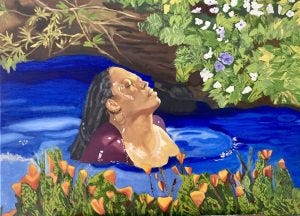 Notes on a painting: ‘Mahalia’ 16.12.2025 10mMahalia, Rising Star places a contemporary Black British vocalist at the centre of a visual language historically complicit in marginalisation. Drawing on Pre-Raphaelite aesthetics while actively interrupting their gaze, the painting confronts questions of mastery, presence, and cultural memory.Created in resistance to spectacle, speed, and aesthetic flattening, this work insists on discipline, subjecthood, and the dignity of becoming. It asks the viewer not to consume, but to remain.Watch on YouTubeContact Me This is a public episode. If you would like to discuss this with other subscribers or get access to bonus episodes, visit brushstrokesofbeing.substack.com
-
 Notes on a Painting: “Sol Gabetta” 02.12.2025 6mIn this new instalment of Letters from the Studio, I open the door to the beginnings of my portrait of Sol Gabetta, a work that listens before it speaks. The first layer meets the canvas through music: the arc of movement, the breath between phrases, the subtle pauses that reveal the life within the performer.Rooted in four hundred years of artistic lineage, this painting grows from a way of seeing shaped by time, silence, and careful observation. Here, the aim is not likeness alone, but the interior world that precedes it, the emotion before the note, the recognition before the gesture.I share why every composition is drawn by hand, how sketches give form to fleeting expressions, and how the music itself becomes a collaborator in the process. The episode also touches on Mastering Light & Shadow™, a course created for artists seeking to overcome flatness and reconnect with the discipline of seeing.Mastering Light & ShadowTMYouTubeContact Me This is a public episode. If you would like to discuss this with other subscribers or get access to bonus episodes, visit brushstrokesofbeing.substack.com
-
 The Story of Art Without Men Review 18.11.2025 7mThis episode offers a reflection on The Story of Art Without Men by Katy Hessel. While the book powerfully restores many women to the narrative of art history, from Renaissance pioneers to modern visionaries, its final chapters reveal a gap that continues to shape our understanding of women’s contributions today.The women who uphold and advance the classical craft of painting from life, artists working with discipline, sensitivity, and a profound commitment to the human presence, remain largely unacknowledged. Their omission underscores a persistent hierarchy in contemporary art discourse, one that prizes conceptual innovation while overlooking the mastery that once allowed earlier women artists to claim their place.Here I examine this paradox and argue for a more complete history: one that embraces the full spectrum of women’s artistic practices across five centuries, including the living lineage of classical realism.watch also on YouTubeBuy the bookFollow me on InstagramContact me This is a public episode. If you would like to discuss this with other subscribers or get access to bonus episodes, visit brushstrokesofbeing.substack.com
-
 The Lost Ground of Mastery 04.11.2025 15mIn this episode of Brushstrokes of Being, I examine the lost ground of mastery and the spiritual essence of art. Moving beyond theory, I reveal how true art arises where craft and consciousness meet.Through philosophy, neuroscience, and lived experience, Karin invites listeners to rediscover art as a sacred act of perception, a portal, not a product.For artists, thinkers, and collectors seeking depth, this is a journey into the soul of creation itself.Watch this episode on youtubeFollow me on InstagramContact me This is a public episode. If you would like to discuss this with other subscribers or get access to bonus episodes, visit brushstrokesofbeing.substack.com
-
 Art as Portal or Mirror? 28.10.2025 1h 18mWelcome back to Brushstrokes of Being, where art meets soul and thought becomes colour. In this episode, ‘Art as Portal or Mirror’, I’m joined by Karen van Hoey Smith (mentor, art director, educator, and curator), whose journey through the art world bridges vision, compassion, and transformation. Together, we explore the shifting tides of the contemporary art market, the deeper meanings behind creation, and the evolving role of the artist. Karen shares her experience in Hungary, where she curated a poignant exhibition for a charity supporting orphaned children; a project in which art becomes both healing and an offering. We reflect on a timeless question: Is art truly art, or is it a portal, a token through which the viewer meets themselves? And finally, we ask: Can art ever really “speak for itself”? You can tune in for an intimate conversation on authenticity, purpose, and the invisible threads that connect the artist, the work, and the world. The charity auction opens on November 13 at 6 PM at the Lena & Roselli Gallery (https://lenaroselligallery.com), where Art Becomes Act and Beauty Meets Meaning. Follow Karen https://www.instagram.com/kvhs_creative/ https://www.linkedin.com/in/karen-van-hoey-smith-96001a26/ Follow me https://instagram.com/karinmerxfineartContact me https://karinmerx.co.uk/contact This is a public episode. If you would like to discuss this with other subscribers or get access to bonus episodes, visit brushstrokesofbeing.substack.com
-
 Ink and Silence 21.10.2025 20mWelcome to this episode of Brushstrokes of Being, Ink and Silence. The book that breathes wisdom, and I frequently turn to, as artist, but also for the wisdom is, Charlie Mackesy’s The Boy, the Mole, the Fox and the Horse. This is one of those rare works that seem to exhale light with every turning page. It is a book that does not announce itself loudly; it whispers. Its sentences are small, its drawings humble, yet between ink and silence something ancient stirs, a reminder that art can still be an act of tenderness in a restless world.This is not so much a book review, but a poetic and philosophical meditation on Charlie Mackesy’s The Boy, the Mole, the Fox and the Horse. Through reflections on line, silence, archetype, and compassion, I explore how Mackesy’s gentle drawings restore tenderness to modern art and remind us that vulnerability is the deepest form of courage.Follow Charlie Mackesy here: https://www.instagram.com/charliemackesy/Contact me at https://karinmerx.co.uk/contactFollow me on https://instagram.com/karinmerxfineart This is a public episode. If you would like to discuss this with other subscribers or get access to bonus episodes, visit brushstrokesofbeing.substack.com
-
 Equine Art 14.10.2025 46mBrushstrokes of Being, Episode 109 – The Spirit of Equine Art: Translating Emotion into Form“Art is not what you see, but what you make others see.” – Edgar DegasIn this illuminating roundtable, host Karin Merx brings together four exceptional voices in equine art and curation:Karen Osborn (Australia), Mirelle Vegers (The Netherlands), Tony O’Connor (Ireland), and Joyce Ter Horst, curator of Paard Verzameld Equine Art Services and the Dutch Equine Art Fair.Together, they explore the unseen dialogue between artist and horse, where anatomy meets intuition, and observation transforms into emotion. From growing up in the forge to living among herds, these artists reveal what it truly means to paint what you feel and translate the spirit of another being onto canvas.Joyce ter Horst offers deep insight into the art of curating, not merely “hanging paintings,” but weaving narrative, connection, and meaning. She shares the story behind the Dutch Equine Art Fair (6–9 November, Living Horse Museum, Amsterdam), a global stage where craftsmanship, emotion, and storytelling meet.Join Karin and her guests as they reflect on artistry, empathy, and why painting horses is far more than a niche — it’s a timeless dialogue between nature, humanity, and art itself.Watch & Subscribe: Brushstrokes of Being: https://youtube.com/@karinmerxfineartEvent: Dutch Equine Art Fair, November 6–9, Living Horse Museum, Amsterdam: https://dutchequineartfair.com Curated by: Paard Verzameld Equine Art ServicesJoyce Ter Horst-Paard Verzameld:https://www.paardverzameld.com https://www.instagram.com/paardverzameld/ https://www.instagram.com/dutchequineartfair_amsterdam/ Tony O’Connor: https://whitetreestudio.ie https://www.instagram.com/tony_o_connor/ Mirelle Vegers: https://mirellevegers.com https://www.instagram.com/mirelle_vegers/ Karen Osborn: https://karenosbornart.com.au https://www.instagram.com/karen.osborn.art/ Follow me: https://karinmerx.co.uk https://instagram.com/karinmerxfineartContact me: https://karinmerx.co.uk/contact This is a public episode. If you would like to discuss this with other subscribers or get access to bonus episodes, visit brushstrokesofbeing.substack.com
-
 Women in the Picture 07.10.2025 12mCatherine McCormack’s Women in the Picture profoundly reframes how we perceive women in art. From Venus to the Monstrous Woman, McCormack uncovers persistent archetypes that structure our visual culture, revealing how seemingly timeless masterpieces actually participate in shaping desire, power, and representation.As an art historian and practicing artist, this book resonated deeply with me and inspired my series The Gaze Reclaimed, which celebrates women artists who reclaimed visibility for themselves and their subjects.Timestamps00:00 Introduction – Changing the way we see00:12 Why Women in the Picture struck me deeply00:33 How representation shapes perception00:48 The roots of The Gaze Reclaimed series01:13 Building Brushstrokes of Being Studio02:05 Catherine McCormack’s contribution to art history and feminist critique03:12 The four archetypes – Venus, Mother, Maidens & Dead Damsels, and Monstrous Women04:28 Archetypes from the Renaissance to the digital age05:17 The illusion of liberation in contemporary culture06:02 Rethinking Vermeer’s Girl with a Pearl Earring07:25 The myth of perfection and the camera obscura08:42 The female gaze and the reenactment of desire09:33 Why McCormack’s writing matters today10:14 “Images are never innocent” – the politics of representation11:08 Seeing differently: art as transformationI also share updates on Brushstrokes of Being Studio, where mini-courses on colour theory are currently available. Explore them today or join the waiting list for the full launch this November.https://onlineartseducation.co.uk/course/palettes-mixing-skin-colours/https://onlineartseducation.co.uk/course/colour-harmony-family-temperature-contrast/https://onlineartseducation.co.uk/course/hues-values-chroma/https://onlineartseducation.co.uk/course/the-colour-wheel-explained/https://onlineartseducation.co.uk/course/a-brief-history-of-colour-free/https://mailchi.mp/a5dd5098f749/waiting-list-brushstrokes-of-being-studion This is a public episode. If you would like to discuss this with other subscribers or get access to bonus episodes, visit brushstrokesofbeing.substack.com
-
 Why Mastery Is the Only Path Worth Taking 30.09.2025 13m“Mastery is the slowest, hardest path in the world, and the only one worth taking.”In this episode of Brushstrokes of Being, I reflect on what it truly means to master an art form. Why Mastery Is the Only Path Worth Taking? As both a painter and a classically trained musician, I’ve lived the reality of endless hours in the studio or at an instrument, practice, repetition, resilience, and passion.Together, we’ll explore:Why mastery demands discipline and patience in today’s instant-gratification culture.What neuroscience reveals about how art and music reshape the brain.Stories from my portraits of Janine Jansen and Sol Gabetta—living examples of artistic mastery.Insights from Iain McGilchrist’s The Matter With Things on creativity, preparation, and illumination.Why deliberate practice is not just about skill—it’s about building focus, resilience, and fulfilment.I will also launch Brushstrokes of Being Studio, where artists can study colour theory, art history, and storytelling. Explore my mini-courses on colour, or join the waiting list for the full launch in November.https://onlineartseducation.co.uk/course/palettes-mixing-skin-colours/https://onlineartseducation.co.uk/course/colour-harmony-family-temperature-contrast/https://onlineartseducation.co.uk/course/hues-values-chroma/https://onlineartseducation.co.uk/course/the-colour-wheel-explained/https://onlineartseducation.co.uk/course/a-brief-history-of-colour-free/Waiting List email landing pagehttps://mailchi.mp/a5dd5098f749/waiting-list-brushstrokes-of-being-studionMastery may be slow, but it’s also deeply transformative, for your art, your brain, and your life.Timestamps:00:00 – Mastery: the slowest, hardest path worth takingWhy the path of mastery in art and music is difficult, slow, and ultimately the most rewarding journey.00:01 – What true mastery looks like in music and artFrom breath control and posture in music to light, shadow, and colour theory in painting—what daily mastery practice really involves.00:02 – The hidden value behind classical concert ticketsA story on why concert tickets reflect years of training, resilience, and invisible hours of practice by world-class musicians.00:05 – Why students struggle with the effort of masteryHow young artists and musicians react to the relentless practice required, and why persistence is the real test of talent.00:12 – Neuroscience of practice and neuroplasticityScientific research on how deliberate practice rewires the brain, strengthens neural pathways, and improves memory, focus, and creativity.00:20 – Stories from painting Janine Jansen & Sol GabettaPortraits of exceptional female musicians reveal subtlety, strength, and poetic mastery built through decades of dedication.00:28 – Iain McGilchrist on creativity: preparation, incubation, illuminationInsights from The Matter With Things on the three stages of creativity and why true insight only arrives after hard preparation.00:36 – The link between mastery, focus, and fulfilmentWhy deep, consistent practice builds resilience, patience, and happiness in both art and life.00:46 – Brushstrokes of Being Studio: antidote to de-skillingHow decades of de-skilling inspired me to create an art education platform rooted in skill, history, and storytelling.00:55 – Mini-courses on colour theory and full program launchExplore mini-courses on colour harmony, pigments, and palettes—or join the waiting list for the full launch in November.Mentioned in this episode:Your Brain on ArtThis is Your Brain on MusicThe Aesthetic BrainThe Matter With Things by Iain McGilchrist This is a public episode. If you would like to discuss this with other subscribers or get access to bonus episodes, visit brushstrokesofbeing.substack.com
-
 Elizabeth Markevitch 23.09.2025 53mIn this episode of Brushstrokes of Being, I sit down with Elizabeth Markevitch, who once worked in the high-end world of Impressionist and Modern masterpieces. She left the “art box” behind to democratise access to art and created IkonoTV https://ikonotv.art/, a platform treating art as medicine.We explore:Why art is still “in the concert hall” while music has been democratizedHow streaming and digital tools can transform art accessThe healing impact of “slow art” films on our minds and emotionsThe parallels between AI, Napster-era music, and the future of creativityJoin us for a conversation that shifts art from luxury to life force.Where to follow Elizabeth Markevitch: LinkedIn: https://linkedin.com/Markevitch Instagram: https://instagram.com/Markevitch Medium: https://medium.com/@markevitch/ IkonoTV: https://ikonotv.art Follow me on: Instagram: https://instagram.com/karinmerxfineart Facebook: https://facebook.com/karinmerx Linkedin: http://linkedin.com/in/karin-merx-ma-8087a867Contact me: https://karinmerx.co.uk/contactSupport Brushstorkes of Being on Patreon This is a public episode. If you would like to discuss this with other subscribers or get access to bonus episodes, visit brushstrokesofbeing.substack.com
-
 The Double Chair 16.09.2025 10mIn this episode of Brushstrokes of Being, The Double Chair, I bring two voices into dialogue: the Artist, living for unity, diversity, and transformation, and the Philosopher, seeking meaning in those values.The conversation weaves together childhood curiosity, music, the Old Masters, the quiet rebellion of painting, the essential role of diversity, and the distinction between discrimination and racism. At its core lies the question of why I do what I do, and who I am as a human and as an artist.This is not an interview with answers; it is an invitation to ask questions again and again and to live as an artist.Timestamps00:00 – Welcome & the deeper questions behind technique00:34 – The artist and philosopher in dialogue01:34 – Following curiosity, music, and art against the grain02:15 – Old Masters, story, and meaning in painting03:19 – Resisting speed and noise: art as slow rebellion04:47 – Unity, diversity, and transformation in practice06:06 – Discrimination vs. racism: the deeper distinction07:28 – Colour as story, music, and truth09:12 – Between rebellion and love, stillness and colourWatch the episode on YouTubeFollow me on InstagramSupport Brushstrokes Of Being on PatreonContact me This is a public episode. If you would like to discuss this with other subscribers or get access to bonus episodes, visit brushstrokesofbeing.substack.com
-
 Adebanji Alade 10.09.2025 24mWhat does it mean to truly see? To slow down, observe, and let creativity flow through your hands? On this episode of Brushstrokes of Being, I speak with Adebanji Alade, the BBC-featured artist and President of the Royal Institute of Oil Painters, about the transformative power of sketching, embracing failure, and loving the process over the final piece.Highlights Adebanji Alade:Why sketching is more than drawing — it’s a way to think.How to treat rejection as a friend and failure as feedback.Adebanji’s approach to observational art, curiosity, and serendipity.The lifeblood of creative practice: seeing, sketching, and process.[00:00:00] Welcome & Introduction[00:01:05] “Observe everything, sketch everything you see” — sketching as a way of thinking[00:05:12] Becoming “The Addictive Sketcher”[00:08:45] Curiosity, slowing down, and seeing the world differently[00:12:34] Failing as feedback & making friends with rejection[00:16:50] What matters most: the process of art[00:19:40] Advice for artists: why sketching is the lifeblood of representational art[00:22:10] Where to find Adebanji & closing thoughtsFollow Adebanji: Instagram/TikTok/Facebook @AddictiveSketcherVisit his website: adebanjialade.co.ukListen & Watch: https://youtube.com/@karinmerxfineartInstagram: https://instagram.com/karinmerxfineartFacebook: https://www.facebook.com/KarinMerxContact: https://karinmerx.co.uk/contact This is a public episode. If you would like to discuss this with other subscribers or get access to bonus episodes, visit brushstrokesofbeing.substack.com
-
 Art as Medicine in the Age of Machines 02.09.2025 16mArt as Medicine in the Age of Machines marks the conclusion of my series The Gaze Reclaimed. After seven episodes honouring women artists who fought to be seen, I turn to our present reality: a time where human creativity is once again at risk of erasure.Today, billions of artworks are silently scraped into datasets without consent, feeding machines that produce hollow images. Yet art is not a product of code. Art is presence, resonance, and transformation. Science now gives us the words—neuroaesthetics—to confirm that art regulates our nervous systems, heals trauma, and strengthens our humanity.This is not just history. It is our future. And the choice is clear: reduce art to pixels, or reclaim it as medicine for the soul.Art Talk has evolved in Brushstrokes of Being: Art is the Cradle of Our Soul0:00 Intro | Brushstrokes of Being1:05 The Gaze Reclaimed – past to present6:11 What is art, really?9:40 Neuroaesthetics: art as medicine13:08 Painting, Photography & AI – three different entities17:55 Children, creativity, and the danger of neglect22:12 Why artists matter now more than ever32:48 Closing | Reclaiming the gazeWatch this episode on YouTubeContact me This is a public episode. If you would like to discuss this with other subscribers or get access to bonus episodes, visit brushstrokesofbeing.substack.com
-
 The Gaze Reclaimed, Part Seven: Camille Claudel 26.08.2025 15mCamille Claudel was more than Rodin’s lover, more than the “madwoman” silenced in an asylum for thirty years. She was a visionary sculptor who gave marble and bronze a pulse, sensual, intimate, and profoundly human.In this episode of Art Talk: The Gaze Reclaimed Part Seven: Camille Claudel, we explore:Claudel’s early brilliance and her fight to study sculpture in Paris.Her bold collaboration and rivalry with Auguste Rodin.Masterpieces like The Waltz, The Mature Age, and Clotho, works that reveal intimacy, grief, and resilience.The injustice of her confinement and her erasure from art history.How her genius is finally honoured today at the Musée Camille Claudel.To reclaim Camille Claudel is to honour all the women who reshaped art against impossible odds. Her gaze, once silenced, returns to us now, sensual, powerful, eternal.Listen, reflect, and share this episode with someone who loves art, history, and the reclamation of forgotten voices.YouTubeSpotifySupport Art Talk on PatreonContact Me This is a public episode. If you would like to discuss this with other subscribers or get access to bonus episodes, visit brushstrokesofbeing.substack.com
-
 Louise-Élisabeth Vigée-Lebrun: The Gaze Reclaimed, Part 6 19.08.2025 11m“To paint is to love again.” Louise-Élisabeth Vigée-Lebrun’s words define a life devoted to courage, beauty, and creation. Born in 1755, she overcame the barriers of a male-dominated art world, teaching herself by copying the works of Rembrandt, Rubens, and Van Dyck. By fifteen, she was a professional portraitist. In this episode, I discuss Louise-Elisabeth Vigée-Lebrun: The Gaze Reclaimed, Part 6.Appointed official portraitist to Marie Antoinette, Vigée-Lebrun captured not only the likeness but the humanity of her subjects. Her Self-Portrait in a Straw Hat, painted at twenty-seven, radiates joy and audacity: palette and brushes in hand, golden curls crowned with a straw hat adorned with flowers and a feather, her gaze meets ours across centuries, declaring creative freedom and personal triumph.Exiled during the French Revolution, she travelled across Europe: London, Vienna, Italy, painting royalty, expanding her style, and leaving a legacy that empowered women artists for generations. Over six hundred works survive, and her memoirs chronicle her life, offering insight into her resilience, skill, and advocacy for women in art.Vigée-Lebrun’s story is one of audacity, self-expression, and reclamation of the gaze; a timeless inspiration for all artists.Support Art Talk on PatreonWatch Art Talk on YouTubeContact me here This is a public episode. If you would like to discuss this with other subscribers or get access to bonus episodes, visit brushstrokesofbeing.substack.com
Similar podcasts


Popular in
The podcast also appears in the podcast charts of these countries.
