
Agentic AI Security and Media Empires
Vish
0
The show explores the intersection of AI technical performance, regulatory compliance, and financial sustainability. It covers LLM benchmarking, the legal guardrails of the EU AI Act, and the growing cyber insurance market. Episodes also examine how developers can deploy secure agentic workflows while creators build profitable media empires in a digital-first economy. The focus is on practical operational protocols and commercial strategies for thriving in the modern AI ecosystem.
Episodes
-
 Quantum Computing & Hindu Philosophy: What Does Connected Mean? 09.11.2026 15mQuantum Computing & Hindu Philosophy: What Does Connected Mean?A careful exploration of quantum interference, entanglement and selected Hindu philosophical interpretations, with brief Buddhist and Christian comparisons. We distinguish mathematical prediction, philosophical analogy and ethical proposal. No claim that quantum computing proves or disproves a religion.Sources:Q1: IBM: superposition and interference — https://quantum.cloud.ibm.com/learning/en/modules/quantum-mechanics/superposition-with-qiskitQ2: IBM: single-system quantum information — https://quantum.cloud.ibm.com/learning/en/cou...
-
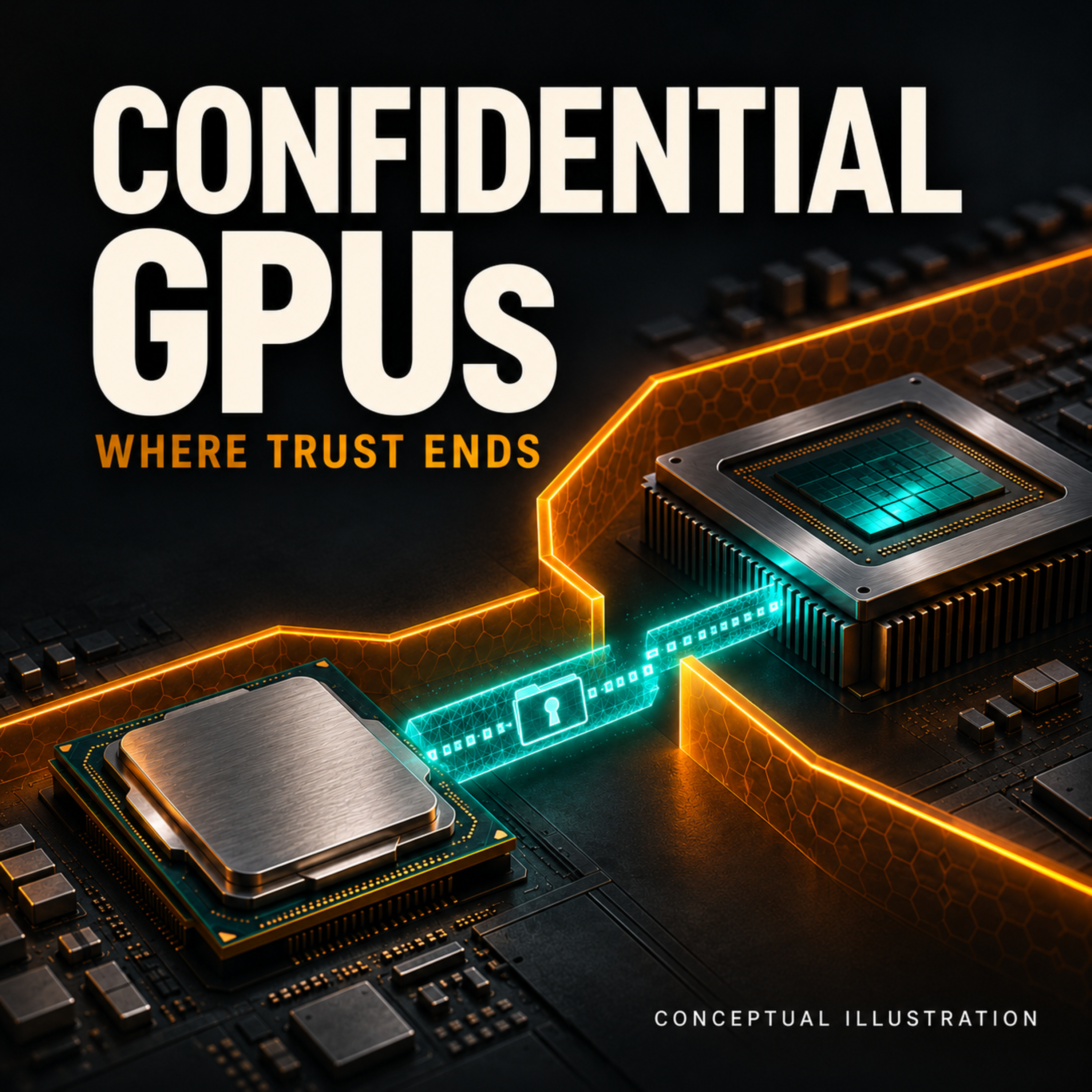 Confidential GPUs: The Hidden Cost of the Trust Boundary 06.11.2026 19mWhen do confidential GPUs fit your threat model? Explore the CPU-to-GPU boundary, serving configuration, attestation, physical security and alternative architectures. Research results apply to particular configurations, not every cloud instance.Citation correction: the narration says August 2025 for Intel’s TDX Connect architecture specification. The verified revision cited here is 354629 003-US, June 2025.00:00 Opening: Where trust ends01:30 CPU-to-GPU trust boundaries03:04 Hopper versus Blackwell interconnects04:47 Standards versus deployment05:44 Scope before headline numbers07:26 Serving s...
-
 Quantum Error Correction: When Fewer Qubits Mean More Engineering 28.10.2026 15mWhen should technical leaders investigate bivariate bicycle error-correction designs? We compare conditional memory savings with connection, decoding and logical-operation requirements, including prototype limitations and adoption risks. The evaluation framework is a proposal; no new experiments or cost estimates are claimed.Chapters:00:00 Fewer qubits, more engineering01:33 Compare the right designs02:12 A conditional memory advantage04:05 Prototype evidence: Kunlun05:56 Throughput differs from latency06:31 A real-time decoding counterexample07:43 A decoder research direction09:00 Beyond memo...
-
Post-Quantum Migration: The Risks of Waiting - and Rushing 20.10.2026 16mYour supplier says “quantum ready.” Which connection is protected—and what happens when the other end cannot support it?A practical conversation about post-quantum cryptography strategy and architecture: what ML-KEM and digital signatures do, why changing a gateway is only part of a migration, and how to test a transition without losing sight of service availability.We examine the negatives too: compatibility failures, larger key shares, hidden fallback, operational cost, vendor dependence and false confidence. Harbour Services is a fictional example, not a measured case study.Voices are AI ge...
-
How Invisible attacks hijack AI Agents 08.04.2026 22mn an era where a single invisible pixel or a cleverly split malicious prompt can hijack an automated virtual assistant, the stakes for AI security have never been higher. This episode dives into the "Wild West" of 2026, where AI has transitioned from a creative tool into an autonomous, high-stakes infrastructure running global businesses.We explore the chilling reality of indirect prompt injections and accountability obfuscation, where hackers can manipulate AI agents through hidden code in website CSS or accessibility trees—leaving no trace of the original attacker.Key topics covered in this...
-
The Dark Forest - Autonomous Threats & The 2026 Resilience Gap 05.04.2026 22mThe "move fast and break things" era has officially hit the wall of 2026. In this episode, we move beyond basic LLM prompts to the "Dark Forest" of agentic infrastructure. We break down the "Lethal Trifecta"—why giving an AI agent access to your private data, untrusted inputs, and a green light to talk to the internet is a recipe for disaster.We dive into high-stakes technical benchmarks, revealing why your choice of programming language (like Python vs. Elixir) might be leaving your security to chance. Then, we tackle the August 2, 2026, EU AI Act deadline and the rising "Resilience Gap" in c...
-
The Protocol War (Episode 2) 01.04.2026 23mThe conversation should shift from simple LLM interactions to Agentic Orchestration. The hosts must emphasize that in 2026, the value isn't in the model itself, but in the Protocol that allows that model to securely interact with the real world.What is MCP? Explain the Model Context Protocol as a standardized "tunnel" between AI assistants and local or remote data.Security as the Foundation: Focus on Session Isolation and Gateways. An MCP server should never have "god-mode" access; it needs a Circuit Breaker to inspect every JSON-RPC call before execution.Zero-Trust for Agents: Introduce the c...
-
The AI Survival Guide: Benchmarks, Borders, and Bankrolls 29.03.2026 20mAs we cross into mid-2026, the "move fast and break things" era of AI has officially collided with a wall of regulation and reality. In this episode, we deconstruct the three pillars every developer and digital creator needs to master to survive the current ecosystem.First, we go beyond the "vibe coding" hype to look at the 2026 AI Benchmarking landscape—why top models like Claude 4.5 and Gemini 3.1 Pro are dominating, but why their performance still hinges on the "popularity bias" of their training data.Next, we tackle the "Shield": The EU AI Act’s looming August 2026 enforcement deadline and...
Similar podcasts


Popular in
The podcast also appears in the podcast charts of these countries.
