
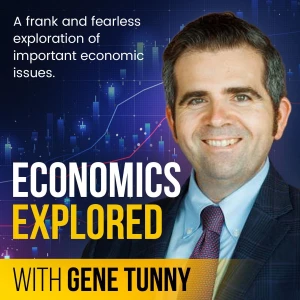
Economics Explored
Gene Tunny
0
Economics Explored applies hard-headed economic analysis to important economic, social, and environmental issues. Host Gene Tunny explores how economic ideas and evidence can inform public policy and everyday decisions. The show examines topics across markets, government, the environment, and society. It aims for clear, practical economic reasoning rather than marketing or partisan commentary.
Episodes
-
 Australia’s Recession Risk Just Got Real w/ John Humphreys 20.11.2026 27mAustralia's economy is flashing warning signs. Unemployment has jumped to 4.9%, real wages continue to fall, and property lending has slumped. Is a recession now unavoidable? Gene Tunny and John Humphreys assess the deteriorating economic outlook, the Reserve Bank's controversial interest rate decisions, and the growing divide between GDP growth and living standards. Could Australia’s long period of economic weakness be about to get significantly worse?
-
Why Economists Disagree (And Who Should You Believe?) 15.11.2026 1h 2mWhy do economists disagree so often? And does that mean economics isn't really a science? In this solo episode, economist Gene Tunny explores four reasons experts reach different conclusions: competing economic models, different interpretations of evidence, uncertainty about how people respond to policies, and disagreements over values. Drawing on disputes over Australia's 5% deposit scheme, the Global Financial Crisis, Trump's tariffs and COVID lockdowns, Gene explains why economic debates can be so difficult to settle and offers practical questions to help you judge competing economic claims...
-
The Hidden Productivity Cost of Working From Home 08.11.2026 39mRemote workers may complete more tasks, but are they missing out on the collaboration that drives innovation? Gene Tunny speaks with Harvard PhD economists Natalia Emanuel and Emma Harrington about their new book, In Person. Discover why face-to-face brainstorming generates more creative ideas, how proximity helps younger workers develop skills, and why remote CEOs may struggle to lead effectively. The conversation examines the evidence behind the return-to-office debate and what it means for productivity, business performance and the future of hybrid work–particularly considering AI.
-
Why Governments Should Fear the Bond Market 01.11.2026 30mWhy did the US Treasury intervene to support the Japanese yen? And what does this tell us about the growing risks in global financial markets? Gene Tunny and John Humphreys examine the connections between exchange rates, government bonds, inflation and public debt. They discuss why selling US Treasury bonds could push up American borrowing costs, the dangers of high debt combined with higher interest rates, and whether Australia is better placed to weather future financial turbulence.
-
Career Advice for Aspiring Economists in the AI Age 25.10.2026 1h 9mIf AI can write code and analyse data, what skills will tomorrow's economists need? Gene Tunny revisits his career advice for economics students and graduates, explaining why critical thinking, clear writing and interpersonal skills may matter more than ever. He weighs the benefits of starting in government versus consulting, explains why publishing your own work can open doors, and shares lessons about networking, mentorship and avoiding burnout. An essential discussion for anyone considering a career in economics.
-
How Economic Growth Saved Us from the Grim Old Days w/ Chelsea Follett, Cato Institute 18.10.2026 46mBefore industrialisation, most people lived in extreme poverty, worked long hours, and faced dangers that are almost unimaginable today. In this episode, host Gene Tunny speaks with Chelsea Follett, Research Fellow at the Cato Institute and author of The Grim Old Days: An Introduction to the Pre-Industrial Past. Chelsea challenges romanticised views of history and explains how the Industrial Revolution and subsequent economic growth transformed human living standards.
-
When Money Disappears: Lessons from a War 11.10.2026 43mWhat happens when a town runs out of money? During the Franco-Prussian War of 1870, the French town of Sedan faced an economic crisis as gold and silver coins disappeared from circulation. Yet, as Émile Zola recounts in his novel The Debacle, an ingenious solution helped keep commerce alive: locally issued emergency paper money. Show host Gene Tunny explores this remarkable story and what it reveals about the nature of money, the importance of trust, and the ability of communities to improvise when conventional financial systems break down.
-
Will AI Finally Show Up in Productivity? With Chris Berg 04.10.2026 50mAustralia's latest Intergenerational Report assumes productivity growth will rebound significantly over coming decades, with AI potentially playing a major role. Is that reasonable? Professor Chris Berg of RMIT joins Gene Tunny and John Humphreys for a wide-ranging discussion of AI's economic potential and risks. They explore lessons from the computer and internet revolutions, AI's huge energy requirements, whether its benefits will appear in GDP, the cybersecurity threat from autonomous agents, and why competition may be a better safeguard than heavy-handed regulation.
-
Gig Economy Pay Rises, Café Closures and the Zero-Sum Fallacy 12.07.2026 27mWhen the award-winning Springfield café Screamin’ Beans announced its closure, Gene Tunny saw it as a symptom of a bigger problem: wage and regulatory costs rising faster than many small businesses can absorb. In this episode, Gene looks at a landmark Australian Fair Work Commission decision that could reshape pay for gig economy delivery drivers, and shares a conversation with John Humphreys of the Australian Taxpayers’ Alliance on why the net benefit of a minimum wage rise to a worker is often very different from the gross headline number. Drawing on Thomas Sowell's concept of the "zero-sum...
-
How Good Tax Policy Gets Made and How It Doesn't: GST vs Capital Gains Tax in Australia 27.06.2026 43mMost tax debates focus on the what: rates, base, and who pays. This episode is about the how: the process by which economic policy gets made. Drawing on his time in the Australian Treasury, host Gene Tunny argues that the latest changes to capital gains tax and negative gearing reflect a breakdown in good policymaking. They were announced on budget night without the consultation, published modelling, or public mandate that major reform deserves. As a contrast, Gene revisits the Howard government's GST process of the late 1990s: a detailed white paper, published modelling, and a policy taken to...
-
Dams, Development & Hyper Australia w/ Senator Matt Canavan, National Party Leader 20.06.2026 32mHousing affordability, congestion and rising living costs are putting pressure on Australia's major cities. Could stronger regional development provide part of the solution? Gene Tunny shares highlights from a recent discussion with Nationals leader Senator Matt Canavan on his "Hyper Australia" agenda. They explore regional infrastructure, public investment, economic concentration, GST distribution and the case for decentralisation, while asking an important economic question: do regional development projects pass the cost-benefit test?
-
Taxing Capital More in a Productivity Slump? Perverse Policy in Australia 13.06.2026 46mAustralia has endured nearly a decade of weak productivity growth, and living standards are under pressure. In this episode, Gene Tunny and John Humphreys explore the common thread connecting several major economic debates: investment and incentives. They discuss Australia's productivity slump, the Federal Government’s proposed capital gains tax changes, Brisbane’s Olympics infrastructure plans, and the challenges facing the National Disability Insurance Scheme (NDIS). Along the way, they explain why economists place so much emphasis on incentives and what current policy settings could mean fo...
-
Debt and Deficits: Have We Lost Discipline? w/ Sinclair Davidson & John Humphreys 25.04.2026 56mDebt and deficits used to be political dealbreakers. So why don’t they seem to matter anymore? In this episode, Gene Tunny explores the concept of fiscal illusion with John Humphreys and Professor Sinclair Davidson. They examine whether Australia is “sleepwalking” into a more precarious fiscal position, and what could happen if a crisis hits. A thought-provoking discussion on debt, accountability, and economic literacy.
-
Have We Gone Too Far on Free Trade? 17.04.2026 39mFree trade has long been a cornerstone of economic thinking, but is it still fit for purpose in a more dangerous and uncertain world? Gene Tunny is joined by Dan Ryan and John Humphreys to debate tariffs, industrial policy, and economic resilience. They explore whether Australia has gone too far in opening its economy, the risks of fragile global supply chains, and the perceived trade-offs between efficiency and national security.
-
Housing Crisis: Supply, Demand, or Both? w/ John Humphreys and Tom Switzer 11.04.2026 25mWhat happens when geopolitical tensions collide with domestic economic pressures? In this episode, Gene Tunny is joined by John Humphreys and Tom Switzer to unpack the economic fallout from escalating tensions with Iran. The conversation then turns to Australia’s housing affordability crisis—examining whether government policies, population growth, or supply constraints are to blame.
-
Fuel, Fertiliser, and Fear Down Under - ep314 27.03.2026 53mAre fears of fuel shortages in Australia overblown—or are we underestimating the risks? Gene Tunny is joined by Dr John Humphreys and farmer Peter Rothwell to explore how rising diesel prices, fertiliser shortages, and supply chain stress could ripple through the economy. From supermarket prices to farm viability, this episode breaks down how a global energy shock could hit households and businesses—and whether markets can cope.
-
AI, Jobs, and the Value of Ideas w/ Benjamin Shiller, Brandeis University 14.03.2026 55mAI can write essays, generate code, and assist with research, but does that mean it will replace human workers? Economist Benjamin Shiller, author of AI Economics, joins show host Gene to discuss how AI may instead make human creativity and ideas even more valuable. In this conversation with Gene Tunny, they explore AI’s potential impact on jobs, productivity growth, education, and inequality, as well as the risks the technology could pose.
-
Why Productivity Matters for Living Standards | Australia’s Productivity Problem 07.03.2026 39mAustralia’s productivity growth has slowed to its weakest rate in decades — and that matters because productivity ultimately drives rising living standards. In this episode, Gene Tunny explores why productivity is so central to higher wages, economic growth, and sustainable prosperity. The episode features insights from Danielle Wood, Chair of the Productivity Commission, on why policymakers need a “growth mindset,” followed by highlights from a lively roundtable discussion on the policies shaping productivity in Australia — including energy costs, taxation, regulation, and government spending...
-
Argentina’s Radical Economic Turnaround 01.03.2026 30mArgentina was on the brink: inflation near 300% a year, real wages collapsing, poverty rising, and a large fiscal deficit. Voters elected libertarian economist Javier Milei, who promised deep spending cuts and radical reform. Many predicted a disaster. Two years on, inflation has fallen sharply, and real wages are projected to rise. In this episode, show host Gene Tunny chats with John Humphreys (Australian Taxpayers’ Alliance Chief Economist) and Michael Arbon (adviser to Senator Ralph Babet) on how disinflation works, why fiscal credibility matters, and what Argentina’s experience could mean...
-
A Pro-Growth Tax Reform Agenda for Australia 21.02.2026 50mWhat would tax reform look like if the goal were higher wages and stronger long-term growth — rather than more revenue? In this episode, Gene Tunny and John Humphreys examine capital gains tax, bracket creep, and income tax reform through the lens of productivity and living standards. While the discussion focuses on Australia, the principles apply everywhere. How should governments tax capital versus labour? Should tax brackets be indexed to inflation? And how can tax systems encourage saving, investment, and innovation? This episode explores the economic ideas behind a genuinely pro-growth ta...
Similar podcasts


Popular in
The podcast also appears in the podcast charts of these countries.
