
Root Causes: A PKI and Security Podcast
Tim Callan and Jason Soroko
0
Digital certificate industry veterans Tim Callan and Jason Soroko explore issues surrounding digital identity, PKI, and cryptographic connections in today's dynamic computing world. They discuss best practices in digital certificates under pressure from technology trends, new laws, cryptographic advances, and evolving computing architectures. The podcast helps listeners stay current on developments in this essential technology platform and understand the whys and wherefores of popular Public Key Infrastructures.
Episodes
-
 Root Causes 691: The AI Cryptographic Proof Factory 20.11.2026 14mIn this episode about building an AI crypto proof factory, Jason and Tim discuss how defenders and cryptographers must move beyond one-off AI vulnerability hunting toward a systematic, repeatable blue-team testing machine. They break down the four layers of cryptographic strength (hardness assumptions, security proofs, parameters, and implementations) and explore how "proof engineering" and continuous AI-driven cryptanalysis can relentlessly stress-test both classical algorithms and post-quantum standards like ML-DSA. Jason Soroko on LinkedIn https://www.linkedin.com/in/jason-soroko-19b41920/
-
 Root Causes 690: Freezer Attack Hits European Grocery Chains 18.11.2026 13mIn this episode about the reported attack on grocery store freezers across Europe, Jason and Tim discuss why the significant operational technology (OT) attack they once predicted seems to have finally arrived. They walk through what Tim describes (heat cranked up in chains in what he thinks were 11 countries, smaller attacks on some US military bases, and French authorities calling it a nation-state attack), recall the Target HVAC breach, and explain how flat networks, old software, AI-found zero-days and stockpiled exploits leave critical infrastructure exposed. Jason Soroko on LinkedIn http...
-
 Root Causes 689: RSA-1024 Attacks Accelerate, RSA-2048 Holds 16.11.2026 10mIn this episode about the latest research against RSA-1024, Jason and Tim discuss whether faster attacks on smaller RSA keys bring a break of RSA-2048 any closer. They recap the hardware security module (HSM) signature attack, which a Google DeepMind team has now sped up with AI, explain why the gap between 1024 and 2048 bits is vast, give their predictions that RSA-2048 holds through 2027 but feels less safe in 2028, and read the 2029 post-quantum cryptography (PQC) targets of Google and Cloudflare as a sign of urgency. Papers mentioned in this episode Modular Roots from a Restricted Oracle:...
-
 Root Causes 688: eMudhra Exits the WebPKI After Key Compromise 13.11.2026 14mIn this episode about the key compromise at the public certificate authority eMudhra and its exit from the WebPKI, Jason and Tim discuss how a researcher found intermediate CA keys with only one byte of entropy and what eMudhra's incident report says went wrong. They walk through the move of keys between hardware security modules (HSMs), the scripting error that replaced the original keys outside the HSMs' safeguards, and the tighter key generation rules Tim expects from the CA/Browser Forum, and why, unlike with Heartbleed, no subscriber can know whether an attack already took place. Clarific...
-
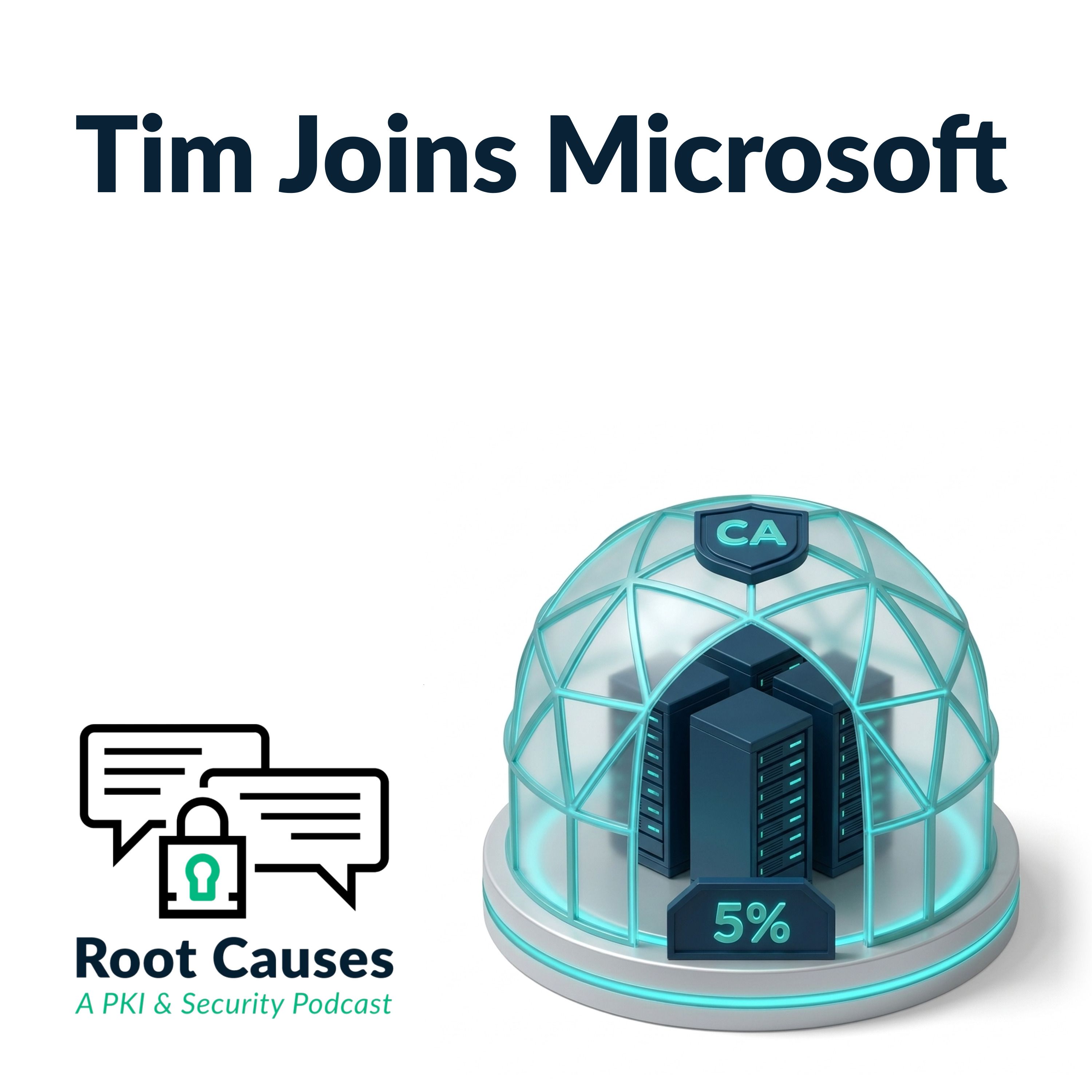 Root Causes 687: Tim Joins Microsoft 11.11.2026 10mIn this episode about Tim's move from Sectigo to Microsoft, Jason and Tim discuss why Microsoft runs a public certificate authority strictly for its own use, and what Tim's new compliance role there involves. They cover the scale of Microsoft's footprint (roughly 5% of the world's public servers, by Tim's estimate), compare Amazon, Google and GoDaddy running their own CAs, explain why the job is narrower than at a commercial CA yet faces the same Merkle Tree Certificates (MTCs), post-quantum cryptography (PQC) and shorter certificate lifespans, and confirm that Root Causes continues. Jason Sor...
-
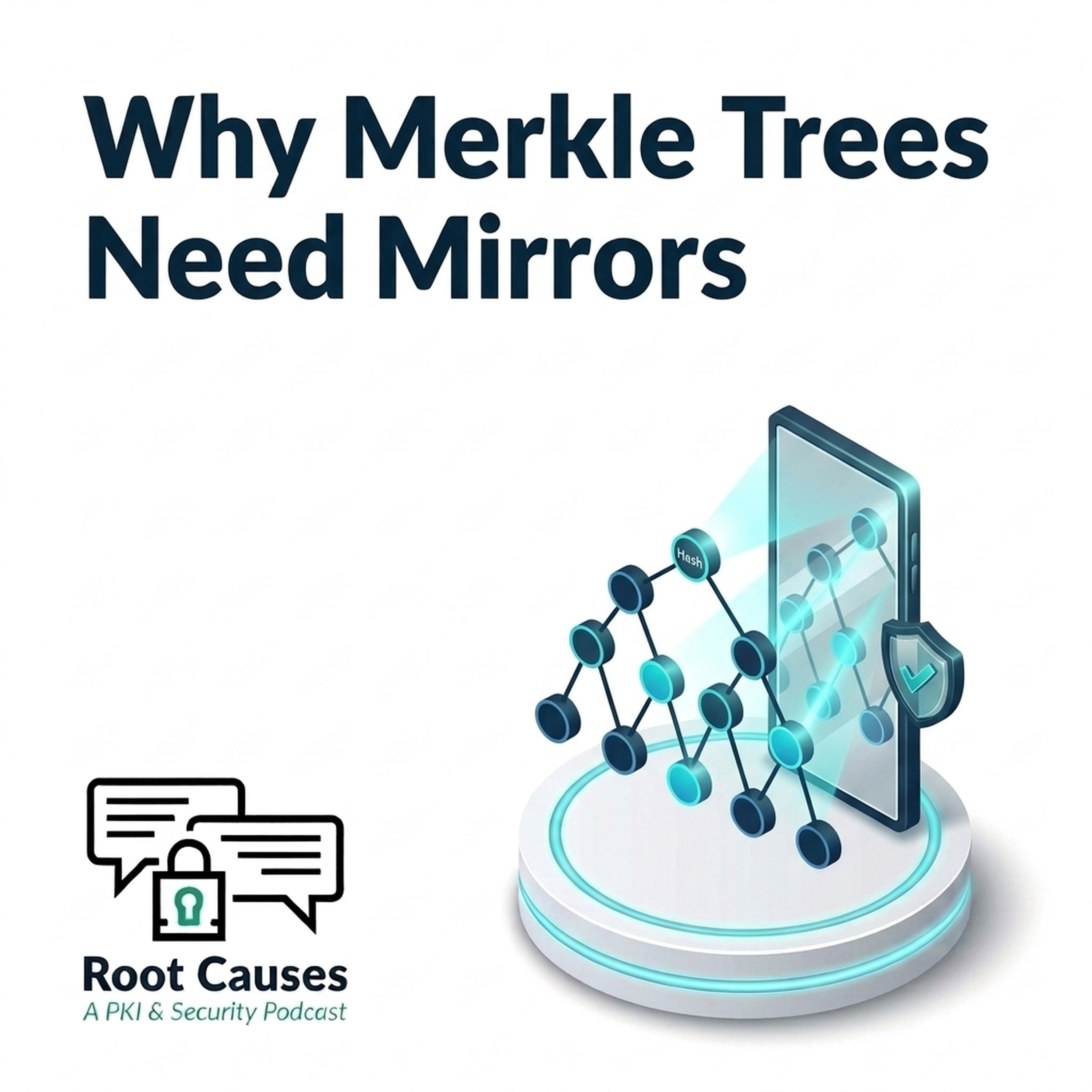 Root Causes 686: Why Merkle Trees Need Mirrors 09.11.2026 9mIn this episode about Merkle trees and cryptographic mirrors, Jason and Tim discuss Jason's hands-on experiment building an RFC-compliant Merkle tree to log autonomous AI actions and keep AI systems tamper-evident. They explain how binary hash pairing works from leaf events up to the root hash, uncover how an attacker or misaligned agent could silently prune unpaired trailing branches without invalidating the root math, and show why independent mirrors run by CAs, browsers, and infrastructure providers are essential to Merkle Tree Certificates (MTCs).
-
 Root Causes 685: A Phone Number Is Not an Identity 06.11.2026 13mIn this episode about the security risks of treating a phone number as an identity, Jason and Tim discuss why a telephone number is merely a routing label for potential reachability rather than a proof of who is on the other end. They examine how silent SIM-swapping attacks, three-line mobile SMS redirection malware, low-entropy knowledge-based verification questions, and AI voice cloning render telephone-based authentication and SMS OTPs below an acceptable security threshold.
-
 Root Causes 684: What Is Certificate Agility? 04.11.2026 17mIn this episode about certificate agility, Jason and Tim discuss what it takes to replace any or all digital certificates across an organization rapidly and reliably. They explain why browser root programs are driving shortened certificate lifespans (down to 47 days) and deprecating public clientAuth certificates as a forcing function for automation, why public WebPKI rules exist to protect everyday internet users, and how visibility and Certificate Lifecycle Management (CLM) prepare enterprises for revocations, key compromises, and post-quantum transitions.
-
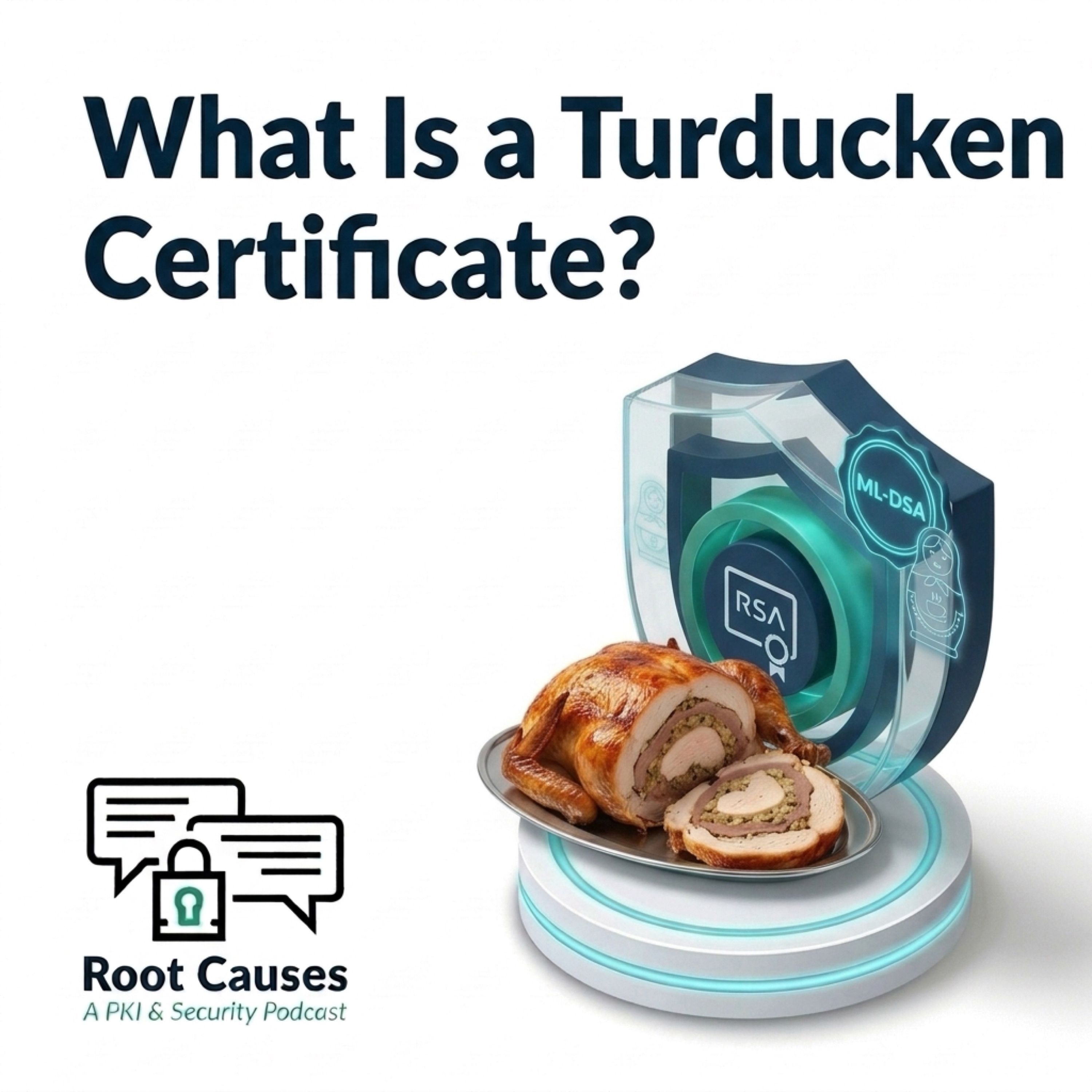 Root Causes 683: What Is a Turducken Certificate 02.11.2026 30mIn this episode about "Turducken" (post-quantum opt-out) certificates and WebPKI downgrade attacks, Jason and Tim discuss why trusting even a single classical Certificate Authority leaves the entire web vulnerable to a cryptographically relevant quantum computer. They explain how wrapping classical RSA or ECC keys inside an ML-DSA post-quantum CA signature prevents global downgrade attacks during the transition to Merkle Tree Certificates (MTCs), and walk through the 2027–2028 browser root store roadmap from Chrome and Apple.
-
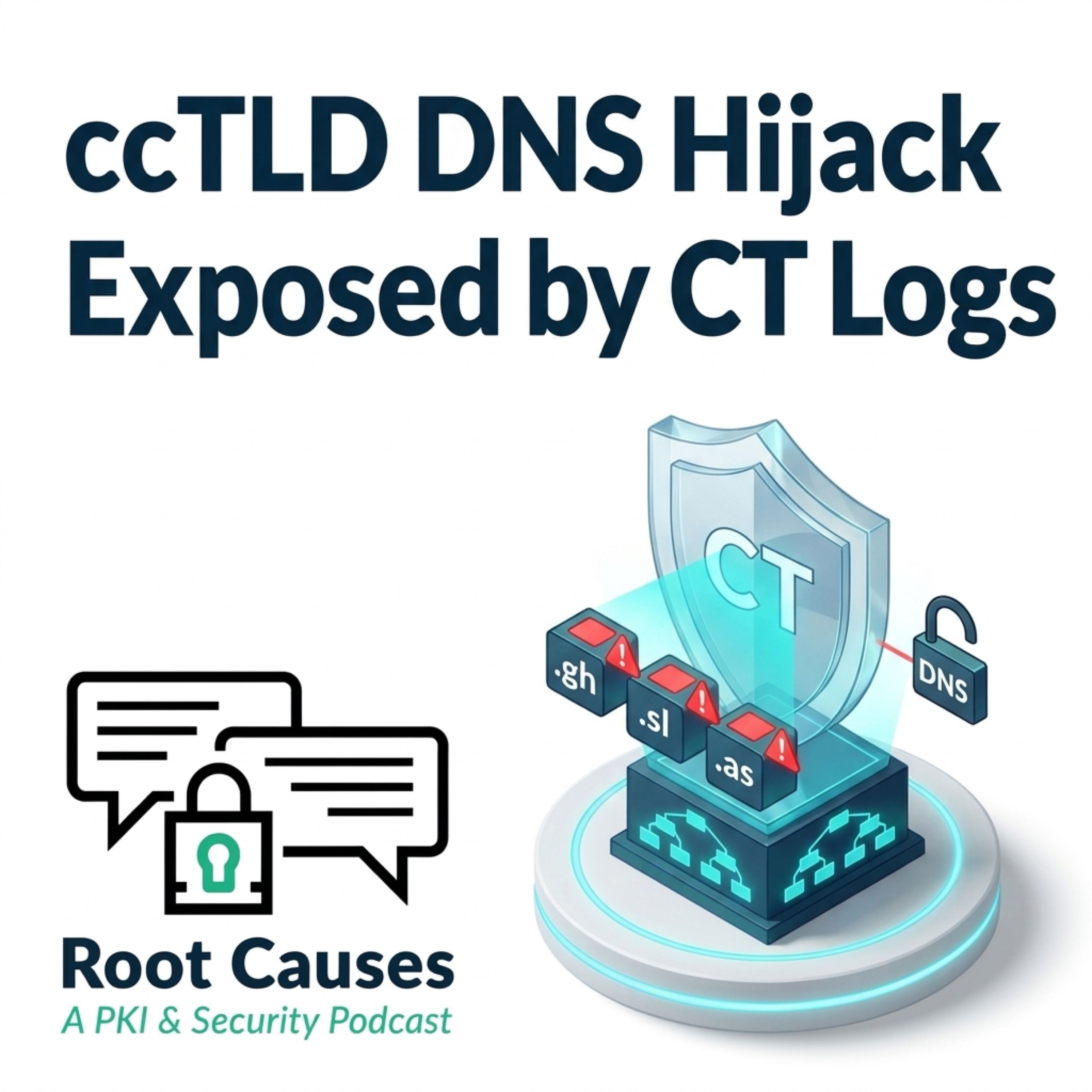 Root Causes 682: ccTLD DNS Hijack Exposed by CT Logs 30.10.2026 9mIn this episode, Jason and Tim discuss the recent compromise of DNS for several country-code top-level domains, including .gh (Ghana), .sl (Sierra Leone) and .as (American Samoa), which made domain control validation untrustworthy for every domain under them. Chrome blocked the unauthorized certificates that were found, thanks to certificate transparency logs, though it could not guarantee it found every affected domain. We explain why CAA records could not help, since CAA lives in the same DNS that the attacker controlled, how this relates to multi-perspective issuance corroboration, and the...
-
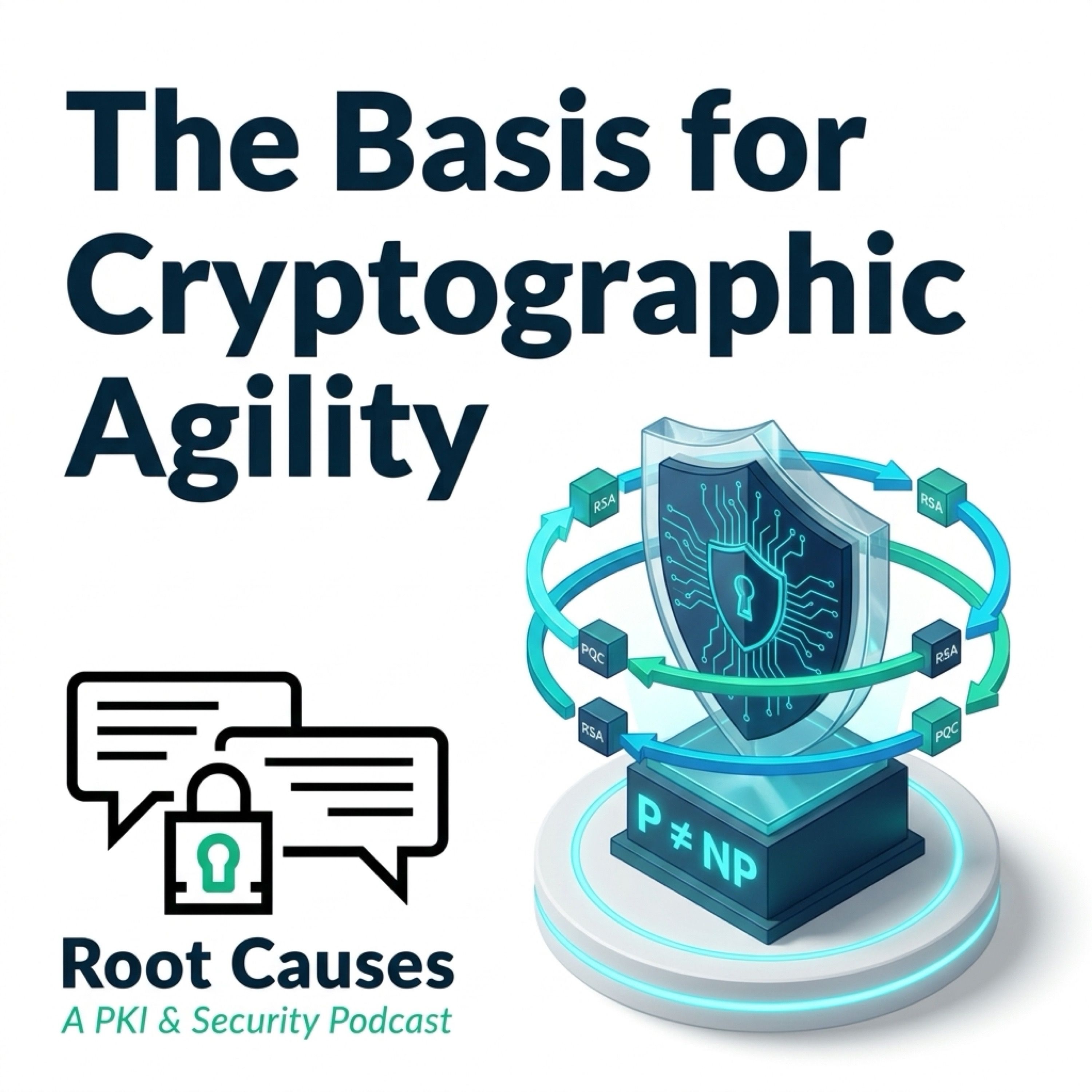 Root Causes 681: The Basis for Cryptographic Agility 28.10.2026 25mIn this episode, Jason and Tim start from the P versus NP question and use a Sudoku puzzle to show the difference between problems that are easy to check and hard to solve. We discuss why RSA and ECC, which rest on factorization, fall to Shor's algorithm and the quantum Fourier transform, and why lattice-based post-quantum algorithms such as ML-DSA were chosen. Because it is impossible to know which hard problem will survive AI-accelerated cryptanalysis, we make the case that cryptographic agility is essential. We also cover NIST's push for math diversity beyond lattices, and Apple's proposed...
-
 Root Causes 680: Bugzilla Bloodbath Redux 26.10.2026 11mIn this episode, Tim and Jason revisit the "Bugzilla bloodbath," the surge of public CA compliance incidents on Mozilla's Bugzilla, which has become the official WebPKI incident reporting platform. A normal year brings around 100 bugs, but there are now 138 open at once and several hundred opened this year. Almost all are reported by third parties, which suggests security researchers are using AI-assisted automation to scour public CA behavior in CT logs, CPS documents and root hierarchies. We discuss why the volume is a healthy sign of the system working as designed, why finding these issues...
-
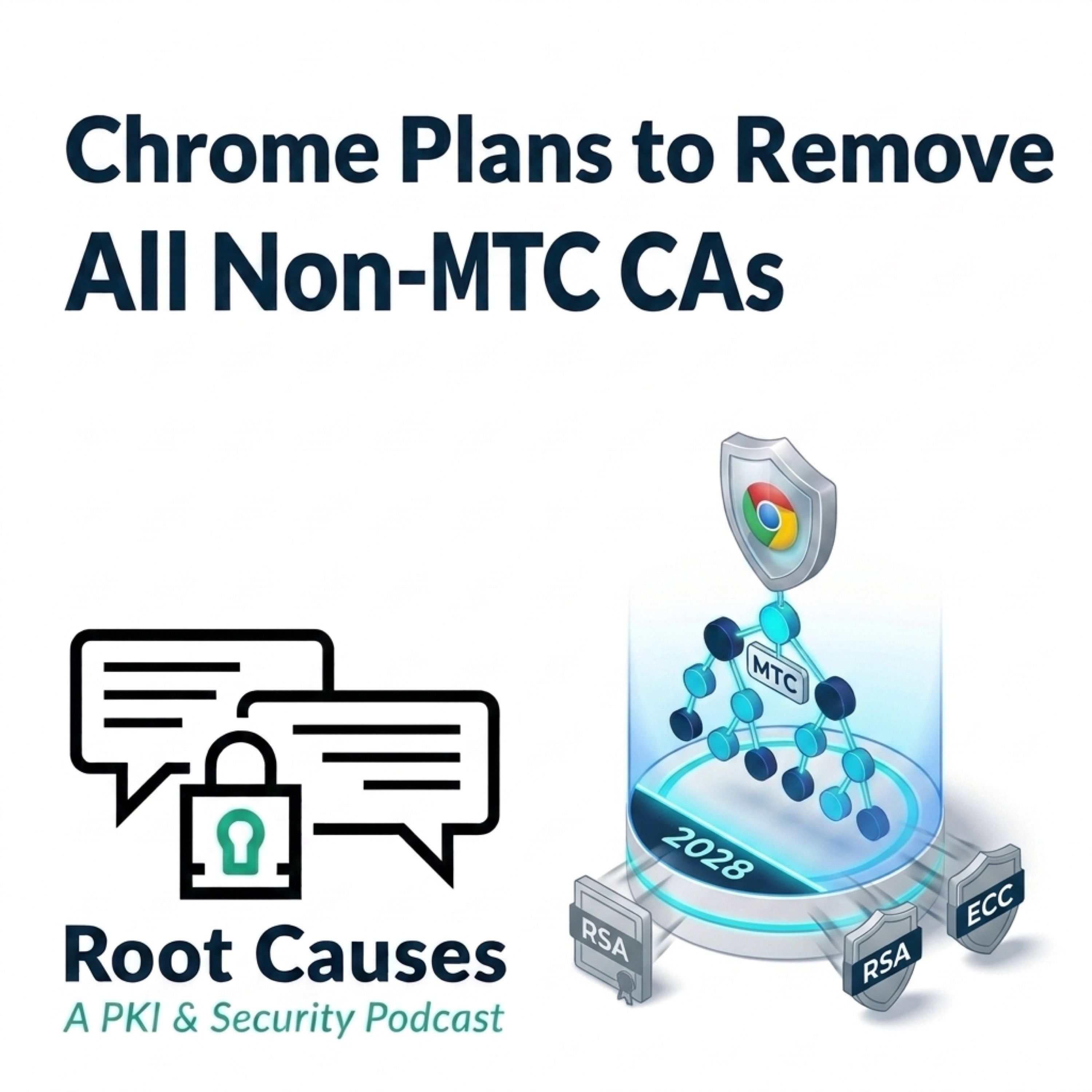 Root Causes 679: Chrome Plans to Remove All Non-MTC CAs 23.10.2026 15mAs the WebPKI drives toward a Merkle Tree architecture for post quantum cryptography, we have seen a significant development. Google Chrome has announced its preliminary intention, as early as 2028, to remove all non-MTC CAs from its traditional root store. We give you the details.
-
 Root Causes 678: The Harmonic Observatory - Simulating Quantum Fourier Transform, Part 2 21.10.2026 10mJason uses a quantum simulator to show us how a cryptographically relevant quantum comptuer (CRQC) would employ Shor's algorithm to attack RSA. Part two of two, with guest Bruno Coulliard.
-
 Root Causes 677: The Harmonic Observatory - Simulating Quantum Fourier Transform, Part 1 19.10.2026 14mJason uses a quantum simulator to show us how a cryptographically relevant quantum comptuer (CRQC) would employ Shor's algorithm to attack RSA. Part one of two, with guest Bruno Coulliard.
-
 Root Causes 676: The Quantum Choir - Simulating Grover's Algorithm, Part 2 16.10.2026 8mIn this second of two episodes, Jason walks guest Bruno Coulliard and me through his real-world experience building quantum simulators, including some of the lessons he learned.
-
 Root Causes 675: The Quantum Choir - Simulating Grover's Algorithm, Part 1 14.10.2026 19mIn this first of two episodes, Jason walks guest Bruno Coulliard and me through his real-world experience building quantum simulators, including some of the lessons he learned.
-
 Root Causes 674: Cryptographic Agility on Both Axes 12.10.2026 19mRepeat guest Bruno Coulliard of Crypto4A joins us to discuss the accelerating pace of change in digital technology, which is going at a rate unprecedented in human history. How do we as people adjust to the hyperspeed of today's technology landscape? And how do we apply these ideas to cryptography?
-
 Root Causes 673: Harvest Now, Decrypt 83 Years Later 09.10.2026 15mResearchers have used AI to decode two German Enigma messages that have remained unbroken since the second world war. We describe how this was accomplished.
-
 Root Causes 672: New AI-driven Attack on RSA 1024 Revealed 07.10.2026 15mThis year we have seen a series of AI-enabled cryptographic attacks. In this episode we discuss a new exploit to abuse signing mechanisms in HSMs.
Similar podcasts


Popular in
The podcast also appears in the podcast charts of these countries.
