
The TWIML AI Podcast (formerly This Week in Machine Learning & Artificial Intelligence)
Sam Charrington
0
The TWIML AI Podcast, hosted by Sam Charrington, features interviews with top researchers and practitioners in machine learning and artificial intelligence. It covers a wide range of topics including deep learning, natural language processing, neural networks, and data science. The podcast aims to make complex AI concepts accessible to a broad audience of engineers, data scientists, and business leaders.
Episodes
-
 Buying Tokens vs Building an AI Factory with Sadeepa Wijesekara - #785 17.11.2026 58mAn AI agent can make many model calls to finish a single job. Some need frontier reasoning. Others can run on an open-weight model, and some involve data that has to stay in-house. How do you decide which inference to buy and which to run yourself? Sadeepa Wijesekara, who leads engineering for HPE Private Cloud AI, joins Sam Charrington to discuss how enterprises make those decisions. They get into what it takes to see the cost of individual calls, how teams route work between hosted and local models, and when running your own GPUs makes economic sense. Sadeepa shares how HPE routes coding req...
-
 Canva Is Tackling AI Design’s Most Frustrating Problem with Stefano Corazza- #784 10.11.2026 57mIn this episode, Stefano Corazza, head of AI research at Canva, joins us to explore how his team is building custom models and agents around iterative design workflows. We discuss the tradeoffs between training models from scratch and adapting open weights models, and how proprietary design data supports specialization. Stefano explains how Craft separates layout planning from pixel generation and how Brush uses design tools and visual feedback to create and revise compositions. We examine the challenges of evaluating design quality beyond a single generation, including the use of vision langu...
-
 Can AI Invent or Just Help Scientists Work Faster? with Richard Socher - #783 03.11.2026 48mAI can help scientists write code, analyze data, and draft papers. But can it generate the ideas that lead to new discoveries? Richard Socher, former chief scientist at Salesforce, founder of You.com, and co-founder of Recursive, joins us to explore the move from AI assisting researchers to AI conducting research. Starting with AI improving AI, we examine what it takes to propose ideas, run experiments, and validate results, and how those capabilities could eventually accelerate discovery across biology, chemistry, and physics. The conversation covers Recursive’s reported results in model trai...
-
 The Brutal Reality of Building Agentic Products Today with Daniel Jeffries - #782 28.10.2026 54mAI agents are becoming accessible to everyone, raising the bar for developers building the next generation of agent products. When capable, general-purpose agents are available out of the box, differentiation increasingly comes down to the architectural decisions and specialized experiences that make an agent uniquely valuable. In this episode, Dan Jeffries, creator of Nautilo, joins us to discuss what he's learned building a platform for personal and collaborative AI agents. We explore his approach to persistent memory, coordinating work across people and agents, managing private context, and...
-
 Airbnb Is Building a ‘Company Brain’ for AI Agents with Ahmad Al-Dahle - #781 21.10.2026 51mAI agents need the institutional knowledge experienced employees rely on: why a system works a certain way, which policies apply, and what never made it into the documentation. Capturing that knowledge is hard. Keeping it useful as people and agents add more may be harder. In this episode, Ahmad Al-Dahle, CTO of Airbnb, shares how his team is building Project Everest, a “company brain” that captures knowledge from employees’ workflows for AI agents. We explore stale information and context poisoning, why too much context can backfire, and how the team evaluates whether shared knowledge improve...
-
 Your Ranking Model Is Optimizing the Wrong Thing with Zoe Weil - #780 15.10.2026 52mIn this episode, Zoe Weil, co-founder and CEO of Sequen, joins us to discuss how ranking systems can use live behavioral signals to optimize for purchases rather than clicks or search relevance alone. Zoe explains why approaches developed at data-rich social platforms don’t necessarily translate to retailers and how Sequen uses scroll speed, hover duration, and other in-session interactions to infer shopper intent without relying on user identity. We explore the company’s large event models and its architecture of specialized models that transform streaming events into features for downstream...
-
 Why Jev Is Changing How We Build With AI with Diogo Almeida - #779 06.10.2026 1h 30mIn this episode, Diogo Almeida, co-founder and CEO of TypeSafe, joins us to discuss Jev, TypeSafe’s recently released model for bringing fast, reliable intelligence directly into software. We explore the idea of “machine-native intelligence” and why Diogo believes models optimized for generating text are poorly suited to many of the decisions required for real-world automation. He explains how Jev differs from traditional classifiers and LLM-based approaches, the role of reinforcement learning from calibrated decisions (RLCD), and why calibration and reliability are central to making AI useful...
-
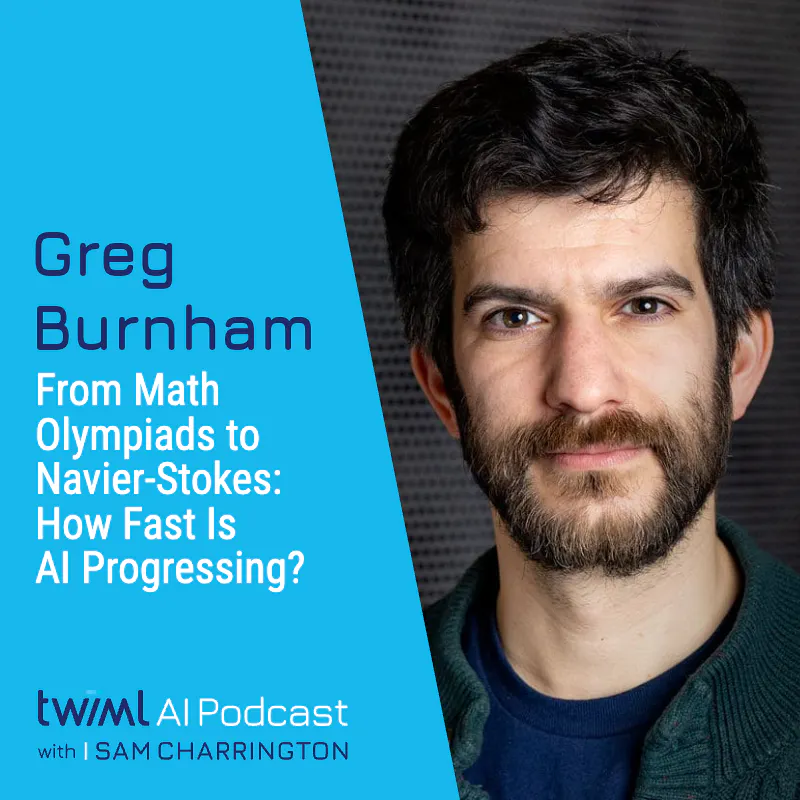 From Math Olympiads to Navier-Stokes: How Fast Is AI Progressing? with Greg Burnham - #778 29.09.2026 1h 7mAI systems have gone from struggling with grade-school math to helping solve research problems that have resisted mathematicians for decades, including Navier-Stokes. In this episode, Greg Burnham, who leads AI capabilities research at Epoch AI, joins us to examine what that progress says about where AI is going. We look at how these systems are solving hard math problems, how much they rely on persistence and prior human work, and whether they are starting to produce genuinely new ideas. We also discuss how to measure progress as traditional benchmarks become less useful, why capability gains...
-
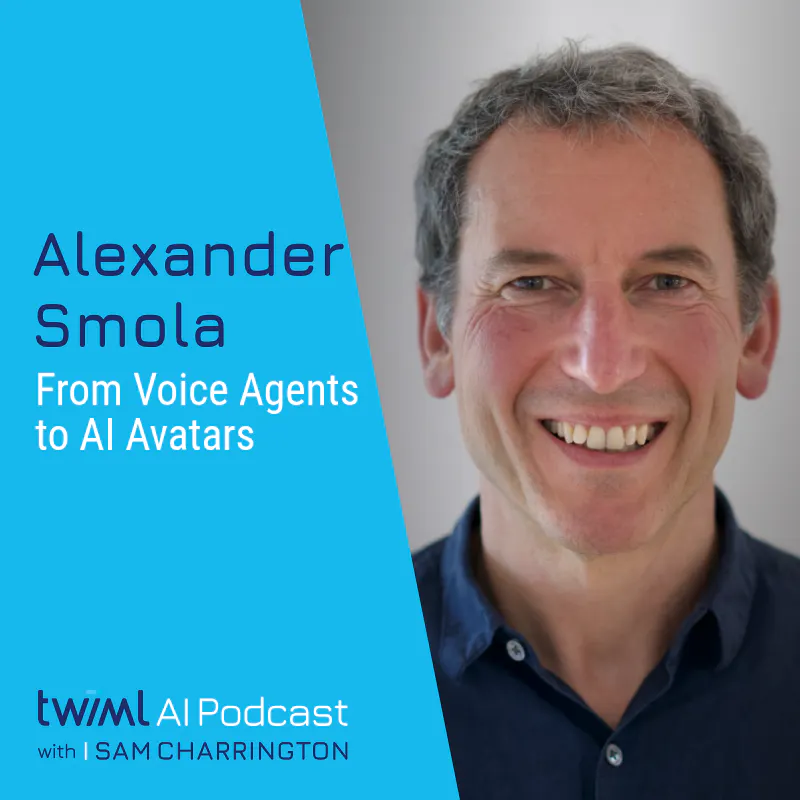 From Voice Agents to AI Avatars with Alexander Smola - #777 17.09.2026 1h 4mVoice AI has gotten remarkably good, but natural conversation remains a high bar. Small delays, awkward interruptions, or the wrong tone can quickly break the illusion—and adding vision and visual presence only raises the stakes. In this episode, Alex Smola, co-founder and CEO of Boson AI, explores the path from today’s voice agents to audiovisual agents and AI avatars. We discuss the technical tradeoffs behind real-time voice, including audio tokenization, latency, model size, and inference cost, as well as what changes when these systems can both see and be seen. We also explore the role of...
-
 Do AI Tokenomics Matter More Than Model Benchmarks? with Chris Potts - #776 09.09.2026 59mAs reasoning models consume more tokens and AI systems become more expensive to run, understanding what those tokens actually buy is becoming increasingly important. In this episode, Stanford professor and Big Spin co-founder Chris Potts joins us to discuss AI tokenomics and his research into “tokenflation”—the possibility that token usage is growing faster than the measurable value those tokens produce. We explore how to measure the return on AI spending, why benchmarks alone provide an incomplete picture of model progress, and what inference-time scaling means for the economics of increasing...
-
 World Models and the Future of Spatial AI with Justin Johnson - #775 01.09.2026 1h 6mIn this episode, Justin Johnson, co-founder of World Labs, joins us to discuss world models and the emerging field of spatial AI. We explore why many researchers see capabilities beyond language as an important frontier for AI, and what it means to build models that can understand, generate, and simulate the environments around them. Justin explains the different approaches to world modeling, including explicit 3D representations and generative models, and why there is still no established recipe for building these systems. We also discuss World Labs’ Marble system, which can generate navigabl...
-
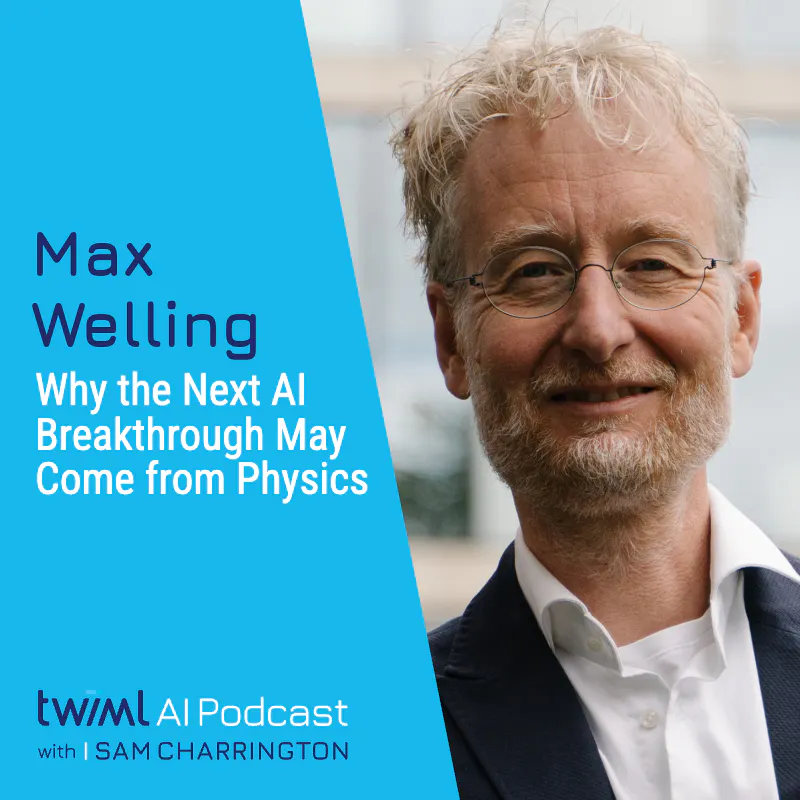 Why the Next AI Breakthrough May Come from Physics with Max Welling - #774 26.08.2026 58mThe conventional wisdom in AI is that the next breakthrough will come from more compute, more data, and larger models. But what if the next leap comes from somewhere else? In this episode, Max Welling—co-founder and CTO of CuspAI and professor at the University of Amsterdam—argues that physics may provide some of the ideas behind the next generation of AI systems. We begin with CuspAI’s work using generative AI to design entirely new materials for semiconductors, batteries, carbon capture, and clean energy. Max explains how foundation models for chemistry, agentic workflows, simulation, and au...
-
 Why Image Generation Needs More Than Bigger Models with Fatih Porikli - #773 12.08.2026 56mText-to-image models have become remarkably good at producing realistic images. But realism isn’t the same as correctness. Ask for several distinct people, a specific composition, or a high-resolution image generated locally, and today’s models still struggle in surprising ways. In this episode, Fatih Porikli, Vice President of Technology at Qualcomm, joins me to discuss what remains unsolved in image generation and several approaches his team presented at CVPR to address those challenges. We explore why better training objectives can improve controllability, how separating scene planning from...
-
 Why Models Are AI’s Next Training Dataset with Damian Borth - #772 27.07.2026 47mFor more than a decade, AI has advanced by training ever-larger models on ever-larger datasets. But as high-quality training data becomes harder to find and pretraining grows increasingly expensive, researchers are looking for new ways to keep foundation models improving. In this episode, Damian Borth, professor of AI and machine learning at the University of St. Gallen, argues we’ve been overlooking an important source of knowledge: the models we’ve already trained. His group’s work on weight space learning treats trained neural networks themselves as data, learning from the distilled results...
-
 How AI Learns to Smell with Alex Wiltschko - #771 08.07.2026 59mIn this episode, Alex Wiltschko, founder and CEO of Osmo, joins the show to discuss his goal of giving computers a sense of smell and what it takes to build olfactory intelligence. We explore the science behind smell, from the hundreds of olfactory receptors in the human nose to the challenge of mapping the relationship between molecular structure and odor, ensuring safety regulations are met, and building foundation models for smell. Alex explains how graph neural networks and advanced embedding spaces allow AI to capture the multi-dimensional structure of scents, grouping them into perceptua...
-
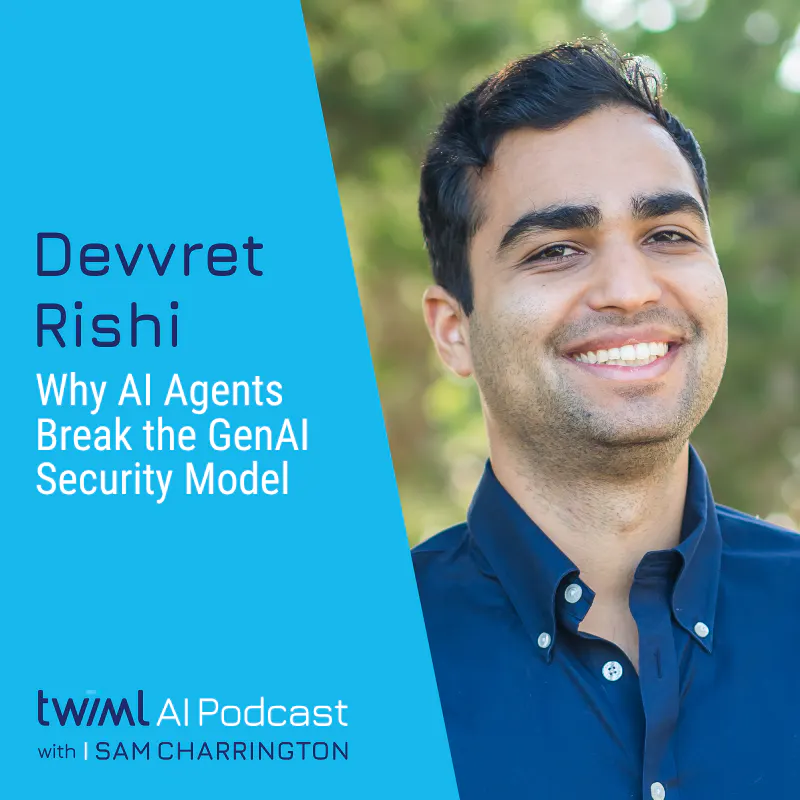 Why AI Agents Break the GenAI Security Model with Devvret Rishi - #770 16.06.2026 56mIn this episode, Sam talks with Dev Rishi, GM of AI at Rubrik, about what happens when agents move beyond answering questions and start taking action across tools, systems, and business processes. We explore why the enterprise playbook of static guardrails plus human approval starts to break down in the agent era. Agents are useful because they can plan, call tools, update systems, write code, send messages, and operate across workflows at machine speed, but those same capabilities make them difficult to govern with rules written in advance or approval prompts reviewed one at a time. Dev expla...
-
 Is RAG Dead? Lessons from Building AI for Tax Law with Alex Bowcut - #769 09.06.2026 51mAs context windows grow into the millions of tokens, many AI practitioners are questioning whether retrieval-augmented generation (RAG) is still necessary. If modern models can ingest entire libraries of documents, why bother with retrieval at all? In this episode, Alex Bowcut, Head of Engineering at Sphere, explains why the answer depends on the application. Sphere uses AI to automate global tax compliance—an environment where getting the answer right isn’t enough. Every conclusion must be backed by the correct legal citation, and every decision must withstand expert review. We explore how Sp...
-
 Relational Foundation Models for Enterprise Data with Jure Leskovec - #768 21.05.2026 1h 6mIn this episode, Jure Leskovec, co-founder and chief scientist at Kumo and professor of computer science at Stanford, joins us to explore two fronts of his work: AI for science and relational deep learning. We begin with AI Virtual Cell, a multiscale effort to learn data-driven representations from proteins to cells to patients using single-cell RNA-seq data, protein language models like ESM, and structure models like AlphaFold—without hand-encoding biology. Jure then dives into relational deep learning, reframing enterprise databases as graphs and training neural networks directly on raw mult...
-
 How to Find the Agent Failures Your Evals Miss with Scott Clark - #767 07.05.2026 53mIn this episode, Scott Clark, co-founder and CEO of Distributional, joins us to explore how teams can reliably operate and improve complex LLM systems and agents in production. Scott introduces a Maslow’s hierarchy of observability: telemetry for logging, monitoring for known signals, and post-production or online analytics to surface unknown unknowns. We dig into examples of real-world failures Scott’s team has seen in production systems, such as “lazy” tool-use hallucinations that standard evals miss, and how mapping traces into vector fingerprints enables clustering and topic discovery to u...
-
 How to Engineer AI Inference Systems with Philip Kiely - #766 30.04.2026 54mIn this episode, Philip Kiely, head of AI education at Baseten, joins us to unpack the fast-evolving discipline of inference engineering. We explore why inference has become the stickiest and most critical workload in AI, how it blends GPU programming, applied research, and large-scale distributed systems, and where the line sits between inference and model serving. Philip shares how research-to-production can move in hours, not months, and why understanding “the knobs” of inference—batching, quantization, speculation, and KV cache reuse—lets teams design better products and SLAs. We trace the...
Similar podcasts


Popular in
The podcast also appears in the podcast charts of these countries.


