
The History Of Bangalore
Ramjee Chandran
0
The History of Bangalore explores the city's evolution from the 4th century AD through the dynasties of the Kadambas and Gangas, princely rule, the British Raj, and Indian independence. It combines scholarly research with engaging storytelling, covering power struggles, alliances, and battles that shaped Bangalore. The podcast is hosted by Ramjee Chandran and supported by the Prestige Group.
Episodes
-
 The Resurrection of the Wadiyars. Aftermath of Seringapatam: Part 2 10.11.2026 23mFollowing the death of Tipu Sultan, Governor-General Richard Wellesley orchestrates a calculated redistribution of power in Mysore rather than an act of chivalrous restoration. This episode details the rejection of Rani Lakshmi Ammani's full territorial claims, the removal of Tipu’s sons to Vellore Fort, the landlocking of Mysore via the Partition Treaty, and the June 1799 coronation of five-year-old Mummadi Krishnaraja Wadiyar III. Bound by the Subsidiary Treaty, the restored kingdom exchanged its sovereignty and treasury for British protection and oversight. Key Details from the Script: Lakshmi Ammani & The Pre-War Treaties: Rani Lakshmi Ammani had sought British help as far back as the unratified 1782 Rana Treaty and wrote again in February 1799 offering to pay for war costs using Tipu's treasury. However, the British dismissed her proposals as "more specious than useful," taking Tipu's treasury for themselves on May 6. Her expectation to recover all territories held prior to 1761 clashed with Wellesley's plan to carve up the kingdom. Exile of Tipu’s Sons to Vellore (June 19, 1799): To eliminate potential rally points for Tipu loyalists, four of Tipu's eldest sons—Fath Hyder, Abdul Khaliq, Muiz-ud-din, and Muhi-ud-din—were escorted under heavy guard out of Srirangapatna to Vellore Fort. Abdul Khaliq and Muiz-ud-din had previously been held as hostages in 1792. The Partition Treaty of Mysore (June 22, 1799): Signed between the East India Company and the Nizam of Hyderabad, the treaty stripped Mysore of its sea access by giving Canara, Mangalore, Coimbatore, key passes, and Srirangapatna directly to the Company. The Nizam received northern districts (later ceded to the British in 1800), while a reserved share for the Marathas was never accepted. Landlocking Mysore & Retaining Bangalore: Deprived of its coast to prevent French naval alliances, the restored Mysore kingdom was reduced to an inland plateau around Mysore, Chitradurga, and Bangalore. An earlier idea to grant Bangalore to Tipu's son was dropped, keeping the city tied to the plateau kingdom. The Coronation of Krishnaraja Wadiyar III (June 30, 1799): Moving the ancestral seat away from British-held Srirangapatna back to Mysore, the coronation of five-year-old Mummadi Krishnaraja Wadiyar III took place in a temporary pavilion beside the Lakshmiramana Swamy temple. Colonel Arthur Wellesley escorted Rani Lakshmi Ammani, while General George Harris and Mir Alam led the boy to the throne. Purniah was appointed Dewan. The Subsidiary Treaty of Mysore (July 8, 1799): Signed at Nazarbad, the treaty turned Mysore into a British vassal state requiring an annual tribute of seven lakh star pagodas. Articles Four and Five granted the British powers to take over governance if subsidy payments failed. Colonel Barry Close was appointed the first Resident, while military command remained with Arthur Wellesley. We gratefully acknowledge the support of the Prestige Group, that makes this podcast possible. Follow The History Of Bangalore on social, here: Instagram: https://www.instagram.com/historyofbangalore/ Facebook: https://www.facebook.com/HistoryOfBangalore Twitter: https://twitter.com/HistoryOfBLR YouTube: https://youtube.com/@HistoryOfBangalore?si=mnH3BsYfI4BUU234 iHeartRadio: https://www.iheart.com/podcast/1323-the-history-of-bangalore-163453722/ Follow Ramjee Chandran on Instagram and Twitter: @ramjeechandran The theme music for the show was composed by German-Indian Koln based percussionist, Ramesh Shotham. Ramjee Chandran's photos by Asha Thadani. RESEARCH AND SOURCES: All our episodes are based on published research and archive records. To request information about our sources, write to hob@explocity.com. Let us know if you are a researcher (either institutional or independent) and also provide some information about why you need this information. Researchers will get priority. We only have time to engage serious, academic queries so please understand if we do not respond to casual requests.
-
 Aftermath of Seringapatam. The British Occupation - Part 1 03.11.2026 24mOn May 5, 1799, the day after Srirangapatna fell, General George Harris declared the conquest complete, placing Colonel Arthur Wellesley in command of the fort. Yet while the capital had fallen, the fate of the wider kingdom hung in the balance. This episode explores the immediate aftermath of Tipu Sultan’s death: the surrender of key leaders like Mir Qamaruddin Khan and chief minister Purniah, the rise of the rebel leader Dhondia Wagh, the mechanics of the British Subsidiary Alliance system, and the covert diplomatic maneuvers led by Governor-General Richard Wellesley and Rani Lakshmi Ammani that set the stage for restoring a four-year-old Wadiyar heir to the throne. Key Details from the Script: The Post-Fall Power Vacuum & Fort Command: On May 5, 1799, General George Harris commended his troops for the "Conquest of Yesterday." Colonel Arthur Wellesley took command of Srirangapatna fort, but while the capital was secured, Mysorean garrisons and troop contingents remained active across the countryside. The Mechanics of the Subsidiary Alliance: The episode breaks down how the East India Company used subsidiary treaties—a framework pioneered by French leaders Joseph François Dupleix and Marquis de Bussy in Hyderabad—to subjugate native states. Rulers paid for British troop contingents, expelled European rivals, surrendered foreign diplomacy, and accepted a British Resident with ultimate administrative veto power. Surrender of Mysorean Generals & Officials: Tipu's son Abdul Khaliq surrendered on May 5 to walk behind his father's bier, while eldest son Fath Hyder remained in the field. General Mir Qamaruddin Khan surrendered his 4,000 cavalry on May 7 (later receiving the jagir of Gurramkonda from the Nizam). Dewan Purniah arrived in camp on May 12 with an army still under his command, his family secured inside the fort. Outlaws & Document Seizures: Freed from Tipu's dungeons, cavalry commander Dhondia Wagh rallied unemployed Mysorean soldiers, proclaimed himself Ubhaya Lokadeeshwara ("King of the Two Worlds"), and carved out territory around Shimoga until Arthur Wellesley defeated him at Conaghul in September 1800. Meanwhile, British forces seized Tipu's state papers and published his French correspondence in Calcutta to build the public case for war. Purniah’s Proposals & The Mysore Commission: On May 13, Purniah proposed placing Fath Hyder on the throne under British protection and making the office of Dewan hereditary for his family. Governor-General Richard Wellesley rejected both, appointing a five-member commission (George Harris, Arthur Wellesley, Henry Wellesley, William Kirkpatrick, and Barry Close, with John Malcolm and Thomas Munro as secretaries) to dictate the post-war settlement. The Wadiyar Restoration Strategy: Building on Rani Lakshmi Ammani's pre-war letter offering to help fund the war effort in exchange for dynastic restoration, the commission secretly selected her four-year-old grandson, Krishnaraja Wadiyar III. On June 2, Purniah agreed to serve as Dewan under the restored Wadiyar dynasty, cementing the political transition. We gratefully acknowledge the support of the Prestige Group, that makes this podcast possible. Follow The History Of Bangalore on social, here: Instagram: https://www.instagram.com/historyofbangalore/ Facebook: https://www.facebook.com/HistoryOfBangalore Twitter: https://twitter.com/HistoryOfBLR YouTube: https://youtube.com/@HistoryOfBangalore?si=mnH3BsYfI4BUU234 iHeartRadio: https://www.iheart.com/podcast/1323-the-history-of-bangalore-163453722/ Follow Ramjee Chandran on Instagram and Twitter: @ramjeechandran The theme music for the show was composed by German-Indian Koln based percussionist, Ramesh Shotham. Ramjee Chandran's photos by Asha Thadani. RESEARCH AND SOURCES: All our episodes are based on published research and archive records. To request information about our sources, write to hob@explocity.com. Let us know if you are a researcher (either institutional or independent) and also provide some information about why you need this information. Researchers will get priority. We only have time to engage serious, academic queries so please understand if we do not respond to casual requests.
-
 Thunder and Lightning in Srirangapatna, Fireworks and Joy in England 27.10.2026 32mOn the evening of May 4, 1799, Srirangapatna lay in British hands, but the war remained incomplete until Tipu Sultan was accounted for. This episode details the night-time search beneath the bodies at the Water Gate, the chaotic looting and military order enforced by Arthur Wellesley, the violent thunderstorm that struck during Tipu's burial, the distribution of imperial spoils, and how news of the Sultan's death ignited an frenzy of celebration and pop-culture fascination across Britain. Key Details from the Script: The Search & Discovery at the Water Gate: Following the palace search led by Major Alexander Allan, killedar Mir Nadim led General David Baird, Colonel Arthur Wellesley, and Colonel Close to the Water Gate tunnel under torchlight. Aided by Tipu's wounded servant Rajah Khan, they pulled Tipu’s warm body from a heap of over 300 fallen soldiers. He bore four gunshot wounds, dressed in fine white linen with a crimson sash and an arm amulet. Plunder and Wellesley’s Command: On the night of May 4, Srirangapatna was widely plundered by British soldiers. The following morning, Arthur Wellesley took command of the fort over a protesting David Baird and forcibly restored order through floggings and executions. Burial at the Gumbaz & The Freak Storm: On May 5, Tipu was buried alongside his father Hyder Ali at the Lal Bagh mausoleum with full British military honors. During the funeral, an unusually violent thunderstorm struck Srirangapatna, bringing lethal lightning strikes that killed several officers, camp hands, and livestock, while destroying hospital tents and leaving 18 amputees dead overnight. The Prize Committee & Spoils of War: The Prize Committee valued Tipu's captured treasury at over £1 million. General Harris received ~£100,000, private soldiers received ~£7, Tipu’s gold tiger throne was broken up, and his famous mechanical "Tipu's Tiger" was shipped to India House in London. News Reaches London (Sept 14, 1799): Carried by the purser of the East Indiaman Barwell, news of Tipu's fall reached London four months later. Celebrations erupted across Britain, Tower of London cannons fired salutes, and Richard Wellesley was granted an Irish Marquessate (which he privately mocked as his "double-gilt potato"). Cultural Impact & Pop Icon Status: Victory over Tipu spawned commercial panoramas by Robert Ker Porter, theatrical spectacles at Astley’s Amphitheatre, commemorative medals, and inspired literature ranging from John Keats’ poetry to Wilkie Collins' 1868 detective novel The Moonstone. We gratefully acknowledge the support of the Prestige Group, that makes this podcast possible. Follow The History Of Bangalore on social, here: Instagram: https://www.instagram.com/historyofbangalore/ Facebook: https://www.facebook.com/HistoryOfBangalore Twitter: https://twitter.com/HistoryOfBLR YouTube: https://youtube.com/@HistoryOfBangalore?si=mnH3BsYfI4BUU234 iHeartRadio: https://www.iheart.com/podcast/1323-the-history-of-bangalore-163453722/ Follow Ramjee Chandran on Instagram and Twitter: @ramjeechandran The theme music for the show was composed by German-Indian Koln based percussionist, Ramesh Shotham. Ramjee Chandran's photos by Asha Thadani. RESEARCH AND SOURCES: All our episodes are based on published research and archive records. To request information about our sources, write to hob@explocity.com. Let us know if you are a researcher (either institutional or independent) and also provide some information about why you need this information. Researchers will get priority. We only have time to engage serious, academic queries so please understand if we do not respond to casual requests.
-
 The Death of Tipu Sultan 20.10.2026 26mFollowing the public exposure of Governor Malartic’s proclamation, Governor-General Richard Wellesley systematically isolated Mysore through military diplomacy and the Subsidiary Alliance system. This episode details the unfolding of the Fourth Anglo-Mysore War, the intercepted communications from Napoleon Bonaparte, the preliminary battles at Siddapura and Malavalli, the astrological rituals performed by Tipu Sultan on his final morning, and his heroic last stand at the Water Gate of Srirangapatna on May 4, 1799. Key Details from the Script: Diplomatic Encirclement (1798): On September 1, 1798, Hyderabad signed a Subsidiary Treaty with the British. The British orchestrated a mutiny among French-led sepoys, disarmed commander Michel Piron and 124 French officers, and absorbed 4,000 sepoys into the British army marching on Mysore. The "Rana Treaty" Blueprint: Rani Lakshmi Ammani’s 1782 draft agreement with the British provided Wellesley with a pre-arranged political solution for restoring the Wadiyar dynasty following Tipu's defeat. Intercepted French Communications: A letter written by Napoleon Bonaparte from Cairo promising military support to Tipu Sultan was intercepted by British intelligence, leaving Tipu unaware of France's attempt to respond. Early War Encounters: The Fourth Anglo-Mysore War opened with Mysorean offensives at Siddapura (Sedaseer) on March 6, 1799—where the Raja of Coorg supported General Stuart—and at Malavalli on March 27. Astrological Rituals of May 4, 1799: Warned by Muslim and Brahmin astrologers of an inauspicious lunar alignment, Tipu gave alms (including a caparisoned elephant, buffaloes, and cash) and peered into an iron pan of black sesame oil to ward off misfortune before sitting down to lunch. The Fall at the Water Gate: At 1:00 PM on May 4, 1799, General David Baird led the assault across the Kaveri River. Tipu personally fought along the ramparts, suffered multiple gunshot wounds while retreating toward the inner fort, and was killed at age 48 inside the narrow arch of the Water Gate after striking back at a soldier attempting to take his sword belt. We gratefully acknowledge the support of the Prestige Group, that makes this podcast possible. Follow The History Of Bangalore on social, here: Instagram: https://www.instagram.com/historyofbangalore/ Facebook: https://www.facebook.com/HistoryOfBangalore Twitter: https://twitter.com/HistoryOfBLR YouTube: https://youtube.com/@HistoryOfBangalore?si=mnH3BsYfI4BUU234 iHeartRadio: https://www.iheart.com/podcast/1323-the-history-of-bangalore-163453722/ Follow Ramjee Chandran on Instagram and Twitter: @ramjeechandran The theme music for the show was composed by German-Indian Koln based percussionist, Ramesh Shotham. Ramjee Chandran's photos by Asha Thadani. RESEARCH AND SOURCES: All our episodes are based on published research and archive records. To request information about our sources, write to hob@explocity.com. Let us know if you are a researcher (either institutional or independent) and also provide some information about why you need this information. Researchers will get priority. We only have time to engage serious, academic queries so please understand if we do not respond to casual requests.
-
 The Jacobin Club and the Strange Monsieur Ripaud 13.10.2026 20mAs revolutionary chaos engulfed Paris, Tipu Sultan found himself isolated and searching for a lifeline after losing half his kingdom in 1792. This episode details the arrival of French privateer François Ripaud in Mangalore, the improbable establishment of the Jacobin Club of Srirangapatna, and how a bungled recruitment drive in Mauritius gave Governor-General Richard Wellesley the ultimate pretext to wage war on Mysore. Key Details from the Script: Impact of the French Revolution (1789–1793): The execution of Louis XVI in 1793 plunged France into political turmoil and brought war with Britain, leading to the surrender of Pondicherry in August 1793 and leaving France without a mainland port in India. François Ripaud’s Deception (1797): French privateer François Ripaud arrived in Mangalore on a damaged ship, falsely claiming to be an official envoy from Île de France (Mauritius) promising 10,000 French troops and 30,000 African soldiers. Overriding Government Assessments: All six Mysorean government departments that evaluated Ripaud’s claims submitted written reports declaring him a liar. Driven by desperate strategic hope, Tipu overrode his ministers, purchased Ripaud's ship, and approved a mission to Mauritius. The Jacobin Club of Srirangapatna (May 1797): Fifty-nine French residents formed a republican club near Tipu's palace, raising the French tricolour flag and planting a Tree of Liberty. They swore an oath of hatred against all monarchs except "Citoyen Tipu," a title Tipu embraced to align with revolutionary France. Malartic’s Disastrous Proclamation (1798): Upon reaching Port Louis in January 1798, Tipu's envoys found no ready army. Governor Malartic issued a public proclamation inviting volunteers to fight for Mysore, yielding only 99 men while publicly exposing Tipu's secret alliance. Wellesley’s Pretext for War: On June 8, 1798, news of Malartic’s proclamation reached Governor-General Richard Wellesley in Calcutta. Wellesley leveraged the published document as definitive proof of a Mysorean-French military pact to justify parliament’s authorization for war. We gratefully acknowledge the support of the Prestige Group, that makes this podcast possible. Follow The History Of Bangalore on social, here: Instagram: https://www.instagram.com/historyofbangalore/ Facebook: https://www.facebook.com/HistoryOfBangalore Twitter: https://twitter.com/HistoryOfBLR YouTube: https://youtube.com/@HistoryOfBangalore?si=mnH3BsYfI4BUU234 iHeartRadio: https://www.iheart.com/podcast/1323-the-history-of-bangalore-163453722/ Follow Ramjee Chandran on Instagram and Twitter: @ramjeechandran The theme music for the show was composed by German-Indian Koln based percussionist, Ramesh Shotham. Ramjee Chandran's photos by Asha Thadani. RESEARCH AND SOURCES: All our episodes are based on published research and archive records. To request information about our sources, write to hob@explocity.com. Let us know if you are a researcher (either institutional or independent) and also provide some information about why you need this information. Researchers will get priority. We only have time to engage serious, academic queries so please understand if we do not respond to casual requests.
-
 The French Connection, Part 2: France in Mysore 06.10.2026 20mDespite being repeatedly abandoned by Paris due to European peace treaties, Tipu Sultan never relinquished his vision of a Franco-Mysore alliance to expel the British from India. This episode explores the pragmatic synergy between Mysore's land power and France's naval capabilities, the origin of Bengaluru's first European garrison in 1761, Admiral Suffren's 1782 naval campaign, and the deep cultural integration of French soldiers in Mysorean military life. Key Details from the Script: Pragmatic Synergy & Objectives: Mysore supplied standing armies, grain, bullocks, territory, land revenue, and western ports. France offered naval power to counter the Royal Navy, skilled artillery engineers, and strategic Indian Ocean staging grounds like Île de France (Mauritius). Bengaluru’s First European Garrison (1761): Following the fall of Pondicherry in 1761, Hyder Ali hired 300 French hussars under Commander Hügel alongside arsenal craftsmen. Stationed in the Bengaluru pete, they established military workshops—forming the city's first European garrison nearly 50 years before the British Cantonment. Admiral Suffren & The Bahour Summit (1782): French Admiral Pierre André de Suffren fought five major naval engagements against the British in under two years and seized Trincomalee. On July 25, 1782, Hyder Ali met Suffren with full state honors at Bahour near Pondicherry, accompanied by naval gun salutes. Triple Abandonment by Paris: France prioritized European diplomacy over Mysore on three key occasions: the 1763 Treaty of Paris, the 1783 Treaty of Versailles (withdrawing Marquis de Bussy during Tipu's siege of Mangalore), and 1789 (when Louis XVI turned down Tipu's request for 10,000 troops). Cultural Integration: Unlike British forces who remained isolated, French officers lived alongside Mysorean troops, learned local languages (Kannada, Tamil, Persian), wore Indian campaign clothes, and participated in court hunts. French Rocks (Pandavapura / Kunti Betta): Located ~130 km southwest of Bengaluru, the granite hills of Pandavapura were historical encampments for French troops serving Mysore, featuring a preserved cemetery with around 30 worn 18th-century graves. We gratefully acknowledge the support of the Prestige Group, that makes this podcast possible. Follow The History Of Bangalore on social, here: Instagram: https://www.instagram.com/historyofbangalore/ Facebook: https://www.facebook.com/HistoryOfBangalore Twitter: https://twitter.com/HistoryOfBLR YouTube: https://youtube.com/@HistoryOfBangalore?si=mnH3BsYfI4BUU234 iHeartRadio: https://www.iheart.com/podcast/1323-the-history-of-bangalore-163453722/ Follow Ramjee Chandran on Instagram and Twitter: @ramjeechandran The theme music for the show was composed by German-Indian Koln based percussionist, Ramesh Shotham. Ramjee Chandran's photos by Asha Thadani. RESEARCH AND SOURCES: All our episodes are based on published research and archive records. To request information about our sources, write to hob@explocity.com. Let us know if you are a researcher (either institutional or independent) and also provide some information about why you need this information. Researchers will get priority. We only have time to engage serious, academic queries so please understand if we do not respond to casual requests.
-
 The French Connection, Part 1: South India 01.10.2026 19mLong before Britain consolidated its hold over the subcontinent, France came tantalizingly close to reshaping Indian history. In Part 1 of this mini-series, Ramjee Chandran traces the rise of La Compagnie des Indes Orientales, the kingmaking ambitions of Joseph François Dupleix, and the strategic innovations of the Marquis de Bussy—whose revenue-for-protection system provided the exact blueprint the British East India Company later used to conquer India. Key Details from the Script: French Expansion & Dupleix: Founded in 1664 by Jean-Baptiste Colbert, La Compagnie des Indes Orientales established key posts at Pondicherry, Chandernagore, Mahé, Yanam, and Karaikal. Under Governor Joseph François Dupleix (1742), France pivoted from trade to aggressive territorial kingmaking. The Subsidiary Alliance Prototype: After the 1746 Battle of Adyar proved European tactics could scatter larger traditional armies, Dupleix raised trained sepoy units. In 1753, the Marquis de Bussy secured the Northern Circars revenue assignment from Hyderabad to maintain French troops—inventing the system later adapted by Richard Wellesley into the British Subsidiary Alliance. The Tamil Pepys: The era’s political maneuvering was documented in detail by Dupleix’s dubash, Ananda Ranga Pillai, whose Tamil diary (1736–1761) provides a vivid eyewitness record of 18th-century South India. First Mysore-French Military Pact (1760): During the Seven Years' War, Hyder Ali dispatched a force under his brother-in-law, Makhdum Ali, to aid French general Comte de Lally at Madras—marking the first joint military venture between Mysore and France. European Priorities & British Supremacy: French ambitions were constantly undermined by European peace treaties (such as trading Madras back to Britain for Canada's Louisbourg in 1748) and British naval power, driving France to seek local land powers like Mysore. We gratefully acknowledge the support of the Prestige Group, that makes this podcast possible. Follow The History Of Bangalore on social, here: Instagram: https://www.instagram.com/historyofbangalore/ Facebook: https://www.facebook.com/HistoryOfBangalore Twitter: https://twitter.com/HistoryOfBLR YouTube: https://youtube.com/@HistoryOfBangalore?si=mnH3BsYfI4BUU234 iHeartRadio: https://www.iheart.com/podcast/1323-the-history-of-bangalore-163453722/ Follow Ramjee Chandran on Instagram and Twitter: @ramjeechandran The theme music for the show was composed by German-Indian Koln based percussionist, Ramesh Shotham. Ramjee Chandran's photos by Asha Thadani. RESEARCH AND SOURCES: All our episodes are based on published research and archive records. To request information about our sources, write to hob@explocity.com. Let us know if you are a researcher (either institutional or independent) and also provide some information about why you need this information. Researchers will get priority. We only have time to engage serious, academic queries so please understand if we do not respond to casual requests.
-
 How Tipu Almost Destroyed Business in the Bengaluru Pete 22.09.2026 21mWhile Tipu Sultan was driven to construct a modern, self-reliant industrial power, his domestic economic policies caused severe disruption for the merchant community of the Bengaluru Pete. Drawing from surveyor Francis Buchanan's 1800 records, this episode examines how trade bans, state monopolies under the Malik-ut-Tujjar, the abolition of private banking, forced state purchases, and an armed thorn hedge enclosure threatened the 250-year-old open marketplace. Key Details from the Script: Francis Buchanan’s 1800 Survey: Primary accounts of Tipu’s economic administration were documented by British surveyor Francis Buchanan in May 1800, capturing the grievances of Pete merchants following the fall of Mysore. The Canteroy Pagoda (Kanteeraya Varaha): Though coins from across India circulated in the Pete, bookkeeping was standardized in the Kanteeraya varaha, a currency introduced in 1638 by Ranadheera Kanteerava Narasaraja Wadiyar I that persisted until the British standardized the Rupee. Moral Controls & Regional Trade Bans: Reversing Hyder Ali’s laissez-faire policies, Tipu banned liquor, white poppy, and hemp cultivation. He also prohibited trade with Arcot and Hyderabad—disrupting key silk, cotton, and export markets. State Monopolies & Financial Control: Essential commodities—sandalwood, pepper, tobacco, cardamom, gold, silver, and sulphur—were nationalized under the Malik-ut-Tujjar (chief of commerce). Tipu also abolished private banking and independent brokers (Shettys), centralizing hundi paper credit under state offices. Forced Purchases & The Thorn Barrier: Merchants were forced to purchase state surplus goods at above-market prices, draining private capital. Furthermore, an armed thorn hedge enclosure was built around the Pete, restricting free movement and movement of goods in a historically open market town. We gratefully acknowledge the support of the Prestige Group, that makes this podcast possible. Follow The History Of Bangalore on social, here: Instagram: https://www.instagram.com/historyofbangalore/ Facebook: https://www.facebook.com/HistoryOfBangalore Twitter: https://twitter.com/HistoryOfBLR YouTube: https://youtube.com/@HistoryOfBangalore?si=mnH3BsYfI4BUU234 iHeartRadio: https://www.iheart.com/podcast/1323-the-history-of-bangalore-163453722/ Follow Ramjee Chandran on Instagram and Twitter: @ramjeechandran The theme music for the show was composed by German-Indian Koln based percussionist, Ramesh Shotham. Ramjee Chandran's photos by Asha Thadani. RESEARCH AND SOURCES: All our episodes are based on published research and archive records. To request information about our sources, write to hob@explocity.com. Let us know if you are a researcher (either institutional or independent) and also provide some information about why you need this information. Researchers will get priority. We only have time to engage serious, academic queries so please understand if we do not respond to casual requests.
-
 The Famous Mysore Silk: How it Happened 16.09.2026 21mHow did a kingdom stripped of its primary commercial ports transform itself into an industrial powerhouse? In this episode, Ramjee Chandran traces the origin of two defining Mysorean legacies: silk and lacquerware toys. From 12-year expeditions sent to China for silkworms to treadmill-pumped mulberry fields outside Bengaluru's old city gates, discover how Tipu Sultan built a closed-loop textile ecosystem and laid the foundation for modern Karnataka's sericulture industry Key Details from the Script: 1786 Sericulture Expeditions: Tipu Sultan dispatched diplomatic missions to China (lasting 12 years) and Bengal (lasting 4 years) to procure silkworms and expert reelers. On September 26, 1786, Tipu wrote to Syed Mahommed, commandant of Srirangapatna fort, ordering temporary housing for the incoming Bengal silkworms near the old palace to commence breeding. Hyder Ali’s Early Foundations: Sericulture in Mysore began under Hyder Ali prior to 1782. Artisans brought from Uraiyur (Trichy) and roughly 300 reelers from Bengal established bamboo mounting frames and silk-reeling techniques at Srirangapatna. Global Trade & Sourcing: Letters from April and May 1786 show Tipu directing Mir Kazim, manager of the Muscat trade post in Oman, to collect silkworms, Persian saffron seeds, and pearls from Bahrain and Hormuz. The Bengaluru Supply Chain: Outside the eastern Halasooru Gate near Sampangi Tank (modern Sampangirama Nagar), human-powered treadmills pumped lake water to cultivate mulberry bushes. These crops fed silkworm breeding units that supplied raw thread directly to looms inside the Bengaluru pete. Refuting the Colonial "Failure" Narrative: British translator William Kirkpatrick (1811) dismissed Tipu’s sericulture project as "unsuccessful". In reality, the imported yellow silkworm adapted to the local climate without hibernating, producing the resilient "Pure Mysore race" that anchors modern silk production. Long-Term Industry Evolution: The Channapatna-Srirangapatna corridor became Mysore’s permanent silk belt. It was expanded later by Italian entrepreneur de Vecchi (Kengeri filature, 1866) and Jamsetji Tata (Tata Silk Farm in Basavanagudi, 1896). Channapatna Manufacturing Hub: Beyond sericulture, Channapatna transitioned from metal and precision crafting—such as veena strings—into the famous lacquerware toy manufacturing town that exists today. We gratefully acknowledge the support of the Prestige Group, that makes this podcast possible. Follow The History Of Bangalore on social, here: Instagram: https://www.instagram.com/historyofbangalore/ Facebook: https://www.facebook.com/HistoryOfBangalore Twitter: https://twitter.com/HistoryOfBLR YouTube: https://youtube.com/@HistoryOfBangalore?si=mnH3BsYfI4BUU234 iHeartRadio: https://www.iheart.com/podcast/1323-the-history-of-bangalore-163453722/ Follow Ramjee Chandran on Instagram and Twitter: @ramjeechandran The theme music for the show was composed by German-Indian Koln based percussionist, Ramesh Shotham. Ramjee Chandran's photos by Asha Thadani. RESEARCH AND SOURCES: All our episodes are based on published research and archive records. To request information about our sources, write to hob@explocity.com. Let us know if you are a researcher (either institutional or independent) and also provide some information about why you need this information. Researchers will get priority. We only have time to engage serious, academic queries so please understand if we do not respond to casual requests.
-
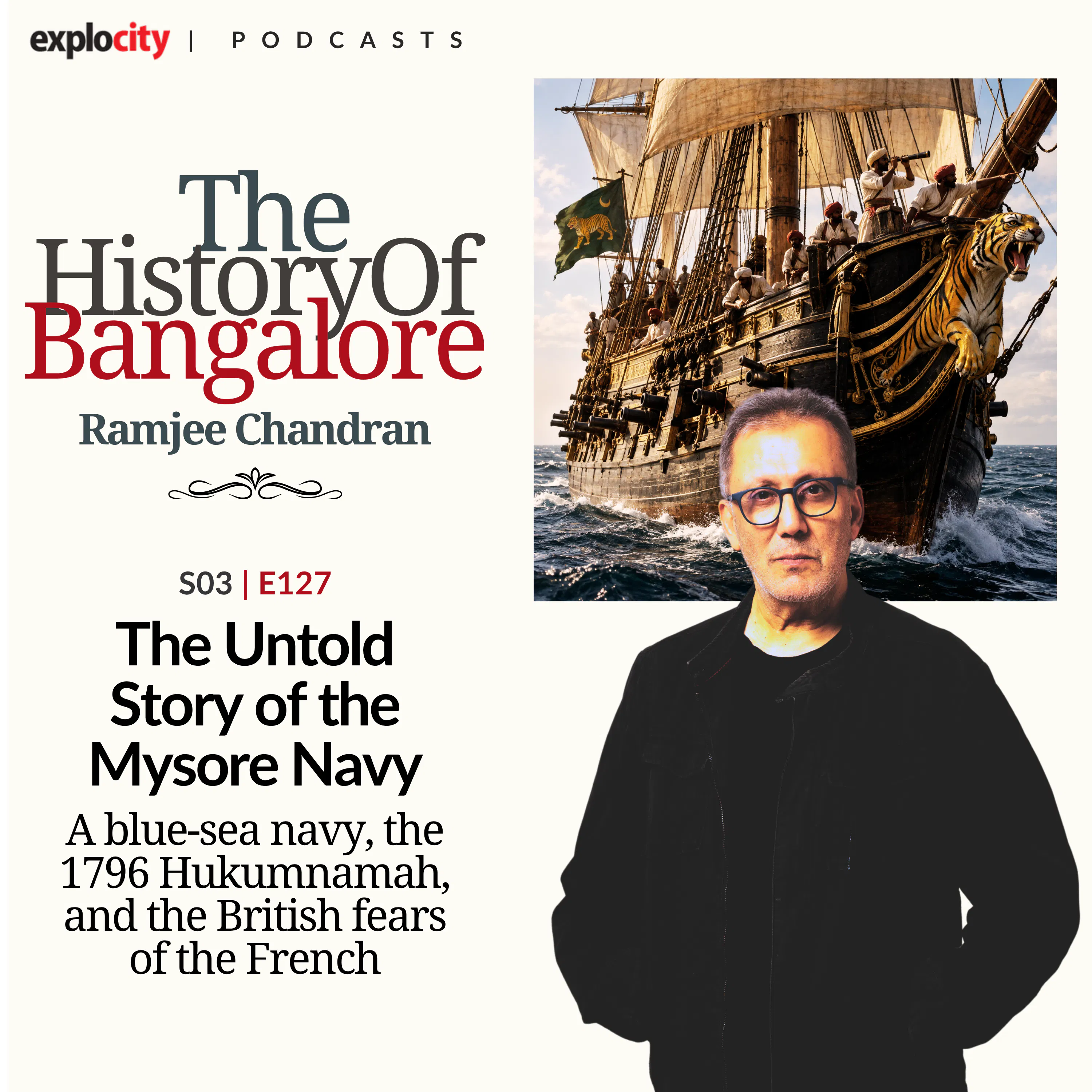 The Untold Story of the Mysore Navy 08.09.2026 21mDid Mysore possess a high-seas navy capable of challenging the Royal Navy? In this episode, Ramjee Chandran uncovers the history of Tipu Sultan’s 1796 naval ordinance (Hukumnamah). Moving beyond coastal defense, Tipu sought to construct a blue-water fleet, establish a Board of Admiralty, and forge a maritime alliance with revolutionary France—a bold strategic shift that directly alarmed the British high command and hastened the fall of Mysore. Key Details from the Script: 1796 Political Context: Debt cleared and sons returned by 1794; Tipu abolished the puppet Maharaja position upon Chamaraja Wadiyar IX’s death in 1796 to assume direct, absolute sovereignty. Blue-Water Strategic Shift: Expanding on Hyder Ali’s 1763 coastal dockyards, Tipu pivoted from a "brown-water" coastal defense to a "blue-water" deep-sea fleet to attack British supply lines and target Bombay by sea. The French Connection: Planned a joint naval strategy with revolutionary France to challenge British maritime dominance and restore open trade corridors. The 1796 Ordinance (Hukumnamah): Established a 11-member Board of Admiralty (Mir Yams) across three dockyard divisions (Mangalore, Basavarajadurga, Sadashivgad) to build 40 ships—including 20 massive 80-gun battleships featuring tiger figureheads. British Alarm & Outcome: Prompted Governor-General Wellesley to call for seizing Mysore's coast in 1798; by 1799, British forces found only 19 smaller craft, leaving it uncertain whether the 20 major battleships were never built or erased from records. We gratefully acknowledge the support of the Prestige Group, that makes this podcast possible. Follow The History Of Bangalore on social, here: Instagram: https://www.instagram.com/historyofbangalore/ Facebook: https://www.facebook.com/HistoryOfBangalore Twitter: https://twitter.com/HistoryOfBLR YouTube: https://youtube.com/@HistoryOfBangalore?si=mnH3BsYfI4BUU234 iHeartRadio: https://www.iheart.com/podcast/1323-the-history-of-bangalore-163453722/ Follow Ramjee Chandran on Instagram and Twitter: @ramjeechandran The theme music for the show was composed by German-Indian Koln based percussionist, Ramesh Shotham. Ramjee Chandran's photos by Asha Thadani. RESEARCH AND SOURCES: All our episodes are based on published research and archive records. To request information about our sources, write to hob@explocity.com. Let us know if you are a researcher (either institutional or independent) and also provide some information about why you need this information. Researchers will get priority. We only have time to engage serious, academic queries so please understand if we do not respond to casual requests.
-
 Tipu’s Options and the Birth of a New Mysore 01.09.2026 21mStanding in the spring of 1792 with a halved kingdom and two sons held hostage in Madras, what choices remained for Tipu Sultan? In this episode, Ramjee Chandran explores the state of mind of the Mysorean monarch. Refusing to become a British vassal or bow to foreign oversight, Tipu paid his massive debt ahead of schedule and pivoted his state toward rapid industrialization, scientific innovation, and global naval ambitions. Key Details from the Script: The Immediate Aftermath (Spring 1792): Allied armies departed, leaving Srirangapatna intact but Tipu surrounded on all sides by enemies (British, Marathas, Nizam). Mysore retained the dry interior plateau, Bangalore, Mangalore, and an army in the field, but owed two-thirds of the 3.3 crore ransom with two young princes held hostage in Madras. Rejecting the Vassal State Trap: Tipu had three paths: accept permanent defeat, buy British protection at the cost of independence (subsidiary alliance/vassalage like Arcot or Awadh), or rebuild and fight. Examples like Nawab Muhammad Ali Khan Walajah of Arcot (trapped in debt to Company servants) and Awadh (forced to pay for British military garrisons) illustrated how "protection" eroded sovereignty. Tipu paid his dues rapidly to ensure no British Resident stayed in Srirangapatna, bringing his sons home by 1794. Understanding British Power: Tipu recognized that British military dominance was built on money, trade, and industrial manufacturing rather than sheer cavalry numbers. He realized co-existence as equals was impossible given three British wars against Mysore in 25 years. Pivoting to an Industrial State: With high-revenue commercial ports gone, Tipu turned inward to transform Mysore into a modern manufacturing and technology-driven economy. Implemented state trading operations, developed the Channapatna manufacturing belt, and established the sericulture/silk industry by sending emissaries to China for silkworms and expert cultivators. Scientific Curiosity & The Taramandalapete Experiment: An account by Englishman William Smith (1794) describes Tipu demonstrating a Mysorean condensing water engine at Taramandalapete in Bangalore that out-performed its European counterpart. Tipu experimented with a Leyden jar (a capacitor storing static electricity) and playfully shocked his ministers holding hands in a circle. The 1796 Naval Ordinance: Tipu established a Naval Board in 1796 to build a war fleet despite holding only a non-commercial coastline. The naval strategy relied on a anticipated alliance with the French Navy to challenge British maritime hegemony and reclaim trade corridors. We gratefully acknowledge the support of the Prestige Group, that makes this podcast possible. Follow The History Of Bangalore on social, here: Instagram: https://www.instagram.com/historyofbangalore/ Facebook: https://www.facebook.com/HistoryOfBangalore Twitter: https://twitter.com/HistoryOfBLR YouTube: https://youtube.com/@HistoryOfBangalore?si=mnH3BsYfI4BUU234 iHeartRadio: https://www.iheart.com/podcast/1323-the-history-of-bangalore-163453722/ Follow Ramjee Chandran on Instagram and Twitter: @ramjeechandran The theme music for the show was composed by German-Indian Koln based percussionist, Ramesh Shotham. Ramjee Chandran's photos by Asha Thadani. RESEARCH AND SOURCES: All our episodes are based on published research and archive records. To request information about our sources, write to hob@explocity.com. Let us know if you are a researcher (either institutional or independent) and also provide some information about why you need this information. Researchers will get priority. We only have time to engage serious, academic queries so please understand if we do not respond to casual requests.
-
 Why Did Cornwallis Not Annex Mysore in 1792? 25.08.2026 23mDescription: Why did Lord Cornwallis leave Tipu Sultan on the throne of Mysore in 1792 after bringing him to his knees? In this episode, Ramjee Chandran debunks the notion that the British lacked administrative capability, proving instead that the decision to leave half a kingdom intact was a calculated move driven by strategic geography, coalition politics, and legal constraints. Discover how Cornwallis secured British interests by shutting off key military passes into the Carnatic while carefully balancing the Maratha Confederacy and operating within strict parliamentary limits. Key Details from the Script: Refuting the "Administrative Incapacity" Myth: Some historians suggest the East India Company was purely a military force incapable of administering the plateau. Ramjee Chandran dismisses this: the British were expert bureaucrats with established Presidencies in Calcutta and Madras. Having already administered Bangalore and secured local palegars, they possessed the immediate capacity to run territories like Baramahal and Salem. Reason 1: Defensive Frontiers Over Territorial Conquest: The primary war goal was eliminating Mysore's capacity to invade the Carnatic—a fear rooted in the disastrous British defeat at Pollilur (1780). Cornwallis strategically annexed Baramahal, Salem, Coorg, and Malabar. These were not chosen merely for wealth, but because they controlled all mountain passes and coastal routes into British territory, effectively trapping Tipu on the interior plateau. Reason 2: Coalition Mechanics & Managing Allies: The Third Anglo-Mysore War was a joint effort with equal partners: the Maratha Confederacy and the Nizam of Hyderabad. Unilateral annexation by the Company would have sparked intense "violent jealousy," especially from the formidable Maratha Confederacy, who would demand their equal share of the entire kingdom. Reason 3: Mysore as a Buffer State: Completely dismantling Mysore would create a long, direct, unprotected frontier between British territories and the powerful Maratha Confederacy. A weakened, residual Mysore served as a vital strategic buffer state between the two powers. Reason 4: Parliamentary Mandates (Pitt’s India Act): As a chartered corporation, the East India Company operated under strict standing instructions from the British Parliament prohibiting offensive territorial expansion. Cornwallis could justify the war in London as a "defensive necessity" that paid for itself, but outright annexation of a defeated kingdom could not be legally defended. We gratefully acknowledge the support of the Prestige Group, that makes this podcast possible. Follow The History Of Bangalore on social, here: Instagram: https://www.instagram.com/historyofbangalore/ Facebook: https://www.facebook.com/HistoryOfBangalore Twitter: https://twitter.com/HistoryOfBLR YouTube: https://youtube.com/@HistoryOfBangalore?si=mnH3BsYfI4BUU234 iHeartRadio: https://www.iheart.com/podcast/1323-the-history-of-bangalore-163453722/ Follow Ramjee Chandran on Instagram and Twitter: @ramjeechandran The theme music for the show was composed by German-Indian Koln based percussionist, Ramesh Shotham. Ramjee Chandran's photos by Asha Thadani. RESEARCH AND SOURCES: All our episodes are based on published research and archive records. To request information about our sources, write to hob@explocity.com. Let us know if you are a researcher (either institutional or independent) and also provide some information about why you need this information. Researchers will get priority. We only have time to engage serious, academic queries so please understand if we do not respond to casual requests.
-
 How Tipu Paid the Ransom. The Aftermath of Seringapatam: Part 2 18.08.2026 23mHow does a nation crippled by territorial losses clear a war debt worth a fraction of a global empire's annual output within two years? In this episode, Ramjee Chandran analyzes the true economic weight of the 3-crore-and-30-lakh-rupee ransom imposed on Tipu Sultan after the Treaty of Seringapatam. Uncover how Tipu avoided borrowing a single rupee by combining personal treasury reserves, severe military wage cuts, and sophisticated revenue extractions from his subjects to bring his hostage sons back from Madras Key Details from the Script: Evaluating the True Value of 3 Crore 30 Lakh Rupees: Economic historian M.H. Gopal converts the indemnity to £3.3 million sterling (at £1 to Rs 10). Using economic historian Stephen Broadberry's methodology—which measures an indemnity's share of a nation's total economic output—the 1792 payment represented 1.5% to 1.75% of Great Britain's entire annual GDP (~£200 million at the time). Applied to the modern UK economy (~£3.15 trillion), this single payment equates to approximately £45 billion today. Inspection of Mysore’s Portable Treasury Books: During initial negotiations, the British originally demanded 6 crore rupees. Mysore’s chief envoys, including Ghulam Ali, presented the kingdom's formal, portable treasury accounts for British inspection. Upon verifying these ledgers, Lord Cornwallis agreed to accept 3 crore rupees, plus 30 lakh rupees for "durbar expenses" (war costs), specifically demanding immediate cash in hand ("ready money" in gold/silver coin and bullion). Immediate Remittance and the Pressure of Hostages: Delay, default, or bad-harvest pleas were impossible options because Tipu’s two young sons were held hostage in Madras. On February 28, 1792—less than a week after preliminary terms were sealed and weeks before the final treaty was signed—Tipu remitted over 1 crore and 9 lakh rupees (~one-third of the total debt). How the Full Ransom Was Raised (Wilks/Gopal Analysis): 110 Lakhs (1.1 Crore): Direct contribution from Tipu Sultan's personal treasury and state reserves. 60 Lakhs: Extracted from the Mysore army via Nazarana (forced ceremonial offerings). Soldiers' annual pay was cut by two months per year over 2.5 years, forcing the defeated military to pay for its own war penalty. 160 Lakhs (1.6 Crore): Collected from the population. Department heads fraudulently assessed themselves as paid on paper and shifted the burden to the districts. The state artificially inflated the conversion value of the gold pagoda, forcing farmers to pay higher actual tax rates. The Paradox of Credit: Mysore vs. East India Company: Mysore: Paid the entirety of its massive, modern multi-billion-pound equivalent debt in cash without borrowing a single anna. East India Company: Conquered India almost entirely on credit extended by Indian banking houses (hundis), leading to a tripled corporate debt under Richard Wellesley that nearly bankrupted the Company. The final payment was delivered in 1794, successfully securing the safe return of princes Abdul Khaliq and Muiz-ud-din. We gratefully acknowledge the support of the Prestige Group, that makes this podcast possible. Follow The History Of Bangalore on social, here: Instagram: https://www.instagram.com/historyofbangalore/ Facebook: https://www.facebook.com/HistoryOfBangalore Twitter: https://twitter.com/HistoryOfBLR YouTube: https://youtube.com/@HistoryOfBangalore?si=mnH3BsYfI4BUU234 iHeartRadio: https://www.iheart.com/podcast/1323-the-history-of-bangalore-163453722/ Follow Ramjee Chandran on Instagram and Twitter: @ramjeechandran The theme music for the show was composed by German-Indian Koln based percussionist, Ramesh Shotham. Ramjee Chandran's photos by Asha Thadani. RESEARCH AND SOURCES: All our episodes are based on published research and archive records. To request information about our sources, write to hob@explocity.com. Let us know if you are a researcher (either institutional or independent) and also provide some information about why you need this information. Researchers will get priority. We only have time to engage serious, academic queries so please understand if we do not respond to casual requests.
-
 The Aftermath of Seringapatam, Part 1: The Ledger 11.08.2026 17mDescription: What remained of the legendary kingdom of Mysore after the Treaty of Seringapatam in 1792? In this episode, Ramjee Chandran dives into the grim fiscal reality facing Tipu Sultan. Beyond losing half its geographical territory, Mysore lost its most profitable economic engines—the lucrative spice coast of Malabar, the strategic mountain passes of Coorg, and the seamless trade routes that sustained Bangalore. Discover how the allies stripped Mysore of its revenue-generating commercial centers while leaving Tipu with a dry, expensive interior and a single, shallow military port to finance a massive war ransom. Key Details from the Script: Clarifying "Landlocked": While Mysore was not strictly landlocked in a purely geographical sense (it retained a small strip of coast), it was effectively landlocked from commerce. The treaty stripped away all of its high-revenue, commercial trading ports, leaving Mysore economically isolated. An Unequal Division of Spoils: The territorial loss was far more than "half a kingdom". The allied coalition selectively annexed the most lucrative and strategically vital regions along their respective borders: The British: Seized Malabar (the spice coast), Coorg, Baramahal, Dindigul, and Salem. The Marathas: Took the fertile and centuries-contested Raichur Doab between the Krishna and Tungabhadra rivers. Hyderabad (The Nizam): Took Cumbum, Cuddapah, and Ganjikota. What Mysore Retained: The dry, inland plateau—including Srirangapatna, Bangalore, Bidanur (Nagara), Chitradurga, Gooty, and the Canara coast. While defensible, this residual state was far poorer per square mile. The Strategic Loss of Malabar and Coorg: Malabar: Represented Mysore's richest asset due to its historic pepper and cardamom trade with Europe, the Persian Gulf, and the Red Sea. Coorg: While earning less direct revenue, Coorg controlled the key mountain passes through the Western Ghats. Losing Coorg meant losing the physical corridors required to transport plateau goods to coastal markets. The Impact on Bangalore: Bangalore was returned to Tipu intact, but its commercial viability was severely crippled. Formerly an interior market with protective geographic depth, Bangalore became a vulnerable frontier city. Its ancient trade routes west to the coast and south through Baramahal were now intersected by hostile British-controlled territory and new feudal checkpoints. Commercial Ports vs. Naval Bases: Commercial ports (like Calicut and Cannanore, now lost to the British) generate state income. Naval bases (like Mangalore, Honnavar, and Kundapur, which Mysore kept) consume state income. Built originally by Hyder Ali for timber access and shallow-draft warships (gallivats and grabs), Mangalore’s harbour had a shallow sandbar entrance. The treaty forced this single military harbour to double as the sole bulk export outlet for the entire kingdom’s state enterprises. The Fiscal Trap: Mysore was left with a halved territory, a disproportionately gutted revenue base, a single bottlenecked port, and an exorbitant bill of 3 crore 30 lakh rupees owed to the victors—all while two young princes remained hostages in Madras. We gratefully acknowledge the support of the Prestige Group, that makes this podcast possible. Follow The History Of Bangalore on social, here: Instagram: https://www.instagram.com/historyofbangalore/ Facebook: https://www.facebook.com/HistoryOfBangalore Twitter: https://twitter.com/HistoryOfBLR YouTube: https://youtube.com/@HistoryOfBangalore?si=mnH3BsYfI4BUU234 iHeartRadio: https://www.iheart.com/podcast/1323-the-history-of-bangalore-163453722/ Follow Ramjee Chandran on Instagram and Twitter: @ramjeechandran The theme music for the show was composed by German-Indian Koln based percussionist, Ramesh Shotham. Ramjee Chandran's photos by Asha Thadani. RESEARCH AND SOURCES: All our episodes are based on published research and archive records. To request information about our sources, write to hob@explocity.com. Let us know if you are a researcher (either institutional or independent) and also provide some information about why you need this information. Researchers will get priority. We only have time to engage serious, academic queries so please understand if we do not respond to casual requests.
-
 Tipu’s Sons. The Treaty of Seringapatam, Part 2 03.08.2026 21mDescription: Behind the ink of formal treaties lies the poignant reality of human collateral. In this episode, Ramjee Chandran details the emotional exchange that saw two of Tipu Sultan’s young sons handed over as political hostages to guarantee a massive war indemnity. Uncover the behind-the-scenes political maneuvering by Mysorean vakeels to protect key heirs, the grand 21-gun procession to the British lines, and how Lord Cornwallis transformed a solemn surrender into a personal, career-defining moment of redemption following his loss at Yorktown. Key Details from the Script: Human Collateral as Guarantee: The preliminary peace articles required Tipu Sultan to yield two of his sons to the British until his three-crore-rupee indemnity (plus 30 lakh rupees in durbar expenses) was paid in full. The Diplomatic Gamesmanship: Tipu’s envoys (vakeels Ghulam Ali Khan and Ali Reza Khan) artfully engineered the handover: Fateh Hyder (The Eldest): The vakeels claimed he was "obnoxious" (disliked) by Tipu. In reality, officers like Alexander Baillie noted he was an active 19-year-old military commander leading troops, making his capture an intolerable military loss. Abdul Khaliq (Middle Son): Claimed to be too sickly to leave the women's quarters; the British rejected this plea, and the 10-year-old was sent regardless. Muiz-ud-din (Youngest of the three): Framed as Tipu's "favourite" and heir apparent to project sincerity. Historians like Denys Forrest suspect the vakeels swapped Muiz-ud-din for Muhi-ud-din—Tipu's only fully legitimate son born of Ruqiya Banu Begum—fooling the British with the phonetic similarity of the names. The Grand Procession: On February 26, 1792, the two young princes (Abdul Khaliq, 10, and Muiz-ud-din, 8) departed Srirangapatna on silver howdahs atop elephants. Escorted by camel couriers, standard-bearers, 100 silver-speared pikemen, and sepoys, they were saluted by both the fortress guns and a 21-gun salute from the British camp. The Meeting with Cornwallis: Lord Cornwallis personally met the boys at his tent door, embracing them and taking each by the hand. Head vakeel Ghulam Ali declared that Cornwallis must now be their father. Cornwallis assured them of equal care to his own son, exchanging gifts of a gold watch for a Persian sword. Publicity, Medals, and Aftermath: News of the handover triggered massive public celebration in London. Matthew Boulton’s Soho Mint struck a commemorative medal featuring Cornwallis with the Latin motto fas sit parcere hosti ("let it be right to spare the enemy"). Artist Robert Home sketched the famous scene, and Cornwallis was elevated from Earl to Marquess. Ghulam Ali Khan remained with the princes in Madras during their two-year captivity until Tipu fully paid the debt in March 1794. Historical Echoes & Cornwallis's Karma: This hostage event echoed theHoysala King Veera Ballala III, whose son Virupaksha was taken as a hostage to Delhi in 1311 and held for two years. For Cornwallis, receiving Tipu's sons and sword provided personal closure after his humiliating 1781 surrender at Yorktown during the American Revolution. We gratefully acknowledge the support of the Prestige Group, that makes this podcast possible. Follow The History Of Bangalore on social, here: Instagram: https://www.instagram.com/historyofbangalore/ Facebook: https://www.facebook.com/HistoryOfBangalore Twitter: https://twitter.com/HistoryOfBLR YouTube: https://youtube.com/@HistoryOfBangalore?si=mnH3BsYfI4BUU234 iHeartRadio: https://www.iheart.com/podcast/1323-the-history-of-bangalore-163453722/ Follow Ramjee Chandran on Instagram and Twitter: @ramjeechandran The theme music for the show was composed by German-Indian Koln based percussionist, Ramesh Shotham. Ramjee Chandran's photos by Asha Thadani. RESEARCH AND SOURCES: All our episodes are based on published research and archive records. To request information about our sources, write to hob@explocity.com. Let us know if you are a researcher (either institutional or independent) and also provide some information about why you need this information. Researchers will get priority. We only have time to engage serious, academic queries so please understand if we do not respond to casual requests.
-
 The Treaty of Seringapatam, Part 1 28.07.2026 16mFollowing the successful encirclement of Srirangapatna, fighting gives way to intense, high-stakes diplomacy in a negotiation tent pitched near the Eedgah. In this episode, Ramjee Chandran details the rigorous process behind the Treaty of Seringapatam in March 1792, where Lord Cornwallis, the Maratha Confederacy, and the Nizam of Hyderabad met with Tipu Sultan’s envoys to dismantle the formidable power of Mysore. Discover how the harsh loss of coastal gateways like Malabar, massive monetary indemnities, and unique cultural clashes during drafting permanently crippled Tipu's empire—leaving it landlocked and reduced by half. Key Details from the Script: The Preliminary Articles and Hostage Clause: Just a day after Tipu Sultan’s final failed breakout attempt, the preliminary peace terms were sealed on the night of February 23, 1792. The preliminary agreement stipulated that Mysore surrender vast territories, pay a massive financial indemnity, and hand over two of Tipu’s young sons as security hostages until the payment was settled. The Triple Alliance at the Table: While popular history frames the conflict primarily as British versus Tipu Sultan, the Maratha Peshwa and the Nizam of Hyderabad were co-signatories who played an essential role in Tipu's defeat. The Marathas fought to secure the fertile Doab territory in northern Mysore, while Nizam Ali Khan (Asaf Jah II) aimed to neutralize the persistent southern threat on his borders and collect his share of land. The High Price of Defeat: Formally negotiated by Sir John Kennaway for the British alongside Tipu's chief vakeels (Ali Reza Khan and Ghoolam Ali), the treaty stripped Mysore of approximately half its territory. The British claimed Calicut, Coorg, Baramahal, Dindigul, and Salem; Hyderabad took Cuddapah and part of the Doab; and the Marathas annexed the districts along their southern frontier. Additionally, Tipu was forced to pay 3 crore rupees in coin and bullion, plus 30 lakh rupees in "durbar expenses". The Fatal Loss of Malabar: The surrender of Calicut was the single most crippling blow to the Mysore State. As Mysore's primary gateway to the Arabian Sea, losing the Malabar coast permanently cut Tipu off from foreign trade in pepper and cardamom, direct arms imports, and maritime contact with the French. The kingdom was rendered landlocked, destroying the economic engine that funded its military. Heated Disputes and Human Diplomacy: The negotiations saw intense legal sparring—the British successfully insisted on protecting the Rajah of Coorg despite Mysore's objections, while Tipu's envoys successfully negotiated to retain Gooty. Despite the grim circumstances, a remarkably respectful, courtly relationship developed between Kennaway and Ali Reza Khan, who softened their harsh diplomatic demands with genuine personal regret. Cultural Clashes in Contract Language: A stark cultural divergence arose over standard legal phrasing. The British inserted the common legal term "successors, heirs and assigns," which the Marathas rejected as feeling finite. Instead, drawing on traditional Deccan inscription language, the Marathas insisted the agreement should hold "as long as the sun, moon, and stars endure". Permanent Dismantling: Finalized between March 17 and 18, 1792, the treaty irrevocably altered the geopolitical landscape. None of the surrendered territories were ever recovered by Mysore, ensuring that despite Tipu's subsequent rebuilding efforts, his empire would never again operate as an invincible, equal sovereign power in India. We gratefully acknowledge the support of the Prestige Group, that makes this podcast possible. Follow The History Of Bangalore on social, here: Instagram: https://www.instagram.com/historyofbangalore/ Facebook: https://www.facebook.com/HistoryOfBangalore Twitter: https://twitter.com/HistoryOfBLR YouTube: https://youtube.com/@HistoryOfBangalore?si=mnH3BsYfI4BUU234 iHeartRadio: https://www.iheart.com/podcast/1323-the-history-of-bangalore-163453722/ Follow Ramjee Chandran on Instagram and Twitter: @ramjeechandran The theme music for the show was composed by German-Indian Koln based percussionist, Ramesh Shotham. Ramjee Chandran's photos by Asha Thadani. RESEARCH AND SOURCES: All our episodes are based on published research and archive records. To request information about our sources, write to hob@explocity.com. Let us know if you are a researcher (either institutional or independent) and also provide some information about why you need this information. Researchers will get priority. We only have time to engage serious, academic queries so please understand if we do not respond to casual requests.
-
 The Fall of Seringapatam, 1792 24.07.2026 19mNine months after a grueling retreat, Lord Cornwallis returns to the gates of Srirangapatna with the full weight of the Triple Alliance. Rather than initiating a slow, conventional siege, Cornwallis strikes under the cover of darkness, launching an aggressive infantry assault that shatters Tipu Sultan's formidable river defenses. In this episode, Ramjee Chandran details the pivotal turning point where the geopolitical fate of Mysore was truly sealed. Witness the completion of a flawless pincer movement as General Abercromby’s Bombay division arrives from the west, pinning the Sultan inside his island fortress and forcing a proud ruler into an unprecedented plea for terms. Key Details from the Script: The True Fall of Mysore: While history books heavily emphasize the bloody 1799 storming where Tipu Sultan lost his life, the geopolitical fate of the Kingdom of Mysore was effectively sealed in February 1792. Following this campaign, Tipu retained his throne for seven more years but was permanently stripped of his status as an equal sovereign among regional powers. The Midnight River Crossing: Srirangapatna was protected naturally by two deep channels of the Kaveri River, fortified with stone ramparts and heavy artillery covering every crossing. Abandoning his usual methodical caution, Cornwallis launched a surprise night assault on Tipu’s heavily fortified camp on the north bank. In chaotic, hand-to-hand combat, British sepoys and Hyderabad troops pushed across the river, establishing a vital allied foothold right on Srirangapatna island. Cornwallis himself sustained a minor wound during the close-quarters fighting. The Pincer Closes: The assault was only the first jaw of a larger strategic trap. General Robert Abercromby successfully marched the Bombay division east from the Malabar coast, navigating the treacherous, steep, and heavily forested passes of Coorg. By mid-February 1792, Abercromby entrenched his forces southwest of the island fortress, working in perfect logistical synchronization with Cornwallis to the north to completely encircle the capital. The Limits of the Cavalry: Tipu Sultan's elite irregular light cavalry, known as looties, remained the finest in India—even earning a private tribute from Cornwallis, who noted that any single lootie was a better soldier than the three British generals previously commanding against them. However, while these swift horsemen excelled at wars of attrition against supply lines, they were entirely unequipped to break a fixed, multi-directional pincer siege. Tipu's Final Assault: On February 22, 1792, Tipu launched a desperate, direct counter-attack against Abercromby's southwestern position, gambling that the newly arrived Bombay division would be vulnerable after their mountain march. Abercromby’s men successfully held their ground, breaking the assault and expending the last independent military momentum Tipu possessed. An Unprecedented Plea for Peace: Realizing that no external allies were coming to his rescue and that allied siege guns were close enough to systematically reduce the fort's walls, Tipu Sultan officially sued for peace. Distinct from an unconditional surrender, this request to negotiate was made from a position of profound weakness while the walls still stood, contrasting sharply with the 1784 Treaty of Mangalore where Tipu had dictated terms as a military equal. Cornwallis's Personal Redemption: For Cornwallis, this victory offered profound personal redemption. A decade prior, he had carried the crushing stigma of losing America after his historic surrender to George Washington's allies at Yorktown, Virginia. By breaking Tipu Sultan on the banks of the Kaveri River, Cornwallis successfully rewrote his own legacy, transforming from the general who lost America into the commander who broke Mysore. We gratefully acknowledge the support of the Prestige Group, that makes this podcast possible. Follow The History Of Bangalore on social, here: Instagram: https://www.instagram.com/historyofbangalore/ Facebook: https://www.facebook.com/HistoryOfBangalore Twitter: https://twitter.com/HistoryOfBLR YouTube: https://youtube.com/@HistoryOfBangalore?si=mnH3BsYfI4BUU234 iHeartRadio: https://www.iheart.com/podcast/1323-the-history-of-bangalore-163453722/ Follow Ramjee Chandran on Instagram and Twitter: @ramjeechandran The theme music for the show was composed by German-Indian Koln based percussionist, Ramesh Shotham. Ramjee Chandran's photos by Asha Thadani. RESEARCH AND SOURCES: All our episodes are based on published research and archive records. To request information about our sources, write to hob@explocity.com. Let us know if you are a researcher (either institutional or independent) and also provide some information about why you need this information. Researchers will get priority. We only have time to engage serious, academic queries so please understand if we do not respond to casual requests.
-
 The Road to Seringapatam, Part 2 23.07.2026 24mFollowing a devastating logistical collapse and a painful retreat from Srirangapatna, Lord Cornwallis discovers he is not as isolated as he feared. Just as hunger begins to dismantle his forces, an unheralded vanguard appears on the horizon, signaling a profound turn of fortune. In this episode, Ramjee Chandran charts the dramatic resurgence of the Triple Alliance. From the miraculous eleventh-hour arrival of 40,000 Maratha horsemen to the systematic dismantling of Tipu Sultan’s "impregnable" granite hill fortresses (navadurgas), follow the allied forces as they return to the gates of the Mysorean capital—this time, leaving absolutely nothing to chance. Key Details from the Script: The One-Day Lifeline: As the British and Nizam’s forces retreated toward Bangalore amid a quiet famine, the vanguard of a 40,000-strong Maratha cavalry army suddenly materialized. Because Tipu’s light horsemen had intercepted all prior messengers, neither army knew the other was close until they blindly converged outside Srirangapatna on May 26, 1791. Had the Marathas arrived just one day earlier, Cornwallis would not have had to destroy his vital heavy siege guns. The Bazaars of the Marathas: The Maratha camp traveled with heavily stocked commercial bazaars, instantly alleviating the British famine with grain and provisions. While the immediate starvation ended, the lack of heavy artillery meant a second siege that season was impossible, forcing the unified coalition to march back to Bangalore to regroup and wait out the monsoon. The Vision of Mahadji Scindia: The coalition Cornwallis now relied upon was an ironic twist of history. Years earlier, the great Maratha statesman Mahadji Scindia of Gwalior had recognized that a divided India would be picked apart by the British and tried to unite Mysore, Hyderabad, and the Marathas. Tipu Sultan’s rigid suspicion and inflexibility alienated his neighbors, resulting in Scindia's envisioned grand alliance being deployed against Mysore instead of for it. Cracking the Navadurgas: To secure his vital supply arteries connecting Bangalore to the Carnatic and Hyderabad, Cornwallis spent the monsoon months systematically reducing Tipu's strategic granite hill fortresses. Nandidurga fell in October 1791, followed by Savanadurga and Hutridurga by December. Capturing these heights permanently flipped control of the Deccan trade routes to the British and severely fractured the Mysorean morale, proving these centuries-old landmarks were no longer impregnable. General Medows' Gold Mine: During the high-stakes assault on Savanadurga, a rumor swept through the advancing sepoy ranks that the breach was booby-trapped with explosives. The famously humorous General William Medows defused the paralyzing tension by dryly remarking that the only mine nearby was a "gold mine," prompting laughter that propelled the Madras Infantry regiments forward to secure victory. The Second March Commences: Refusing to be distracted by Tipu’s 28-day diversionary siege and capture of Coimbatore to the south, Cornwallis turned his massive, fully refitted allied force back toward the capital on January 25, 1792. By February 5, the army set up an extensively supplied camp at French Rocks (modern Pandavapura), just six miles north of Srirangapatna. Dismantling the Pleasure Gardens: In an industrial display of hand-labor, 1,200 allied soldiers manufactured thousands of gabions, fascines, and pickets in a single day to prepare for the siege. In a bitter twist of wartime irony, the raw brushwood and timber for these defensive earthworks were methodically chopped down from Tipu Sultan's famously beautiful, perennially blooming pleasure gardens situated right outside the fortress walls. We gratefully acknowledge the support of the Prestige Group, that makes this podcast possible. Follow The History Of Bangalore on social, here: Instagram: https://www.instagram.com/historyofbangalore/ Facebook: https://www.facebook.com/HistoryOfBangalore Twitter: https://twitter.com/HistoryOfBLR YouTube: https://youtube.com/@HistoryOfBangalore?si=mnH3BsYfI4BUU234 iHeartRadio: https://www.iheart.com/podcast/1323-the-history-of-bangalore-163453722/ Follow Ramjee Chandran on Instagram and Twitter: @ramjeechandran The theme music for the show was composed by German-Indian Koln based percussionist, Ramesh Shotham. Ramjee Chandran's photos by Asha Thadani. RESEARCH AND SOURCES: All our episodes are based on published research and archive records. To request information about our sources, write to hob@explocity.com. Let us know if you are a researcher (either institutional or independent) and also provide some information about why you need this information. Researchers will get priority. We only have time to engage serious, academic queries so please understand if we do not respond to casual requests.
-
 The Road to Seringapatam, Part 1 06.07.2026 22mWith Bangalore secured, Lord Cornwallis turns his sights west toward the ultimate prize: Tipu Sultan’s island capital of Srirangapatna. But a secondary fortress stocked for a year's siege serves as a stark warning that Mysore’s resources remain deeply formidable. In this episode, Ramjee Chandran chronicles the grueling, circuitous march against two ticking clocks—the impending southwest monsoon and a looming European war in London. Discover how Tipu’s devastating scorched-earth strategy transformed the landscape into a lethal weapon, breaking the British logistics spine and forcing a deeply demoralising retreat within sight of the capital's walls. Key Details from the Script: The Scale of Tipu's Reserves: When British engineers surveyed the captured ammunition stores in Bangalore Fort, they found 120 foreign cannons (Spanish, French, and British) and enough dry magazine ammunition to withstand a full year's siege. This made Cornwallis realise that Mysore was far from running out of resources, raising the stakes for what awaited them at the capital. The Two Ticking Clocks: Cornwallis was operating under intense time constraints. Locally, the southwest monsoon was due in June, leaving only a two-month window to march and conquer the capital. Globally, the radicalisation of the French Revolution put London on high alert for an impending Anglo-French war, prompting the Board of Control to explicitly pressure Cornwallis to end the campaign quickly. The Long Way Round: To avoid marching directly into Tipu's prepared defenses along the shortest western route through Closepet (modern Ramanagara), Cornwallis chose a circuitous path down the Kanakahalli Road. This cautious manoeuver was deeply influenced by Cornwallis's haunting memories of being encircled and trapped into a historic surrender at Yorktown, Virginia, a decade prior. The Nightmare of Scorched Earth: Tipu executed a brutal scorched-earth campaign inherited from his father, Hyder Ali, emptying villages, stripping grain stores, fouling wells, and slaughtering livestock. As fodder vanished, thousands of vital draft bullocks collapsed and died. British soldiers were forced to harness themselves to ropes to drag heavy siege guns across the rough, dissolving terrain by hand. Disease and Desperation in Camp: The marching camp quickly deteriorated as smallpox tore through the ranks of soldiers and vulnerable camp followers. Driven by extreme hunger and exhausted rations, lower-caste followers and troops were reduced to subsisting on the meat of dead buffaloes to survive. The Hollow Victory at Arakere: On May 14, 1791, the coalition forces—allied with the Nizam’s Hyderabad contingent—met Tipu’s army at the village of Arakere, just 20 kilometers from Srirangapatna. Although the combined artillery held the center and forced Tipu's forces to withdraw behind their capital walls, it was a hollow battlefield victory. A Heartbreaking Retreat: A quick reconnaissance revealed that the battered, starving, and disease-ridden army lacked the strength to breach Srirangapatna's walls. On May 24, 1791, an early monsoon broke, turning the roads to mud. Cornwallis made the agonizing decision to blow up his irreplaceable heavy siege cannons, dump his dry ammunition into the Kaveri River, and order a long, miserable march back to Bangalore. We gratefully acknowledge the support of the Prestige Group, that makes this podcast possible. Follow The History Of Bangalore on social, here: Instagram: https://www.instagram.com/historyofbangalore/ Facebook: https://www.facebook.com/HistoryOfBangalore Twitter: https://twitter.com/HistoryOfBLR YouTube: https://youtube.com/@HistoryOfBangalore?si=mnH3BsYfI4BUU234 iHeartRadio: https://www.iheart.com/podcast/1323-the-history-of-bangalore-163453722/ Follow Ramjee Chandran on Instagram and Twitter: @ramjeechandran The theme music for the show was composed by German-Indian Koln based percussionist, Ramesh Shotham. Ramjee Chandran's photos by Asha Thadani. RESEARCH AND SOURCES: All our episodes are based on published research and archive records. To request information about our sources, write to hob@explocity.com. Let us know if you are a researcher (either institutional or independent) and also provide some information about why you need this information. Researchers will get priority. We only have time to engage serious, academic queries so please understand if we do not respond to casual requests.
-
 In The Aftermath of the Fall of Bangalore, 1791 29.06.2026 21mHistory moves quickly to the next battle, but it rarely stops to examine the morning after. Following the harrowing midnight breach of March 21, 1791, Bangalore awoke to a transformed reality. In this episode, Ramjee Chandran takes us inside the captured fort and pete to explore the immediate, human cost of victory. From the contrasting grief of two mothers on opposite sides of the ocean to the systematic plunder of Tipu Sultan’s grand palaces, the rapid establishing of British colonial bureaucracy, and a dark act of vengeful retaliation that sealed the fate of nineteen captive Highlanders, discover how the aftermath of Bangalore's fall reshaped the war. Key Details from the Script: The Tale of Two Mothers: The episode opens by contrasting the human toll on opposite sides of the conflict. In Bangalore, a Mysorean mother mourns her son—a soldier or craftsman lost in the brutal midnight crossfire where 1,400 people died. Thousands of miles away in Britain, another mother anxiously awaits news, knowing her son might be among the heavy British casualties or survivors. The Plunder of Tipu’s Palace: Once the fort fell, the initial hours dissolved into chaotic and extensive plundering by victorious troops. Soldiers ransacked Tipu Sultan's beautiful, double-storied teak palace within the fort. They stripped away rich carpets, heavy silken hangings, gold ornaments, and fine porcelain. Priceless books and manuscripts from Tipu's personal library were scattered across the dirt. Cornwallis Restores Absolute Order: To stop the chaos, Lord Cornwallis acted decisively. He placed strict guards at the fort gates, established an immediate military police presence, and ordered all stolen property to be returned to a centralized prize fund. Any soldier caught looting after the order faced public floggings or execution, demonstrating the strict discipline of the British war machine. Securing the Taramandala Industry: Beyond treasure, the British captured Tipu's highly sophisticated taramandala (armaments factory). They discovered fully operational foundry equipment, advanced wind- and water-driven boring machines, and stockpiles of half-finished iron rockets and cannon barrels. This effectively dismantled Tipu's primary industrial base for weapons manufacturing. The Rapid Rise of Colonial Bureaucracy: Within days, the British transformed the conquered military outpost into a functioning administrative hub. Markets in the pete were forcibly reopened, standard trade regulations were implemented, and the local population was induced to return to supply the British army with grain and cattle. The Vengeful Execution of the Highlanders: When news of Bangalore's fall reached Tipu Sultan, his shock dissolved into vengeful fury. He turned his anger on nineteen British Highlander prisoners he had held captive since an earlier engagement—men he had previously humiliated by forcing them to dress in women's clothing and perform for his court. In a sudden, exemplary act of retaliation, Tipu ordered all nineteen prisoners executed. The Advanced Base for Seringapatam: By April 1791, the fort was fully repaired, garrisoned, and the Triple Alliance coalition was safely assembled. As historian John Fortescue later noted, taking Bangalore provided the ultimate advanced base of operations. Cornwallis now stood in the strongest fortress of Mysore, turning his eyes directly west toward the final objective: Seringapatam. We gratefully acknowledge the support of the Prestige Group, that makes this podcast possible. Follow The History Of Bangalore on social, here: Instagram: https://www.instagram.com/historyofbangalore/ Facebook: https://www.facebook.com/HistoryOfBangalore Twitter: https://twitter.com/HistoryOfBLR YouTube: https://youtube.com/@HistoryOfBangalore?si=mnH3BsYfI4BUU234 iHeartRadio: https://www.iheart.com/podcast/1323-the-history-of-bangalore-163453722/ Follow Ramjee Chandran on Instagram and Twitter: @ramjeechandran The theme music for the show was composed by German-Indian Koln based percussionist, Ramesh Shotham. Ramjee Chandran's photos by Asha Thadani. RESEARCH AND SOURCES: All our episodes are based on published research and archive records. To request information about our sources, write to hob@explocity.com. Let us know if you are a researcher (either institutional or independent) and also provide some information about why you need this information. Researchers will get priority. We only have time to engage serious, academic queries so please understand if we do not respond to casual requests.
Similar podcasts


Popular in
The podcast also appears in the podcast charts of these countries.

