
BEAM There, Done That
Plangora
0
BEAM There, Done That is a podcast about building real systems with Elixir, Erlang, and the BEAM. Each episode dives into practical lessons from shipping software on the BEAM: architecture decisions, scaling challenges, operational failures, and the patterns that actually work. No hype, just hard-won experience from engineers who've been there.
Episodes
-
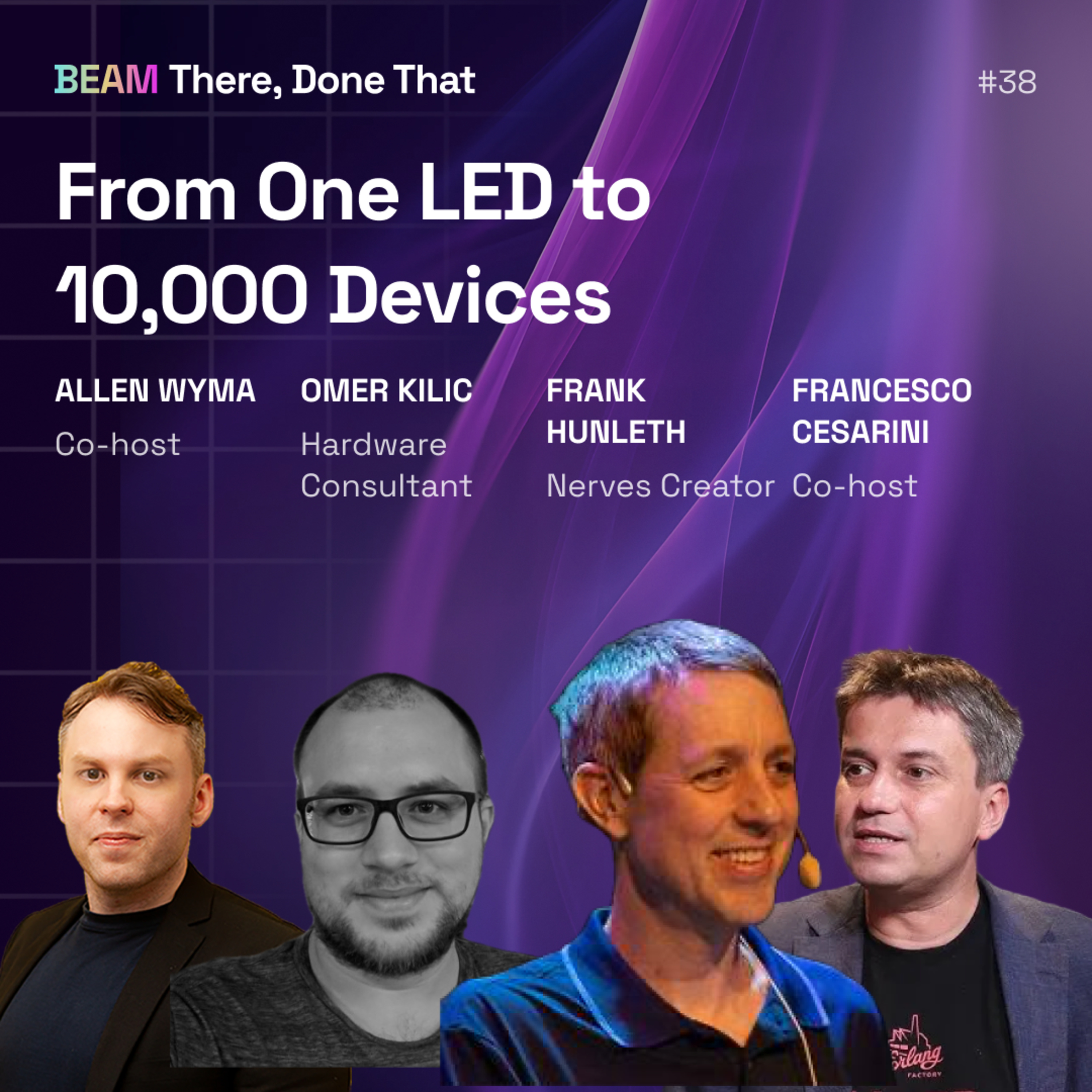 From One LED to 10,000 Devices: Omer Kilic & Frank Hunleth on Nerves 20.11.2026 1h 5mA Nerves device at SmartRent once reported an exception in which an empty list had become a zero. The timestamp and location showed it came from Florida, just as a hurricane made landfall and a brownout hit the area. A bit had flipped in memory. The GenServer crashed, the supervisor restarted it, and the resident never noticed anything. Frank Hunleth only looked into it out of curiosity.Frank created Nerves. Omer Kilic runs Ordinatra Minima, a London hardware and manufacturing consultancy, and worked on Erlang Embedded at Erlang Solutions and built Erlang/ALE. In 2013, at Erlang Factory San Fr...
-
 Agents on the BEAM: Mike Hostetler on Jido 13.11.2026 1h 9mIn the first version of Jido, every agent was a DynamicSupervisor. Each GenServer also kept a private queue in its own state so an action could push follow-up work to the front of the line instead of waiting in the mailbox. Mike Hostetler calls both decisions things he still cringes at, and he rebuilt the framework for 2.0 to get rid of them.Jido began as bot infrastructure before there was a model to call, and the LLM is still kept out of the core on purpose. In Jido an agent is a validated struct. The process that runs it is a separate concern, and side effects are returned as directives for...
-
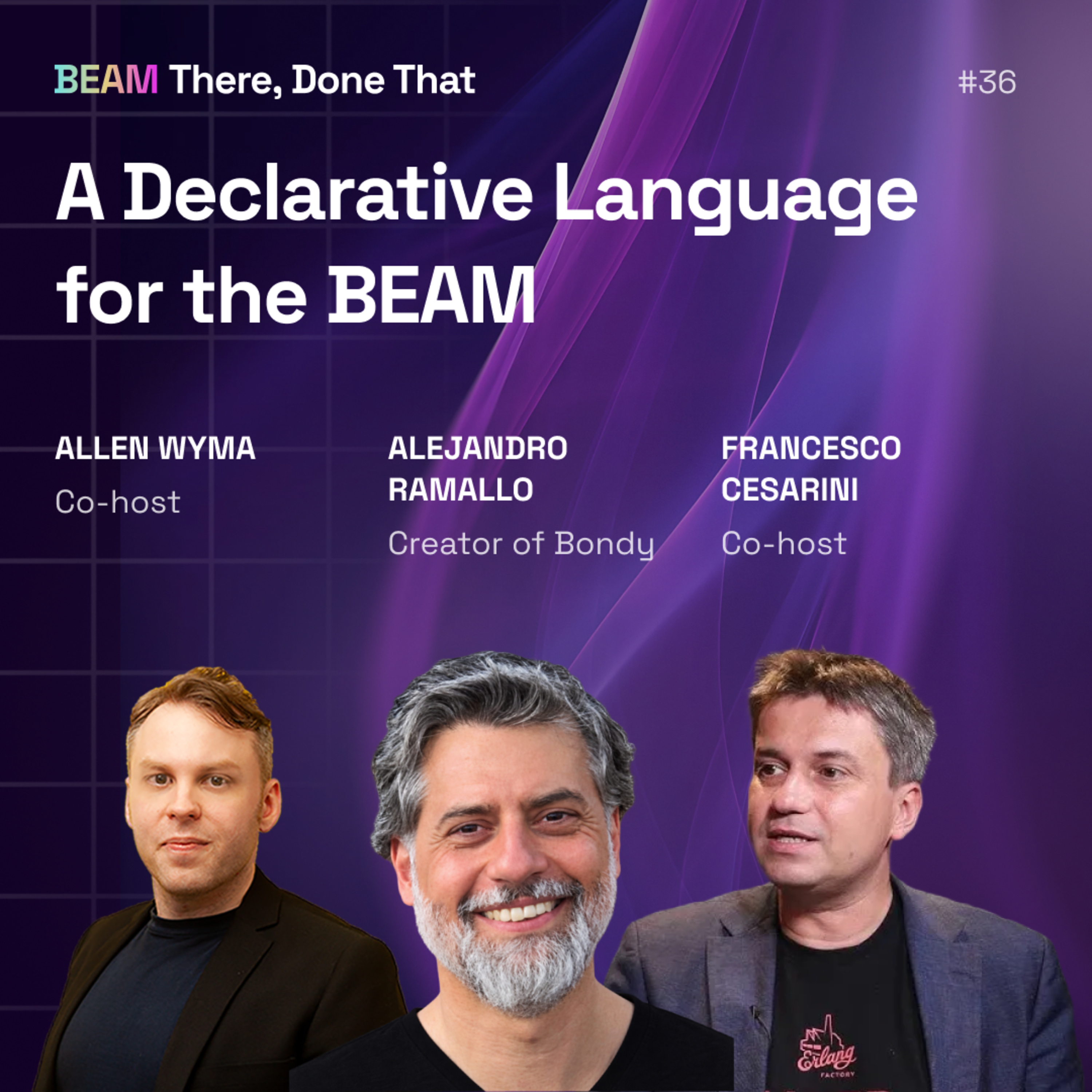 A Declarative Language for the BEAM: Alejandro Ramallo on Bondy 06.11.2026 1hAlejandro Ramallo spent months losing sleep over NIF memory leaks that only appeared under high load and were almost impossible to reproduce. The fix in the latest Bondy Connect release: remove every NIF, go pure Erlang, and replace the storage layer with an operation-based CRDT database running causal+ consistency.A decade of running that distributed router in production, and maintaining Partisan underneath it, is the background to Bondy, the declarative language Alejandro introduced at Code BEAM a week before this recording. It targets a specific pain: business rules spread across gen_statem...
-
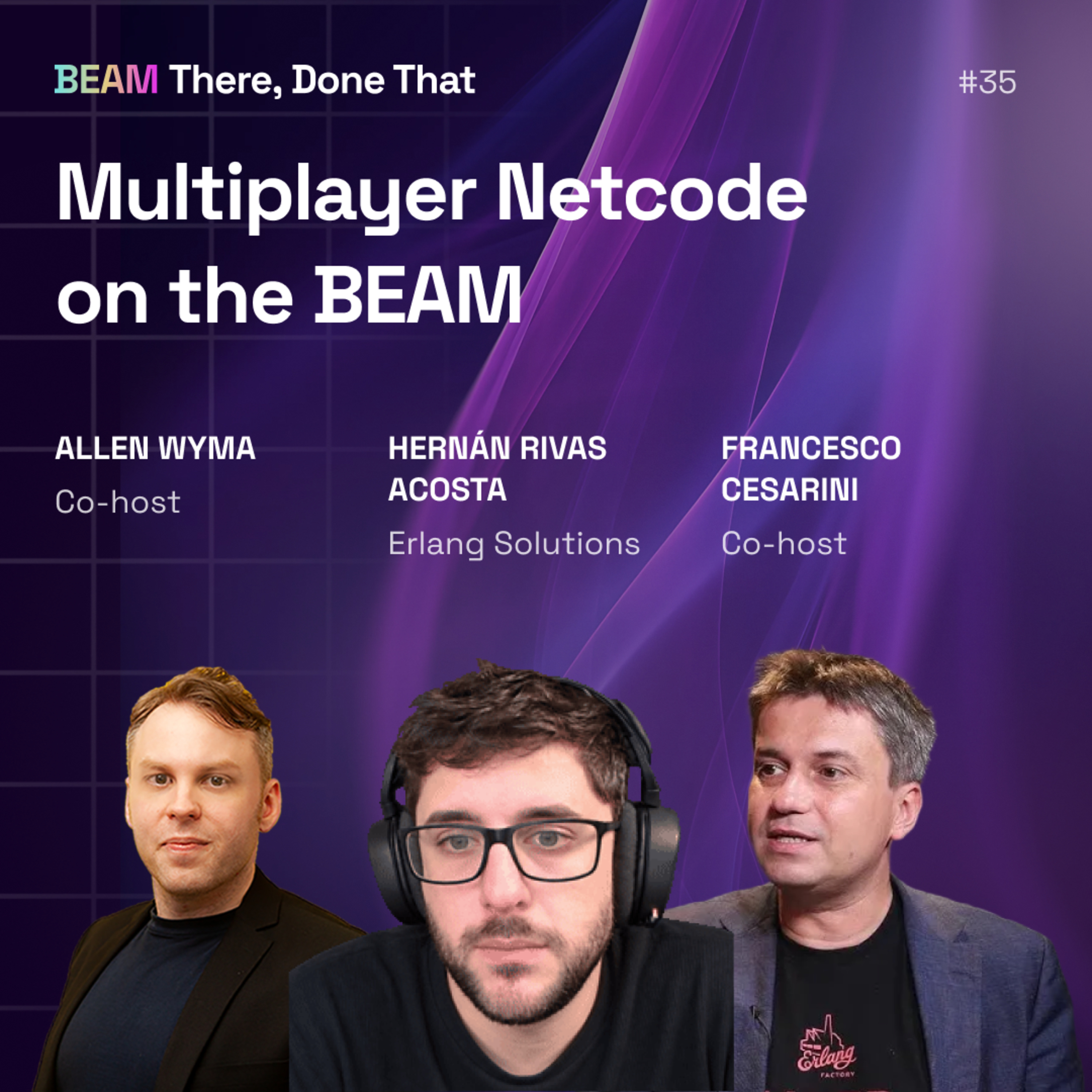 Multiplayer games with Netcode on the BEAM 30.10.2026 1h 13mHernán Rivas Acosta's first Erlang game server, a football game for Cartoon Network, reached 50,000 concurrent players on one machine. The BEAM didn't stop it there. The OS file descriptor limit did, and the team chose not to raise it. The Java option they had considered would have managed a few thousand.Roughly fifteen years later, Hernán, now an architect at Erlang Solutions, has put the game loop itself on the BEAM. Spawndemonium, shown at Code BEAM Europe in Haarlem, is a top-down shooter whose simulation is written once in Rust, compiled to WebAssembly, and run both in the browser and ins...
-
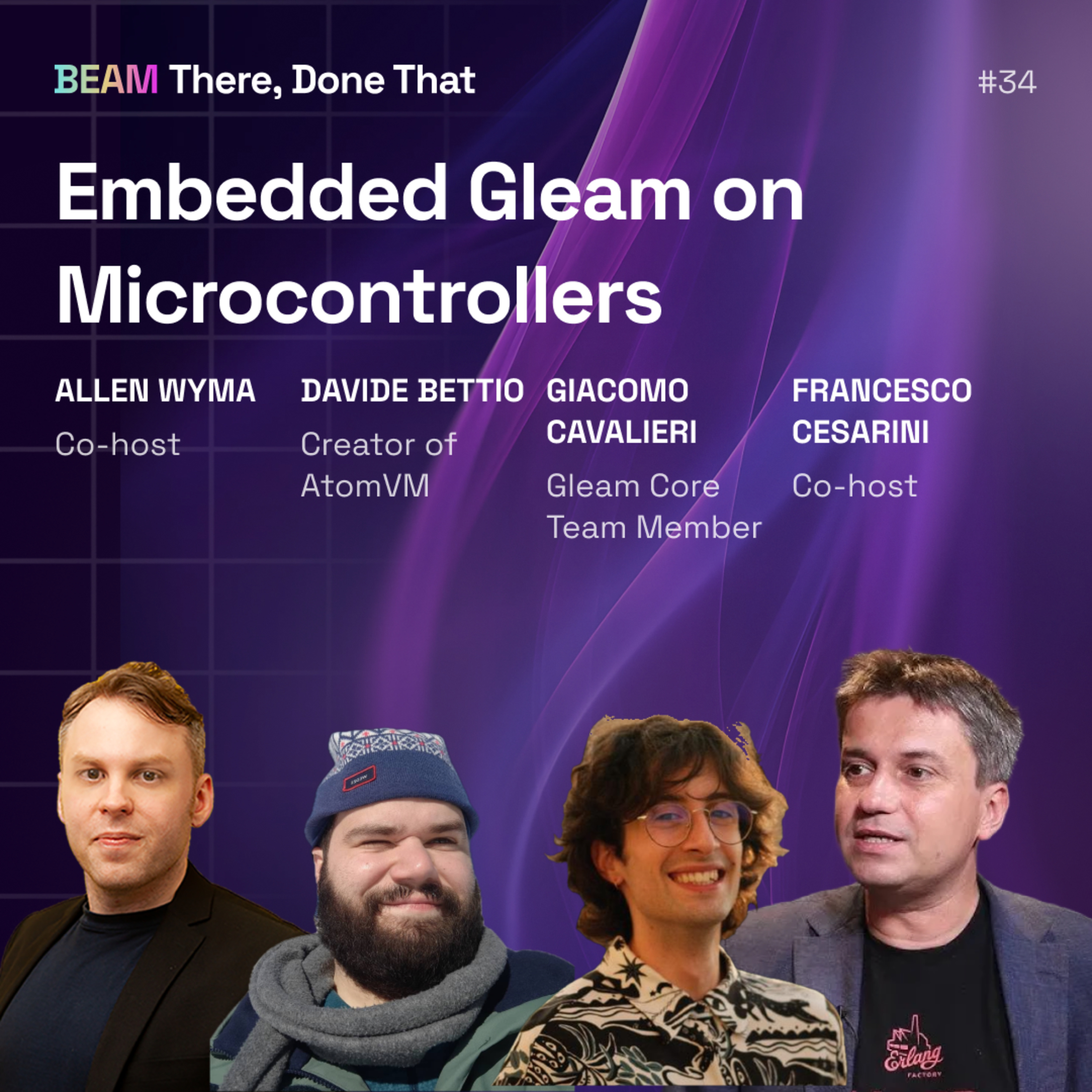 Embedded Gleam for Everyone: D. Bettio & G. Cavalieri on Microcontrollers 23.10.2026 56mIn 2017, Davide Bettio created AtomVM to run Erlang, Elixir and Gleam code on embedded devices with just a few kilobytes of memory. Fast forward to today, and Giacomo Cavalieri of the Gleam core team has built tooling that flashes a Gleam project onto a board with a single command.Two dollars, some sensors, and a weekend is all it takes to get started with embedded Erlang development. No more dealing with low-level C, complex drivers, or painful debugging. Gleam's delightful developer experience combined with AtomVM's BEAM bytecode support brings approachable IoT to the masses.In this episode,...
-
 Data Sovereignty & Local-First AI: Building Eldrim with Erik Stenman 16.10.2026 41mOn Christmas Eve, the BEAM's scheduler throttled down to save power. A batch job arrived. A Christmas worth of XML took down all three failover nodes. The Klarna CEO called. Erik Stenman was already at his desk.That incident sent him deep into the BEAM runtime — and eventually led to the BEAM Book. Now he's applying the same habit of asking where resources really go to a different question: where does AI compute actually run, and who controls it?Erik Stenman (known as Happi) has been with Erlang since 1994. He wrote the BEAM Book, built Klarna's payment core, and is now building Eldrim — a sov...
-
 Ingela Andin on the TLS Stack Running Under Every BEAM App 09.10.2026 38mEvery secure connection made from an Erlang, Elixir, or Gleam application runs through code she wrote. Most developers have never heard her name.Ingela Andin has spent more than two decades on the OTP team at Ericsson, maintaining the TLS stack — the piece of infrastructure underneath HTTPS, LDAP, SMTP, and every other secure protocol in the BEAM ecosystem. She is the first point of contact when an AI-generated vulnerability report lands in the OTP inbox. And this year, that inbox changed entirely.At the start of 2026, maintainers were still laughing at AI bug reports. Daniel Stenberg, creator...
-
 Alex Koutmos on Elixir for Finance, Trading & Blockchain 02.10.2026 1h 2mBrex runs on Elixir. Klarna runs on Erlang. Mastercard is believed to use it. And most of the community that builds on these systems watches them with PromEx - a library written by today's guest.Alex Koutmos has been in the Elixir ecosystem for over a decade. He wrote PromEx - the Prometheus metrics library most of this audience runs in production - and he's just written Elixir for Finance with his brother Dimitrios, a tenured finance professor at Texas A&M. The book takes Livebook, Explorer, NX, and Scholar and points them straight at markets, trading strategies, and blockchain infrastructure...
-
 Kip Cole on Time, Localization and Building Agenda 25.09.2026 1h 9mThe Navajo Nation inside Arizona observes daylight saving. The Hopi reservation inside the Navajo Nation skips it again. There's a corner of the Yucatan Peninsula that takes 20 minutes to drive through and costs you an hour on your sat nav. No compiler warns you about any of this.Kip Cole has spent 10 years building the Elixir libraries that handle what software gets wrong about human reality: localization, time, and scheduling. CLDR/ex_cldr gave the ecosystem 173,000 Unicode characters and locale-aware formatting for numbers, dates, currencies, and units. Tempo remodelled time as an interval...
-
 Is Your Elixir Code Actually Fast? Tobias Pfeiffer on Benchmarking 18.09.2026 1h 11mEveryone has an opinion about whether the BEAM is fast or slow. Almost nobody has actually measured it properly.Tobias Pfeiffer -PragTob on the internet, benchmarking nerd, real-time engineer at Supabase -came to Elixir from Ruby because Ruby couldn't handle WebSockets at scale. Then he learned the language the way he learns every language: by building a benchmarking library. Ten years later, Benchee is what most of the Erlang and Elixir world reaches for when it wants a number instead of an argument.Topics include:why Tobias writes a benchmarking library every time he learns a new language -a...
-
 Louis Pilfold on Building Gleam - Static Types on the BEAM 11.09.2026 1h 11mWhat if the BEAM had a language that felt like talking to a friend instead of fighting a compiler?That's the problem Louis Pilfold set out to solve. He loved the BEAM. He missed static types. Every other option was a tradeoff he couldn't live with. So he built Gleam - and after years of quietly saying no to everything he wasn't sure about, it's gathered a community, found production users, and now runs on servers, browsers, and $2 microcontrollers.Topics include:why every successful language is born from a problem - and what specific frustration made Louis start building rather than just compl...
-
 How WhatsApp Fixed Erlang's Tooling Problem | Roberto Aloi & Michał Muskała 04.09.2026 36mPart one established that Erlang scales. Part two is about what comes after - keeping a codebase that large healthy for years, when most engineers arrive having never written Erlang before.WhatsApp's answer was to invest in the language itself. The formatter, the language server, the type checker. And then to open source almost all of it back to the community - not as charity, but because diverse use cases and external bug reports make the tools better.Roberto Aloi and Michał Muskała are back for the half that doesn't appear on conference posters.Topics include:why the investment in tooling ca...
-
 Inside WhatsApp with Roberto Aloi & Michał Muskała 28.08.2026 34mEveryone quotes WhatsApp when the topic of Erlang and scale comes up. Fewer people know what it actually looks like from the inside - what was hard, what was never hard, and what the team spent their time on once the concurrency stopped being the problem.Roberto Aloi and Michał Muskała work on the team keeping it running. This is the first of two episodes with them.Topics include:what Roberto's first Erlang moment was - implementing a GenServer for a robot at university and learning binary pattern matching felt like cheatingwhy Michał came to Erlang backwards, from Elixir, and what the tooling...
-
 Erlang on a Microcontroller: Davide Bettio & Paul Guyot on AtomVM 21.08.2026 54mIn 1952, Marvin Minsky and Claude Shannon built a box with a single switch. When you flip it, the only thing it does is reach out and switch itself back off. Seventy years later, 5,000 of those boxes are sitting on desks worldwide — and the thing making them tick is Erlang, running on a chip smaller than a fingernail.Davide Bettio built AtomVM, the virtual machine that makes this possible. Paul Guyot wrote the Erlang firmware, added SMP support as a weekend project, and shipped 5,000 units.Topics include:what AtomVM is — a from-scratch BEAM-compatible VM for microcontrollers with a few hundred...
-
 Mat Trudel on Building Bandit - the Web Server Running Your Phoenix App 14.08.2026 1h 19mBandit quietly became the default web server in Phoenix. Mat Trudel wrote it by hand, in pure Elixir, as a side project - and kept it that way even as AI changed how everyone else writes code.This episode goes two places at once: the engineering of a foundational piece of infrastructure most developers never think about, and an honest conversation about what it means to keep building something by hand when you don't have to.Topics include:how a six-month debugging session - Wireshark, a 30-page RFC, and a single misread line in the HPACK spec - explains why HTTP is genuinely hard to get rightw...
-
 Erlang Without an OS: Maxim Kharchenko on Building LING 07.08.2026 1h 3mBooting OTP without a Linux kernel underneath it. Running Erlang directly on a Xen hypervisor. Implementing a VM where every single out-of-memory condition is explicitly handled — not a single allocation without a recovery path.Maxim Kharchenko spent five to eight years building Ling, a from-scratch Erlang runtime that runs without an operating system. Not a fork of the BEAM. Not a modification. A clean implementation, built to answer one question: can you run a system that never stops?Francesco Cesarini joins Alan Wyma for this episode — he was there when it was built, running the Erlang Solu...
-
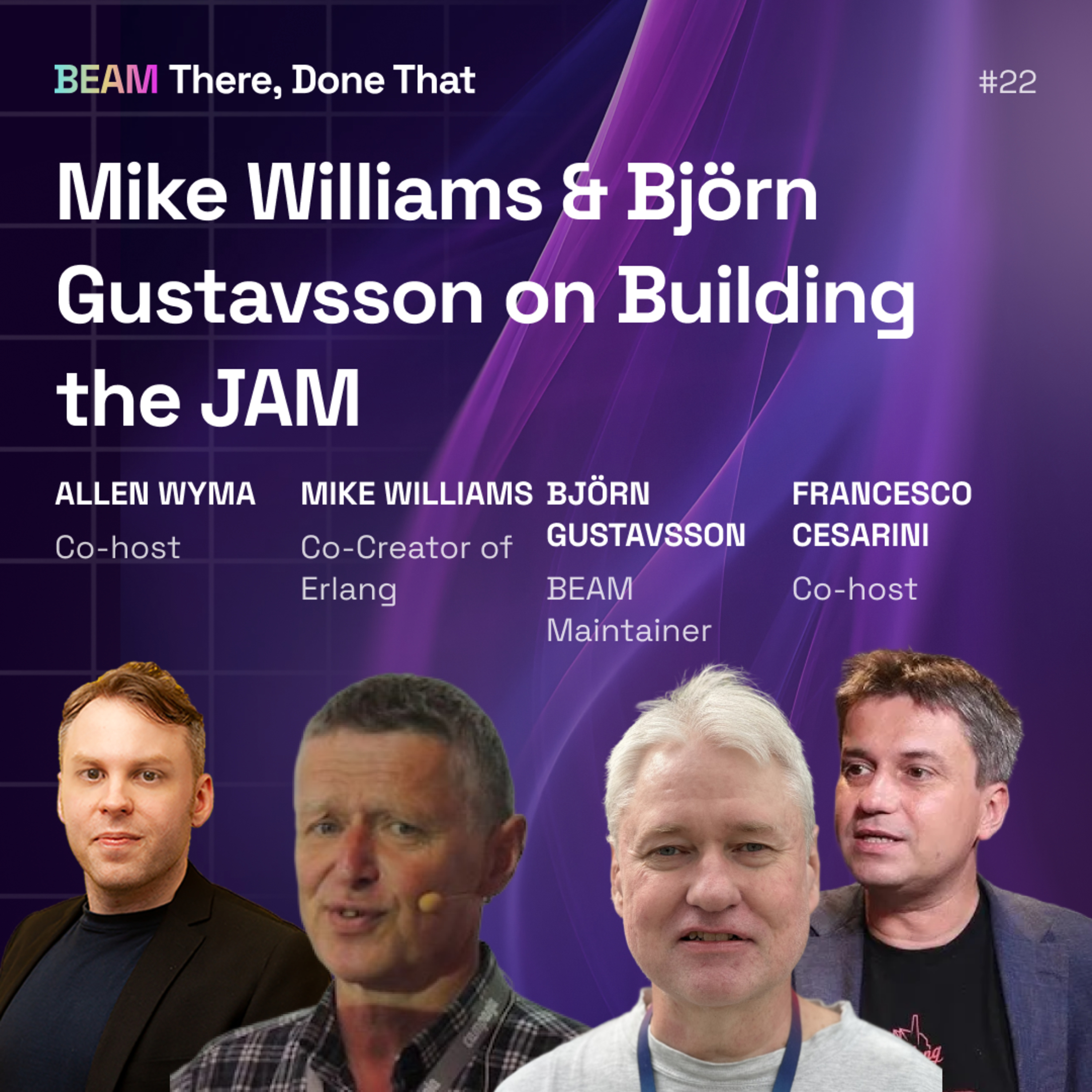 Mike Williams & Björn Gustavsson on Building the JAM 31.07.2026 42mBefore the BEAM, there was the JAM - Joe's Abstract Machine. It was the first virtual machine that made Erlang fast enough to run in production, and it was built by a handful of people at Ericsson's computer science lab who had a mandate to do whatever they wanted.Mike Williams wrote large parts of the emulator. Björn Gustavsson inherited it in 1996 and built what came after. In this episode - the most historically significant we've recorded - Alan Wyma and Francesco Cesarini bring them both together to tell the story of where the BEAM actually came from.Topics include:why Mike looked at Joe A...
-
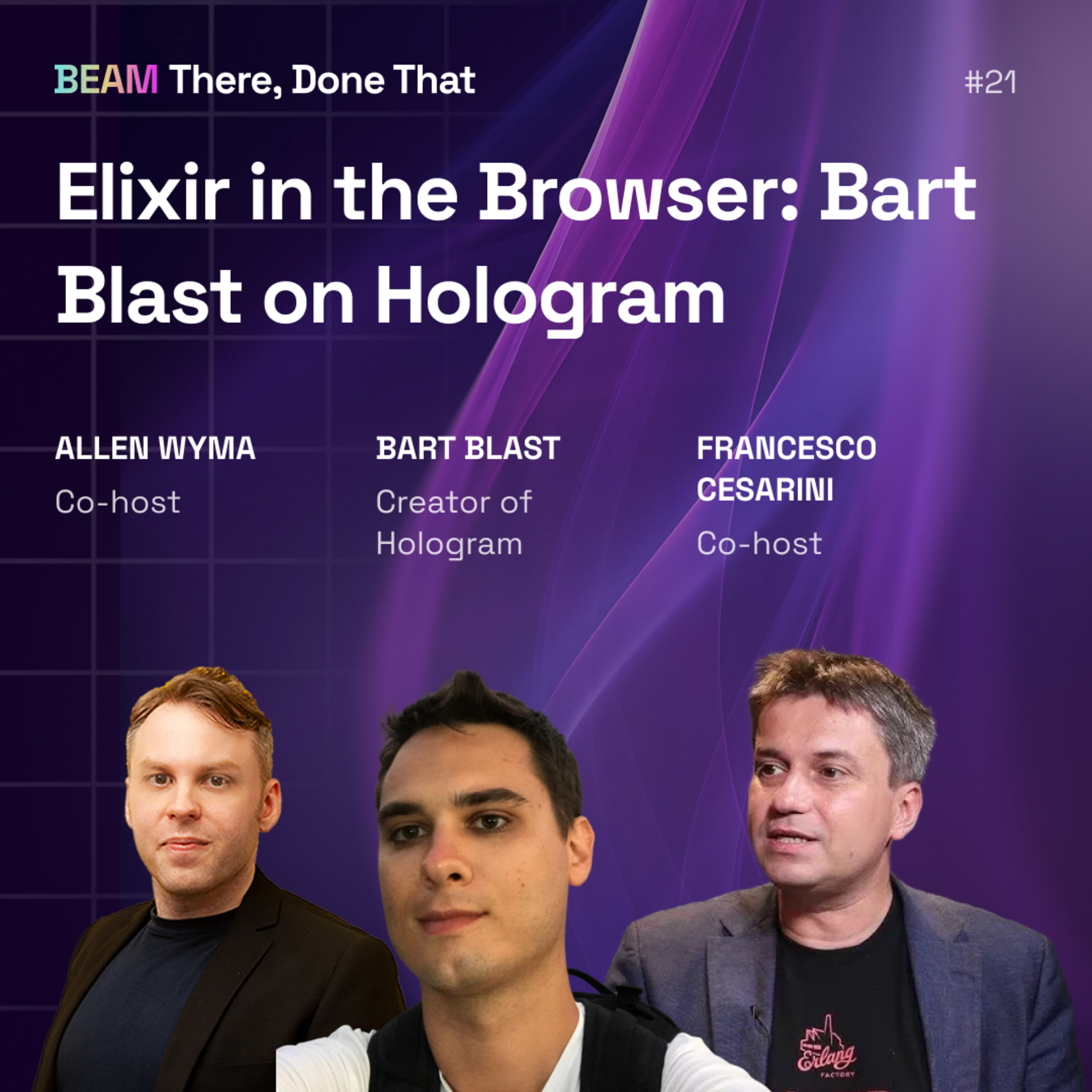 Elixir in the Browser: Bart Blast on Hologram 24.07.2026 45mWhat if instead of making your server smarter to handle the browser, you just ran your Elixir in the browser instead?That's the bet Bart Blast has been making for six years - three of them full time. Hologram is a full-stack web framework that compiles Elixir to JavaScript and rebuilds the Erlang runtime in the browser: pattern matching engine, OTP guarantees, boxed types, all of it. No JavaScript to write. No round trip on every interaction. No inconsistent state between client and server.This is the fourth episode in the podcast's ongoing series on where state should live - following Chris M...
-
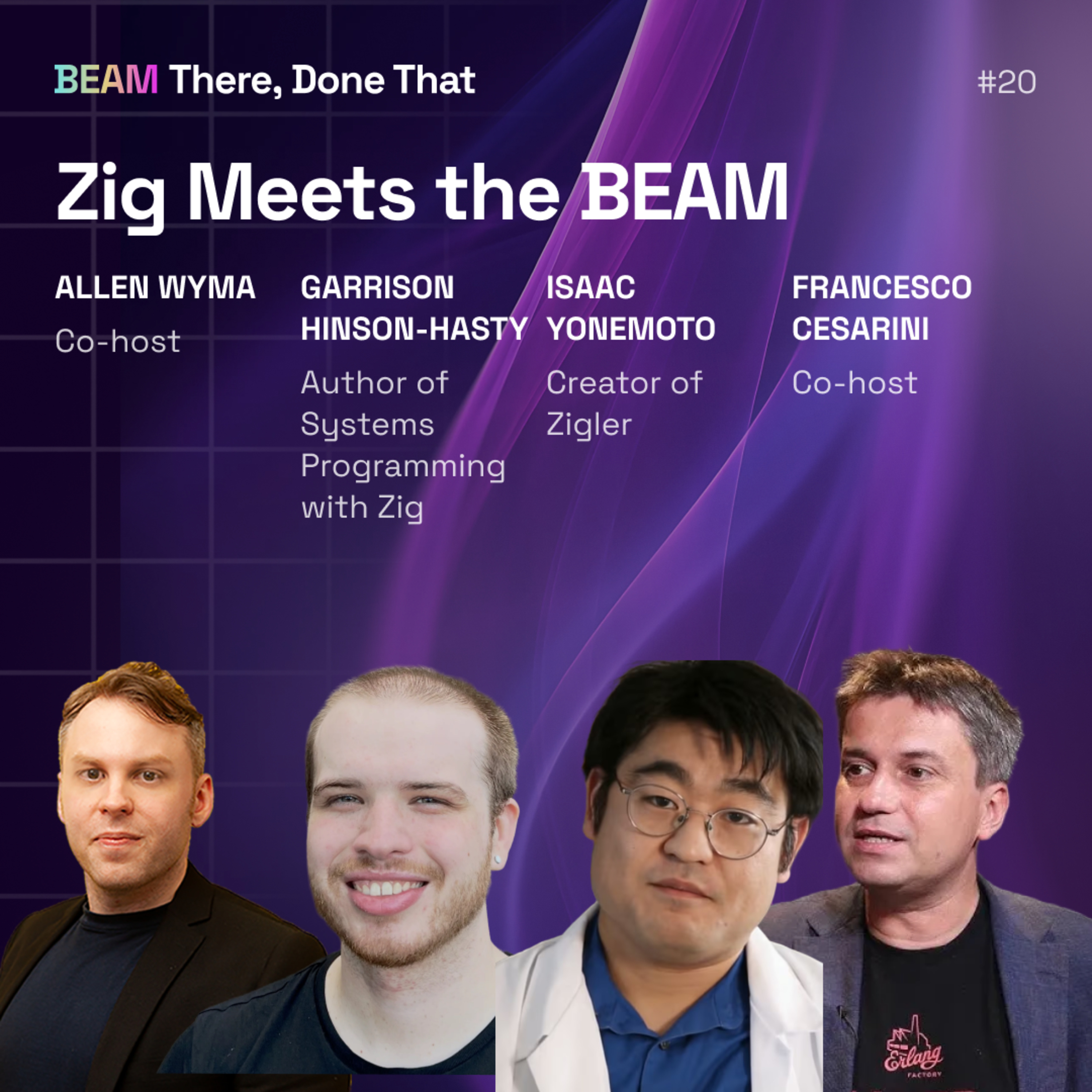 Zig Meets the BEAM: Garrison Hinson-Hasty & Isaac Yonemoto on Safer Native Code 17.07.2026 1h 2mEveryone who's ever written a C NIF for the BEAM knows the story. You have a bottleneck, you reach for native code, it works - until one day it doesn't, and instead of a process crashing, the whole node goes down. A segfault in a NIF takes the entire BEAM with it, bypassing every fault-tolerance guarantee OTP was designed to provide.This episode asks a simple question: do we have to accept that? The answer, increasingly, is no.Allen Wyma and Francesco Cesarini sit down with Garrison Hinson-Hasty, author of Systems Programming with Zig, and Isaac Yonemoto, creator of Zigler - the library that l...
-
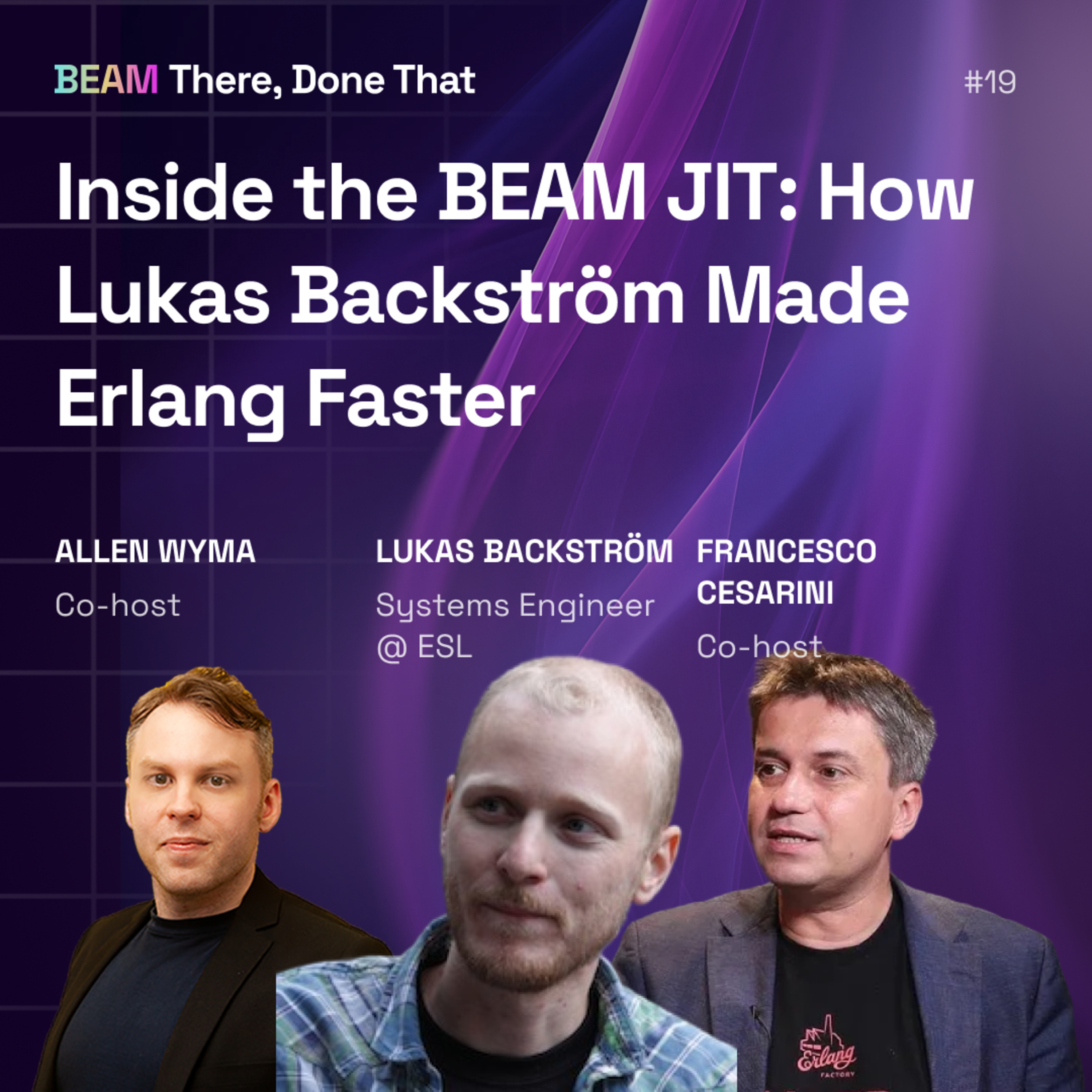 Inside the BEAM JIT: How Lukas Backström Made Erlang Faster 10.07.2026 1h 1mIn 2021, Erlang got something it had been promised for years: a Just-In-Time compiler. The person who built the first working prototype, spent years on failed experiments before it, and quietly shipped it to every Erlang and Elixir system on the planet is Lukas Backström — OTP team member since 2009, Francesco Cesarini's former student, and one of the most consequential engineers in the ecosystem that most people have never heard of.In this episode, Alan Wyma and Francesco Cesarini sit down with Lucas for a deep dive into how the BEAM JIT actually works, what it took to get there, and where it...
Similar podcasts


Popular in
The podcast also appears in the podcast charts of these countries.

