
The Colonial Department
Lio Mangubat
0
A narrative nonfiction podcast that unearths forgotten stories from Philippine history. Written, produced, and engineered by Lio Mangubat, the show presents compelling historical narratives in an audio format. A book version of the project has been published by Faction Press. Each episode delves into lesser-known events and figures, bringing lost chapters of the country's past to light.
Episodes
-
 PREVIEW Kakapon: Bolomen and Beheadings in Wartime Northern Luzon 14.11.2026 2mThis is a preview of a bonus episode that's exclusive to Patreon Scholars. Become a Scholar-tier member on Patreon to listen to the full episode. When the Japanese invaded the Philippines, the worlds of the indigenous peoples of northern Luzon were upended in the wake of the occupation. The violence that had begun in Manchuria, Poland, and Pearl Harbor crept up the slopes of the Cordilleras and the Sierra Madre, rekindling old feuds and igniting new ones. High up in the mountains, the old ways returned… and the blades that had been kept sharp for so long were turned against the necks of the in...
-
 INTERVIEW: History and psychology as kapwa (feat. Sikodiwa) 30.10.2026 52mSince 2022, scholar and teacher Carl Lorenz Cervantes has been sharing his thoughts on psychology, folk wisdom, and spirituality through a series of social posts, podcasts, online essays, and even zines. Collectively, he calls this ongoing project “Sikodiwa”, which combines the words for psychology—sikolohiya—and the word for spirit or essence—diwa. His work often frames the concepts of sikolohiyang Pilipino through a very spiritual, very approachable, and very uplifting lens. In 2025, the book version of Sikodiwa was published under North Atlantic Books, based out of Berkley, California. The...
-
 S8E13 The Philippines-India Express 17.10.2026 18mThe threads that connect the Indian subcontinent to the Philippine archipelago stretch back centuries. Some have been lost to time, survived only by goldwork and the testimonies of Spanish missions. Some survive as actual threads—as textiles that captured the fancy of Philippine residents. Some are remembered as painful history; an invasion engineered by empires, followed by a brutal and fruitless occupation. And some survive to the present day—in the words formed from our throats, and perhaps even the food that passes through our mouths.My book Silk, Silver, Spices, Slaves is now available on...
-
 S8E12 Borderline Bureaucrats: An Early History of La Union 03.10.2026 17mAs La Union historian Adriel Obar Meimban writes, La Union fits neatly into its geography: bound by rivers on the north and south, by the Cordillera mountain range on the east, and then, on its west side, the pounding surf that has made San Juan one of the country’s most popular tourist spots. But even in its earliest days, the borders of La Union were drawn and redrawn in bureaucratic squabbles. The newly minted province and its neighbors could not decide where one ends and another begins—and caught in the middle of these disputes were ordinary townsfolk whose lives and rhythms would not be d...
-
 INTERVIEW: Mapping a life on time—the making of a historian 25.09.2026 59mIn 2018, I first encountered The Sulu Zone and Iranun & Balangingi—two important books by James Francis Warren that opened my eyes to the rich, roiling history of the seafaring cultures of the Sulu Sea. His groundbreaking work laid out a way of looking at the past that was neither stoic nor static—a historiography that truly widened horizons.At the launch of his newest book, Valentina Mendoza and the Great Ilocos Flood of 1867, I spoke with Dr. Warren about his long and fruitful career as a scholar. In the thoughtful, hour-long conversation that followed, he dissected for me how the events of...
-
 S8E11: We're Off to the 1924 Paris Olympics! 11.09.2026 16mMore than a century ago, the Philippine flag was unfurled for the first time on the biggest sports stage in the world. It was—and is—a matter of great pride to our nation. But it was also an event that was bizarrely marked with mystery and controversy. From disappearing athletes to extra flags, let’s head to Paris in 1924, as we join two sports legends in their journey to the Olympics!The thumbnail image is from the book The First Filipino Olympians, written by Isidra Reyes, Gerard Lico, and Lorenzo Manguiat. Additional audio in this episode is from the Olympics YouTube page.My book Silk, Silv...
-
 S8E10 In Paracale, the Faintest Gleam of Gold 27.08.2026 17mAccording to historian Linda Newson, Bicol did not bow down easily to the Spanish occupation. For their resistance, they paid a dear price. Population showed Camarines lost almost half of its population from 1591 to 1649. With no major plagues or Moro raids recorded, Newson could only conclude that it must have been because of brutal conflict with the Spaniards. Either the Bicolanos were killed, or they fled so far inland that they escaped the census takers. One of the things the Spaniards were looking for in Camarines were the gold mines of Paracale. By the time of the occupation, this town w...
-
 S8E9 White-Hot Heat: Climate and Culture in the Late 1800s 08.08.2026 17mWriting in June 1889, the Manila-based correspondent for La Solidaridad listed down the calamities afflicting the archipelago: cholera, fires, earthquakes, and economic ruin. In those days, even the sky seemed to be on fire. Our reporter told his ilustrado readers in faraway Europe that standing in the shade in Manila would give you no comfort, because the temperature was 39 degrees. 39 degrees! How did the way we talk about and think about heat change our culture and our history? For the 100th episode of The Colonial Dept., join us in a journey that takes us from a Roman poem to a Rizal essay...
-
 INTERVIEW: What was it like to commute in Manila 100 years ago? 01.08.2026 44mJust the thought of commuting around Manila is enough to set one’s teeth on edge. But do our current-day problems of congestion and overcrowding have their roots in decisions and policies made a century ago?There’s no one better to answer this question than our podcast guest today. For more than ten years, Michael Pante, Ph.D., an associate professor at the Ateneo de Manila University, has been researching the history of transportation, mobility, and urbanization in the capital city. He even has a forthcoming book on the topic entitled The Immobile Metropolis: A History of Motorized Transporta...
-
 S8E8 Pacific Sick Ships: Medicine Aboard the Galleons 18.07.2026 18mIn the long journeys from Manila to Acapulco, disease was the clingy passenger no one wanted around. But it wandered around the decks, knocked on every cabin, stalked everyone on board—until one day, you woke up, and disease was just everywhere. How could it not be? There was food rotting inside the barrels, slick and moldy woodwork, crew and passengers and officers packed into tight spaces, pests crawling over the meals, the overpowering smell of human waste. And so they came, that grim parade: fever, chills, dysentery, infection, dermatitis, beriberi, the dread scurvy. How did the ships of t...
-
 S8E7 The Fractured Plateau: Bukidnon in World War II 04.07.2026 18mThe word Bukidnon means “people of the mountains”, but historian Ronald K. Edgerton also gives another name for them: the people of the middle ground. As he writes in his book of the same name, “Many Bukidnons mastered the art of borrowing from the new without losing touch with the old. [...] And over time they developed a capacity to envision themselves [...] as negotiators between worlds, skilled at including both in a new, more accommodating world view.”This middle ground was pushed to the limit during World War II, when Japanese troops invaded the fastness of the mountains and Philippine s...
-
 INTERVIEW: Making a Magellan Comedy Manga 27.06.2026 40mIn the offbeat manga Ferdie!, Ferdinand Magellan and Antonio Pigafetta are caught up in a storm right before they arrive in the Philippines…and find themselves transported five hundred years into the future into a place that’s beyond anything they could have imagined. So what is an explorer and colonizer to do in 2020s Philippines? Why, become a content creator, of course!In this Interview episode, I talk to Ferdie! creators Julius Tabios and Jeri Llorca about their comic book. Where did this crazy idea come from? How did their understanding of the historical Magellan craft their own funny and...
-
 S8E6: After the Black Ships Departed 13.06.2026 17mThe island of Balangingi stands halfway between Borneo and Mindanao. Surrounding Balangingi were sharp reefs and surging cross-currents that would be lethal to any boatman… except for the Balangingi Samal, of course. Surrounding the main landmass were little islets that would wink in and out with the tides. On the coast were thick snarls of mangrove; in the parched interior were swaying groves of coconut. During the Spanish occupation, the Balangingi Samal—also known as the Banguingui Sama or the Sama Balangingi—visited the Philippines twice a year, raiding coastal villages across the Philippi...
-
 S8E5: Rajio Taisō; Or, How to Get Fit in a Time of War 29.05.2026 15mAt seven o’clock on the dot, a high-pitched Japanese voice blared out from speakers and switched-on radios all across the archipelago. The program came on like clockwork, chirping in immediately after every station signed on for the day—a cheery signal of a brand-new day under Imperial rule. In wartime Philippines, Rajio Taisō was everywhere—schools, private companies, government offices, military camps. If you browse through pictures from World War II, you can see many pictures of dozens or even hundreds of citizens stretching and twisting in unison. But how was this radio regimen baked into...
-
 INTERVIEW: Restoring historical markers with Project Panandito 23.05.2026 50mYou pass by them every day: plaques of metal set onto walls and plinths, heavy with text and history. You may have wondered—how do you maintain these historical markers?A group of students in the University of the Philippines Diliman wondered the same thing. So, for their required NSTP initiative, they formed Project Panandito, a student-led project that, during the sweltering summer months of 2026, went around historical sites in Manila to clean and restore some of these markers. In this interview, I talk to them about the nuts and bolts of cleaning a plaque, what to expect in Manila when you...
-
 S8E4: Edison’s Cameras, Manila’s Trenches 09.05.2026 15mYes, Edison as in Thomas Edison, the light bulb guy. At the turn of his century, the tech wizard of Menlo Park produced thousands of movies as a showcase for his company’s vitascopes. Among those movies are five films about the Philippine-American War, produced in a flurry all throughout June of 1899. It turns out that the boom of cinema dovetailed neatly with America’s growing imperial ambitions. But what made this faraway war so compelling for wide-eyed audiences captured by the magic of the silver screen?Support us on Patreon: patreon.com/thecolonialdeptFollow us on IG: @thecolonialdeptFoll...
-
 S8E3: Nobody Expects the Philippine Inquisition! 25.04.2026 17mWhen you pulled up to the dock, they were there waiting for you, those holy men of God.But beyond inspecting ships that docked in the ports of Manila and Cavite for blasphemers and banned items, the Inquisition in the Philippines also investigated Protestants. Jews. Masons. Muslims. Non-Catholic Christian sects, like Armenian Christians or Jansenists. Its investigators monitored cases of heresy, blasphemy, apostasy, bigamy, and contempt. They kept tabs on witches, sorcerers, palm readers, fortune tellers, astrologers, and peddlers of superstition. And they dutifully recorded all their investig...
-
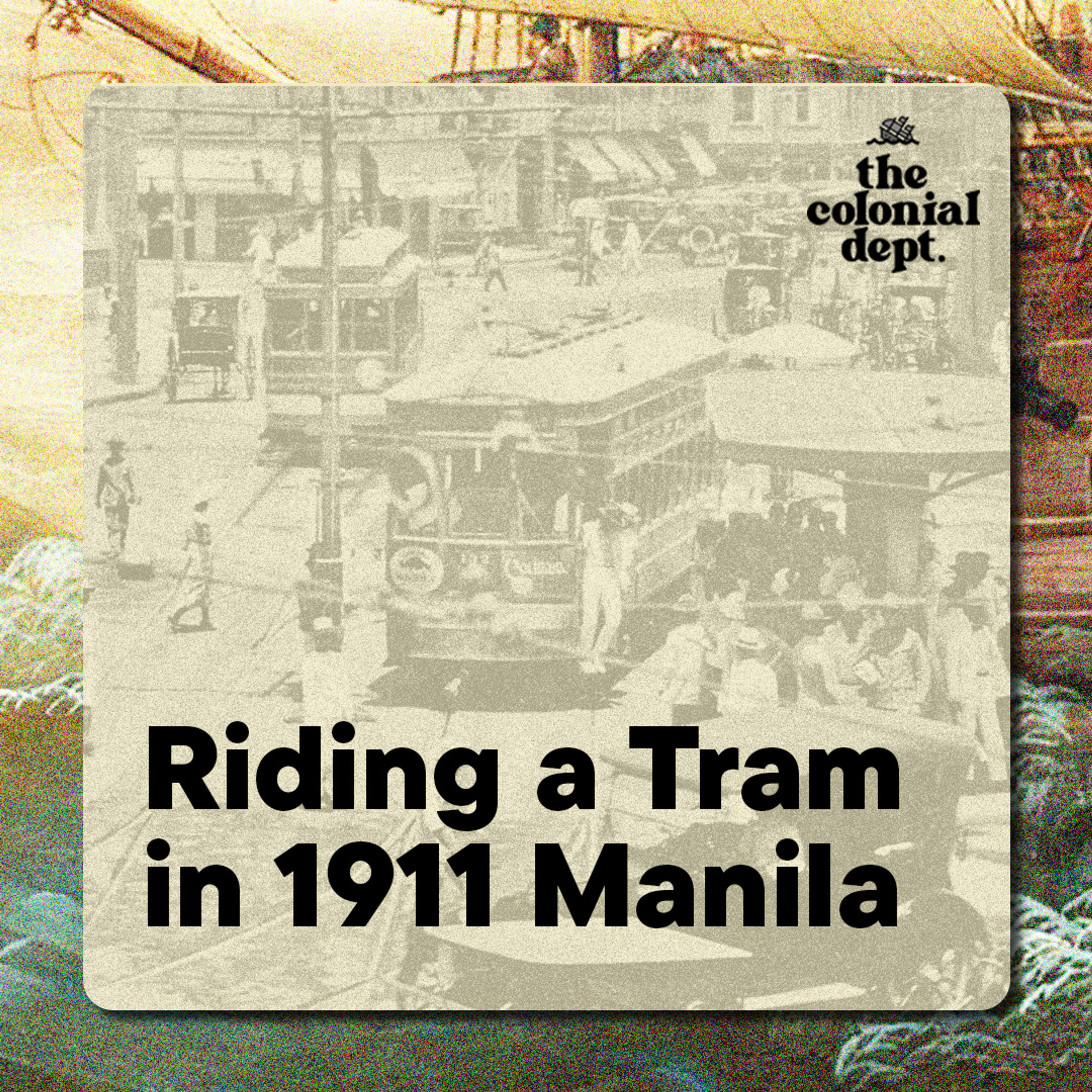 S8E2: Riding a Tram in 1911 Manila 10.04.2026 17mWhat kind of city was waiting for Dutch scholar Gerret Pieter Rouffaer when he got to Manila?After more than a decade of occupation, the Americans had given the colonial capital some thorough nips and tucks. Aside from the glimmering roads and shady plazas, the Americans also laid down more tramways. Trams were already up and running during the latter part of the Spanish occupation, but in 1905, the US rehabilitated the old system. Unlike the old Spanish versions, these new streetcars barrelled along on double-wheeled trucks and could fit fifty people. They also ran on electricity. When Rouffa...
-
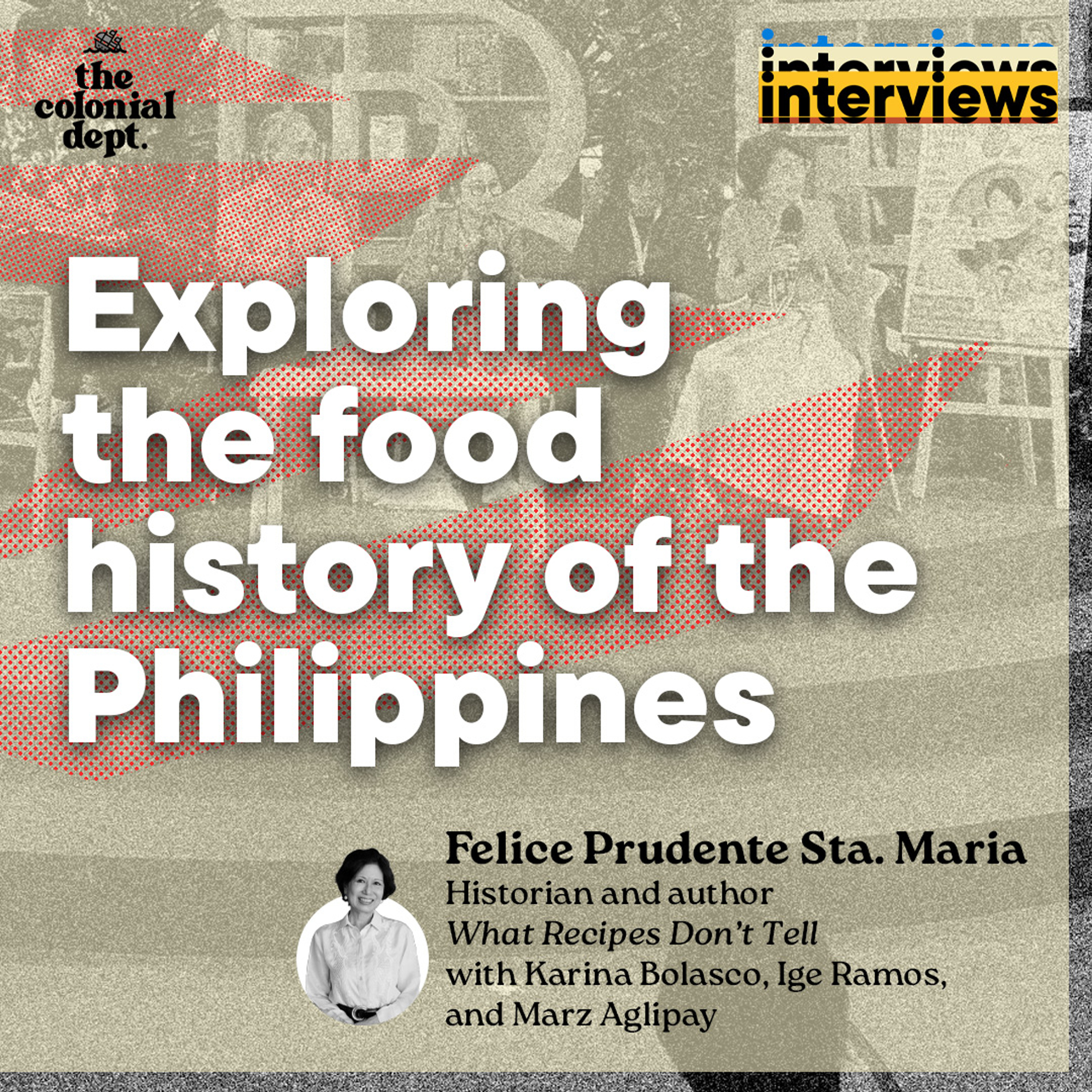 INTERVIEW: Exploring the food history of the Philippines 04.04.2026 37m“There’s a message to it: It’s our responsibility to keep Filipino food popular!”At the launch for her book What Recipes Don’t Tell: Philippine Food History in Fifty Words, author and historian Felice Prudente Sta. Maria talked to a rapt audience at the Philippine Book Festival about a long career of writing about food. What new things can food tell us about our own history? How did we adapt techniques and ingredients from abroad… while still preserving our own? And how should we nurture this knowledge for future generations?Joining her in this panel were publisher and editor Karina Bolasco, g...
-
 S8E1: The Philippine Sour-chipelago 21.03.2026 17mSourness, according to Doreen Fernandez, “is a favored Philippine flavor.” Just how sour is sour? “Sour enough to savor, to make the lips pucker and the eyes squint slightly, and yet not too sour—just at the point of perfection.”In the spectrum of sensation, sourness can be both sharp and sudden, an acetic shudder down the spine. Asim, the Tagalogs call it. From the earliest written records about the Philippines, it is this taste that has come to define our cooking. “Spanish colonials from the 1500s through the 1800s described indio food as primarily salty and sour,” writes food historian Feli...
Similar podcasts


Popular in
The podcast also appears in the podcast charts of these countries.
