
Stephan Livera Podcast
Stephan Livera
0
Join Stephan as he interviews the sharpest economic and technical minds in Bitcoin and Austrian Economics to help you understand how money is changing and evolving. Leading names in the world of Bitcoin join the show to share their insights, whether they are developers, CEOs, economists, authors, analysts, and more.
Episodes
-
 Paolo Ardoino: Stop Tokenizing Apple Shares | SLP786 03.11.2026 39mTokenizing Apple shares is not innovation. Paolo Ardoino of Bitfinex argues the Bitcoin way to securities is opening capital markets for companies that cannot raise like a Manhattan issuer — not wrapping megacap stocks everyone can already trade at a bank.We also cover exchange OPSEC after a large hack, why Lightning wins on physics for agentic payments, zero trading fees, the Liquid incident, and RGB as a transport layer.00:00 — Intro00:34 — Reaction to the Binance Hack02:10 — Do Hacks Scare People Off Bitcoin?02:27 — Custody and Self-Custody Both Look Fragile05:11 — Employee Laptops and LinkedIn Targeting07:53 — Multisig UX Still Fails Normies10:34 — Exchanges Are Not Banks11:36 — Why Shared-State Chains Cannot Scale Agents13:32 — Lightning Wins Because of Physics15:41 — Liquidity Gravity Around Big LN Nodes17:01 — Hub Risk Without Protocol Failure18:30 — Let Agents Invent Payment Protocols20:33 — Zero Fees Instead of Taxing Retail22:03 — Who Bitfinex Serves in 202623:21 — The Bitcoin Way to Securities25:44 — Microcredit, Bitcoin Treasuries, Liquid27:32 — Liquid Hack and the Near-Term AI Threat29:06 — Tokenize Farmland, Not Just Stocks32:40 — Inclusion on the Sell Side Too35:08 — RGB, Taproot Assets and Transport Layers37:32 — Fork Markets Put Money Where Mouth Is#Bitcoin #Lightning #Bitfinex #Tokenization #ExchangeSecurity #AgenticPayments #StephanLivera #StephanLiveraPodcast
-
Morgen Rochard: Holding Bitcoin Is Not a Financial Plan | SLP785 27.10.2026 39mHolding Bitcoin is not a financial plan. That is the starting point of Morgen Rochard's new book, Bitcoin Personal Finance, and of her return to the show. Bitcoin can fix the money, but it does not fix under-saving, spending habits or the money scripts people carry with them. Her book aims to help readers build a plan with Bitcoin as the core balance sheet asset rather than a token allocation.Morgen is the founder of Origin Wealth Advisers and a financial planner who works with Bitcoin-holding clients. In her words, there are plenty of personal finance books and plenty of Bitcoin books, but none that combine the two to show people what to do once they own Bitcoin.Stephan and Morgen discuss what Bitcoiners and the fiat world each get wrong, and matching assets to when the money is needed, using the example of a preschool fund put into Bitcoin near the top. They also cover how large a fiat emergency fund should be, and why forced selling tends to arrive with job losses and bear markets. She explains why most homes and renovations are consumption, why single rental properties often earn less than a REIT, and how leverage magnifies the damage when something goes wrong.They also get into debt as a campfire that can become a wildfire, and the narrow case where a Bitcoin-backed loan makes sense. Morgen explains that borrowing to fund spending has sent some of her clients back to work. The conversation closes on spending-based retirement planning, tax planning versus tax preparation, charitable giving, trusts, and why she prefers educating children over restrictive trust rules.Timestamps:00:00 — Intro 00:21 — Why She Wrote Bitcoin Personal Finance 01:11 — Holding Bitcoin Isn't a Financial Plan 02:45 — What the Fiat World Gets Wrong 04:02 — Hot Trades vs Your Actual Goals 05:40 — Chasing Returns vs a 20% Savings Rate 08:23 — Match Assets to When You Need Them 11:31 — How Big a Fiat Emergency Fund? 15:52 — Is Your Home a Store of Value? 18:02 — Rentals vs REITs vs Bitcoin 19:31 — Leverage and Single-Property Risk 24:06 — Debt Is Like a Campfire 27:16 — When Bitcoin-Backed Loans Make Sense 30:05 — Spending-Based Retirement Planning 32:12 — Tax Planning Isn't Tax Preparation 35:09 — Trusts and Trusting Your Kids 36:58 — No One-Size-Fits-All AllocationLinks:Morgen Rochard on X: https://x.com/MorgenRochardOrigin Wealth Advisers: https://www.originwa.com/Bitcoin Personal Finance (book site): https://bitcoinpersonalfinancebook.com/Bitcoin Personal Finance on Amazon: https://www.amazon.com/dp/1394394055
-
Debt, Oil, AI and Bitcoin: A Gradual Print Until It Isn't | James Lavish SLP784 26.10.2026 46mJames Lavish explains why he expects a gradual print to turn into a big one, what weak Treasury auctions signal, and what he got wrong about Bitcoin this cycle.Timestamps00:00 — Intro00:48 — Markets: Warsh, Oil and a Narrow Rally04:22 — How Much Debt Will AI Need?08:41 — Outgrowing the Debt: A Polite Fiction10:50 — Brent at $108, 10-Year at 5.13%13:44 — Weak Auctions and Who Buys Treasuries15:54 — Oil Shock: Supply, Not Demand18:03 — If CoreWeave Trips: The Downside Case19:56 — How the Fed and Treasury Would Respond24:15 — The Base Case: Growth and Nominal Inflation28:49 — Big Print or Gradual Print?32:58 — Gradual Until All Bets Are Off34:07 — Why Faith in the Dollar Breaks Slowly38:11 — What James Got Wrong This Cycle39:54 — Decentralization and Politics as Hurdles41:59 — JPMorgan's Shift and Career Risk43:45 — Why Bitcoin Over AI?
-
Plan Your Second Passport Before You Need It | Alex Recouso SLP783 21.10.2026 52mOfficial Podcast Episode: https://stephanlivera.com/783Alex Recouso argues that Bitcoin solved capital mobility but not human mobility: you can move money across borders without permission, yet you still need permission to move yourself. His answer is that everyone should think about a second passport before they need one, because, as he puts it, you can't buy insurance once the house is on fire.Alex is co-founder and CEO of CitizenX. He says he discovered the idea of alternative citizenship at 14, and that understanding Bitcoin in 2020 convinced him it was the missing piece. CitizenX sells citizenship by investment programs and, by his account, advises governments, including El Salvador, so he is not a neutral observer.He splits buyers in two: citizenship programs suit people with high liquidity and low mobility, while residency and naturalization suit people with high mobility and less capital. They cover the main tiers, from cheaper Plan B passports to Caribbean programs, Turkey, El Salvador and Argentina's newly announced program, and why he prefers donation routes to government-approved real estate.The downsides get airtime too. Alex expects EU pressure to cost Caribbean programs their visa-free access or make them unattractive. He argues European rules can change overnight, citing Italy's flat tax and Spain's closed golden visa. And naturalization through residency is cheaper but never guaranteed. They close on AI's limits as an advisor, rising versus established countries, and compounding in a low-tax place.Timestamps00:00 — Intro00:43 — Bitcoin Solved Capital, Not Human, Mobility02:04 — Selling Citizenship: Countries Competing05:14 — Buy or Earn: Liquidity vs Mobility06:57 — Why Program Prices Rise and Fall08:55 — Weak Passports vs Plan B Buyers11:32 — Donation vs Real Estate Routes13:35 — Three Tiers: Plan B, Caribbean, Outliers17:06 — Argentina's Program: Costs and Country Risk20:09 — EU Pressure and Schengen Risk23:12 — What Countries Gain or Risk25:52 — Beyond Visa-Free: Settlement Rights28:43 — HENRYs, Urgency, and Sequencing31:14 — Insurance Before the House Is on Fire33:06 — Naturalization Is Cheaper but Not Guaranteed37:00 — Changed Rules in Portugal, Italy, Spain41:07 — UAE, Singapore and Citizenship Limits42:49 — CitizenX vs Traditional Firms47:08 — Can AI Replace Citizenship Advisors?49:02 — Rising Countries: High Risk, High Reward51:34 — Lower Taxes and CompoundingLinks: https://x.com/recousohttps://x.com/CitizenXhttps://citizenx.com/Stephan Livera links:Follow me on X: @stephanliveraSubscribe to the podcastSubscribe to Substack
-
Debanking and Bitcoin Business Accounts in the EU | Prashanth Chandrashekar SLP782 19.10.2026 37mPrashanth Chandrashekar argues that much of Europe's debanking comes down to how banks score transfers. Money arriving from a crypto exchange's account is treated as a higher-risk third-party payment, while a transfer between two accounts in your own name passes with far fewer flags. Bringin's answer is a named virtual IBAN for each customer, which he says lowers the risk of being debanked rather than removing it.Prashanth, who is from India, started Bringin after moving to Estonia holding Bitcoin and finding he couldn't easily spend it. He now runs the company's consumer app and its new business accounts.They cover MiCA's licensing reset, which by his figures left only about 30% of earlier firms licensed but lets the survivors passport across the EU; accounts closed without explanation under tipping-off rules; and how named IBANs differ from the deposit IBANs exchanges hand out. On the consumer wallet, built on Spark, he is direct about the trade-offs: operators are mostly centralized and can see payments, though they cannot move funds alone.On Bringin for Business, he describes pilot users such as mining-rig sellers paying suppliers abroad, plus stablecoin support and accounting exports. The custody model differs from the consumer app: keys sit in a hosted Turnkey enclave with spending policies, Bringin holds an extra key in multi-director setups, seed export is discouraged, and ownership changes run through Bringin's backend. Third-party euro payments were promised within days of recording, and corporate cards are not yet available.Disclosure: Stephan is a small investor in and advisor to Bringin.Timestamps:00:00 — Intro00:37 — MiCA: Costly but Passportable03:28 — Debanking: Why Banks Block Exchange Flows07:04 — Named vIBANs vs Exchange Deposit IBANs11:25 — Spark Self-Custody and Its Trust Trade-offs13:03 — Why Banks Are Harder on Businesses15:22 — Who Joined the Business Pilot18:08 — Beyond Debanking: Accounting Headaches20:31 — Business Keys in Turnkey Enclaves24:53 — Key Rotation Runs Through Bringin's Backend26:24 — Roadmap: Third-Party Payments, No Cards Yet30:45 — Next Customers: Stablecoins and Agents33:31 — Regulation Outlook: DAC8 and Data Risk34:39 — AI Agents, MCP, and PaymentsLinks: https://x.com/prashanthc123https://x.com/bringinxyzhttps://bringin.app/businessStephan Livera links:Follow me on X: @stephanliveraSubscribe to the podcastSubscribe to Substack
-
Seed Phrases vs Key Sharding: Multisig's UX Trade-offs | Setzeus SLP781 08.10.2026 43mSetzeus argues that 90% of people will never properly use seed phrases and hardware wallets, and that services like Privy and Turnkey, which split a key behind an email or phone login, are a good-enough floor for self-custody. Stephan pushes back on what that gives up: verifiability, portability across devices, and a degree of vendor lock-in.Setzeus (Jesus Najera) runs SetDev, a Bitcoin L2 and metaprotocol engineering and security shop whose biggest client has been Stacks. He built BitScript and founded Cofund, a cross-chain multisig web app aimed at families, fiduciaries, and founders.The conversation opens on the recent run of hacks, including the Coldcard incident, and his view that the cryptography is not broken but AI has made attacks on everything around it cheaper. They cover Justin Drake's "bunker mode" post, why Bitcoin builders get nerd-sniped by technology over product, why multisig adoption remains small, and whether ETFs are better than nothing for people who won't self-custody.On Cofund itself, Setzeus explains spending policies built from signer sets, thresholds, and rules on Taproot script paths. He is plain about the limits: on Bitcoin only the signer set is enforced on-chain, spend caps rely on the client without covenants, rotating a signer means moving funds to a new set, and the free tier charges a 1% transaction fee.Timestamps:00:00 — Intro00:37 — From SetDev's L2 Work to Multisig03:20 — After the Coldcard Hack: Why Self-Custody?07:56 — Justin Drake's Bunker Mode and ECDSA10:13 — Are Bitcoiners Bad at Building Products?15:59 — Seed Phrases vs Privy-Style Key Sharding20:25 — Trade-offs: Verifiability and Lock-In25:35 — Recommending Self-Custody After Hacks30:40 — Families, Fiduciaries, and Founders34:25 — Spending Policies via Taproot Script Paths37:24 — Limit: Bitcoin Spend Caps Not On-Chain39:59 — Key Rotation Means Moving Funds41:11 — Cofund Pricing and Fees42:03 — Thesis: Multisig Becomes Joint AccountsLinks: https://x.com/getcofundhttps://x.com/setzeushttps://getcofund.com/Stephan Livera links:Follow me on X: @stephanliveraSubscribe to the podcastSubscribe to Substack
-
Smarter Web's Capital Structure and MORE Preferred | Andrew Webley SLP780 05.10.2026 44mAndrew Webley walks through Smarter Web's capital structure—ordinary shares as growth equity, a repaid short convert, Coinbase credit, and MORE as the income preferred.Webley is CEO of The Smarter Web Company (LSE: SWC), the UK's largest publicly traded Bitcoin treasury. He traces the path from Hargreaves Lansdown to listing on Aquis, then the LSE Main Market, while building toward roughly 2,747 BTC on the balance sheet.The conversation covers ordinary shares versus preferred equity, why SWC repaid its short convert, how the Coinbase credit facility fits a "buy leverage when cheap" playbook, and the launch of MORE—an income preferred designed alongside SWC growth equity. Webley contrasts treasury companies with ETFs and spot Bitcoin, stressing Bitcoin-per-share growth, liquidity for institutions, and GBP denomination without US dividend withholding.He also flags the downsides: treasury structures amplify Bitcoin volatility, management can mess up capital allocation, and in a drawdown there is no guarantee that equity, credit, or preferreds will be available.Timestamps:00:00 — Intro00:25 — Hargreaves Lansdown to Smarter Web02:09 — Saylor Pivot Was His Bitcoin Moment04:00 — Listing the UK Treasury Play08:44 — Clean Balance Sheet Structure11:25 — Coinbase Credit at the Bottom14:32 — Debt vs NAV Reporting19:45 — Bitcoin-per-Share vs Total Return21:32 — How Institutions Actually Buy25:02 — Treasury Co vs ETF vs Bitcoin28:12 — MORE Preferred Equity Explained30:17 — Amplification Cap at 35%33:11 — Sterling Preferred Advantage37:49 — Downside Risks: Volatility and Execution40:27 — Drawdowns and Uncertain Capital AccessLinks: https://x.com/asjwebleyhttps://x.com/smarterwebukhttps://www.smarterwebcompany.co.uk/Stephan Livera links:Follow me on X: @stephanliveraSubscribe to the podcastSubscribe to Substack
-
Lightning in x402 and Agent Payments | Ben Carman SLP779 03.10.2026 45mBitcoiners built L402 for a Lightning-native web. Crypto built x402 for agents — and early volume is mostly stables. Ben Carman helped get Lightning into the x402 standard, and argues the pragmatic move is to meet that stack in the middle rather than wait for L402 alone.Ben Carman of Spiral rejoin me to unpack HTTP 402 Payment Required, facilitators versus Coinbase Commerce, why agentic payments are still near zero today, and why AI agents may adopt Bitcoin faster than humans — because models already know sats, invoices, and QR codes.Timestamps:00:00 — Intro00:50 — L402, x402, and MPP01:09 — What HTTP 402 Actually Is02:41 — Meet x402 in the Middle03:44 — Facilitators and Coinbase Default06:06 — x402 Standard vs Coinbase Commerce07:26 — Stables Dominate Early Volume08:03 — Agentic Payments Still Near Zero08:55 — Agents Already Know Bitcoin12:05 — Personal Agents vs B2B Agents13:03 — Pay-Per-Query Agent Wallets16:14 — Businesses on Bitcoin Are Easier16:39 — AI Climb and Builder Craft22:29 — Won't Fund OpenAI — Still Uses Them25:38 — Cost Deflation = Human Freedom28:57 — Best AI tools as of Oct 231:16 — Terminal Bench and Real Evals32:25 — Bench Maxing vs Real Feel34:59 — Four Years From ChatGPT36:56 — Quantization Without the LARPs39:51 — Mesh Alliance and Mesh LLM42:37 — Goose, LDK, Think BigLinks: https://x.com/benthecarmanhttps://x.com/spiral_xyzStephan Livera links:Follow me on X: @stephanliveraSubscribe to the podcastSubscribe to Substack
-
Why Bitkey Ditched Seed Phrases | Clay Garrett SLP778 01.10.2026 59mBitkey ditched seed phrases for a recovery-focused 2-of-3 design: an app key, hardware key, and Block server key that use phones, hardware, and cloud access to help people retain control of their funds.Clay Garrett, Bitkey lead at Block, joins Stephan Livera to explain the design trade-offs: safety as security plus recoverability, cloud backup that needs your hardware to decrypt, and why Bitkey does not treat vendor lock-in as its ethos.They dig into recovery paths, multi-vendor trade-offs, transfer-without-hardware limits, Recovery Contacts and inheritance, a working FROST prototype, what covenants could move on-chain, chain code delegation, and privacy-conscious Electrum options.Timestamps:00:00 — Intro00:19 — Clay Garrett Joins — Bitkey at Block00:56 — Bitkey V2 and the 2-of-3 Model03:03 — Safety Means Access and Recoverability04:11 — App+Hardware Spends Without Block07:09 — Cloud Backup and Instant Phone Swap09:27 — Lost Hardware and the 7-Day Delay12:14 — Vendor Lock Is Temporary, Not Ethos15:44 — Multi-Vendor After Coldcard21:20 — Which Wallet Fits Your Threat Model?26:49 — $5 Wrench and Transfer Without Hardware30:04 — Recovery Contacts and Inheritance36:06 — FROST Prototype Already in the Repo38:04 — On-Chain Looks Like Single-Sig39:34 — Covenants Could Move Policy On-Chain42:09 — Chain Code Delegation — BIP 8946:10 — Electrum, Mempool, and Custom Servers52:08 — Industry After Coldcard Changed55:21 — Wallet Plus Free-for-Life Co-SigningLinks: https://x.com/clay_garretthttps://bitkey.world/Stephan Livera links:Follow me on X: @stephanliveraSubscribe to the podcastSubscribe to Substack
-
Bitcoin Savings vs Casino Exchanges | Julian Liniger SLP777 29.09.2026 51mMost crypto exchanges are built like casinos: they chase the next hot token, prediction market, or trading product. Relai is building a different category—a savings brand for people who want to accumulate Bitcoin, hold it in self-custody, and build wealth over the long run. Julian Liniger explains why serving patient savers requires a different product, message, and business model.The conversation also explores why rising living costs are pushing Europeans to rethink ordinary savings, and why the temptation to get rich quickly can drive people toward momentum trading and leverage. Julian makes the case for a longer time horizon: Bitcoin savings is less about chasing the next move and more about consistently building a position through changing market conditions.Supporting context includes Relai's MiCA compliance journey, where regulatory overhead is costly but can also raise the bar for smaller competitors. Julian also discusses the company's self-custody model and reports more than 100,000 users holding over 20,000 BTC in their own wallets—not under Relai management. The episode covers how a Bitcoin-only company can earn revenue through services around long-term ownership while keeping the savings proposition at the center.Timestamps:00:01 — Europe's Cost of Living Squeeze03:11 — Why Europeans Still Don't Get Bitcoin07:37 — High Time Preference & Get-Rich-Quick10:31 — Bitcoin Needs Patience Again10:54 — AI Hype vs Bitcoin as Savings14:58 — Bitcoin Is Where You Keep Your Winnings21:42 — Leverage, Treasury Cos & Risk23:46 — Relai Private Loans in Europe29:03 — MiCA: Overhead and Moat33:11 — Bitcoin Savings vs Casino Exchanges35:26 — 100k Users, 20k+ BTC Self-Custody37:49 — Retail App vs Relai Private40:00 — Self-Custody Phone Wallet42:58 — Seven-Figure Raise in a Bear Market45:12 — AI for Building and Securing Relai50:00 — Living Costs Drive Bitcoin SearchLinks: https://x.com/julian_linigerhttps://x.com/relai_appStephan Livera links:Follow me on X: @stephanliveraSubscribe to the podcastSubscribe to Substack
-
Bitcoin PIPEs v2 | Misha Komarov SLP776 24.09.2026 42mBitcoin soft-fork debates around CTV, CSFS, OP_CAT, and OP_VAULT keep stalling — and Misha Komarov of Allocinit argues you can emulate much of that covenant behavior with cryptography instead of changing consensus.Misha joins Stephan to unpack Bitcoin PIPEs v2: a Witness Encryption design that locks a signing key under an NP statement so a valid zero-knowledge proof decrypts the key and produces an ordinary Schnorr spend. Bitcoin L1 only checks a normal signature.They compare PIPEs v1 (Functional Encryption / richer post-covenants) with v2 (Witness Encryption / binary pre-covenants), ciphertext sizes from ~300 TB toward single-digit terabytes, DKG and 1-of-n setup assumptions, non-custodial vault and shared-pool use cases, contrasts with cosigner models like Sigbash, and how Allocinit’s Shielded Bitcoin design differs from Shielded CSV’s client-side validation approach — plus open cryptanalysis challenges and a path toward implementable code.Timestamps:00:00 — Intro: Misha & Bitcoin PIPEs v200:27 — Background: BitMessage to =nil;01:31 — Soft-Fork Fatigue & Nice-to-Haves03:24 — Emulate Opcodes Without Soft Forks04:54 — Witness Encryption Unlocks Keys06:01 — Witness Encryption vs Bitcoin Witness09:00 — PIPEs v1 vs v2: FE to WE11:39 — Ciphertext Size & Cost Trade-offs15:28 — Vaults as the Unhappy Path16:23 — PIPEs vs Sigbash Cosigner18:05 — DKG Setup & 1-of-n Trust21:11 — Shared Vaults & Lending Use Cases23:24 — Beyond Canonical OP_VAULT26:35 — Shielded Bitcoin vs Shielded CSV32:17 — Self-Custody Peg-In and Peg-Out37:14 — On-Chain Footprint Walkthrough39:42 — Security Challenges & Code RoadmapLinks: https://x.com/nemothenoonehttps://x.com/allocinitxyzStephan Livera links:Follow me on X: @stephanliveraSubscribe to the podcastSubscribe to Substack
-
rbitcoin: Bitcoin Full Node With Zero Human Code | reardencode SLP775 24.09.2026 45mAlmost every public Bitcoin node still runs Bitcoin Core. Brandon Black argues that client monoculture is a systemic risk — and that automation plus AI now make independent consensus implementations more realistic than skeptics assume.Brandon (aka reardencode) returns to Stephan Livera Podcast for the first episode in a mini-series on non-Core Bitcoin implementations. He is shipping rbitcoin, a Rust full node aimed at server-side wallet and Lightning backends, with Electrum served in-process.They dig into why rbitcoin has no UTXO set and no Core-style dbcache, how build-time differential testing differs from satd’s in-process libbitcoinconsensus dual-eval, BIP324 v2-only P2P, archival storage tradeoffs, LibreRelay-inspired policy, and what “production-ready™” means when every first-party line was written by AI under his prompting.Brandon is blunt about maturity: the project is still early, contributors are welcome at rbitcoin.org, and listeners should treat alt clients as high-scrutiny infrastructure — not a drop-in replacement for Core tomorrow.Timestamps:00:00 — Intro: Brandon Black & rbitcoin00:34 — Why Build rbitcoin03:46 — Alt Clients Mini-Series04:39 — Consensus Divergence Risk05:53 — satd vs rbitcoin Paths06:51 — Automation Makes Diversity Possible08:29 — Build-Time Differential Testing09:20 — Why Consensus Bugs Matter10:55 — Lessons from btcd Divergences13:35 — Target User: Wallet Backends15:29 — Miners Leave the Non-Goal List16:47 — Kill the dbcache Model20:50 — Electrum In-Process22:23 — Silent Payments & Tor23:01 — BIP324 v2-Only P2P23:46 — AI-Coded: Zero Human Lines25:04 — Grok Plus Multi-Model Review27:01 — DoS Rules & LibreRelay28:34 — Upgrade Hooks29:34 — Archive-Only, No 'UTXO Set'31:50 — AI as the New Compiler33:52 — Context Limits & Dependencies38:06 — rust-bitcoin Relationship39:08 — Wallet Infra Opportunity40:00 — Still 10% a Joke41:35 — Future of Client Diversity44:50 — Outro: rbitcoin.orgLinks: https://x.com/reardencodehttps://rbitcoin.org/Stephan Livera links:Follow me on X: @stephanliveraSubscribe to the podcastSubscribe to Substack
-
Bitcoin Accelerator on Mirissa Beach | James of Ârc SLP774 22.09.2026 36mMost Asian markets still make buying and saving Bitcoin painfully hard. James of Ârc argues the fix is not another protocol breakthrough — it is local founders shipping simple DCA and savings products market by market.James joins me from Mirissa Beach, Sri Lanka, where Arc is partnering with Fulgur Ventures on a continuous Bitcoin accelerator. He is a former EY advisor and Playfair Capital investor who previously built with Alexander Mann (now Fulgur GP) and later sold Consequence, an early LLM-on-databases company.The conversation covers why the program is continuous rather than a six- or twelve-week cohort, how to apply at arc.lk/Fulgur, why Sri Lanka ranks among his top-three country bets, the South Coast talent melting pot, funding DCA apps across Asia even where operators already exist, AI agents as Bitcoin users, and why Strike expanding should not scare local founders.Timestamps:00:00 — Intro: James of Ârc00:35 — From Accenture to Venture Capital02:13 — Building With Alex Singh03:21 — Fed Up With Monkey JPEGs05:10 — Ârc Fulgur Bitcoin Accelerator06:35 — Continuous Program at Mirissa07:34 — Two Paths Into Ârc Fulgur10:13 — Why Sri Lanka?12:02 — Top-Three Country Bet12:23 — Whales, Leopards, Beach Hub15:00 — South Coast Talent Melting Pot18:36 — 34 Local Founders Already In21:39 — Fund DCA Apps Across Asia25:23 — AI Agents Will Use Bitcoin28:18 — Room for Many Asian Operators32:23 — Just Focus on Your Customer32:39 — Apply NowLinks: https://x.com/James_of_Archttps://x.com/FulgurVentureshttps://arc.lk/Stephan Livera links:Follow me on X: @stephanliveraSubscribe to the podcastSubscribe to Substack
-
Institutional Custody, Multisig & the War on Cash | Mike Belshe SLP773 16.09.2026 1h 7mMike Belshe, co-founder and CEO of BitGo, walks through how institutional Bitcoin custody actually works in 2026: qualified custody, self-custody co-signing, and why BitGo still centers a 2-of-3 model after pioneering P2SH multisig in 2013.BitGo now operates as a US-regulated qualified custodian and public company, while still offering the same wallet stack individuals can run in self-custody mode. The conversation covers what “institutional security” means in practice — HSM-backed co-signing, open-source recovery paths, multi-jurisdictional key storage (including how BitGo moved WBTC when US regulation looked hostile), and why on-chain multisig still beats vendor-locked MPC for cold ops.They also dig into the political and operational risks around large Bitcoin holdings: KYC and PII as honeypots, France tying names to amounts, the war on cash reaching Bitcoin, and whether an EO 6102-style confiscation risk still belongs in the threat model. On the institutional side, Belshe pushes back on multi-custodian setups that add failure modes, explains insurance limits versus the size of the Bitcoin market, and why splitting wallets matters after events like Bybit.Timestamps00:00 — Intro: Mike Belshe of BitGo00:59 — Don't Lose Self-Custody's Power05:41 — Retail Deserves Institutional Security07:16 — Humans Are Terrible at OpSec09:56 — 2-of-3 Protects Theft and Loss14:35 — Retail Pays 160 Basis Points19:22 — Why People Drift Toward Banks20:35 — Self-Custody Is Never Trustless23:39 — Why BitGo Sticks to 2-of-330:31 — A Public CEO Holds Zero at Home31:27 — KYC Leaks Are Government Honeypots39:28 — France Doxed Bitcoin Holdings41:30 — War on Cash Reaches Bitcoin43:45 — Multi-Jurisdictional Key Storage45:29 — Executive Order 6102 Could Return47:43 — Quantum-Resistant Wallets Today49:27 — Multisig Beats MPC53:33 — Splitting Custodians Adds Failures58:29 — 2-of-2 MPC Can't Recover Loss01:00:57 — $5–7B Insurance vs $1.6T Bitcoin01:03:35 — Bybit Lost 10x by Not Splitting01:05:21 — Multi-Institution vs Qualified CustodyLinks: https://x.com/mikebelshehttps://x.com/bitgoStephan Livera links:Follow me on X: @stephanliveraSubscribe to the podcastSubscribe to Substack
-
 Trustless Swaps Across Bitcoin Layers | Walter Maffione SLP772 15.09.2026 37mWalter Maffione, CEO and co-founder of KaleidoSwap, join me to explain how the project grew from an RGB Lightning DEX into a broader swap engine and LSP stack — Lightning as rails between Liquid, Arkade, Taproot Assets, Spark, and RGB — plus KaleidoSDK, desktop app, and browser Extension.We dig into web app and SDK integrations for merchants and unified-balance wallets, how HTLC atomicity works across layers, BOLT 12 multi-asset offers and Nostr discovery for competing providers, Bitcoin-only scope with Flashnet and Utexo bridges for external stables, and a product lineup of desktop app, browser extension, and dual SDKs.Walter also covers agentic payments via MCP plugins, self-sovereign local models with Tether’s QVAC, fee ranges around 0.5–1%, and a one-to-three-month mainnet launch path for the extension, swap provider, and web app.Timestamp:00:00 — Intro: Walter & KaleidoSwap00:50 — From RGB to Multi-Layer Swaps02:14 — LSP Plus Swap Provider Stack03:42 — Merchants, Stables, Unified Balance05:38 — Why Swap UX Took Over Wallets06:42 — Liquidity Ops and Mainnet Path07:58 — AI Attacks After Boltz Shutdown10:23 — Defending Non-Custodial Swaps12:18 — How Atomic Swaps Actually Work13:36 — RGB, Liquid, Arkade, Spark 14:36 — Open Spec, BOLT 12, Nostr Discovery18:23 — Pay Anything via the SDK19:34 — Bitcoin Layers Only + Bridges22:05 — Desktop, Extension, Dual SDKs25:05 — UX That Adapts to the User26:32 — Agentic Payments and QVAC33:22 — MCP Plugins, Keep Your Own AI35:11 — Fees Around 0.5–1%35:57 — Launch Timeline: Next 1–3 Months37:05 — Find KaleidoSwap OnlineLinks: https://x.com/bit_walthttps://x.com/kaleidoswaphttps://docs.kaleidoswap.com/whats-kaleidoswap/introductionStephan Livera links:Follow me on X: @stephanliveraSubscribe to the podcastSubscribe to Substack
-
 Bitcoiners Must Remove Single Points of Failure | Dhruv Bansal SLP771 10.09.2026 49mRecent attacks exposed how even large, educated Bitcoin holders remained exposed through single-vendor setups. The core lesson is that self-custody alone does not remove single points of failure; deliberate design is required.Dhruv Bansal, co-founder and CISO of Unchained, joins to examine these incidents and the practical barriers that keep most hardware wallet users on single sig despite years of warnings.The conversation covers the gap between theoretical multisig knowledge and actual adoption, the trade-offs between anonymity and regulated inheritance paths, why newer layers attract attacks first, and the need for human review of AI-generated code at Bitcoin firms.Bansal argues that cryptographic hardware will become ordinary infrastructure for everyone in an AI-driven internet, not a niche Bitcoin tool, and that mature risk systems rely on fractal networks rather than centralized controls.Timestamps:01:42 — No Single Points of Failure Allowed05:34 — Even Large Holders Skip Multisig?09:14 — You Could Be Your Own Failure Point13:35 — Anonymity vs KYC16:27 — Don't Half-Ass Your Bitcoin Security21:23 — One Wallet, True Multi-Vendor Security24:24 — Single Sig Can Still Lose Everything30:26 — Why Everyone Will Need Hardware Wallets32:06 — Why Attackers Hit Bitcoin L2s First36:32 — Bitcoin Firms Must Human-Review AI Code40:05 — Bitcoin as Humanity's AI Defense System42:59 — Remove Single Points of Failure Forever45:25 — Hardware Wallets at Every Gas Station47:34 — Bitcoiners and Key EntropyLinks: https://x.com/dhruvbansalhttps://x.com/unchainedhttps://www.unchained.com/Stephan Livera links:Follow me on X: @stephanliveraSubscribe to the podcastSubscribe to Substack
-
 Interviews at Origin Seoul 2026 | SLP770 03.09.2026 41m00:00 - Interview with Gabriele Vernetti of Stratum V2 @gitgab1915:38 - Interview with Jimmy Kostro @jimmykostro29:30 - Interview with James Check of checkonchainLinks: https://x.com/gitgab19https://x.com/jimmykostrohttps://x.com/_checkonchainhttps://x.com/_checkmatey_https://x.com/stratumv2Bitcoinchiangmai.org
-
 Bitcoin Asia (HK) 2026 Day 2 Interviews | SLP769 31.08.2026 27mInterviews at Bitcoin Asia 2026 Day 200:00 - Piriya Sambandaraksa05:14 - Alexander Mann11:04 - Shone Anstey of LQWD17:03 -Liam Eagen from Ideal GroupLinks: https://x.com/piriyahttps://x.com/idealgrouphttps://x.com/liameagenhttps://x.com/LQWDTechhttps://x.com/shoneansteyhttps://x.com/alex_singh_mannStephan Livera links:Follow me on X: @stephanliveraSubscribe to the podcastSubscribe to Substack
-
 Bitcoin Asia (HK) 2026 Day 1 Interviews | SLP768 29.08.2026 40mIn this episode, I interviewed several people at Bitcoin Asia 2026.Timestamps:00:00 - Interview with Adam Poulton06:28 Interview with Giovanni Santostasi15:18 Interview Jeff Walton of Strive34:11 Interview with Alex B from ArkLabsLinks: http://x.com/Giovann35084111http://x.com/adampoultonhttp://x.com/bergealex4http://x.com/arklabshqhttp://x.com/punterjeffhttp://x.com/striveStephan Livera links:Follow me on X: @stephanliveraSubscribe to the podcastSubscribe to Substack
-
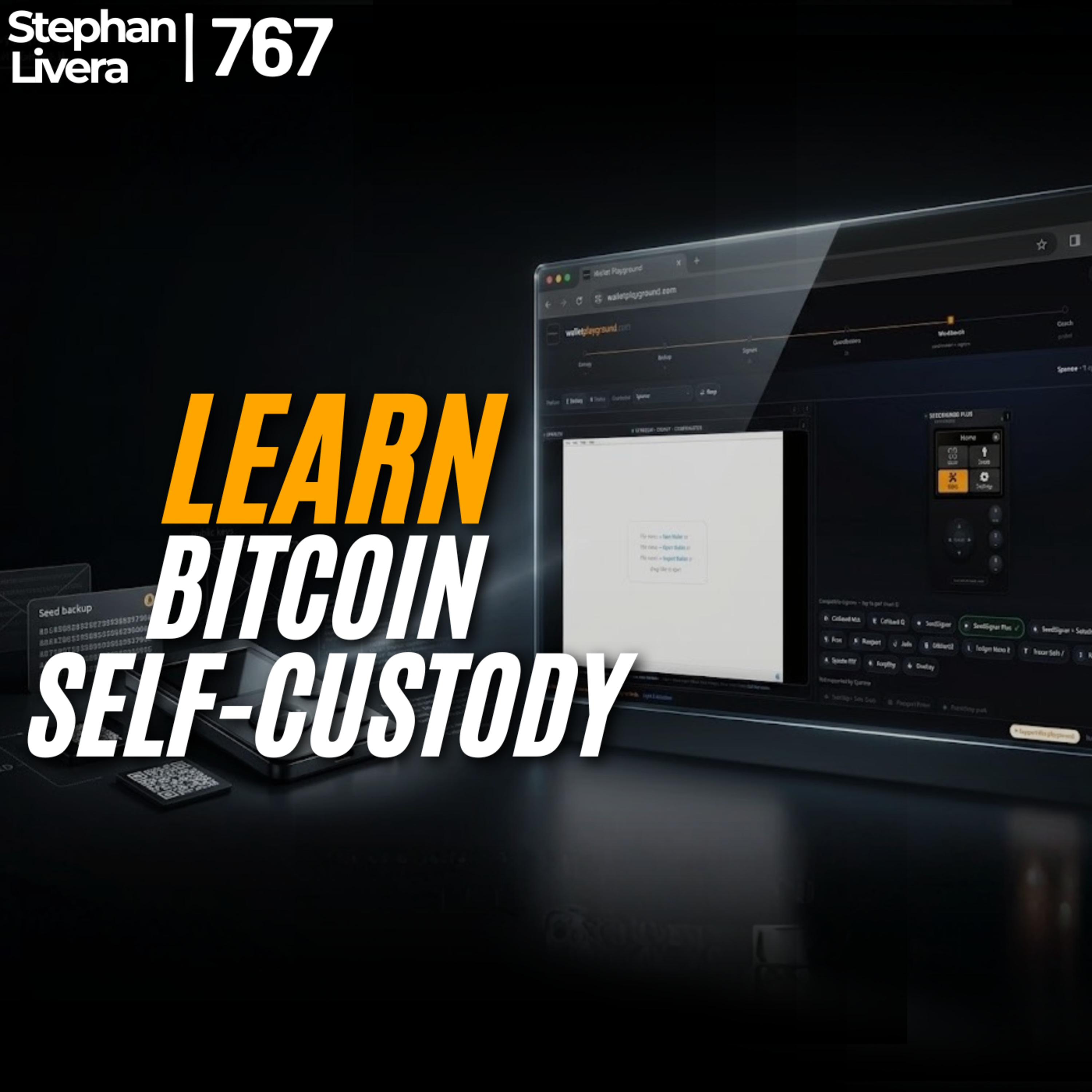 Wallet Playground for learning Bitcoin self custody with Piers Macrae | SLP767 25.08.2026 29mIn this episode, Piers Macrae demonstrates Wallet Playground and explains why hardware wallets are signing devices, not wallets.Timestamps:01:10 — Teach Me vs Do It For Me03:23 — Test Any Wallet Free in Browser09:09 — Coldcard Drama Forced Early Release14:03 — Generate Seeds Using Your Webcam17:52 — Hardware Wallets Aren't Real Wallets21:52 — Only 1% Use Multisig for Life Savings25:33 — Self-Custody Like Firearms Drilling?27:30 — Only Tiny Percentage Will Self-CustodyLinks: X: @mineracks — https://x.com/mineracksWallet Playground: https://walletplayground.com/mineracks: https://www.mineracks.com/Stephan Livera links:Follow me on X: @stephanliveraSubscribe to the podcastSubscribe to Substack
Similar podcasts


Popular in
The podcast also appears in the podcast charts of these countries.

