
Space Nuts: Astronomy Insights & Cosmic Discoveries
Professor Fred Watson and Andrew Dunkley
0
Join Professor Fred Watson and Sci-Fi Author Andrew Dunkley on Space Nuts as they delve into astronomy, space travel, and cosmic mysteries. Explore groundbreaking discoveries and listener Q&A in captivating discussions. Two episodes a week with news and explainer focused editions on Thursdays and a Listener Q&A focused edition on Mondays.
Episodes
-
 Rubin’s New Dwarf Planet & Neptune’s Trojan Asteroid: Discoveries on the Solar System’s Edge 05.11.2026 30mSpace Nuts: A New Dwarf Planet, 3I/ATLAS, and Neptune’s Hidden TrojansIn this episode of Space Nuts, Andrew Dunkley and Professor Fred Watson explore three discoveries from across the Solar System and beyond. They begin with the Vera C. Rubin Observatory’s discovery of a distant, potentially large dwarf planet, and discuss what its unusual orbit could tell us about the hunt for the elusive Planet Nine. Next, they examine new James Webb Space Telescope observations of interstellar comet 3I/ATLAS, whose unusual chemistry may preserve clues to its origins in a very cold environment billions of years ago. Finally, the hosts turn to Neptune’s long-sought Trojan asteroids, discovered in data from the Rubin Observatory by a team in Belfast. Join Andrew and Fred Watson for distant worlds, ancient cosmic ice and asteroids hiding in the dark.Key topics- The Vera C. Rubin Observatory’s discovery of dwarf planet candidate 2026 ED138.- What makes an object a dwarf planet, and how its orbit could inform the Planet Nine debate.- 3I/ATLAS’s unusual isotope ratios, methane and possible origins in an ancient, cold environment.- The discovery of Neptune’s Trojan asteroids and why they have been so difficult to observe.Timestamps00:00 - Introduction and episode overview01:20 - The Vera C. Rubin Observatory discovers a new distant dwarf planet05:30 - What defines a dwarf planet and how it may eventually be named09:00 - The object’s size, unusual orbit and possible relevance to Planet Nine12:00 - 3I/ATLAS and its unusual chemistry revealed by the James Webb Space Telescope16:00 - Isotope ratios, methane and clues to the comet’s age and origins20:00 - Neptune’s Trojan asteroids are finally discovered24:00 - How Trojan asteroids share a planet’s orbit and why Neptune’s were hard to find27:00 - Closing remarks and where to follow Space NutsBecome a supporter of this podcast: https://www.spreaker.com/podcast/space-nuts-astronomy-insights-cosmic-discoveries--2631155/support.
-
 The Great Attractor & Saturn’s Rings: Unravelling Cosmic Questions 02.11.2026 30mSpace Nuts: The Great Attractor, What Makes a Moon, and Life Beneath the RingsIn this listener Q&A episode of Space Nuts, Andrew Dunkley and Professor Fred Watson tackle a curious collection of cosmic questions. They explain why a crescent Moon can appear alongside the Sun in the morning sky, then explore the Great Attractor: the enormous concentration of galaxy clusters influencing the motion of our Local Group. The conversation turns to a lingering classification puzzle — what exactly makes a moon a moon, and should it have to clear its orbit? Finally, they imagine the view from a rocky world with rings, considering how the rings might look through the seasons, how sunlight would filter through them and what spectacular shadows or eclipses might occur. Join Andrew and Fred Watson for astronomy, imagination and the occasional tractor joke.Key topics- Why the Sun and a crescent Moon can be visible together in the morning sky.- The Great Attractor, the Zone of Avoidance and the Laniakea Supercluster.- Whether moons need to be spherical or clear their orbits, and the case of Pluto and Charon.- What a ringed planet might look like from its surface, including seasonal changes, shadows and eclipses.Timestamps00:00 - Introduction and overview of listener questions01:20 - Why the Sun and crescent Moon can appear together in the morning06:00 - Moon phases and how sunlight illuminates the Moon09:30 - Paul’s question about the Great Attractor11:00 - The Zone of Avoidance and the Laniakea Supercluster16:00 - What defines a moon, and should it clear its orbit?20:00 - Binary planets, Pluto and Charon23:00 - What it might look like to stand beneath a planet’s rings26:00 - Seasonal ring illumination, shadows and possible eclipses30:00 - Listener feedback, updates and closing remarksBecome a supporter of this podcast: https://www.spreaker.com/podcast/space-nuts-astronomy-insights-cosmic-discoveries--2631155/support.
-
 Japan’s Phobos Mission & Martian Quakes: Exploring Mars’ Moons, Canyons, and the Search for ET 29.10.2026 33mSpace Nuts: Mars’ Moons, Martian Quakes, and the Search for ETIn this engaging episode of Space Nuts, Andrew Dunkley and Professor Fred Watson explore two mysteries from Mars, along with a new effort to listen for signs of life beyond Earth. First, they unpack Japan’s Martian Moons eXploration (MMX) mission, which will study Phobos and Deimos, attempt a landing on Phobos and bring samples back to Earth. The discussion turns to a Marsquake traced to the immense Valles Marineris canyon, offering fresh clues that the Red Planet may still be geologically active. Finally, Andrew and Fred Watson examine Saudi Arabia’s plans for a major astronomical observatory, including a site for Laser SETI detectors searching for brief flashes of possible extraterrestrial communication. Join them for a cosmic tour filled with planetary puzzles, ambitious missions and a little speculation about how aliens might get in touch.Key topics- Japan’s MMX mission to investigate Mars’ moons and return samples from Phobos.- The possible origins of Phobos and Deimos, and the challenges of landing on a world with almost no gravity.- A Marsquake linked to Valles Marineris and what it suggests about the planet’s geological activity.- Saudi Arabia’s planned observatory and the use of optical Laser SETI detectors in the search for extraterrestrial signals.Timestamps00:00 - Introduction and episode overview01:20 - Japan’s MMX mission and the mysteries of Phobos and Deimos06:00 - How the mission will study Phobos and attempt to collect samples12:00 - The challenges of landing on Phobos and the planned sample return to Earth15:45 - A Marsquake traced to Valles Marineris19:30 - What the quake reveals about Mars’ geological activity22:00 - Saudi Arabia’s new observatory and the Laser SETI search26:00 - How optical detectors could look for signals from extraterrestrial intelligence29:00 - Closing thoughts and listener engagementBecome a supporter of this podcast: https://www.spreaker.com/podcast/space-nuts-astronomy-insights-cosmic-discoveries--2631155/support.
-
Galactic Ejections & Black Hole Explosions: Exploring Cosmic Queries 26.10.2026 30mSpace Nuts: Ejected Stars, Black Hole Deaths, and Astronomy ResourcesIn this engaging Q&A episode of Space Nuts, hosts Andrew Dunkley and Professor Fred Watson tackle a variety of intriguing questions from listeners. The episode kicks off with Clark from Auckland, who wonders about the possibility of stars and planets being ejected from galaxies, and what that means for rogue celestial bodies. Next, Scott from Hobart delves into the life cycle of black holes, asking what happens when they can no longer hold back light and how they ultimately meet their end. Rusty from Brooklyn poses a thought-provoking hypothetical scenario about the sun disappearing and its effects on Earth's gravitational tether. Finally, Bea from Sydney seeks advice on resources for beginners in astronomy, prompting a discussion on apps, books, and equipment to kickstart a cosmic journey. Join Andrew and Fred Watson as they explore these cosmic curiosities with their signature blend of wit and insight.Key topics- The mechanics of stars and planets being ejected from galaxies and the existence of rogue celestial bodies.- Understanding the final stages of black holes, including Hawking radiation and potential explosive endings.- The implications of the sun's sudden disappearance on Earth's gravitational stability.- Resources and tips for beginners looking to dive into the world of astronomy.Timestamps00:00 - Introduction and overview of listener questions01:20 - Clark’s question about ejected stars and planets from galaxies15:30 - Scott’s inquiry on the life cycle and death of black holes25:00 - Rusty’s hypothetical scenario about the sun disappearing35:15 - Bea’s request for beginner astronomy resources45:00 - Closing thoughts and listener engagementBecome a supporter of this podcast: https://www.spreaker.com/podcast/space-nuts-astronomy-insights-cosmic-discoveries--2631155/support.00:00 - Introduction to Space Nuts and Listener Questions About Ejected Planets and Black Holes01:56 - Can Planets and Stars Be Ejected From a Galaxy and the Nature of Intergalactic Space04:24 - Understanding Stellar Ejection Mechanisms and Measuring Galactic Escape Velocity07:37 - Comparing Earth's Escape Velocity to Our Galaxy's and the Impact of Galactic Mergers09:04 - Analogy of Bank Mergers to Galactic Mergers and Universe Dynamics09:50 - Exploring Black Hole Evaporation Through Hawking Radiation and the Final Violent Burst11:17 - The Inverse Relationship Between Black Hole Mass and Temperature Leading to Evaporation14:09 - Theoretical End States of Black Holes Including Gravitational Shockwaves and Information Release15:13 - Summarizing Black Hole Endings and Thanking Listeners for Thought-Provoking Questions15:44 - What Happens if the Sun Instantly Disappears and the Speed of Gravity19:56 - Writing a Prequel and Speculating on Threats to Earth and Solar System Stability21:11 - Concluding Questions and Addressing Beginner Astronomy Resources21:43 - Recommended Astronomy Resources Including Podcasts, Websites, and Sky Apps23:06 - Using Binoculars and Telescopes for Sky Observation and Visiting Astronomy Optics Stores24:30 - The Value of Planispheres and Considering a Smart Telescope for Modern Astronomy26:07 - Smart Telescopes with Built-in Filters and AI Image Enhancement Capabilities27:26 - Enhancing Astronomical Images with AI Software and Affordable Smart Telescope Options29:04 - Concluding the Episode and Discussing Time Dilation and Future Episodes30:11 - A Humorous Ejection Analogy and Farewell from Space Nuts Hosts30:42...
-
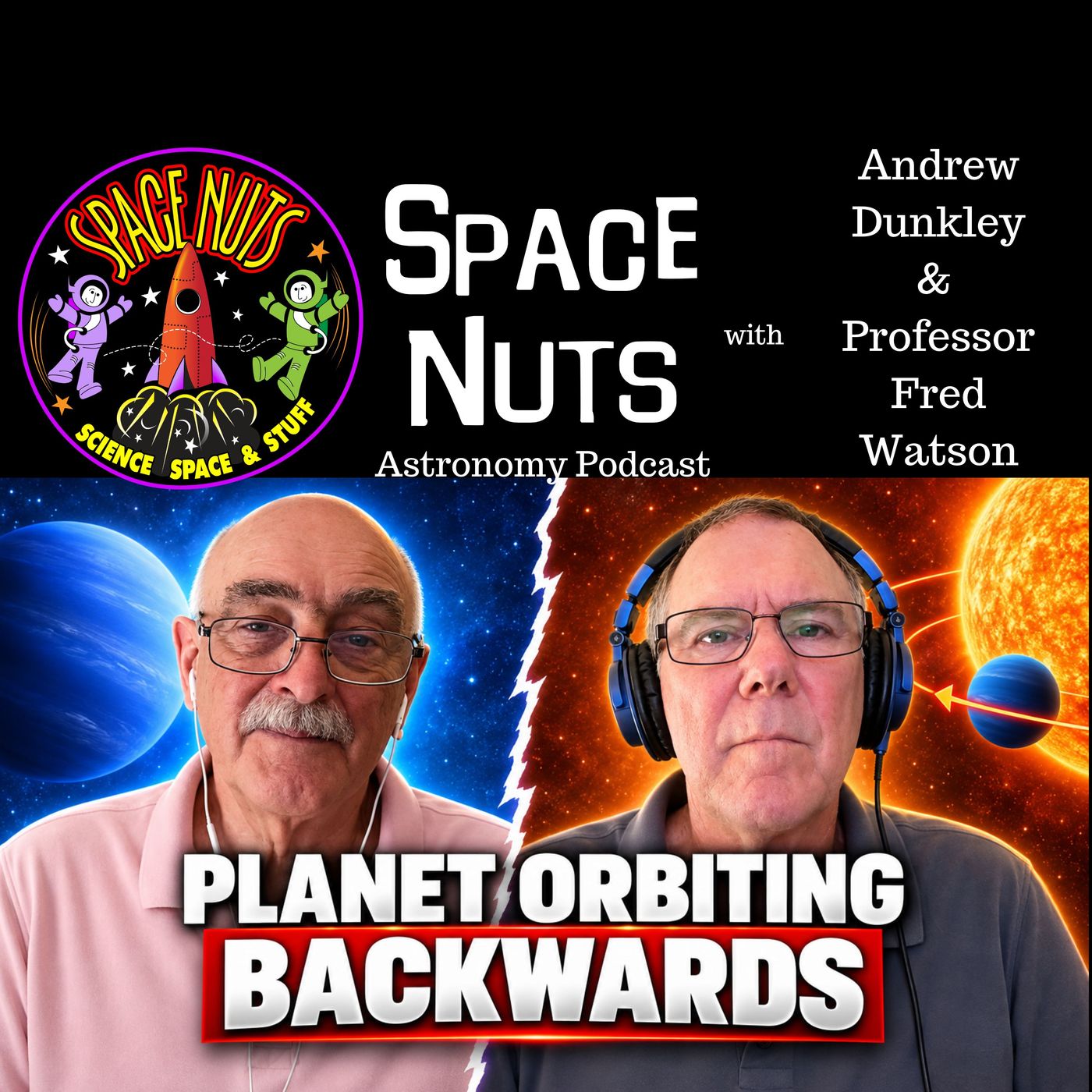 Retrograde Orbits & Cosmic Collaborations: Unraveling NASA's Boeing Deal and Backward Exoplanets 22.10.2026 36mSponsor Link:This episode of Space Nuts is brought to you by NordVPN. Protect your online privacy today by visiting www.nordvpn.com/spacenuts for an exclusive offer!Space Nuts: NASA's Starliner, Retrograde Exoplanets, and the Square Kilometre ArrayIn this thought-provoking episode of Space Nuts, hosts Andrew Dunkley and Professor Fred Watson delve into some of the latest developments in space exploration. They kick off with NASA's recent decision to stick with Boeing's Starliner for additional crewed missions, despite its rocky history. The conversation then shifts to the intriguing discovery of the exoplanet GJ 3090B, which is orbiting its star in the opposite direction, raising questions about planet formation and dynamics. Finally, they explore the innovative designs behind the Square Kilometre Array, examining how nature-inspired layouts may enhance its functionality while addressing technical challenges. Join Andrew and Fred Watson as they unravel these cosmic stories with their signature blend of wit and insight.Key topics- NASA's ongoing collaboration with Boeing for the Starliner missions and its implications for future space travel.- The unusual retrograde orbit of exoplanet GJ 3090B and what it reveals about planetary systems.- The design and challenges of the Square Kilometre Array and its nature-inspired antenna layout.Timestamps00:00 - Introduction and overview of today's topics01:20 - Discussion on NASA's partnership with Boeing and the Starliner missions15:30 - Exploration of the retrograde orbit of exoplanet GJ 3090B25:00 - Insights into the Square Kilometre Array and its innovative designs35:15 - Final thoughts and listener engagementBecome a supporter of this podcast: https://www.spreaker.com/podcast/space-nuts-astronomy-insights-cosmic-discoveries--2631155/support.
-
Cosmic Questions & Stellar Insights: Diving into the Oort Cloud, Kuiper Belt, and Lunar Landers 19.10.2026 35mSponsor Link:This episode of Space Nuts is brought to you by NordVPN. Protect your online privacy today by visiting www.nordvpn.com/spacenuts for an exclusive offer!Space Nuts: The Oort Cloud, Dwarf Planets, and Innovative Lander DesignsIn this enlightening Q&A episode of Space Nuts, hosts Andrew Dunkley and Professor Fred Watson tackle a series of thought-provoking questions from listeners. Kicking off with Gerwin from Wales, they delve into the mysteries of the Oort Cloud and Kuiper Belt, discussing the potential mass of these distant regions and their influence on our solar system. Bob from Utah presents a unique perspective on dwarf planets, sparking a lively debate on definitions and classifications. Shumo from Oxford challenges the design of lunar landers, proposing a more insect-like approach to enhance stability on uneven terrain. Finally, Steve from the UK poses a fascinating hypothetical about gathering historical scientific greats to solve modern mysteries like dark matter and dark energy. Join Andrew and Fred Watson as they explore these cosmic curiosities with their signature blend of humour and insight.Key topics- The mass and significance of the Oort Cloud and Kuiper Belt in the solar system.- Redefining dwarf planets: A discussion on classifications and implications.- Innovative lunar lander designs inspired by nature's solutions to stability.- The potential of historical scientists collaborating on contemporary scientific challenges.Timestamps00:00 - Introduction and overview of listener questions01:20 - Gerwin’s question about the Oort Cloud and Kuiper Belt15:30 - Bob’s thoughts on the definition of dwarf planets25:00 - Shumo’s proposal for insect-inspired lunar landers35:15 - Steve’s hypothetical scenario of historical scientists solving modern mysteries45:00 - Closing thoughts and listener engagementBecome a supporter of this podcast: https://www.spreaker.com/podcast/space-nuts-astronomy-insights-cosmic-discoveries--2631155/support.00:00 - Introduction to Space Nuts Q&A Edition and Topics for Today's Episode00:17 - Discussion of Listener Questions Including Oort Cloud, Kuiper Belt, and Dwarf Planet Theory01:46 - Addressing a Question from Wales About the Oort Cloud and Kuiper Belt's Potential Planetary Mass03:52 - Analyzing the Mass of Trans-Neptunian Objects and Oort Cloud Bodies in Relation to Planetary Formation07:20 - Speculating on Planet Nine and the Hypothetical Mass of the Oort Cloud's Influence08:53 - Debating Dwarf Planet Theory and the Definition of a Planet with Historical Context13:29 - Exploring Biometric Approaches for Lunar Landers Versus Traditional Designs and Recent Mission Failures23:54 - Humorous Discussion on Simple Solutions for Landing Stability and Future Lunar Missions25:11 - Hypothetical Collaboration of Past and Present Scientists to Solve Cosmic Mysteries Like Dark Matter32:01 - Concluding Thoughts on Unsolvable Mysteries and the Limits of Science.
-
 Lunar Magnetism & Cosmic Signals: Insights into Moon Mysteries and Radio Discoveries 17.10.2026 33mSpace Nuts: Lunar Magnetism, Exoplanet Signals, and the Evolution of Spacecraft WindowsIn this captivating episode of Space Nuts, hosts Andrew Dunkley and Professor Fred Watson dive into a range of fascinating astronomical topics. The episode kicks off with an exploration of lunar magnetism, as they discuss new findings suggesting that the Moon may have once possessed a primordial magnetic field, stemming from solidified magma beneath its surface. The duo then shifts gears to a groundbreaking discovery of radio signals originating from the exoplanet Beta Pictoris B, revealing the presence of auroras on this distant gas giant. Finally, they examine the evolution of spacecraft windows, highlighting the importance of visibility for astronauts and the advancements in window technology over the decades. Join Andrew and Fred Watson as they unravel these cosmic mysteries with their signature blend of humour and insight.Key topics- The Moon's magnetic history and the implications of recent research on its geological structure.- Detection of auroras on exoplanets through radio signals and what it means for our understanding of planetary atmospheres.- The evolution of spacecraft windows: from early designs to modern innovations and safety considerations.Timestamps00:00 - Introduction and overview of today's topics01:20 - Discussion on lunar magnetism and the Moon's geological history15:30 - Discovery of radio signals from exoplanet Beta Pictoris B and the significance of auroras25:00 - Evolution of spacecraft windows and their importance for astronauts35:15 - A unique photo capturing the International Space Station and a plane against the sun45:00 - Closing thoughts and listener engagementBecome a supporter of this podcast: https://www.spreaker.com/podcast/space-nuts-astronomy-insights-cosmic-discoveries--2631155/support.
-
Time Dilation & Cosmic Mysteries: Unpacking Your Space Queries 13.10.2026 26mSponsor Link:This episode of Space Nuts is brought to you by NordVPN. Protect your online privacy today by visiting www.nordvpn.com/spacenuts for an exclusive offer!Space Nuts: Fast-Moving Planets, Photon Pressure, and the Nature of MoonsIn this engaging Q&A episode of Space Nuts, hosts Andrew Dunkley and Professor Fred Watson tackle a series of intriguing listener questions. Kicking off with Ron's query about the implications of living on a super fast-moving planet orbiting Sagittarius A*, they delve into the fascinating world of time dilation and its effects on scientific observations. Next, Jeff from Colorado poses a thought-provoking question regarding photon pressure and its potential influence on the universe's expansion, leading to a discussion on dark energy and cosmic mysteries. Brian from the Gold Coast wonders about the visibility of cosmic microwave background radiation behind black holes, while Bob rounds off the episode with a query on the characteristics that define a moon. Join Andrew and Fred Watson as they navigate these cosmic curiosities with their trademark wit and insight.Key topics- The effects of high-speed planetary motion near a black hole on time and observational science.- Exploring photon pressure and its relationship to the universe's expansion and dark energy.- The cosmic microwave background radiation and its interaction with black holes.- Defining moons: How small and irregular can they be while still being classified as moons?Timestamps00:00 - Introduction and overview of listener questions01:20 - Ron’s question about living on a fast-moving planet and time dilation effects15:30 - Jeff’s inquiry into photon pressure and its impact on cosmic expansion25:00 - Brian’s question regarding cosmic microwave background radiation and black holes35:15 - Bob’s exploration of what constitutes a moon45:00 - Closing thoughts and listener engagementBecome a supporter of this podcast: https://www.spreaker.com/podcast/space-nuts-astronomy-insights-cosmic-discoveries--2631155/support.
-
 Strange Spins and Cosmic Rings: Exploring NGC 4698 and Chariklo's Secrets 12.10.2026 34mSponsor Link:This episode of Space Nuts is brought to you with the support of NordVPN. To check out our special money-saving deal, visit www.nordvpn.com/spacenutsSpace Nuts: Unraveling the Mysteries of NGC 4698 and Chariklo's RingsIn this exciting episode of Space Nuts, hosts Andrew Dunkley and Professor Fred Watson explore some truly peculiar cosmic phenomena. They kick off with a deep dive into the strange behaviour of the galaxy NGC 4698, known for its unusual rotational patterns and mysterious bulge, leading to discussions about possible galactic mergers. Next, the duo ventures into the intriguing world of Chariklo, a centaur object with changing rings, as they discuss the latest observations from the James Webb Space Telescope and the implications of its unique ring structure. Join Andrew and Fred Watson as they navigate these captivating astronomical tales with their signature blend of humour and insight.Key topics- The peculiar characteristics of NGC 4698: What makes this galaxy behave strangely?- Insights into the dynamics of galaxy mergers and their effects on structure.- Chariklo's rings: How have they changed since their discovery, and what does this mean for our understanding of ring systems?- The potential existence of a hidden moon influencing the structure of Chariklo's rings.Timestamps00:00 - Introduction and overview of today's topics01:20 - Discussion on the peculiar galaxy NGC 4698 and its unusual features15:30 - Exploring Chariklo and the changes in its ring system25:00 - Insights from the James Webb Space Telescope and the hidden moon hypothesis35:15 - Final thoughts and listener engagementWanting a commercial free option of Space Nuts? Become a supporter of this podcast: https://www.spreaker.com/podcast/space-nuts-astronomy-insights-cosmic-discoveries--2631155/support.
-
Time Travel & Cosmic Questions: The Science Behind Our Universe 09.10.2026 29mSponsor Link:This episode of Space Nuts is brought to you by NordVPN. Protect your online privacy today by visiting www.nordvpn.com/spacenuts for an exclusive offer!Space Nuts: Time Travel, Orbiting Telescopes, and Gold OriginsIn this Q&A episode of Space Nuts, hosts Andrew Dunkley and Professor Fred Watson tackle a range of thought-provoking listener questions. They begin with a fascinating inquiry from Andy, a train driver in the UK, about the implications of time travel at relativistic speeds. What does it mean to age differently when travelling close to the speed of light? The duo then dives into the mechanics of orbiting telescopes, addressing Nick's questions about how these instruments manage their observations while minimising interruptions from Earth. Finally, Ash from Brisbane poses an intriguing question about the origins of gold, prompting a discussion on neutron star collisions and the cosmic processes that create heavy elements.Key topics- Time travel and the effects of relativistic speeds on aging: Can we really travel through time?- The scheduling and operational strategies of orbiting telescopes like Hubble: How do they maximise observation time?- The origins of gold in the universe: What role do neutron star collisions play in the creation of heavy elements?Timestamps00:00 - Introduction and overview of listener questions01:20 - Andy’s question on time travel and relativistic speeds15:30 - Nick’s inquiry about orbiting telescopes and their observation strategies25:00 - Ash’s question regarding the origins of gold and neutron star collisions35:15 - Final thoughts and listener engagementBecome a supporter of this podcast: https://www.spreaker.com/podcast/space-nuts-astronomy-insights-cosmic-discoveries--2631155/support.
-
 Space Force Unveiled: The Surprising Reality of Weapons in Orbit 09.10.2026 33mSponsor Link:This episode of Space Nuts is brought to you with the support of NORDVPN. Get your privacy in order today. To check out our special offer and support the show, visit www.nordvpn.com/spacenutsSpace Nuts: Space Force Weapons, Purple Mars, and New Lunar CraterIn this episode of Space Nuts, hosts Andrew Dunkley and Professor Fred Watson delve into some fascinating and thought-provoking topics. They kick off with the recent revelation about the existence of weapons in orbit around Earth, a significant admission from the United States that raises questions about the future of space security. The conversation shifts to Mars, where stunning new images suggest that we might need to reconsider its nickname as the "Red Planet" due to striking purple hues observed in its southern regions. Finally, the duo discusses a newly discovered crater on the Moon, the largest of its kind in recent history, and what this means for our understanding of lunar impacts and surface changes.Key topics- The United States acknowledges the presence of weapons in space, sparking discussions about the implications for global security and the arms race in orbit.- An exploration of Mars' changing colour palette, with new images revealing purple landscapes that challenge our traditional views of the planet.- The discovery of a significant new crater on the Moon, highlighting the ongoing geological activity and impact history of our celestial neighbour.Timestamps00:00 - Introduction and overview of topics01:20 - Discussion on weapons in orbit and implications for space security15:30 - Mars as the "Purple Planet" and the significance of new imagery25:00 - New lunar crater discovery and its implications for lunar geology35:15 - Closing thoughts and listener engagementBecome a supporter of this podcast: https://www.spreaker.com/podcast/space-nuts-astronomy-insights-cosmic-discoveries--2631155/support.
-
The Intricacies of Angular Momentum - What Happens Near Black Holes 28.09.2026 30mSponsor Link:This episode of Space Nuts is brought to you with the support of NordVPN.. To check out special money saving deal, visit www.nordvpn.com/spacenuts Space Nuts: Q&A on Radial Velocity, Dark Matter, and Angular MomentumIn this engaging Q&A episode of Space Nuts, hosts Andrew Dunkley and Professor Fred Watson tackle a variety of intriguing listener questions, ranging from the complexities of radial velocity in exoplanet detection to the mysteries of dark matter and angular momentum in black holes. Join them as they explore these cosmic conundrums with their characteristic wit and expertise.Key topics- Hussein from Yemen asks about the radial velocity method for detecting exoplanets, prompting a discussion on how astronomers can isolate individual planets from the combined gravitational effects of multiple bodies.- Martin from Maryland raises a thought-provoking question on the potential to harness dark energy for space flight, leading to an exploration of the feasibility of accelerating spacecraft to near-light speeds.- Peter from Sweden inquires about the angular momentum of matter falling into black holes, sparking a conversation on whether this matter retains its momentum or needs to shed some energy before crossing the event horizon.- Andrew and Fred Watson also touch on the ongoing search for Planet Nine and the importance of surveying exoplanets for understanding the universe's structure and potential for life beyond Earth.Timestamps00:00 - Introduction to the Q&A format and listener questions01:20 - Hussein's question about radial velocity and exoplanets10:30 - Martin's inquiry on harnessing dark energy for space travel18:45 - Peter's question about angular momentum and black holes26:00 - Discussion on the significance of ongoing exoplanet surveys32:15 - Closing thoughts and listener engagementBecome a supporter of this podcast: https://www.spreaker.com/podcast/space-nuts-astronomy-insights-cosmic-discoveries--2631155/support.
-
 Mars Gullies Aren't Made by Water: The Surprising Dry Ice Answer 24.09.2026 32mPerseverance drove to the edge of an ancient Martian lake expecting a beach and found the inside of a volcano — rock that water has been through at least three separate times. Europe's Jupiter probe comes home on Monday night and crosses Australia in a fully dark sky. Two teams, using two completely different techniques, both find something hiding inside the most famous planetary system we have ever photographed — and an Australian instrument is in the middle of one of them. Plus: heavy water in an interstellar comet, and what it says about the star that made it. In this episode · LEAD — Three floods at the crater's edge. Candice Bedford (Purdue) and colleagues publish in Communications Earth & Environment: the Margin Unit at Jezero is igneous, not sedimentary, and records at least three distinct episodes of water — CO₂-rich groundwater making carbonate ridges, then silica associated with the lake, then a later hot-water event leaving fluorite veins. Habitability context, not a biosignature. · Juice returns. ESA confirms the third Earth gravity assist for 28 September — closest approach 11:45 UTC over the Indian Ocean, bending the trajectory ~20° and adding ~3.5 km/s. The spacecraft crosses Australia north-east to north-west 15–30 minutes earlier, in full darkness. · HR 8799. Two preprints in two weeks point at a fifth, inner planet — one from archival JWST aperture-masking data (~7 au, a few Jupiter masses), one from Gaia astrometry (2–3 au, 10–14 Jupiter masses). They do not obviously describe the same object. Neither is peer-reviewed. · 3I/ATLAS. A modelling paper explains the high deuterium-to-hydrogen ratio measured in March as consistent with formation around a low-metallicity — meaning old — star. · Quick hit: Starship Flight 14 still targeting 28 September; Crew-13 still 'no earlier than early October' on NASA's own page; Albania signs the Artemis Accords as the 73rd country. · Skywatch: the equinox as an instant rather than a date, the Juice pass over Australia, Venus and Mercury for the south, Mars and Jupiter before dawn for the north, and Saturn heading into opposition. Sources and further reading · Bedford, C. C. et al., 'Lake- and groundwater-associated alteration of the olivine-rich Margin unit in Jezero crater, Mars', Communications Earth & Environment (2026). DOI 10.1038/s43247-026-03997-9 · NASA/JPL, 'NASA Discovery Reveals Complex Water Systems on Early Mars', 21 September 2026. · ESA, 'Juice to fly past Earth for third gravity assist', 21 September 2026. · Nguyen, J. S. et al., 'A Candidate Innermost Fifth Planet In the HR 8799 System Revealed By JWST NIRISS Aperture Masking Interferometry', arXiv:2609.10507. · Lagrange, A.-M. et al., 'A fifth companion in the HR 8799 system revealed by Gaia', arXiv:2609.20996 (submitted to Nature Astronomy). · Furuya, K., Cordiner, M., Bockelée-Morvan, D. et al., arXiv:2609.12370. · NASA OIIR, 'NASA Welcomes Albania as Newest Artemis Accords Signatory', 21 September 2026. Skywatch figures computed in-session with PyEphem 4.2.1 for Sydney, Los Angeles, New York and London. Times are local unless marked UTC.Become a supporter of this podcast: https://www.spreaker.com/podcast/space-nuts-astronomy-insights-cosmic-discoveries--2631155/support.
-
Navigating the Cosmic Questions: Gravity Assists, Neutrinos, and Time Dilation Explained 21.09.2026 30mSpace Nuts: Q&A on BepiColombo, Neutrinos, and Time DilationIn this Q&A edition of Space Nuts, hosts Andrew Dunkley and Professor Fred Watson dive into a series of intriguing listener questions that span topics from the nuances of orbital velocity to the enigmatic world of neutrinos and the complexities of time dilation. Join them as they unravel these cosmic queries with their signature blend of insight and humour.Key topics- Larry from Nebraska asks about the BepiColombo mission and the relationship between gravitational assists and orbital velocity, prompting a discussion on how spacecraft navigate the solar system.- Eduardo explores the nature of neutrinos, questioning whether they are affected by gravity and whether they can be trapped by black holes.- Shumo presents a thought-provoking idea about using high-energy gamma rays or neutrinos as interstellar beacons, leading to a discussion on the potential for advanced civilisations to communicate through unconventional means.- Colin from Adelaide raises questions about time dilation effects as depicted in the science fiction movie "Project Hail Mary," specifically the implications of travelling close to the speed of light and the resulting age differences upon return to Earth.Timestamps00:00 - Introduction to the Q&A format and listener interactions01:20 - Larry's question about BepiColombo and gravitational assists10:30 - Eduardo's inquiry on neutrinos and black holes18:45 - Shumo's question about interstellar beacons using gamma rays or neutrinos26:00 - Colin's confusion about time dilation in "Project Hail Mary"32:15 - Discussion on the implications of time dilation and relativityBecome a supporter of this podcast: https://www.spreaker.com/podcast/space-nuts-astronomy-insights-cosmic-discoveries--2631155/support.
-
 Why Venus May Have Lost Its Moon Forever 17.09.2026 33mSponsor Link:This episode of Space Nuts is brought to you with the support of NordVPN. your first stop for online privavcy. To check out our special offer with a 30 day money back guarantee, visit www.nordvpn.com/spacenutsSpace Nuts: Venus’s Missing Moon, Satellite Pollution, and Space Force Uniform ControversySpace Nuts covers three very different space stories in this episode, ranging from planetary science to the consequences of satellite reentry and a controversial military uniform design. Andrew Dunkley and Professor Fred Watson also field listener questions on orbital mechanics, neutrinos, alien communication, and time dilation.The discussion is broad, but the main thread is clear: how real-world physics shapes everything from Venus’s history to the future of spaceflight and even the look of space-age uniforms.Key topicsVenus is Earth-like in size, mass, and gravity, but unlike Earth it has no moon, and the episode explores whether it may once have had one.Fred explains a modeling study led by Stephen Kane suggesting a Venus moon could have spiraled inward, crossed the Roche limit, and been torn apart by tidal forces.The team discusses what evidence might remain if Venus once consumed a moon, including possible chemical fingerprints in the atmosphere or surface.Satellite pollution is examined through the lens of reentering spacecraft, especially the growing number of Starlink reentries and their impact on the upper atmosphere.The European Space Agency’s jet-based chase of two reentering Cluster spacecraft, Tango and Samba, is described as an effort to measure reentry byproducts directly.The conversation raises concerns about aluminium oxides, atmospheric chemistry, and whether repeated reentries could have broader consequences such as ozone depletion.The final main story looks at proposed United States Space Force uniforms and why the design drew immediate comparisons to World War II-era fascist aesthetics and Starship Troopers.Andrew and Fred note how uniform design can shape perception, and why the new concept feels divisive rather than inspiring.Timestamps00:00 - Intro and setup for the episode00:41 - Venus, satellite pollution, and Space Force uniforms preview04:40 - Venus as Earth’s twin and why it has no moon08:21 - Modeling a missing Venusian moon09:20 - Gravitational tug-of-war and moon migration toward Venus11:44 - Conditions for a moon to survive around Venus12:43 - Possible traces of an ancient moon impact16:06 - Satellite pollution from reentering spacecraft17:16 - Starlink reentries and atmospheric contamination18:14 - ESA’s jet chase of reentering Cluster spacecraft20:06 - Observing Tango and Samba during controlled reentry21:45 - Why the atmospheric consequences could become controversial23:12 - Wood as a potentially more benign spacecraft material24:16 - Space Force uniforms and the first visual reaction25:34 - Starship Troopers and deliberate fascist design cues27:29 - Why the proposed uniforms feel unsettlingBecome a supporter of this podcast: https://www.spreaker.com/podcast/space-nuts-astronomy-insights-cosmic-discoveries--2631155/support.
-
Your Questions Answered: The Mysteries of Jupiter and the Sun 14.09.2026 32mSponsor Link:This episode of Space Nuts is brought to with the support of NordVPN. To grab our special NordVPN deal, simply visit www.nordvpn.com/spacenuts ....take control of your online privacy because no-one else is going to do it for you!Space Nuts: Q&A on Mitsubishi's Role in Telescope Manufacturing, Jupiter's Storms, and Gravitational WavesIn this Q&A episode of Space Nuts, hosts Andrew Dunkley and Professor Fred Watson tackle a range of fascinating listener questions, from the involvement of Mitsubishi Heavy Industries in telescope manufacturing to the mysteries of Jupiter’s storms and the nature of gravitational waves. Join them as they delve into these cosmic queries with their signature wit and expertise.Key topics- Thomas from Canberra asks about Mitsubishi Heavy Industries and their role in the manufacturing of telescope hardware at Siding Spring Observatory. Fred Watson explains the engineering behind the Anglo-Australian Telescope and the significance of its construction.- Young listener Emily poses a question about Jupiter's Great Red Spot, prompting a discussion on the dynamics of storms and atmospheric patterns on the gas giant.- Butch from the UK inquires about the Parker Solar Probe and its mission to study the sun, as well as the advancements in solar observation technology.- Trent from North Georgia wonders if gravitational waves are slowed down by passing through matter, leading to an insightful explanation of how these waves interact with the fabric of spacetime.- The episode wraps up with a lively discussion on the role of artificial intelligence in astronomy and its implications for the future of scientific research.Timestamps00:00 - Introduction to the Q&A format and listener interactions01:20 - Thomas's question about Mitsubishi Heavy Industries and Siding Spring Observatory10:30 - Emily's question about storms on Jupiter18:45 - Butch's inquiry on the Parker Solar Probe and solar missions26:00 - Trent's question about gravitational waves and their speed32:15 - Discussion on artificial intelligence in astronomy and its impact40:00 - Closing remarks and listener engagementBecome a supporter of this podcast: https://www.spreaker.com/podcast/space-nuts-astronomy-insights-cosmic-discoveries--2631155/support.
-
 The Dark Matter Hint That Could Rewrite Physics 10.09.2026 30mSpace Nuts: Dark matter clues, Saturn’s new decagon, Mars and Titan missions.Andrew Dunkley and Professor Fred Watson cover a packed astronomy episode that moves from a tentative dark matter signal to a newly spotted ten sided storm pattern on Saturn. They also dig into two upcoming sample return style missions, one to Mars and one to Titan, before finishing with listener questions about Jupiter’s Great Red Spot, solar missions, gravitational waves, and AI in astronomy.Key topicsIn this episode, Andrew and Fred discuss the Lux-Zeppelin underground detector result, where researchers saw a low-energy flash that might be consistent with dark matter, though the signal is still far short of discovery level.Fred explains why dark matter is inferred from galaxy rotation and gravitational lensing, and why direct detection experiments need to be buried deep underground and shielded from background noise.The discussion covers Fred’s own migraine aura experience, including the zigzag visual pattern he describes as a brain-based phenomenon that affects both eyes.In this episode, they celebrate an outback astronomy success story involving Trevor Barry of Broken Hill, whose long-term Saturn observations helped connect amateur and professional work on planetary atmospheres.Fred explains Saturn’s famous north polar hexagon and the newly reported south polar decagon, noting that the southern feature appears to have formed only since 2023.They cover China’s Tianwen-3 Mars sample return plans, including the narrowing of candidate landing sites from 86 to 12 and the mission’s focus on clay-rich terrain that may preserve signs of ancient life.Fred and Andrew also discuss NASA’s Dragonfly mission to Titan, including the chosen region near Selk crater, the expected 3.3-year primary mission, and why Titan’s dense atmosphere makes rotorcraft flight more practical there than on Mars.Timestamps00:00 - Pre-show timing and getting ready to go live00:49 - Welcome to Space Nuts and what’s coming up02:23 - Fred joins the show and mentions recovering from knee surgery03:17 - First story: a possible dark matter detection at Lux-Zeppelin05:28 - Why dark matter is hard to detect directly06:56 - Underground detectors and the LZ experiment in South Dakota08:50 - The flash event and why it is only a hint, not a discovery11:44 - The 2.6 sigma result and what that means statistically13:55 - Trevor Barry and the discovery of Saturn’s south polar decagon16:23 - Saturn’s north polar hexagon and why the south is unusual17:49 - The decagon’s possible recent formation and what comes next21:26 - China’s Tianwen-3 Mars sample return mission23:40 - Candidate landing sites narrowed down and why clays matter25:20 - NASA’s Dragonfly mission to Titan26:03 - Why the Titan landing region near Selk crater is scientifically interesting27:31 - Dragonfly’s three point three year primary mission and Titan’s chemistry29:09 - Listener shout-outs and wrapping the first halfBecome a supporter of this podcast: https://www.spreaker.com/podcast/space-nuts-astronomy-insights-cosmic-discoveries--2631155/support.
-
Cosmic Q&A: From Redshift to the Moon's Hidden Temperatures 07.09.2026 30mSpace Nuts: Q&A on the Swift Satellite, Redshift, and Hypothetical White HolesIn this engaging Q&A edition of Space Nuts, hosts Andrew Dunkley and Professor Fred Watson dive into a myriad of intriguing questions posed by listeners. From the fate of the Swift satellite to the mysteries of redshift and the speculative nature of white holes, this episode covers a wide range of cosmic curiosities.Key topics include:- The fate of the Swift satellite and the challenges faced by the Link mission meant to boost its orbit.- An exploration of redshift and the implications of energy loss in distant light.- Insights into the temperature variations on the Moon and the potential for human habitation beneath its surface.- A thought-provoking discussion on the hypothetical merger of black holes and white holes, and what that could mean for our understanding of the universe.Join Andrew and Fred Watson as they tackle these questions with their signature blend of humour and expertise, providing listeners with a deeper understanding of the cosmos.00:00 - This is where the audience asks us questions, we scratch our heads01:20 - Do you always record on the same day and time02:56 - What are your thoughts on the red dots as seen by James Webb Telescope06:33 - A spacecraft called Link will boost the decaying orbit of the Swift satellite14:08 - Is distant light redshifted? What happens to the lost energy16:18 - Professor Fred Watson discusses Apollo 13 problems in Q and A edition17:19 - Fenton from Minnesota has a question about the temperature on the moon23:13 - European astrobiologist working on Roslyn Franklin rover on Mars26:03 - Fred Watson asks what would happen if a white hole merged with a black holeBecome a supporter of this podcast: https://www.spreaker.com/podcast/space-nuts-astronomy-insights-cosmic-discoveries--2631155/support.
-
 The Starless Galaxy That Shouldn’t Exist - But Does 03.09.2026 38mSpace Nuts: Spanish Eclipse, Nancy Grace Roman Launch, Cloud Nine, and Venus's Mysterious CloudsAndrew Dunkley and Professor Fred Watson cover four big astronomy stories in this episode, from Fred’s trip to view a sunset eclipse in Spain to the launch of the Nancy Grace Roman Space Telescope. They also unpack a starless dwarf galaxy called Cloud Nine and a new way of thinking about the strange dark material in Venus’s clouds.Guests and speakersAndrew Dunkley - Host, frames the news, asks listener questions, and guides the discussion.Professor Fred Watson - Astronomer at large, explains the eclipse, the Roman telescope, Cloud Nine, and Venus’s clouds.Key topicsIn this episode, Fred recounts the Spanish eclipse expeditionThe eclipse was only 9 degrees above the western horizon at totality, making the viewing conditions unusually challenging.He and Marnie led a 16-person tour through France, Spain, and Switzerland before settling near Santander in northern Spain.They staked out a viewing site 2 kilometers from the hotel, set up a gazebo, and had to tie it down to a car to keep it from blowing away.The weather looked threatening, but a hole opened in the cloud just before totality, giving them a clear view of the corona.Fred described the yellowish corona, pink hydrogen clouds, and the crowd of around 2,000 people.We discuss the Nancy Grace Roman Space Telescope launchAndrew watched the launch live after being nudged by his own brain at the right moment.Fred noted the launch was flawless, with 27 Merlin motors firing.The telescope is headed for the L2 Lagrange point, about 1.5 million kilometers away.Roman is a 2.4-meter Hubble-class telescope but with 100 times the field of view.Its wide-angle infrared design should enable major surveys of dark matter, dark energy, and exoplanets via its coronagraph.Fred explains why Cloud Nine mattersCloud Nine is described as a starless dwarf galaxy about 14 million light years away.It lies near Messier 94 and was studied using the Gran Telescopio Canarias and its Hypercam instrument.The deep exposure was 2.36 hours, yet the team found no convincing stellar population.Fred says theory suggests the gas may be too hot to cool and collapse into stars because of the ultraviolet background radiation after reionization.He says Cloud Nine may be the first strong example of a galaxy predicted by standard cosmology but never before clearly identified.Venus’s clouds are still puzzling astronomersFred explains that Venus appears yellowish because we see the top of its cloud layer, especially in visible light.In ultraviolet, Venus shows dramatic global cloud patterns caused by an as-yet unidentified absorber.The new study uses radiative transfer modeling to constrain what the unknown absorber could be.The team compares Venus’s cloud droplets to cigarette smoke, tiny particles that look light-colored when dispersed but could become dark sludge in bulk.The result suggests the absorber must be very efficient, very concentrated, or both, but it is not being claimed as evidence of life.Become a supporter of this podcast: https://www.spreaker.com/podcast/space-nuts-astronomy-insights-cosmic-discoveries--2631155/support.
-
Waves, Signals, and Cosmic Aromas: A Q&A Journey Through Space 31.08.2026 37mIn this intriguing Q&A episode of Space Nuts, hosts Andrew Dunkley and Professor Jonti Horner tackle a variety of cosmic queries from listeners. Join them as they explore the fascinating world of radio telescopes and how they produce images from radio waves, delve into the complexities of gravitational waves, and ponder the sounds and smells of space.Key topics include:- How photographic images are generated from radio telescopes, despite only receiving radio waves, and the fundamental principles behind this technology.- A deep dive into gravitational waves, their impact on space, and how LIGO detects these minute disturbances in the fabric of spacetime.- An imaginative discussion on what sounds might exist in space and the potential smells one could encounter beyond Earth’s atmosphere, including the curious idea of cosmic fragrances.Join Andrew and Jonty as they demystify these concepts, providing clarity and insights into the wonders of astronomy and space science.00:00 - Space Nuts aims to answer questions from the audience about astronomy and space science01:37 - Were the pyramids built by aliens or were they built by humans04:26 - How is a photographic image produced from a radio telescope and not an optical telescope12:36 - Dean: I often hear about gravity waves and I have a hard time visualising20:15 - Andrew Dunkley: I think ideas become easier to explain over time22:45 - Our next question comes from David from Port Washington, New York30:37 - Several volcanoes have blown up since we've been to them32:08 - The metropolitan area of Auckland contains 53 volcanoes35:02 - If you could take a big inhale, what would space smell like36:22 - If you would like to send us some questions, please do through our websiteBecome a supporter of this podcast: https://www.spreaker.com/podcast/space-nuts-astronomy-insights-cosmic-discoveries--2631155/support.
Similar podcasts


Popular in
The podcast also appears in the podcast charts of these countries.


