
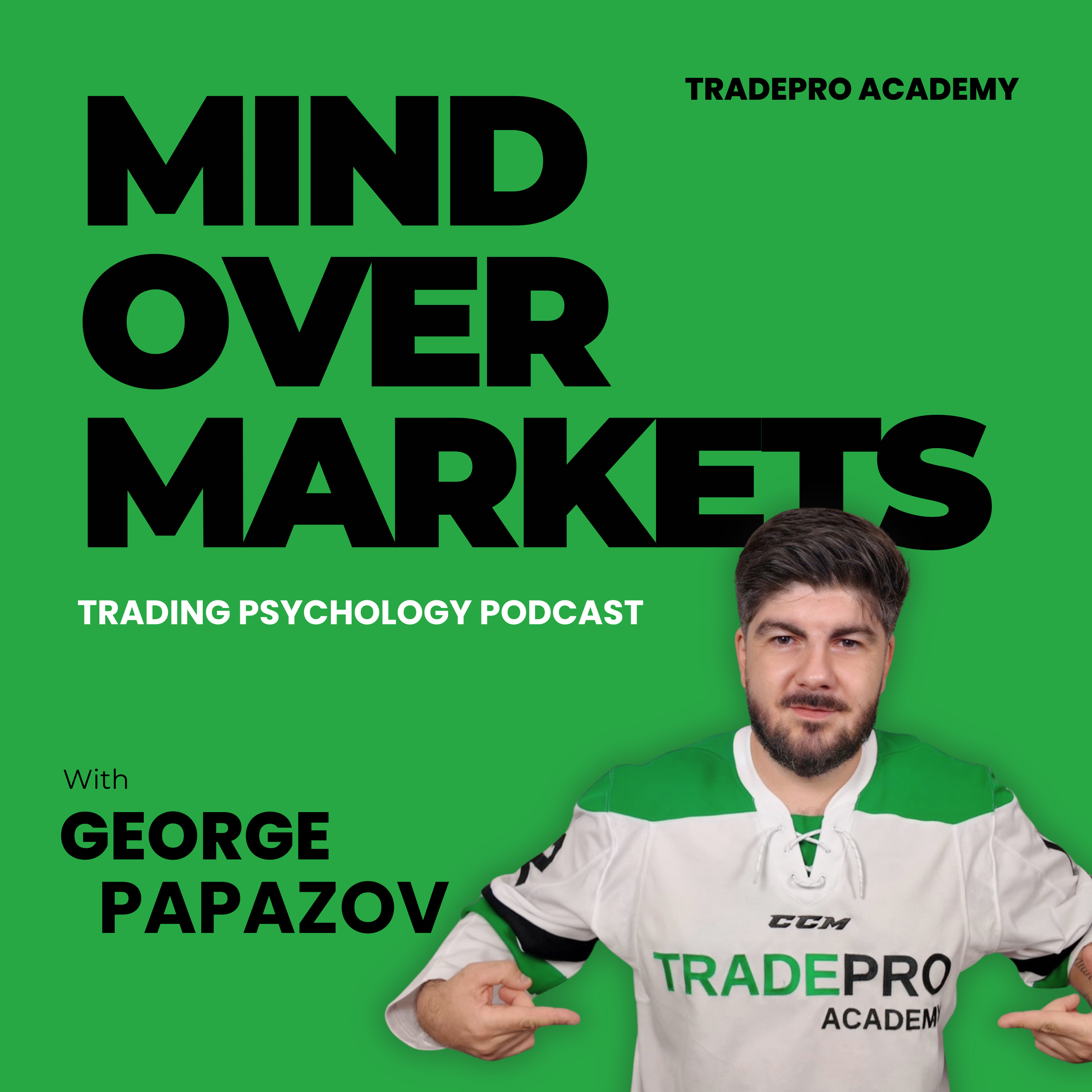
Mind Over Markets: Trading Psychology Podcast
George Papazov
0
Mind Over Markets is a trading psychology podcast hosted by George Papazov, founder of TRADEPRO Academy. It helps traders master their mindset by breaking emotional loops, regulating impulses, and building a confident trader identity using NLP, coaching, and performance psychology. The show offers practical techniques to rewire the mind for better trading decisions. Listeners can unlock the full ASCEND psychology program inside TRADEPRO Academy.
Episodes
-
 What It REALLY Takes to Be a Professional Trader 19.11.2026 29mShow notesPeople assume trading gets easy after 20+ years. It doesn’t. In this episode I show you exactly what goes into my process every single day: a 20+ page trading plan and journal, real-time reflective journaling, biometrics, an accountability log I sign in ink, and the books that have done more for my trading than any trading book ever has.The people who succeed at this don’t know more than you. They do a few things extremely well, and they work harder than you think.In this episode:Why signal rooms and copy trading aren’t the pathMy morning prep: the story, correlations, gamma, econ ca...
-
Tracking the Life Cycle of an Order: The Future of Order Flow 05.11.2026 13mIt’s been a few months since I closed TRADEPRO Academy as a business, and this is my first episode back. I wanted to check in, share where I’ve been, and tell you what pulled me back into the industry.In this episode:Why I switched from trading ES to NQ full timeMy current NASDAQ strategy: 20-point stop, 20 and 60 point targets, and how I scale out in real time to avoid getting round-trippedWhy I scale out into live resistance and two-sided auction, not pre-drawn levelsThe new order flow software I’ve partnered on, which tracks the full life cycle of an order: placed, partially filled, filled,...
-
I Quit Selling Trading Education, Now it's All Free! (BIG Announcement) 23.06.2026 6mI stopped selling stuff, and I'm officially now a retired trading educator.I'll still be making free content, and giving away courses thar were behind the paywall in the weeks to come.Thank you for being with me for this 14 year journey, and reaching over 9 million traders!
-
The Stage of Trading That All Traders are Trying to Reach 04.06.2026 28mYou’ve finally arrived to the final stage of the traders mindset, this is where you have been trying to get to from the start! In this episode George explains how it feels to be in this final stage, what you can expect in trading and in life as well as the freedom that comes with being a profitable trader. All the psychology work, time in the market and consistency have led you here. Check out our FREE live webinar - June 9th @ 8PM EST (Register now because seats are limited!)Key TakeawaysWhen everything starts to click for trading, you start to realize that the “hard” parts of trading are no...
-
The Real Price of Becoming a Trader that No One Talks About 28.05.2026 32mYou want the freedom of being a trader, but there is a cost to becoming a trader that no one talks about. If you are willing to pay the price upfront and put in the time, the value that comes from the cost will be fully worth it.The cost and the amount of time you are willing to put in to becoming the trader you want to be is something only you can decide.Key TakeawaysOne of the main financial costs are how much money are you willing to put in for my trading education.Be willing and ready to put in time as trading will demand more time than it appears.You are becoming a high performer when you...
-
Every Trader Goes Through This Journey 21.05.2026 25mIn this episode, George takes you through six phases of the trader journey. Each phase has it's own challenges that every trader can relate to no matter what phase they are in.Key TakeawaysEvery Trader goes through these phases, but most never make it to phase four and beyond.Traders will hit a wall and have to decide whether or not they should keep going with trading or start a new venture.Once you get to stage four, this is where you start to realize the reality of trading.When you get to stage six, trading becomes consistent and routine. You will stay steadily growing your account as well a...
-
What Nobody Tells You 14.05.2026 30mIn this episode, George Papazov breaks down the hidden realities of the trading journey, the emotional, psychological, and personal challenges nobody talks about. Instead of focusing on strategies or technicals, this episode explores “the middle part” of trading: the grind between starting out and becoming consistently profitable. George shares personal experiences about isolation, identity, self-worth, emotional pressure, and the nonlinear nature of growth in trading. The episode is ultimately about understanding the real path of becoming a trader so you can prepare for it instead of being bl...
-
You're Not Getting Stopped Out. You're Being Used. 07.05.2026 27mYou’re not getting stopped out because your strategy is bad.You’re getting stopped out because you’re part of the liquidity cycle. In this episode, George breaks down the hidden mechanism behind most retail losses: how institutional traders use retail positioning to enter and exit trades at the best possible prices. What looks like a “failed level” is often a perfectly engineered move designed to trigger stops, create liquidity, and fuel the real trend.You’ll learn how one single institutional trade is often funded twice by retail traders, once during the stop run (entry liquidity) and again d...
-
Spoofing in ES Futures: How to Spot Fake Orders on the DOM Before They Stop You Out 30.04.2026 25mIn this finale, George reveals how spoofing, fake orders on the DOM—tricks traders into exiting winning trades.Using a real 437-lot example, he shows how to spot fake vs real liquidity, stay in trades, and only exit when the market truly changes.This episode closes the series by teaching one core edge:Don’t react to what the market shows, read what it actually does.Key TakeawaysSpoofing = fake large orders meant to manipulate behavior3 tells: never fills, reappears, pulls before price hitsMost traders lose by reacting emotionally and exiting earlyBig orders above your long = targets, not threa...
-
How Heavy Buying With No Follow Through Tells You Exactly Where to Enter 23.04.2026 27mIn Episode 196, George breaks down one of the most misunderstood concepts in trading: the failed auction.What looks like strong buying and a breakout is often a trap, when heavy buying comes in but price doesn’t move, it’s not strength, it’s rejection.Instead of chasing the move, professional traders recognize this as a signal that rotation is coming, and patiently wait for price to pull back into key support levels for a high-probability entry.The episode ties together previous concepts (sweeps and exhaustion) and shows how they combine into a clear edge: reading what the market is actually d...
-
You're Not Late to the Move, You're Early to the Trap 16.04.2026 25mThis episode explains why the pause after a strong move isn’t a second chance, it’s a trap.When aggressive buying continues but price stops moving, it signals exhaustion and absorption, not strength. Most traders fall into FOMO, chase the pause, and get stopped out, only to watch price return to their original level.The key lesson: don’t chase. Mark your level, stay patient, and let the market come to you.Key Takeaways The pause is not an entry, it’s exhaustionHeavy buying + no price move = absorption (warning)More effort, less progress = buyers are losing controlFOMO turns you into exit liqui...
-
How to Use Big Money Moves Instead of Chasing Them 09.04.2026 26mIn this episode, George breaks down why large lot sweeps are not entry signals, but information signals. What looks like an invitation to jump in is actually a clue about where smart money entered, and where they’re likely to defend.Instead of buying the top, you’ll learn how to identify the true edge:waiting for the pullback to the sweep level and trading with institutional positioning, not behind it.This episode reframes how to read aggressive order flow, helping traders shift from emotional reactions to precision-based execution aligned with big money behavior.Key TakeawaysDon’t chase sweep...
-
Why Price Really Moves: The Order Flow Mechanic Every Futures Trader Needs to Understand 02.04.2026 19mThis episode breaks down one of the most misunderstood truths in trading: price doesn’t move because of indicators or patterns, it moves because of orders.Using real-world auction analogies, George explains how markets function as a continuous negotiation between buyers and sellers. At its core, the market is simply matching supply and demand through two types of participants:Passive traders (limit orders) waiting for priceAggressive traders (market orders) forcing executionWhen aggressive orders consume available liquidity, price is forced to move, not because of opinion, but because there’s...
-
Trading Is Subtraction, Not Addition 26.03.2026 28mThis episode breaks down why most traders struggle with execution, not because they lack tools, but because they rely on too many. When traders feel uncertain, they naturally seek more indicators, strategies, and information, believing complexity will solve their problems. In reality, this leads to confusion, hesitation, and repeated mistakes.George emphasizes that trading, especially order flow, is fundamentally simple: it’s just an auction between buyers and sellers. The real edge comes from removing unnecessary information, separating analysis from execution, and focusing only on what direc...
-
Why the Market Feels Random (And What You’re Missing) 19.03.2026 11mIn this episode, George breaks down why the market often feels random, and why that’s actually a misunderstanding of how price really moves.Most traders rely on past data (candles, indicators, support/resistance), which creates confusion, hesitation, and late entries. The real issue isn’t discipline, it’s using the wrong information.George introduces a deeper layer of the market: real-time order flow, liquidity, and institutional positioning. These elements drive price movement and reveal key levels before they appear on traditional charts.By shifting from “more information” to the right infor...
-
Why Better Traders Trade Less 12.03.2026 31mIn this episode of Mind Over Markets, George Papazov explores why the best traders often trade less, not more. Many traders struggle because they operate beyond their mental and strategic capacity, leading to overtrading, emotional decisions, and unnecessary losses. George explains how aligning your expectations with your capacity, focusing on fewer high-quality setups, and preserving mental energy leads to more consistent and stress-free trading. He also introduces an upcoming webinar on Market by Order (MBO) and how it reveals key liquidity levels before price reaches them.Key TakeawaysRestr...
-
The Hidden Reason You’re Not Consistent Yet 05.03.2026 28mIn Episode 189, George explains that most traders aren’t inconsistent because they lack skill, they’re inconsistent because they measure the wrong thing. Judging performance by P&L, win rate, or risk-reward only captures the outcome, not the discipline behind it. Emotional trades like FOMO, tilt, and revenge entries distort results and hide whether your actual plan has edge.The real metric of consistency is simple: trades taken according to plan versus trades taken in violation of it. When traders remove off-plan trades from their review, many discover they’re much closer to consistency than t...
-
The ‘Pretend You’re Already In’ Mental Trick 26.02.2026 27mIn this episode of Mind Over Markets, George shares a powerful mental technique designed to eliminate FOMO and prevent late trade entries, without relying on indicators or additional analysis.By shifting from a “chasing” mindset to a “managing” mindset, you collapse emotional fantasy, regain objectivity, and turn missed opportunities into mental capital. Instead of spiraling into urgency, you use imagination as a structured decision-making tool to evaluate stops, targets, and trade management, as if you had taken the trade.This mental reframe closes emotional loops, builds confidence, and stre...
-
The Next Best Trade (And Why Emotion Means You’re Early) 19.02.2026 35mIn this episode of Mind Over Markets, George Papazov breaks down why emotion spikes in trading, especially when there isn’t actually a valid trade. He explains that emotion is often a sequencing error: traders skip steps in their process and try to execute before confirmation exists.George introduces the concept of the Next Best Trade (NBT), a framework that keeps you focused on what truly matters instead of chasing movement. When you know exactly what you’re waiting for, patience becomes natural and FOMO disappears.The key shift is moving from “now or never” thinking to “what comes next.” Pro...
-
Why Missing Trades Is Part of Consistency 12.02.2026 28mIn this episode of Mind Over Markets, George explores why missed trades often feel worse than losing trades, and why that reaction quietly destroys consistency.George explains how traders emotionally code missed opportunities as personal failure, leading to revenge trading, softened rules, and distorted risk perception. George reframes missed trades as gained information, showing how professionals use them to confirm bias, strengthen confidence, and improve future execution without risking capital.The core shift: you didn’t miss money, you gained information.Key TakeawaysMissed trades attack i...
Similar podcasts


Popular in
The podcast also appears in the podcast charts of these countries.


