
Channel Your Enthusiasm
Channel Your Enthusiasm
0
A chapter by chapter recap of Burton Rose's classic, The Clinical Physiology of Acid Base and Electrolyte Disorders, a kidney physiology book for nephrologists, fellows, residents and medical students.
Episodes
-
 NephJC Fall Pledge Drive 2026 23.09.2026 3mTime to dig deep and donate to NephJC: https://www.nephjc.com/news/2026/9/8/nephjc-fall-pledge-drive
-
Chapter Twenty-Three: Hypoosmolal States–Hyponatremia part 2 of 3 18.09.2026 1h 37mReferencesThis is the thiazide induced hyponatremia reference mentioned by Friedman: Thiazide-Induced Hyponatremia: Reproducibility by Single Dose Rechallenge and an Analysis of PathogenesisThis is the study that Josh mentioned regarding genetic predisposition Phenotypic and pharmacogenetic evaluation of patients with thiazide-induced hyponatremia and it was considered by Neph JC too Thiazide induced hyponatremia, a detailed phenotypic and genotypic analysisAnd here’s a great review: Thiazide-Associated Hyponatremia: Clinical Manifestations and Pathophysiology - American Journal of Kidney Dise...
-
Chapter Twenty-Three: Hypoosmolal States–Hyponatremia 16.08.2026 1h 37mRoger’s Hydrogen to pH tableReferencesDecember 19, 2023Joel had a patient with severe hypothyroidism and hyponatremia- case reportMel reviewed the endocrine factors that can contribute to hyponatremia in this report (from the 2020 ASN quiz and questionnaire): Pattern Recognition versus Pathogenesis - PMC and amy shared this too: Impact of etiology, age and gender on onset and severity of hyponatremia in patients with hypopituitarism: retrospective analysis in a specialised endocrine unitJC mentioned reports of sodium loss from biliary sodium as a cause of hyponatremia: Severe Persistent Hypona...
-
Chapter Twenty-Two: Introduction to Disorders of Osmolality 29.06.2026 1h 9mReferencesThis is the famous Edelman equation from JCI in 1958 by Isodore Edelman! Interrelations between serum sodium concentration, serum osmolarity and total exchangeable sodium, total exchangeable potassium and total body water (not to be confused by Isildur House of Isildur - Tolkien GatewayJoel mentioned his slide deck on Edelman: https://pbfluids.com/wp-content/uploads/2023/04/QN_III-The-Edelman-Equation-full-lecture-from-2020-07-30.pdfThis is an excellent review (with great figures) on Osmotic homeostasis by Danziger and Zeidel in CJASN Joel and JC mentioned the work from Joseph Verbal...
-
Chapter Twenty: Respiratory Acidosis 03.06.2026 1h 44mReferencesBiff Palmer! Respiratory Acidosis and Respiratory Alkalosis: Core Curriculum 2023Josh what is sensed- pCO2 or pH and some exploration suggests that it is not settled! Sensing, physiological effects and molecular response to elevated CO2 levels in eukaryotes - PMC and this one with catchy title: Out of thin air: Sensory detection of oxygen and carbon dioxide - PMCIf anna does VOG on Haldane- we’ll need references The Response of Extracellular Hydrogen Ion Concentration to Graded Degrees of Chronic Hypercapnia: The Physiologic Limits of the Defense of pH - PMC (this is the correct refe...
-
Chapter Twenty One: Respiratory Alkalosis 24.03.2026 1h 6mReferencesChapter 19, Part 3 August 30, 2023Biff Palmer’s Ted Talk-Why not? Biff Palmer at TEDxSMU 2013Anna mentioned this issue of lactic acidosis in a panic disorder: The Lactic Acid Response to Alkalosis in Panic Disorder | The Journal of Neuropsychiatry and Clinical NeurosciencesReminder of important clinical lesson: Lactate: panicking doctor or panicking patient? - PMCMelanie regaled the group with an excerpt (page 351) Cohen, J. J., Kassirer, J. P. (1982). Acid-base. United States: Little, Brown.Biff Palmer! Respiratory Acidosis and Respiratory Alkalosis: Core Curriculum 2023Melanie love...
-
Chapter Nineteen: Metabolic Acidosis, part 3 22.02.2026 1h 57mReferencesChapter 19, Part 3 August 30, 2023Joel and Roger mentioned the most common cause seems to be Sjögren’s syndrome for an acquired distal RTA. We mentioned this in an earlier episode and referenced this example of an absence of the H+ ATPase, presumably from autoantibodies to this transporter. Here’s a case report: Absence of H(+)-ATPase in cortical collecting tubules of a patient with Sjogren's syndrome and distal renal tubular acidosis Joel mentioned this paper in the New England Journal of Medicine in which there were patients who had hyperkalemia with a distal RTA: Hyperkalemic Dist...
-
Chapter Nineteen: Metabolic Acidosis, part 2 11.10.2025 1h 45mReferencesChapter 19, Part 12Metabolic acidosis June 14, 2023ReferencesChapter 19, Part 2Roger mentioned MELAS syndrome MELAS syndrome: Clinical manifestations, pathogenesis, and treatment optionsJosh mentioned this blog on lactate- Understanding lactate in sepsis & Using it to our advantageWe discussed the Warburg effect The Warburg Effect: How Does it Benefit Cancer Cells? - PMC and here’s a case from skeleton key- Skeleton Key Group Case #28: Mysterious Acidosis in Cancer - Renal Fellow NetworkOtto Warburg won the Nobel Prize in Physiology and Medicine in 1931 for describing how animal tumo...
-
Chapter Eighteen: Metabolic Alkalosis, part 2 22.07.2025 1h 39mReferencesPart 2, March 1, 2023The alkaline tide phenomenon in studies that measured both the alkaline tide and acid secretion, the bicarbonate accumulation increased in linear fashion with the acid secretion. Melanie thought this was first recognized in the 60’s but later found this manuscript from 1939 in JCI! ALKALINE TIDES - PMCMelanie mentioned this old study that explores the respiratory response of metabolic acidosis and finds it “incomplete” compared to expected. EVALUATION OF RESPIRATORY COMPENSATION IN METABOLIC ALKALOSIS and there’s another image in a review by Michael Emmett Figure...
-
Chapter Nineteen: Metabolic Acidosis, The Show, part 1 02.06.2025 1h 45mReferencesChapter 19, Part 1 Metabolic acidosis June 14, 2023American Society of Nephrology | Medical Students - Kidney TREKS this is the program that Josh mentioned at Mount Desert Island! Effects of pH on Potassium: New Explanations for Old Observations - PMC here’s the review melanie from Peter Aronson that clarifies the fact that there are no H+-K+ antiporters outside the kidney but rather coupled transport-We discussed whether we like “Winter’s formula” Quantitative Displacement of Acid-Base Equilibrium in Metabolic Acidosis | Annals of Internal Medicine Dr. R. W. Winters was charged with...
-
Chapter Eighteen: Metabolic Alkalosis, part 1 23.03.2025 1h 5mWe are a bit slappy at the beginning of the episode since we had just recorded our conversation with the Glaucomfleckens. ReferencesChapter 18 Metabolic alkalosis! Part 1 February 23, 2023It is chloride depletion alkalosis, not contraction alkalosis classic review by Galla and Luke, the metabolic alkalosis mavens who review the role of chloride.On the mechanism by which chloride corrects metabolic alkalosis in man and this is the study when they induced a metabolic alkalosis and studied the effect of treating with KCl vs NaPhos and found the former (with chloride) reversed the alkalosis but no...
-
Chapter Seventeen: Introduction to Simple and Mixed Acid-Base Disorders 21.02.2025 1h 31mReferencesI said I used MDCalc but I was mistaken I use MedCalX which is nice but getting dated. We talked about this out of print book that we love: Cohen, J. J., Kassirer, J. P. (1982). Acid-base. United States: Little, Brown.Josh mentioned this article that looked at over 17,000 samples with simultaneous measured and calculated bicarbonate and found a very small difference. Comparison of Measured and Calculated Bicarbonate Values | Clinical Chemistry | Oxford AcademicBase deficit or excess- Diagnostic Use of Base Excess in Acid–Base Disorders | NEJM (check out the accompanying letter to the...
-
Chapter Sixteen: Edematous States, part 2 29.01.2025 1h 27mReferencesWe talked about winning the 2022 ASN innovation contest and here’s a link to our promo video https://www.dropbox.com/scl/fi/g4osnf0nradsfryyo51fi/ASN-Education-Contest-Channel-Your-Enthusiasm-Podcast.mp4?rlkey=pnso45x07nr3pane9y8cux8yg&e=1&dl=0We wondered about “permissive hypercreatinemia” and Josh referenced the DOSE trial: Relevance of Changes in Serum Creatinine During a Heart Failure Trial of Decongestive Strategies: Insights From the DOSE Trial - PMCPlus this editorial by Steve Coca: Ptolemy and Copernicus Revisited: The Complex Interplay between the Kidneys and Heart FailureWe...
-
Chapter Sixteen: Edematous States, part 1 20.12.2024 1h 18mReferencesCapillary Hemodynamics Insights into Salt Handling and Blood Pressure | NEJMAmy mentioned about the 3 phases of the interstitiumAre the precapillary sphincters and metarterioles universal components of the microcirculation? An historical review - PMCSafety factor?Renal Function during Recovery from Minimal Lesions Nephrotic Syndrome - Abstract - Nephron 1987, Vol. 47, No. 3 - Karger PublishersAre diuretics effective for idiopathic lymphedema? : Evidence-Based PracticeRapid diuresis in patients with ascites from chronic liver disease: the importance of peripheral edema for fig 16-7Act...
-
Chapter Fifteen: Clinical Use of Diuretics, part 2 17.08.2024 1h 36mReferencesProximal Tubule-Specific Deletion of the NHE3 (Na+/H+ Exchanger 3) in the Kidney Attenuates Ang II (Angiotensin II)-Induced Hypertension in Mice Melanie is in love with this paper that shows that sodium retention Bumetanide and furosemide in heart failure everyone agreed that we love this classic paper from Craig Brater on diuretics (and the source of figure 15-6). Lety referenced the Cr x 20 formula, a strategy to multiply the serum creatinine by 20 to estimate the initial furosemide dose. We agreed that this is more appropriate than the House of God formula of age + BUN = dose (whi...
-
Chapter Fifteen: Clinical Use of Diuretics, part 1 13.05.2024 2hOutline Chapter 15 — Clinical Use of Diuretics- Among most commonly used drugs- Block NaCl reabsorption at different sites along the nephron- The ability to induce negative balance has made them useful in multiple diseases- Edematous states- Hypertension- Mechanism of action- Three major classes- Loop- NaK2Cl- Up to 25% of filtered sodium excreted- Thiazide- NCC- Up to 3-5% of filtered sodium excreted- Potassium sparing- ENaC- Up to 1-2% of filtered sodium excreted- Each segment has a unique sodium channel to allow tubular sodium to flow down a concentration gradient into the cell- Table 15-1...
-
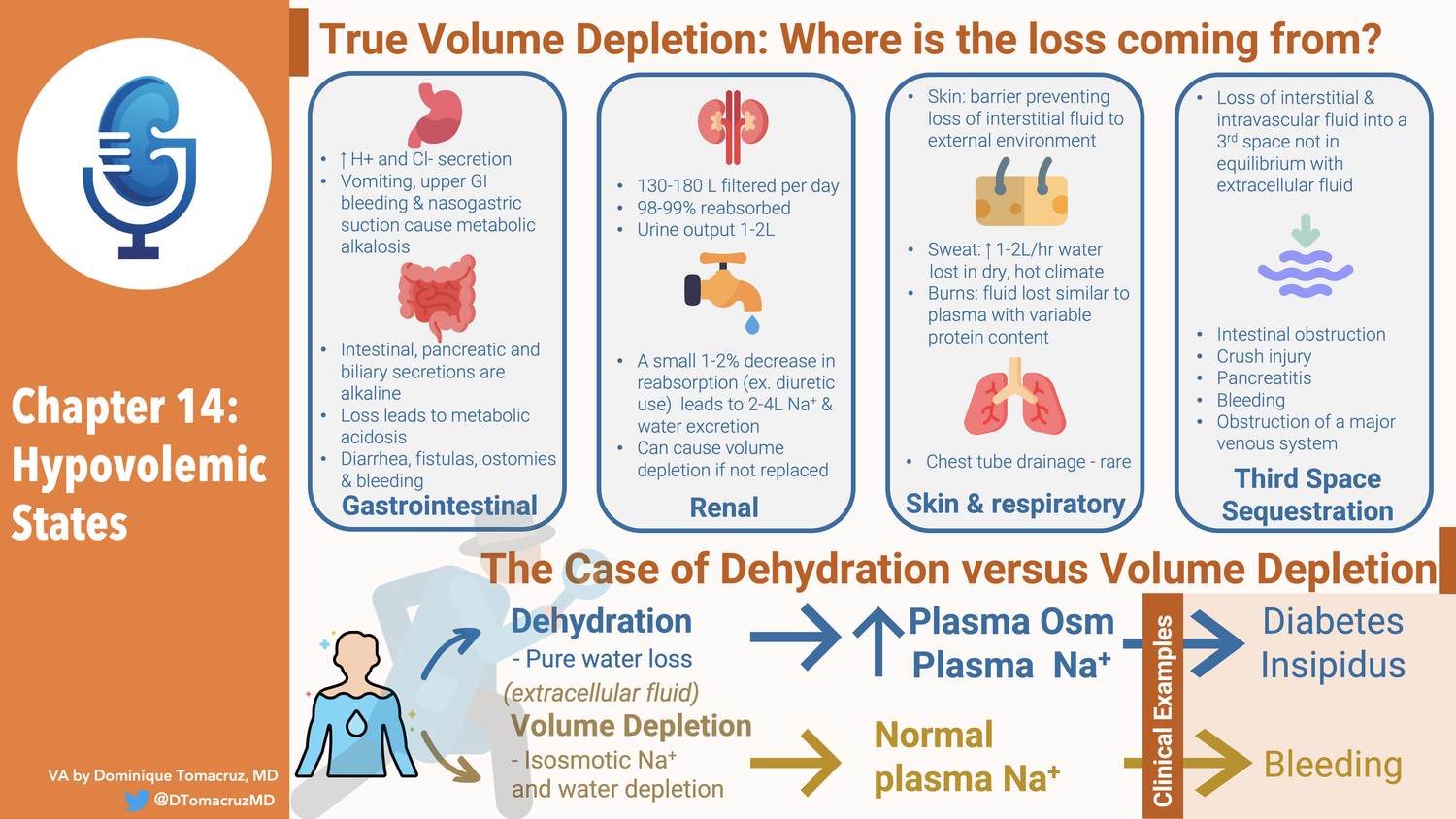 Chapter Fourteen: Hypovolemic States, part 2 24.03.2024 1h 39mOutline Chapter 14 — Treatment- Treatment - Both oral and IV treatment can be used for volume replacement - The goal of therapy are to restore normovolemia - And to correct associated acid-base and electrolyte disorders - Oral Therapy - Usually can be accomplished with increased water and dietary sodium - May use salt tablets - Glucose often added to resuscitation fluids - Provides calories - Promotes intestinal Na reabsorption since there is coupled Na and Glucose similar to that seen in the proximal tubule - Rice based solutions provide more calories and amino acids which also promote sodium...
-
Chapter Fourteen: Hypovolemic States, part 1 29.01.2024 1h 45mOutlineChapter 14- Hypovolemic States- Etiology - True volume depletion occurs when fluid is lost from from the extracellular fluid at a rate exceeding intake - Can come the GI tract - Lungs - Urine - Sequestration in the body in a “third space” that is not in equilibrium with the extracellular fluid. - When losses occur two responses ameliorate them - Our intake of Na and fluid is way above basal needs - This is not the case with anorexia or vomiting - The kidney responds by minimizing further urinary losses - This adaptive response is why diuretics do not cause progressive volume depletion -...
-
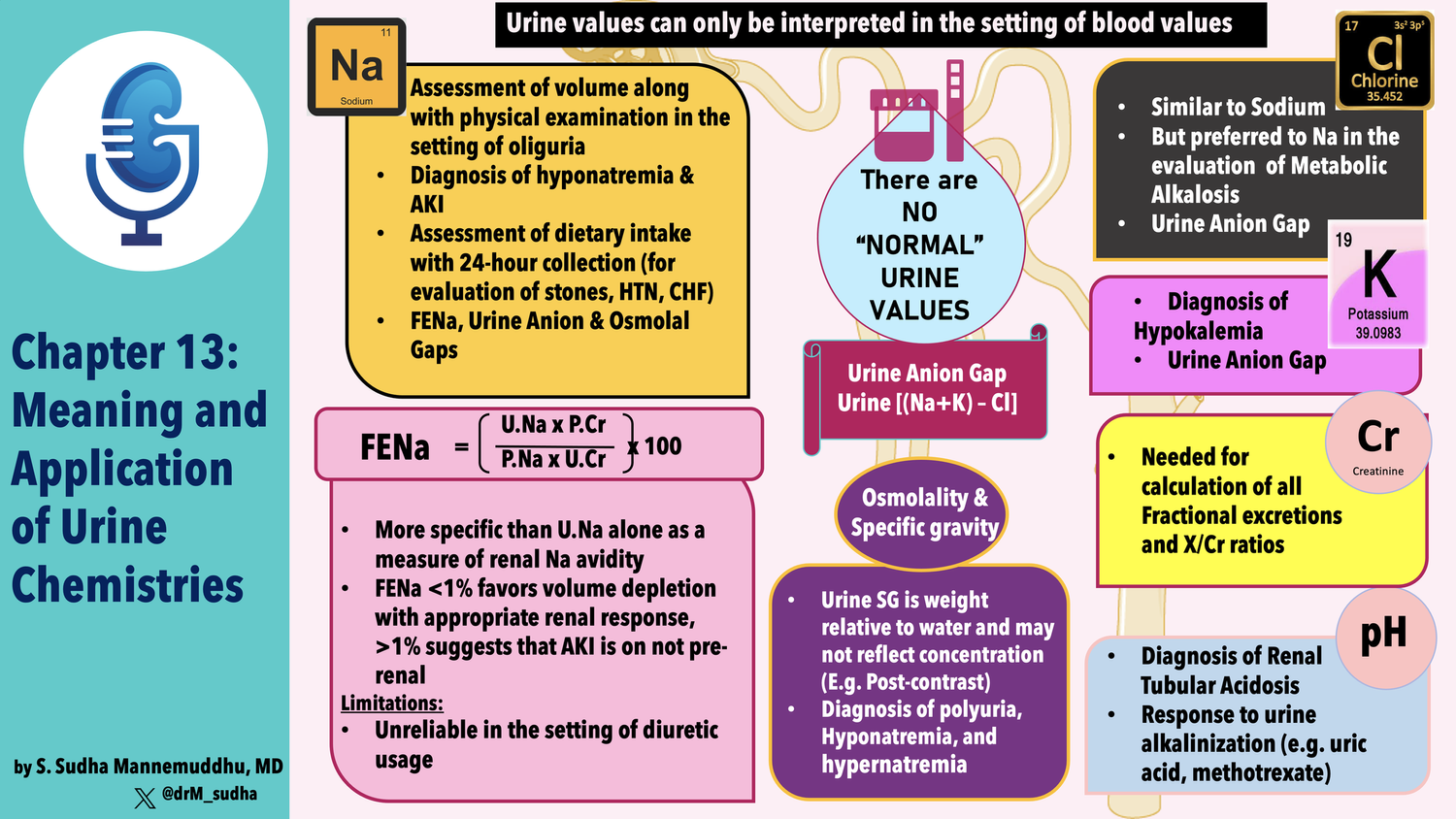 Chapter Thirteen: Meaning and Application of Urine Chemistries 18.09.2023 1h 31mReferencesJC mentioned that the diagnostic accuracy of 24 hour urine collection increases with more collections! Metabolic evaluation of patients with recurrent idiopathic calcium nephrolithiasisWe didn't refer to a particular study on sodium intake and the 24 hour urine but this meta-analysis Comparison of 24‐hour urine and 24‐hour diet recall for estimating dietary sodium intake in populations: A systematic review and meta‐analysis - PMC 24‐hour diet recall underestimated population mean sodium intake.Anna looking up ace i and urinary sodium Effects of ACE inhibition on proximal tubule sodiu...
-
 Chapter Eleven: Regulation of Acid-Base Balance, part 2 20.05.2023 1h 30mReferencesWe considered the complexity of the machinery to excrete ammonium in the context of research on dietary protein and how high protein intake may increase glomerular pressure and contribute to progressive renal disease (many refer to this as the “Brenner hypothesis”). Dietary protein intake and the progressive nature of kidney disease: the role of hemodynamically mediated glomerular injury in the pathogenesis of progressive glomerular sclerosis in aging, renal ablation, and intrinsic renal diseaseA trial that studied low protein and progression of CKD The Effects of Dietary Protein Res...
Similar podcasts


Popular in
The podcast also appears in the podcast charts of these countries.


