
Babbage from The Economist
The Economist
0
Babbage is The Economist's weekly podcast on science and technology, named after Charles Babbage. It explores topics from AI to genetics, particle physics, and space travel with host Alok Jha. The award-winning podcast features in-depth interviews with top scientists and special episodes investigating wellness trends. New episodes are published every Wednesday.
Episodes
-
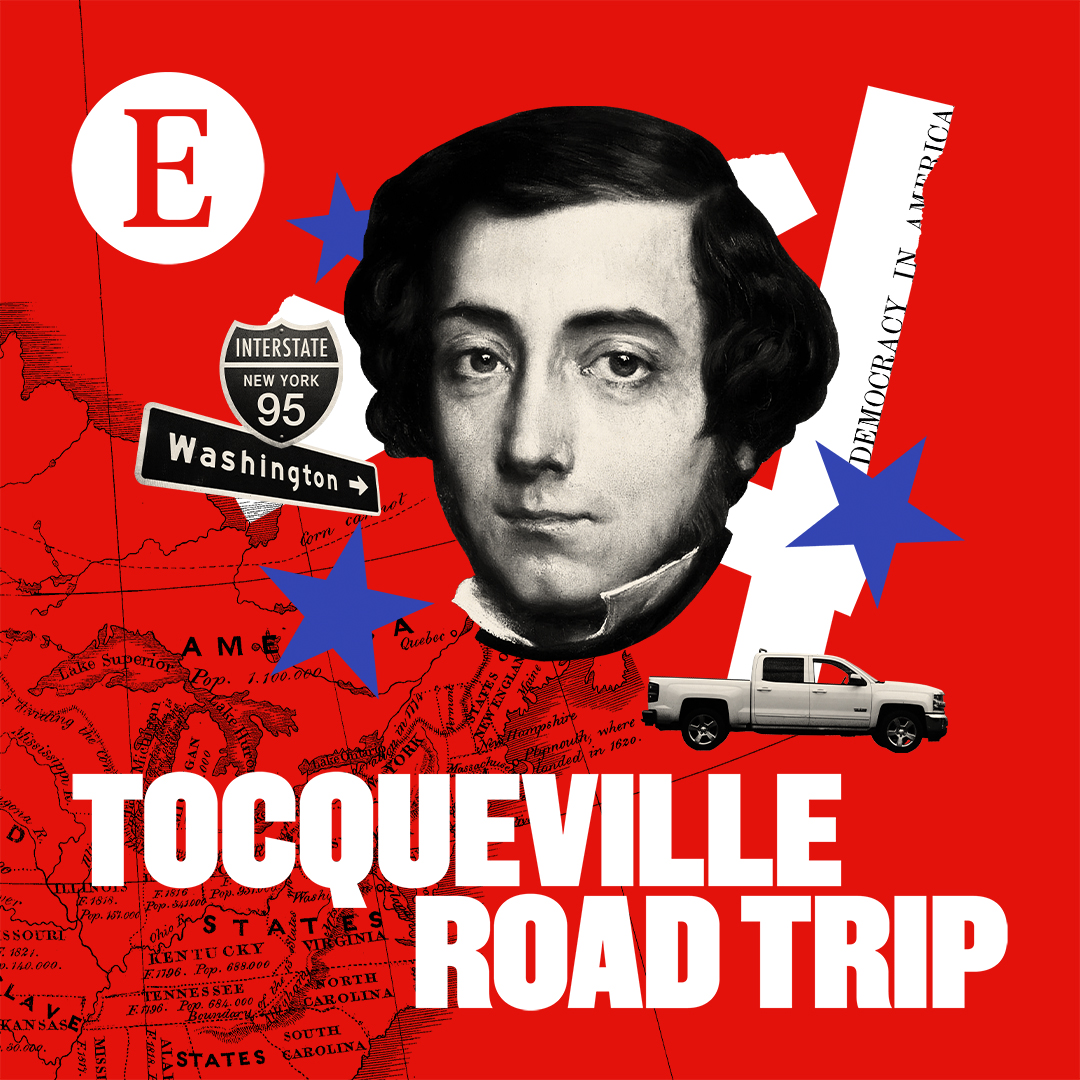 Trailer: Tocqueville Road Trip 23.06.2026 3mWhen Alexis de Tocqueville visited America from France in 1831 he saw a new kind of society. Not just a country, but an idea that would change the world. His book “Democracy in America” was a big influence on later generations of writers and thinkers, including The Economist’s US Editor John Prideaux. Now, 250 years after its birth, the vitality of that democracy is under question. In this series, John retraces the route Tocqueville took to find out how much of what inspired Tocqueville about America remains—and how worried we should be about what’s changed.Out nowFind the show on The Economis...
-
 The bomb (part 1): were nuclear weapons inevitable? 16.07.2025 44mWhere did the world’s most devastating weapon come from? In a four-part series, we go behind the scenes at America's nuclear laboratories to understand how a scientific-mystery story about the ingredients of matter led to a world-changing (and second-world-war-ending) bomb less than five decades later. Nuclear weapons have been central to geopolitical power ever since. Now America is seeking to modernise its stockpile and, in doing so, its scientists are pushing the frontiers of extreme physics, materials science and computing.In episode one, we look at the birth of nuclear physics—the science...
-
 AI and health part one: DrGPT will see you now 22.05.2024 45mArtificial intelligence is already making its mark in health care—but new, bigger, models promise to improve how patients access services, help doctors spot diseases faster and transform how medical research is done. In the first of two episodes on the potential of AI in health care, we ask: how will patients benefit from the technology behind ChatGPT? Host: Alok Jha, The Economist’s science and technology editor. Contributors: Natasha Loder, The Economist's health editor; Gerald Lip of NHS Grampian; Peter Kecskemethy of Kheiron Medical; Pranav Rajpurkar of Harvard Medical School; Hugh Harvey...
-
 Babbage: Teens and their screens 01.05.2024 42mEver since there have been smartphones and social media, there have been concerns about how they might be affecting children. Over the past decade, doctors have seen a decline in mental health in the young in much of the rich world. But whether that rise can be attributed to technology is still a matter of fierce debate. Nevertheless, demands are growing to proactively restrict teenagers’ access to phones and social media, just in case. How concerned should parents and teachers be? Or is this just another moral panic? Host: Alok Jha, The Economist’s science and technology editor. Contributors:...
-
 Babbage: The science that built the AI revolution—part one 06.03.2024 42mWhat is intelligence? In the middle of the 20th century, the inner workings of the human brain inspired computer scientists to build the first “thinking machines”. But how does human intelligence actually relate to the artificial kind?This is the first episode in a four-part series on the evolution of modern generative AI. What were the scientific and technological developments that took the very first, clunky artificial neurons and ended up with the astonishingly powerful large language models that power apps such as ChatGPT?Host: Alok Jha, The Economist’s science and technology editor. Contr...
-
 Babbage: The hunt for dark matter 21.02.2024 43mDark matter is thought to make up around a quarter of the universe, but so far it has eluded detection by all scientific instruments. Scientists know it must exist because of the ways galaxies move and it also explains the large-scale structure of the modern universe. But no-one knows what dark matter actually is.Scientists have been hunting for dark matter particles for decades, but have so far had no luck. At the annual meeting of the American Association for the Advancement of Science, held recently in Denver, a new generation of researchers presented their latest tools, techniques and idea...
-
 Babbage: Sam Altman and Satya Nadella on their vision for AI 24.01.2024 45mOpenAI and Microsoft are leaders in generative artificial intelligence (AI). OpenAI has built GPT-4, one of the world’s most sophisticated large language models (LLMs) and Microsoft is injecting those algorithms into its products, from Word to Windows. At the World Economic Forum in Davos last week, Zanny Minton Beddoes, The Economist’s editor-in-chief, interviewed Sam Altman and Satya Nadella, who run OpenAI and Microsoft respectively. They explained their vision for humanity’s future with AI and addressed some thorny questions looming over the field, such as how AI that is better than humans...
-
 Babbage: Science book club 20.12.2023 42mBooks are the original medium for communicating science to the masses. In a holiday special, producer Kunal Patel asks Babbage’s family of correspondents about the books that have inspired them in their careers as science journalists.Host: Alok Jha, The Economist’s science and technology editor. Contributors: Rachel Dobbs, The Economist’s climate correspondent; Kenneth Cukier, our deputy executive editor; The Economist’s Emilie Steinmark; Geoff Carr, our senior editor for science and technology; and Abby Bertics, The Economist’s science correspondent. Reading list: “The Periodic Table” by Prim...
-
 Babbage: Fei-Fei Li on how to really think about the future of AI 22.11.2023 38mA year ago, the public launch of ChatGPT took the world by storm and it was followed by many more generative artificial intelligence tools, all with remarkable, human-like abilities. Fears over the existential risks posed by AI have dominated the global conversation around the technology ever since. Fei-Fei Li, a pioneer that helped lay the groundwork that underpins modern generative AI models, takes a more nuanced approach. She’s pushing for a human-centred way of dealing with AI—treating it as a tool to help enhance—and not replace—humanity, while focussing on the pressing challenges of disi...
-
 Babbage: How to avoid a battery shortage 25.10.2023 44mIn the coming decades, electric vehicles will dominate the roads and renewables will provide energy to homes. But for the green transition to be successful, unprecedented amounts of energy storage is needed. Batteries will be used everywhere—from powering electric vehicles, to providing electricity when the sun doesn’t shine or the wind doesn’t blow. The current generation of batteries are lacking in capacity and are too reliant on rare metals, though. Many analysts worry about material shortages. How can technology help? Host: Alok Jha, The Economist’s science and technology editor. Contribut...
-
 Babbage: Trailer 06.05.2015 2mBabbage is our weekly podcast on science and technology, named after Charles Babbage—a 19th-century polymath and grandfather of computing. Host Alok Jha talks to our correspondents about the innovations, discoveries and gadgetry shaping the world. Published every Wednesday. Hosted on Acast. See acast.com/privacy for more information.
Similar podcasts


Popular in
The podcast also appears in the podcast charts of these countries.
-
 Tunisia
-
 Croatia
-
 Lebanon
-
 North Macedonia
-
 Cayman Islands
-
 Slovenia
-
 Laos
-
 Albania
-
 Singapore
-
 Bulgaria
-
 Costa Rica
-
 Maldives
-
 Mongolia
-
 Nicaragua
-
 Jamaica
-
 Armenia
-
 Romania
-
 Bosnia and Herzegovina
-
 Paraguay
-
 Yemen
-
 Greece
-
 Guyana
-
 Mauritania
-
 Sri Lanka
-
 Luxembourg
-
 Bahrain
-
 El Salvador
-
 Malawi
-
 Zimbabwe
-
 Cyprus
-
 Mozambique
-
 Peru
-
 Latvia
-
 Slovakia
-
 Kenya
-
 Lithuania
-
 Namibia
-
 Cameroon
-
 Chad
-
 Estonia
-
 Ukraine
-
 Bermuda
-
 Uruguay
-
 Barbados
-
 Belize
-
 Brunei
-
 Serbia